

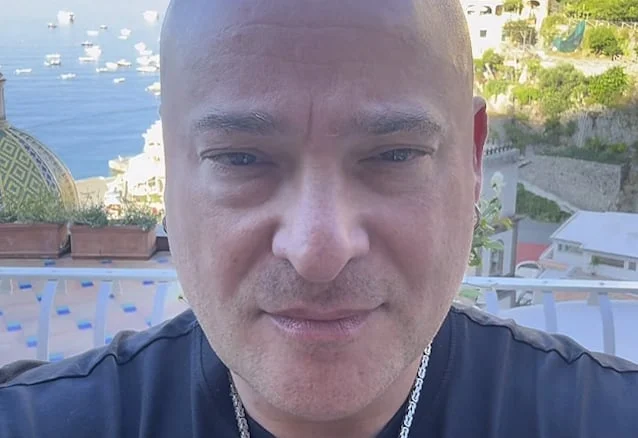
In a deeply personal and candid interview on The Brink podcast with host Andrew Fox, David Draiman, the formidable frontman of the Grammy-nominated rock band Disturbed, has broken his silence on a range of critical issues, most notably the devastating Hamas attacks of October 7, 2023, and the ensuing wave of antisemitism. Draiman’s conversation offers a profound look into his unwavering commitment to defending the Jewish people, a conviction rooted in his family’s harrowing history and his own experiences with prejudice. He addresses the immense personal and professional risks associated with his outspoken advocacy, detailing why remaining silent in the face of what he perceives as existential threats to Jewish communities is not an option.
Draiman’s engagement with the podcast comes at a time of heightened global tension and scrutiny, following an event that marked the deadliest day for Jews since the Holocaust. The October 7th attacks, characterized by widespread brutality and the taking of numerous hostages, have ignited a complex and often contentious discourse worldwide. Draiman’s participation is particularly significant given his prominent platform as a globally recognized musician, and his willingness to leverage it for advocacy.
A Legacy Forged in Survival and Service
The bedrock of David Draiman’s identity, and his fierce advocacy, lies in his family’s profound connection to Jewish history and the enduring trauma of the Holocaust. He revealed that both his maternal grandparents were survivors of Nazi concentration camps, with his grandmother enduring the horrors of Auschwitz and his grandfather surviving Dachau. This direct lineage to unimaginable suffering has instilled in him a deep-seated imperative to ensure that such atrocities are never repeated.
"My mother’s side of the family, we’re a family of Holocaust survivors," Draiman shared. "My grandmother on my mother’s side was a survivor of Auschwitz, and my grandfather on my mother’s side was a survivor of Dachau. So, it’s meant a lot for all kinds of reasons, whether on my mother’s side, my father’s side, for a very long time." This ancestral legacy is not merely a historical footnote for Draiman; it actively shapes his present-day actions and his understanding of the threats facing Jewish people.
This profound connection is also reflected in Disturbed’s music. The band’s anthem "Never Again," from their 2010 album "Asylum," is a powerful testament to this commitment. Draiman describes it as "a call to arms for our people. It’s a refusal to back down. It’s a refusal to cower in the face of adversity and in the face of the most dangerous bullies in existence." He noted that the song is a mandatory inclusion in their setlist whenever Disturbed performs in Israel, a country he has visited only twice but holds significant personal meaning for him.
Furthermore, Draiman’s family has a history of direct service to Israel. His father and grandfather both served in the Israel Defense Forces (IDF), adding another layer to his deeply ingrained sense of connection and responsibility towards the Jewish state and its security. His grandfather also served as a cantor in Israel, further underscoring a multifaceted heritage intertwined with faith, service, and cultural preservation.
The Unyielding Stance: Refusing to Cower
Draiman drew a powerful parallel to the iconic character Tevye from "Fiddler on the Roof," illustrating his refusal to remain passive or to "bend too far" in an effort to appease or conform. He articulated a deep-seated aversion to burying his head in the sand, stating, "I can’t be the ostrich. I can’t put my head in the sand. I can’t pretend that the world isn’t on fire around me. I’m, like, ‘Oh, no, everything is fine.’ I’m not one of those people." This resolute stance underscores his belief that indifference in the face of perceived threats is a betrayal of his heritage and his conscience.
The decision to speak out, particularly in the charged post-October 7th environment, has not been without its consequences. Draiman acknowledged the potential career repercussions, stating, "It would be a lot easier to not have the association. It’s a burden to carry that a lot of people don’t realize." He also expressed his deepest reservations and guilt not for himself, but for his bandmates in Disturbed, who have had to "bear a burden that has really little to do with them other than the fact that I am their friend." He conveyed immense gratitude for their unwavering support, acknowledging that the situation has tested their camaraderie.
The Personal Imperative: A Father’s Duty
At the heart of Draiman’s resolve is his commitment to his son, who is of mixed Asian and Jewish heritage. This dual identity, he explained, places his son in a particularly vulnerable position in the current global climate, where both ethnicities are, unfortunately, subjected to significant hatred.
"It comes down to this. It comes down to my son. It comes down to, what do I tell my son?" Draiman posed, his voice heavy with paternal concern. "How do I tell him to navigate this world that we’re in? He’s got the best of both sides of ethnicities that right now in this world are some of the most hated. He’s part Asian and part Jewish. And so it’s a tough mix for the boy."
Despite these challenges, Draiman is determined to instill in his son the same principles that guide him: courage, integrity, and a commitment to justice. "It’s important for me to impart to him that we do not cower. We do not cower to bullies, that we stand up for those who are weaker than us, that we have honor and integrity and all those things that unfortunately for so many this world are a lost art, are incredibly important to me and incredibly important for me to teach my son." This paternal duty, he explained, was instrumental in helping his bandmates understand the depth of his convictions.
Navigating the Complexities of Activism and Profit
Draiman did not shy away from addressing one of the most controversial moments of his activism: inscribing "Fuck Hamas" on an Israeli artillery shell. He defended this action unequivocally, stating he has "no regrets." This act, while provocative, reflects his visceral anger and his perception of Hamas as a genocidal terrorist organization responsible for immense suffering.
However, Draiman also extended his empathy to Palestinian suffering and expressed a genuine hope for coexistence. He believes that both Israelis and Palestinians deserve a future free from perpetual conflict. This nuanced perspective acknowledges the complexities of the Israeli-Palestinian conflict, seeking a path towards peace despite the deeply entrenched animosities.
His activism has also led him to critique what he perceives as a commodification of the fight for Jewish safety. He expressed frustration with individuals who, in his view, use advocacy as a platform for self-enrichment and personal gain. "Too many view the defense of our people as a business," he asserted, "and too many try to profit off of it, and too many go ahead and enjoy having their backs patted in echo chambers everywhere and it reverberates and it leads to higher speaking fees and you name it, and it’s just insanity."
Draiman distinguishes his own approach, emphasizing that he engages in advocacy "for absolutely nothing. I never ask for anything." He believes that individuals with a platform have a responsibility to use it honorably and without self-aggrandizement, particularly in times of crisis. He called out those who "have kind of taken advantage of it and made it part of their persona and made it part of like… If you are blessed with a platform, if you are blessed to influence and be an influencer, you’re given a gift. Use it responsibly, use it honorably, use it without trying to self-enrich, without trying to take advantage of a situation that is dire."
The Power of Music and Legacy
The profound impact of music in times of tragedy was underscored by the use of Disturbed’s song "Hold On To Memories" at the funeral of Shiri, Ariel, and Kfir Bibas, who were killed during the October 7th attacks. Draiman spoke movingly about his friendship with Yarden Bibas, the father and husband of the deceased, and the solace that music can provide in the darkest of hours. This event highlights the unexpected and deeply human ways in which art can connect individuals and offer comfort amidst profound loss.
Draiman’s public stance has not always been met with universal acclaim. He has faced boos at live events, such as during Black Sabbath’s farewell show, due to his outspoken support for Israel and the IDF. He has also reported significant losses of social media followers after sharing his pro-Israel sentiments and documenting his visits to the country, including lighting a candle at the Western Wall in remembrance of terror attack victim Eli Kay. In December 2021, he stated he had lost thousands of followers after publicizing a trip to Israel.
Despite these challenges, Draiman remains steadfast, drawing strength from his convictions. He ultimately believes that aligning his actions with his conscience outweighs any potential professional gains or accolades. "Whatever the professional consequences of speaking out, being able to act according to my conscience matters more than becoming ‘the next Metallica,’" he concluded, drawing a stark contrast between commercial success and moral integrity.
Draiman’s multifaceted identity, encompassing his role as a rock icon, a devoted father, and a passionate advocate, has positioned him at the forefront of contemporary discussions surrounding antisemitism, the complexities of the Middle East conflict, and the ethical responsibilities of public figures. His willingness to confront these issues head-on, despite the personal cost, underscores a profound commitment to his heritage and his unwavering belief in standing up against injustice.
