

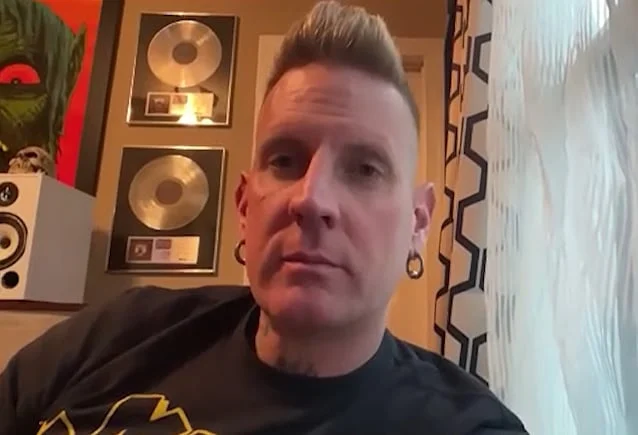
In a candid and emotionally charged interview with "The Break Down With Nath & Johnny," Mastodon drummer and vocalist Brann Dailor has shed light on the profound personal and professional challenges that shaped the band’s latest offering, "Marrow Deep." The newly released documentary, "The Mastodon In The Room," serves as a raw and unflinching account of the band’s journey, particularly in the wake of the passing of original guitarist and singer Brent Hinds. Dailor, alongside bassist/vocalist Troy Sanders and guitarist Bill Kelliher, felt compelled to address Hinds’s death directly, aiming to provide fans with their perspective amidst the speculation and public discourse surrounding the tragic events.
The decision to release "The Mastodon In The Room" over a month prior to "Marrow Deep," the band’s first full-length album without Hinds, underscores the weight of these circumstances. Hinds was reportedly fired from the band in March 2025 and tragically died five months later in a motorcycle accident. Dailor confessed to initial reservations about the documentary’s deeply personal nature, acknowledging the absence of Hinds as a participant. "Of course, I had huge question marks about putting out ‘The Mastodon In The Room’," Dailor stated, as transcribed by BLABBERMOUTH.NET. "I was, like, ‘That’s pretty personal.’ And Brent’s not here to defend himself. And so I didn’t like that part of it either, and I talked about that with everybody. I was just, like, sort of on the fence about it."
However, the band felt a responsibility to their fanbase, who were left with unanswered questions following public statements made by Hinds. Dailor explained, "We left our fans with all these questions because Brent obviously attacked us in the press. And I knew that that was coming, and I address that in the video as well. And I knew that he didn’t mean that." He elaborated on Hinds’s tendency for impulsive pronouncements, stating, "I don’t know how many times I had heard him late at night, with a few, say some ridiculous shit, and I’d just be, like, ‘You don’t feel that way at all, but whatever. Okay.’" The band ultimately concluded that a simple announcement of their new album would be insufficient. "We couldn’t come out and be, like, ‘Oh, R.I.P., Brent. We love you. And here’s our new record,’ and that’s it. I felt like we had to address it and just be honest, and that’s all we were. We were just being honest, and really didn’t get… We didn’t really spill any tea about him. I don’t think we threw him under the bus at all. And we didn’t even touch the tip of the iceberg with that whole very complex relationship."
The Genesis of "Marrow Deep": A Chronicle of Loss and Resilience
The creative process for "Marrow Deep" was fraught with unprecedented challenges, beginning as early as two years prior to its release. The initial writing sessions were interrupted by the band’s extensive "Leviathan" 20th-anniversary tour with Lamb of God. It was during the latter stages of this tour that the band resolved to dedicate themselves fully to new material. This period, however, coincided with significant personal upheavals.
"We started really writing for this record maybe a couple of years ago, and then we interrupted that writing to go on the ‘Leviathan’ [20th-]anniversary tour [of Mastodon’s sophomore album] with Lamb of God around the States," Dailor explained during an August 6 appearance on SiriusXM’s "Trunk Nation With Eddie Trunk." "And around the end of that tour, we decided, ‘Okay, we’re gonna hunker down and really start writing.’ And that’s where we experienced some turmoil with our brother Brent, and I, unfortunately, lost my mother." His mother, Michele Lawrence, passed away in February 2025, a profound loss that deeply impacted Dailor and the band’s trajectory.
The band continued their work, embarking on a summer tour of Europe with the intention of entering the studio in September 2025. However, another devastating event struck: Brent Hinds’s death at the end of August 2025. "Then we went to Europe for a summer tour. We were diligently working on the material, getting it ready to go into the studio in September [of 2025], and unfortunately, another tragedy – we lost Brent at the end of August," Dailor recounted.
Despite the immense grief and uncertainty, Mastodon made the difficult decision to proceed with studio sessions just a week after Hinds’s passing. "But we still had to go into the studio in about a week after losing Brent and kind of thought that maybe it was not the best idea. We weren’t sure, but it ended up being exactly what we needed to kind of go in there and lean on each other and just dig in on these songs and put every little bit of all of these couple of tragedies that, unfortunately, visited us into the music, into the lyrics, into everything about it, and to just power through and, like I said, lean on each other to get through and come out the other side with this album that we’re all very proud of but is very emotional for us."
Addressing the Unspoken: The "Mastodon In The Room" Narrative
Dailor emphasized the fundamental honesty that underpins "The Mastodon In The Room" documentary and the band’s public statements. "[‘The Mastodon In The Room’] was a very basic, honest conversation about really what was going on. That’s what was going on. I don’t know what to tell you," he asserted. He expressed a desire for Hinds’s happiness, stating, "I just wanted him to be happy. I wanted him to be happy and healthy and feel good. I know he was having a hard time [after we parted ways], but trying over and over again for 10 years plus, it does a number on yourself."
The drummer articulated the band’s internal struggle and the necessity of self-preservation. "And I’m, like, ‘I’m a person, too.’ What am I supposed to do? What are we supposed to do? It’s kind of, like, forcing our hand, and then at some point you need to protect yourself and your own mental health and be, like, ‘I don’t know, man. I don’t know what else to do. Obviously we just need a break [from him] or something.’" He candidly admitted to hoping for a future reconciliation: "And I really honestly thought that – I don’t know if it would be a year, I don’t know if it would be two years or whatever happened, but that we would eventually squash it and just be, like, ‘Dude, what was all that bullshit?’ Hugs and kisses. And I don’t know if we would’ve jammed again, but we probably would’ve, I would imagine. But it just sucks that we won’t have that opportunity."
Dailor reiterated the importance of addressing Hinds’s passing directly to counteract potential misinterpretations by fans. "If we say nothing, the fans are just left with, like, ‘Oh, I guess they’re just three shit human beings in a terrible band.’ I just think it’s ridiculous thinking that myself, Bill and Troy just woke up one day and said, ‘Hey, let’s fire Brent. Let’s get rid of one of the greatest guitar players ever, and let’s just be dicks and do that. What do you guys say?’ ‘Yeah, high five, let’s go do that.’ It’s ridiculous. I think it’s crazy to think that that’s what we would do." He described the period leading up to Hinds’s death as one of the most difficult times in his life, compounded by the recent loss of his mother. "It was one of the hardest parts of my life, going through that – before he died even. Because my mom had just died, and it sucked. And then that happened. I hated it. I really fucking hated it, but I was doing my best."
A New Era: "Marrow Deep" and its Sonic Landscape
"Marrow Deep" represents a significant turning point for Mastodon, not only thematically but also in its personnel. The album was co-produced by the band at their own West End Sound studio in Atlanta, with the esteemed Patrik Berger (known for his work with Lana Del Rey and Charli XCX) and Kurt Ballou (a veteran of High on Fire and Converge) at the helm. The mixing duties were handled by Andrew Scheps, whose impressive resume includes collaborations with Adele, Black Sabbath, and Metallica.
Crucially, "Marrow Deep" marks the official integration of new guitarist Nick Johnston into the band’s full-length output. Keyboardist João Nogueira also contributes significantly to the album’s sound. When asked if any of Hinds’s musical ideas penned prior to his departure were incorporated into "Marrow Deep," Dailor stated, "Unfortunately not." He explained the band’s repeated attempts to involve Hinds in recent writing sessions, citing his personal struggles and nomadic lifestyle as impediments. "Really, for the last few records, we would try to get him to come down and contribute, but he was just kind of off doing his thing. He was riding his motorcycle around. But we would always keep writing, and we would text him or I’d call him and say, ‘Hey, we’re gonna be down there at the space. We’re gonna be writing. So, just letting you know. And if you wanna get down there with us and get your hands dirty, you’re more than welcome. We want you to be more involved.’ But he had a lot going on in his life as well, and he was going through some things personally that were tough, and so we understood that, and we were just giving him as much grace as we could and just always leaving the door open."
However, the band’s creative momentum could not be halted. "But also, we are three creative people that the faucet just doesn’t turn off, and so we just wanted to be, like, ‘Hey, man, we’re gonna keep on writing, and we’re very excited for you to get in on this stuff,’ and always left that door open. But, unfortunately, for the last bunch of months of touring and while we were working on the skeletons of the songs that became ‘Marrow Deep,’ he just was kind of nowhere to be found within those writing sessions. And as a result, we don’t have any material from him that is on the new record. So it’s solely the three of us kind of creating everything from the ground up, and then getting the new members involved towards the end to sort of, quote-unquote, ‘punch up’ the songs that existed and really get them to be as good as they possibly could be with some fresh and new energy with João and Nick Johnston on guitar."
Touring and New Collaborations
To support the release of "Marrow Deep," Mastodon will embark on "The Poisonous Weapons Tour," a nationwide concert series commencing September 16 in Orlando. The tour will feature support from Deafheaven and Alcest, with the final date scheduled for October 24 at Sick New World Dallas.
The album’s second single, "Snakes For Dinner," boasts a significant guest appearance from Queens of the Stone Age frontman Josh Homme. This collaboration marks a reunion of sorts, as Homme previously lent his talents to Mastodon’s iconic 2006 track "Colony of Birchmen." The inclusion of Homme on "Marrow Deep" highlights the band’s continued ability to attract high-profile collaborators, even amidst profound personal transitions.
The narrative surrounding "Marrow Deep" is undeniably one of resilience in the face of overwhelming adversity. The documentary and the album itself serve as a testament to Mastodon’s enduring creative spirit and their commitment to honoring their past while forging ahead into an uncertain future. The emotional weight of loss and the complex dynamics of long-standing relationships have been transmuted into a powerful artistic statement, offering fans a deeper understanding of the band’s journey and the profound impact of these events on their music.
