

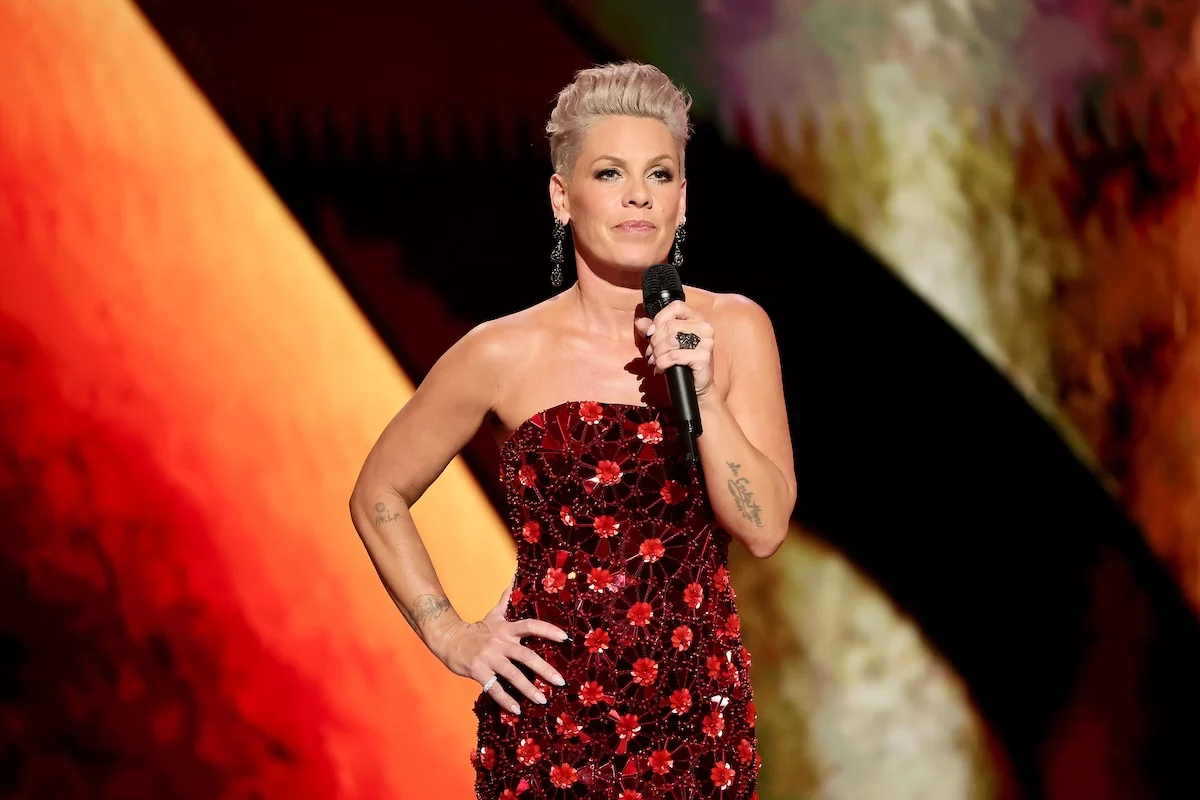
Pop superstar Pink has released a lengthy and deeply personal statement clarifying her position on the Israeli-Palestinian conflict, following a week of intense social media backlash stemming from her reposting of a critical message about rapper Macklemore’s recent pro-Palestine remarks. The controversy erupted after Pink shared a post from the organization StopAntisemitism, which criticized Macklemore’s performance as an opening act for Ed Sheeran in New Jersey, where he screened his "Hinds Hall" video and spoke out in support of Palestine. Pink’s subsequent engagement with the social media storm through sarcastic memes further fueled the debate, prompting her to offer a comprehensive explanation of her views, her Jewish heritage, and her history of activism.
The Genesis of the Controversy: Macklemore’s Performance and Initial Backlash
The catalyst for the recent uproar occurred approximately one week prior when Macklemore, performing as an opener for Ed Sheeran at a concert in New Jersey, used his platform to address the ongoing Israeli-Palestinian conflict. During his set, Macklemore notably screened his music video for "Hinds Hall," a protest song released in May 2024 that explicitly condemns U.S. support for Israel and expresses solidarity with Palestinian people, particularly in light of the conflict in Gaza. The song itself, named after Hamilton Hall at Columbia University, which was occupied by pro-Palestinian student protestors, became an anthem for many advocates for Palestine.
Eyewitness accounts and shared footage from the concert indicated that Macklemore appeared on stage wearing a keffiyeh, a traditional Middle Eastern scarf that has become a symbol of Palestinian nationalism. He reportedly shouted "Free Palestine" and accused Israel of "genocide," transforming what many attendees expected to be a mainstream musical event into a politically charged platform. The organization StopAntisemitism quickly responded, sharing audience-shot footage of the performance on Instagram. Their caption unequivocally condemned Macklemore’s actions, stating: "Awful – Jewish fans bought tickets to see Ed Sheeran sing last night in NJ, not to be ambushed by Macklemore’s anti-Israel propaganda. Instead, Macklemore walked onstage in a keffiyeh, shouted ‘Free Palestine,’ accused Israel of a false ‘genocide,’ and turned a mainstream event into a political nightmare against the Jewish state. Concert goers are owed apologies and refunds @teddyvsphotos – this is unacceptable." This post ignited a firestorm across social media, drawing both fervent support and fierce criticism for Macklemore, and inadvertently setting the stage for Pink’s involvement.
Pink’s Initial Reaction and the Amplification of Social Media
Pink, whose real name is Alecia Beth Moore, entered the fray by resharing the StopAntisemitism post on her Instagram Stories. Her initial engagement with the escalating controversy was characterized by a series of sarcastic memes, a response she later admitted was a coping mechanism for feeling "hurt." This approach, however, was widely interpreted as her endorsing the entirety of the original post’s sentiment and intensified the social media spotlight on her. Critics swiftly accused her of being anti-Palestinian or insensitive to the plight of Gaza, while supporters defended her right to express concern about the politicization of a concert space and the potential for antisemitic undertones in public discourse. The rapid spread of information and opinion across platforms like X (formerly Twitter) and Instagram meant that nuanced positions were often lost, and artists found themselves categorized into binary "pro-Israel" or "pro-Palestine" camps, regardless of their actual, more complex beliefs.
The pressure mounted on Pink to issue a clearer statement, as her silence (or rather, her meme-sharing) was being interpreted in various, often conflicting, ways. The incident underscored the pervasive challenge celebrities face in navigating highly sensitive geopolitical issues in the age of instantaneous social media reactions, where a simple repost can quickly spiral into a full-blown public relations crisis.
A Comprehensive Clarification: Deconstructing Pink’s Statement
Today, Pink broke her silence with a lengthy, deeply reflective statement, offering an unvarnished account of her beliefs, her personal experiences, and her motivations. She began by acknowledging her initial approach: "I’ve been quiet in my own words for a week, which you know isn’t like me. So here they are. Last Sunday I reposted somebody else’s post about Macklemore’s set at Ed Sheeran’s show. It said things in words I didn’t write, and I wouldn’t have chosen all of them. Then the comments came, and I did what I do when I’m hurt, which is post snarky memes and act like I’m fine. That’s on me. A repost isn’t a statement, and a meme isn’t a spine. Social media makes all of us cheap and fast, and we all know it." This opening set a tone of accountability, admitting to the pitfalls of social media communication while also preparing the ground for a more authentic expression of her thoughts.
A Nuanced Stance on the Conflict and Personal Identity
Pink explicitly articulated a balanced humanitarian stance on the Israeli-Palestinian conflict, reiterating a position she first shared in October 2023: "Hamas is a terrorist organization. Palestinians deserve a future that honors their humanity and their aspirations. Protecting innocent life comes first, everywhere, and nobody should ever celebrate the death of a child. Anybody’s child." She highlighted her decade-long work as a UNICEF ambassador, stating, "I’ve spent a decade as a UNICEF ambassador for kids who didn’t choose the country or the war they were born into, and I have grieved every one of them, on both sides of that fence. I didn’t do it from behind a screen; I went to those children and held them." This emphasized her long-standing commitment to humanitarian causes and her belief in the universal value of innocent life, aiming to transcend the often-reductive political narratives.
Crucially, Pink addressed her Jewish identity, which she described as an inherent part of who she is: "I was born a Jew. I didn’t pick it, and I’ve never hidden it." She expressed frustration at being labeled and judged without her full perspective being heard: "this week a whole lot of people decided what I believe without asking me, without checking a single thing I’ve ever said or done, because a repost and the word ‘Jew’ were apparently enough to fill in the rest." She clarified that she does not speak for Israel or any government, underscoring her independence from state politics.
Macklemore’s Actions: Past and Present Concerns
A significant portion of Pink’s statement delved into her specific grievances with Macklemore, both historically and concerning his recent performance. She recounted a past incident from 2014, where Macklemore performed in a costume widely perceived as an antisemitic caricature (a hooked nose, black beard, and bowl cut), which he dismissed as a "random costume." Pink recalled her reaction: "Every Jew I know knew exactly what it was. The same love, it turned out, had a guest list, and we weren’t on it." While she acknowledged his subsequent apology at the time, this historical context deeply informed her reaction to his recent actions.
Regarding the Ed Sheeran concert, Pink expressed profound concern over Macklemore’s choice to display "violent images from a war on the screens" in a venue filled with "music-loving families," and then to tell "all of the Jews in the stadium that it wasn’t about them." She forcefully rejected this assertion: "You don’t get to decide that for us." Her repost, she clarified, was prompted by this specific feeling of being targeted and dismissed, rather than a blanket opposition to "Free Palestine" or artistic freedom. "What I need is to be able to say, as a Jewish mom, ‘that scared me, and it scared people I love,’ without being told our fear is just propaganda, and without being told I’m somehow cool with genocide because I noticed?" she powerfully asserted.
A History of Unpopular Stands and the Current Climate
Pink leveraged her extensive history of activism to reinforce her integrity and courage in speaking out on contentious issues. She reminded her audience of her 2006 protest song "Dear Mr. President," released during the Iraq War, and her willingness to face "hate for it." She highlighted her consistent support for marginalized communities: "I stood with gay kids before it was fashionable and with trans kids now, when it isn’t, and with their families, and I handed out the books that got banned, and you know I got called every name there is, and I’d do all of it again tomorrow." This robust defense of her past actions underscored her commitment to social justice, asserting that her current stance is consistent with a lifelong pattern of advocating for "other people’s people."
However, she noted a distinct shift in the current climate, particularly when advocating for her own community: "And now I’m standing up for my own people, and I thought I knew going in how lonely that would be. And it’s lonelier than that." She described the prevalent use of terms like "From the river to the sea" and "Zionist" as slurs in her comments section, often by individuals who hadn’t engaged with her actual beliefs. She expressed concern that a narrative has emerged where "the Jew who won’t apologize for existing must be the villain."
Broader Implications and the Challenge of Nuance in Public Discourse
Pink’s statement illuminates several critical challenges in contemporary public discourse, particularly concerning the Israeli-Palestinian conflict. The incident underscores the difficulty for public figures to articulate nuanced positions on such a deeply polarized issue. Social media, while offering a direct channel to audiences, often distorts complex messages into simplistic binaries, leaving little room for empathy or understanding across divides.
The debate also highlights the tension between artistic expression and audience expectations. While artists often use their platforms for political commentary, audiences, particularly at mainstream concerts, may feel "ambushed" when a performance deviates sharply from purely entertainment value, especially on highly sensitive topics. For Jewish attendees, Macklemore’s performance, coupled with his past controversial actions, was perceived by some as creating an unwelcoming or even hostile environment, rather than a space for open dialogue.
Pink’s experience reflects a growing sentiment among some Jewish individuals who feel that criticism of Israeli government policies often bleeds into antisemitism, or that their concerns about safety and identity are dismissed as propaganda. Her call to differentiate between disapproval of Israeli government actions and hostility towards Jewish individuals ("You don’t have to agree with one thing Israel’s government does to not want the Jewish family two rows down from you to be scared or targeted at a concert") is a plea for greater empathy and a more discerning approach to the conflict.
Concluding Thoughts and a Call for Understanding
Pink concluded her statement with a call for understanding and a reassertion of her unwavering commitment to speaking her truth. She invited those genuinely interested in her views to ask her directly, emphasizing her accessibility. She acknowledged the universal weariness many feel from the constant conflict and division, extending her empathy to "the ones who are frightened this week, Jewish or Muslim or Palestinian or Israeli or just tired of all of it."
Her statement ended on a personal and poignant note, connecting her public stand to her private life and traditions. She mentioned the significance of Friday for working people, the 25th anniversary of September 11th, and the impending observance of Rosh Hashanah, the Jewish New Year. "Now I’m going to go make dinner for my kids, light the candles, dip some apples in honey, pour a glass of wine and be full of gratitude. That’s my tradition. It also happens to be a Jewish one. Shana tova," she wrote, grounding her powerful public message in a deeply personal and cultural context, a reminder of her identity and the continuity of life amidst public scrutiny. Her words stand as a testament to the complexities of celebrity activism and the enduring human quest for clarity and compassion in a deeply divided world.
