

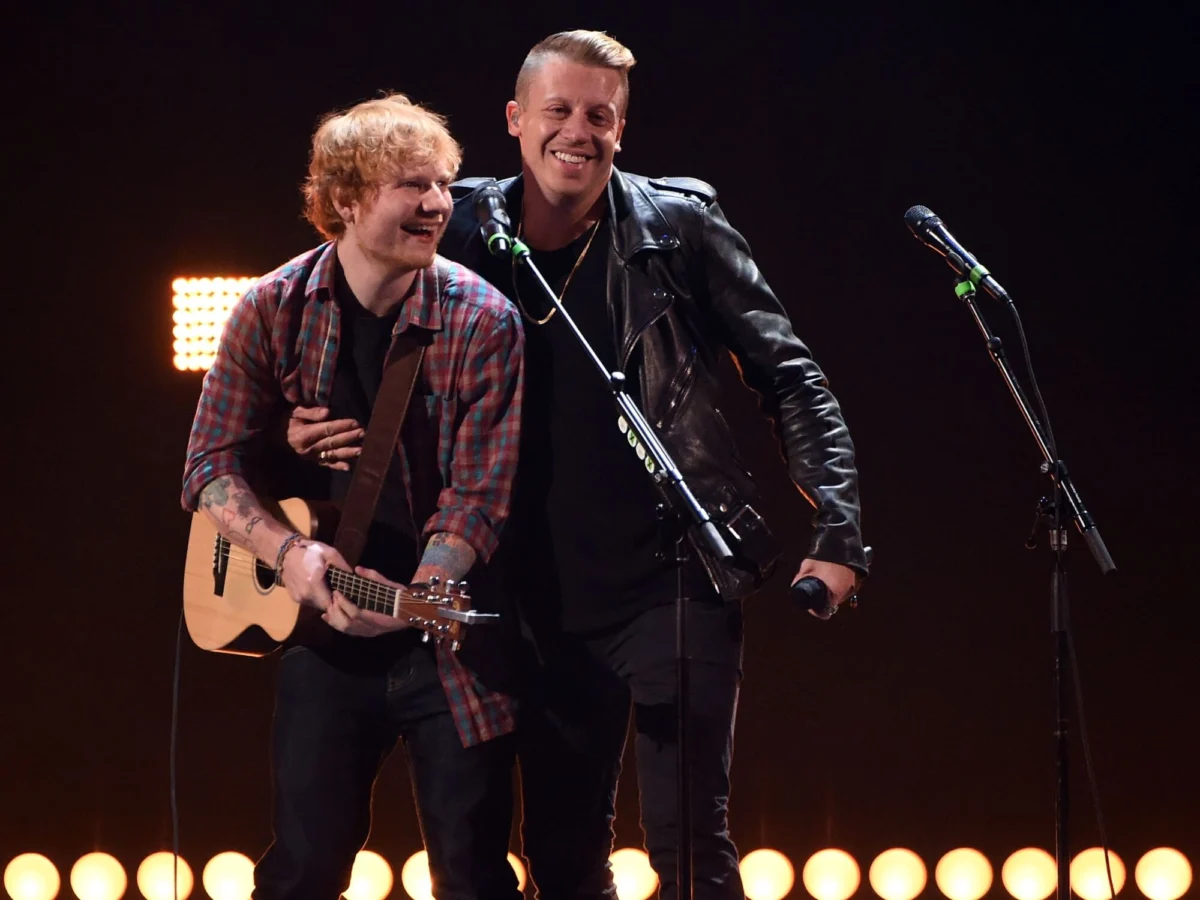
A cascade of online activism has engulfed a high-profile competition to open for global superstar Ed Sheeran, transforming what was intended as a career-making opportunity for emerging musicians into a platform for political protest. The "Open For Legends" contest, organized by Guitar Center, has been inundated with "false" entries and pro-Palestine messages, a direct response to the recent removal of rapper Macklemore from Sheeran’s "Mathematics Tour" and the subsequent mass withdrawal of all support acts in solidarity. This unprecedented digital mobilization underscores the increasing intersection of music, politics, and online culture, presenting significant challenges for artists, tour organizers, and corporate sponsors navigating complex global issues.
The Genesis of Controversy: Macklemore’s Stance and Tour Departure
The roots of the current upheaval trace back to early September 2023, when Grammy-winning artist Macklemore, known for his socially conscious lyrics, utilized his platform during two MetLife Stadium shows on September 4th and 5th. As a support act for Ed Sheeran’s highly anticipated "Mathematics Tour," Macklemore made public statements expressing solidarity with Palestine, a move that would swiftly ignite a firestorm.
During his September 4th performance, a widely circulated TikTok clip captured Macklemore stating, "The truth is, a big part of the reason why I wanted to do this tour in the first place is so I can stand up in stadiums like this and say two words that are very near and dear to my heart: Free Palestine." This direct declaration, made before tens of thousands of concertgoers, immediately garnered significant attention, both positive and negative, across social media platforms.
The following night, on September 5th, Macklemore further addressed the growing commentary surrounding his statements. Responding to criticisms, including those from campaign groups like StopAntisemitism, he directly addressed "Jewish brothers and sisters" in the audience. "Criticism of Israel, criticism of apartheid, being against genocide, is in no way a criticism of you," he clarified, attempting to delineate between critique of governmental policies and antisemitism. These statements, delivered during a major international tour, positioned Macklemore squarely in the ongoing, deeply contentious global discourse surrounding the Israeli-Palestinian conflict, an issue with heightened global sensitivity.
The consequences for Macklemore were swift and severe. On September 14th, he was officially removed from the remainder of Ed Sheeran’s "Mathematics Tour." While specific details regarding the decision-making process for his removal were not immediately made public, the timing and context strongly suggested a direct correlation with his outspoken political advocacy. This incident reignited debates within the music industry about artistic freedom of speech versus contractual obligations and the potential for political statements to disrupt large-scale commercial ventures.
Solidarity Movement: Artists Withdraw from Sheeran’s Tour
Macklemore’s removal did not end the controversy; rather, it catalyzed a powerful show of solidarity from other artists slated to perform on the "Mathematics Tour." The very next day, September 15th, an unprecedented collective withdrawal saw every remaining support act abandon the tour. This included Sheeran’s own backing band, Beoga, an Irish traditional music group that had collaborated extensively with the pop superstar.
The artists who pulled out made their reasons explicitly clear through social media. Finneas O’Connell, the Grammy-winning producer and artist, took to Instagram to state unequivocally, "artists should not be silenced when they speak up for the oppressed." His statement resonated widely, echoing sentiments about the importance of artistic integrity and the right to political expression. Beoga, Sheeran’s long-time collaborators, issued an even more pointed statement on their Instagram, expressing strong opposition to what they termed "the silencing of Macklemore by zionist lobbies." This specific language escalated the political framing of the incident, attributing Macklemore’s removal to targeted pressure campaigns.
The collective withdrawal plunged Ed Sheeran’s tour into an unforeseen crisis, leaving him "in desperate need of new support," as the original report indicated. The immediate logistical and financial implications of such a mass exodus for a tour of this magnitude were considerable, forcing organizers to scramble for replacements and manage public relations fallout. The incident highlighted the growing power of artist solidarity in an era where political and social issues are increasingly intertwined with popular culture.
The "Open For Legends" Competition: A New Battleground
Coincidentally, or perhaps ironically given the timing, Guitar Center had launched its "Open For Legends" competition on September 14th, the same day Macklemore was removed from the tour. The competition offered an aspiring musician the dream opportunity to open for Ed Sheeran, providing a platform and exposure that could be career-defining. Designed to "support musicians at every stage of their journey and create opportunities for artists to share their talent with the world," the contest suddenly took on a drastically different significance in the wake of the tour’s collapse.
With Sheeran’s tour now devoid of support acts, the competition became a highly visible potential avenue to fill the vacant slots. However, for online supporters of Macklemore’s message and the broader pro-Palestine movement, the contest presented a unique opportunity for collective digital protest. The rules of entry were minimal: participants merely needed to be over 18 and hold a valid US passport. This low barrier to entry, combined with a public voting system that determined initial rankings before a final judging panel, created fertile ground for a "culture jamming" operation.
Digital Mobilization and the Influx of "Troll" Entries
Netizens, galvanized by the perceived injustice of Macklemore’s removal and the solidarity shown by other artists, quickly mobilized. Social media platforms, particularly Twitter (now X), TikTok, and Instagram, became coordination hubs for a campaign to flood the "Open For Legends" submission site with non-legitimate entries. As reported by Entertainment Weekly, the site was "flooded with memes and pro-Palestine messages criticising Sheeran."
These "troll" entries ranged from genuine but politically charged musical submissions to outright satirical videos, often captioned with "Free Palestine" or other messages critical of the tour’s decision to drop Macklemore. The public voting system further amplified the impact, as coordinated efforts directed votes towards these protest entries, pushing them to the top of the leaderboards and vastly overshadowing any "real" submissions from aspiring musicians genuinely seeking the opening slot.
This form of online activism, where digital platforms and contests are co-opted for political messaging, is not without precedent. Notable examples include Taylor Swift’s 2012 contest where a public vote humorously decided she should perform at Horace Mann’s School for the Deaf, or the 2010 online poll that attempted to send Justin Bieber to North Korea. In these earlier instances, the motivation was often prank-based humor. However, the "Open For Legends" incident demonstrated a more politically charged and ideologically driven form of digital intervention, leveraging internet culture for a specific cause.
The sheer volume of these protest entries created a significant logistical challenge for Guitar Center. The company, which had designed the competition as a positive initiative for musicians, found its platform inadvertently transformed into a battleground for a heated political debate. The phenomenon highlighted the double-edged sword of open-submission platforms and public voting in an interconnected, highly politicized digital landscape.
Guitar Center’s Response and the Broader Implications
In response to the overwhelming influx of "false" entries, Guitar Center was compelled to take action. The company began systematically removing submissions deemed not to be legitimate applications for the program. An archived version of the contest homepage offered a glimpse into the extent of the disruption before these purges.
Guitar Center issued a statement to Entertainment Weekly, attempting to clarify its position and reaffirm the competition’s original intent. "Guitar Center has long been committed to supporting musicians at every stage of their journey and creating opportunities for artists to share their talent with the world," the company stated. "The Open for Legends competition series was developed months ago as part of that broader commitment and is designed to create opportunities for musicians to perform on major stages alongside a range of artists."
Addressing the specific issue of the protest entries, the statement continued: "As with any open submission process, we received entries that were not legitimate applications to participate in the program. Those submissions will not be considered so that the opportunity can remain focused on musicians who are seeking to showcase their talent. We’re continuing to review and manage the program in accordance with its intended purpose and look forward to recognising and supporting talented musicians through the initiative."
This response underscored the difficult position brands find themselves in when their platforms become unwitting stages for political activism. Guitar Center’s objective was to remain neutral and uphold the integrity of its competition, but the very act of moderating entries became entangled in the political narrative. The incident serves as a stark reminder for companies hosting user-generated content or public-facing competitions to anticipate and prepare for potential misuse for non-commercial or political purposes.
Analysis of Impact and Future Considerations
The Ed Sheeran/Macklemore controversy and the subsequent targeting of the Guitar Center competition highlight several critical implications for the music industry and beyond:
- Artist Agency vs. Commercial Interests: The incident starkly illustrates the tension between an artist’s desire to use their platform for social and political advocacy and the commercial realities of large-scale tours, which involve significant financial investment, sponsorships, and diverse audiences. Tour organizers and venues often prioritize maintaining a politically neutral environment to maximize ticket sales and avoid alienating segments of the audience or sponsors.
- The Power of Collective Online Action: The coordinated effort to flood the Guitar Center competition demonstrates the formidable power of online communities to mobilize for a cause. This "culture jamming" or digital activism can disrupt corporate initiatives and force conversations into spaces where they were not intended, challenging established narratives and corporate control.
- Brand Vulnerability: Companies like Guitar Center, whose core mission is non-political, can find themselves inadvertently drawn into highly contentious political debates. This necessitates robust content moderation policies, clear terms of service, and a proactive approach to managing user-generated content, especially in public-facing campaigns. The "Streisand effect," where attempts to suppress information inadvertently draw more attention to it, is a constant risk in such situations.
- Shifting Landscape of Tour Support: The mass withdrawal of support acts signals a potential shift in the dynamics of touring. Artists are increasingly willing to exercise their collective power and prioritize solidarity and ethical stances over lucrative opportunities, particularly when issues of human rights and free speech are perceived to be at stake. This could lead to more stringent contractual clauses regarding political expression in future tour agreements.
- Audience Engagement and Polarization: The incident also reflects the deeply polarized nature of public discourse. Audiences are increasingly expecting artists to take stances on social and political issues, and their engagement is often influenced by these positions. This puts artists in a precarious position, as taking a stand, while potentially galvanizing a segment of their fanbase, may also alienate others.
In conclusion, the Ed Sheeran tour controversy, sparked by Macklemore’s "Free Palestine" statements and amplified by the Guitar Center competition, represents more than just a logistical hiccup for a global pop star. It is a microcosm of broader societal trends, illustrating the potent interplay between artistic expression, political activism, corporate responsibility, and the ever-evolving landscape of digital mobilization. As the lines between entertainment and advocacy continue to blur, the music industry, artists, and brands alike will face ongoing challenges in navigating these complex, interconnected spheres. The "Open For Legends" competition, initially conceived as a pathway to musical dreams, ultimately became an unexpected and potent symbol of global political solidarity.
