

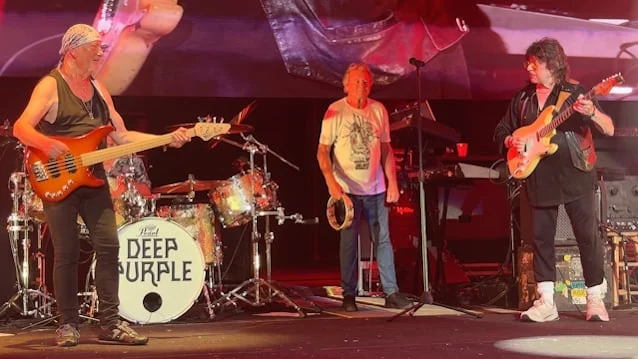
The legendary guitarist Ritchie Blackmore, a co-founder of the iconic rock band Deep Purple, has broken his silence regarding his highly anticipated reunion with his former bandmates. In a candid interview with Phil Aston, editor-in-chief of Now Spinning magazine, Blackmore detailed the serendipitous circumstances and profound emotions surrounding his surprise appearance on stage with Deep Purple on August 12th at the Northwell at Jones Beach Theater in Wantagh, New York. This marked Blackmore’s first performance with the band in over thirty years, since his acrimonious departure in 1993, and the event has been hailed by many as a significant moment in rock music history.
The 81-year-old guitarist’s return to the Deep Purple fold was not a meticulously planned affair but rather an spontaneous impulse that materialized from a simple thought. "I sat up in bed and thought, ‘What about if I got up on stage?’" Blackmore recounted to Aston. The allure of the Jones Beach Theater, an outdoor venue known for its magnificent setting overlooking the water, played a significant role. Blackmore had long harbored a desire to perform at this particular venue. The idea solidified into a concrete proposal when he approached his wife, Candice Night. "How do you feel about me just asking [DEEP PURPLE singer] Ian Gillan if it’s all right to play in ‘Smoke On The Water,’ then just disappearing?" he asked. Candice, supportive of the idea, facilitated the communication.
Blackmore, who admitted to still finding modern technology, including telephones, somewhat challenging, delegated the communication to his wife. "I don’t deal with that nonsense," he stated. Candice sent an email to Ian Gillan, who was receptive and enthusiastic. "Yes, of course. Welcome aboard. All the band is up for it. Come on stage for ‘Smoke’," Gillan replied. Blackmore’s intention was clear: to perform a single song, and his choice was the universally recognized Deep Purple anthem, "Smoke On The Water." He explained his rationale for selecting this particular track, noting its significant impact in the United States, even more so than in Europe. "It’s big over here [in the U.S.] – bigger here than it was in Europe." The band and Blackmore opted for a subtle promotion of the guest appearance, a move that surprisingly led to an increase in ticket sales, a detail Blackmore found "nice."
The actual performance itself was met with overwhelming warmth and camaraderie, according to Blackmore. "Everybody was so helpful. It was almost like overkill. Everybody was incredibly nice," he described. Despite the lack of a personal soundcheck, which he admitted is usually a preference, the performance was seamless. "I never did a soundcheck, which was a little bit off-putting, putting because I do like to do a soundcheck. But my roadie did that for me, thank goodness. And the sound was good." The reception from the audience was ecstatic. "The people went nuts, and half of them were sitting in water," Blackmore observed, referring to the unique atmospheric conditions of the venue where sections of the audience were occasionally sprayed by water.
Blackmore described the experience as akin to playing with old friends, emphasizing the positive and efficient atmosphere backstage and on stage. "It was like playing with old friends. Everybody was super nice and super efficient." He reflected on the considerable gap since his last performance with the band, stating, "Well, it’d been like 35 years since I’d actually played with the band, and nobody had changed. Everybody was great." The guitarist expressed relief that the performance went off without a hitch, acknowledging the potential for an embarrassing mishap. He drew a poignant analogy to soldiers returning from the Western Front, thought to be lost, only to reappear alive. "I felt like I was one of the soldiers that had come back from the Western Front, and everybody thought I was dead. And there I was – I was alive." The four minutes spent on stage felt like a brief period of celebrity, a status Blackmore, a self-proclaimed non-celebrity who simply plays the guitar, found both surprising and rewarding. "It was well worth doing. It was a good idea that I had, and it came to me very early one morning when I was in bed. I just thought, ‘Why not?’ ‘Cause we never know when we’re going to meet again, which is like a sad note in a way."
A Long Road to Reconciliation: Deep Purple’s Evolving Dynamics
The reconciliation between Ritchie Blackmore and Deep Purple, particularly with vocalist Ian Gillan, has been a long and complex journey, marked by significant creative differences and personal estrangement. Blackmore’s departure from the band in 1993 followed years of increasing tension, primarily centered on musical direction and creative control. He had been instrumental in shaping Deep Purple’s sound, penning many of their most enduring riffs, including the iconic "Smoke On The Water." However, his desire to explore more neo-classical and Renaissance-influenced music eventually led him to form Rainbow and later Blackmore’s Night, distancing himself from the hard rock sound he helped pioneer.
Despite the bitter end to his tenure, a thaw in relations had begun in recent years. Ian Gillan, in a separate interview with Joann Butler In Studio With…, described the reunion as "lovely" and "fantastic." He revealed that he and Blackmore had been in contact for several years, with "a lot of water gone under the bridge." Gillan elaborated on Blackmore’s initial inquiry, stating, "He wrote me a nice letter a few days before we got to New York and said, ‘Would it be all right, do you think? What do you reckon if I step up in smoke?’" The immediate response was positive, bringing "an instant smile" to Gillan’s face. "I thought, ‘Well, of course it would be wonderful. It’d be fantastic.’"
The reunion brought a "wonderfully warm feeling," especially considering the passage of time and the mending of past grievances. Gillan noted that while he and other band members had resolved their issues, the wider public might not have been aware of this reconciliation. The post-performance gathering in the dressing room, which included drinks, added to the convivial atmosphere. "I think he went home a bit tiddly. But it was great – really a magic moment."
Gillan also addressed the broader context of band dynamics, drawing parallels to the documentary "Spinal Tap." He explained that the intense camaraderie and power that form in young bands can be disrupted by external influences and the complexities of human chemistry as the band’s success grows. However, he emphasized that past conflicts do not have to define the future. "Life goes through so many different phases, and you can’t really allow all these problems to continue to exist. They become destructive forces in their own right then. We’ve grown out of all that." This sentiment of moving past old wounds and embracing a renewed sense of connection was echoed by Blackmore himself.
A Moment of Reflection and Gratitude
The significance of the reunion was not lost on Blackmore, who, in an interview with Guitar Player magazine shortly after the event, described the experience as "very moving." He acknowledged the challenging circumstances of his immediate performance without a warm-up, but reiterated his primary motivation: "I wasn’t there to be playing correct notes. I was there to see old friends I hadn’t seen in 40 years, and we’re all getting older. I think we realized it could be the last time we see each other, maybe." He consciously kept his playing simple, focusing on the "rudiments of being simple," and admitted to briefly losing his place. However, he maintained that this was secondary to the emotional purpose of the appearance. "I was there to heal any wounds – but there weren’t any wounds. Everyone was like we were in the army all along the Western front and we were all getting together again. Very emotional moment."
During the concert, after the rendition of "Smoke On The Water," Gillan publicly acknowledged Blackmore’s presence. He addressed the crowd, stating, "I’ve gotta say something. A couple of days ago, I got a message. A couple of days ago, I got a message from a local lad. I got a letter from this man saying, ‘I only live around the corner. Do you mind if I come and jam with you?’ And I tell you, it was an absolute pleasure to have back on stage the founder member, the great legend, the immortal Ritchie Blackmore." Gillan concluded with a warm, "Thanks, Ritchie. I have to say it was a great pleasure. I’ll see you in the bar."
Blackmore himself shared his positive experience on social media, writing, "Good night had by all, I hope. I know I had a great time. Thanks a lot lads. Carry on and have a good tour." Deep Purple’s official social media channels lauded the event as "a big moment in rock history," while Gillan expressed on his own platform the following day, "What a pleasure it was to welcome Ritchie Blackmore on stage with us to play ‘Smoke’ last night… Thanks Ritchie, that meant a lot to many people; not least me." Even current Deep Purple guitarist Simon McBride shared a backstage photo with Blackmore, calling it his "absolute pleasure to share the stage with this legend, such a great guy and an inspiration to all."
Addressing Health Challenges and Future Prospects
Blackmore’s participation in the Jones Beach show was not without its personal challenges, as he has been navigating significant health issues. He revealed in an August 11th Instagram Live session with his wife, Candice Night, that he had received a steroid injection in his lumbar area the previous day to help him stand on stage. He suffers from four herniated discs, and playing a Stratocaster guitar can exacerbate issues with his shoulders and lower back. He also mentioned experiencing a severe vertigo attack in late 2025 that led to canceled tour dates, along with chronic gout and arthritis affecting his fingers and feet, and previous heart problems.
"I did have my injection in my lumbar area yesterday," Blackmore stated. "It’s a special injection I have that enables me to stand in one spot, because if I’m playing a Strat on stage, I have a hard time with the shoulders and the lumbar area. I’ve got four herniated discs, if anybody wants them. And I had my injection yesterday of a steroid which helps me get through standing up on stage. But I do have a kind of a stool there just in case I start toppling over or something." He also acknowledged that Gillan is dealing with his own health concerns, including eyesight issues. "And so as you get older, you collect all these things… And fusion is out of the question. That’s too big a job. But the stem cell stuff looks interesting." He expressed gratitude to the doctors at Stony Brook University Hospital for their care.
Despite these ongoing health battles, the successful reunion has sparked discussions about the possibility of future collaborations. However, given Blackmore’s previous statements and the history between the members, any such developments would likely be approached with careful consideration and perhaps a similar spontaneous spirit. His focus remains on managing his health while appreciating the musical connections he has forged throughout his illustrious career.
A Legacy Reaffirmed
Ritchie Blackmore’s return to the Deep Purple stage, however brief, served as a powerful reminder of his indelible impact on rock music. As a co-founder and principal songwriter, his guitar riffs are woven into the very fabric of Deep Purple’s identity. His foray into neo-classical rock with Rainbow and his Renaissance-inspired work with Blackmore’s Night showcase his diverse musical talents and his continuous artistic evolution. The reunion, coming after decades of separation and despite past animosities, underscores the enduring power of music to transcend personal differences and bring people together. The event at Jones Beach was not just a concert; it was a historical moment, a testament to the lasting legacy of Deep Purple and the unique artistry of Ritchie Blackmore. The shared glances, the familiar licks, and the thunderous applause from the audience all contributed to an unforgettable night, a chapter added to the rich and complex history of one of rock’s most influential bands.
