

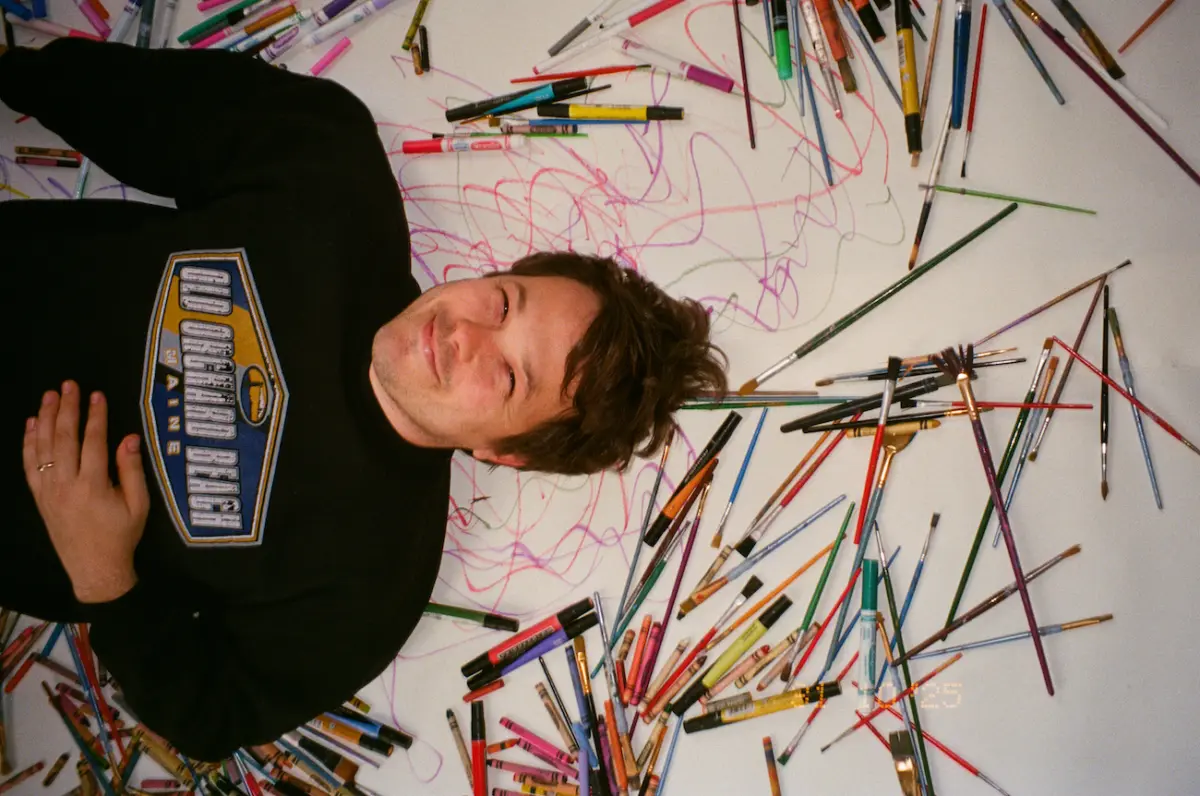
Michael Cormier-O’Leary stands as a pivotal figure in the contemporary independent music landscape, a prolific artist whose contributions span composition, performance, and curation. The Philadelphia-based musician is the visionary composer behind Hour, a chamber-pop ensemble known for its intricate arrangements and basement-DIY origins. His latest work with Hour, the spellbinding album Ghost Bridge, is set for release this Friday, further cementing his reputation for crafting profoundly emotive and elegantly complex soundscapes. Beyond Hour, Cormier-O’Leary is also the long-standing drummer for two of indie rock’s most respected acts, Friendship and 2nd Grade, and a co-founder of Dear Life Records, a label that has rapidly become a beacon for compelling and well-crafted independent music. This year has also seen the release of his solo EP, Proof Enough, underscoring a remarkably diverse and active creative output.
The Evolution of Hour: From DIY Roots to Orchestral Aspirations
Ghost Bridge marks a significant milestone in Hour’s journey, expanding the ensemble to an impressive 13 members. This larger configuration provides Cormier-O’Leary with an enriched palette to convey the album’s central themes of melancholia and preemptive grief, creating a collection of tracks that are both gorgeously plaintive and elegantly composed. The album’s sophisticated sound belies its humble recording origins, challenging conventional associations of basement sessions with artists rooted in the punk scene. Its intricate beauty becomes more apparent with each successive listen, revealing layers of thoughtful arrangement and emotional depth.
Cormier-O’Leary’s path to becoming a composer for a large ensemble like Hour began with formal studies and evolved through the fertile ground of the West Philadelphia DIY scene. He initially pursued music at Ohio Wesleyan University, where he gained foundational knowledge in theory. However, the program’s focus on traditional classical performance and teaching paths did not align with his early interest in blending compositional structures with improvised sections. This led him to the vibrant, experimental West Philly DIY scene after graduation, a community that proved remarkably supportive of diverse musical impulses. "A lot of my friends, I’d say, ‘Oh, now they’re trying this sort of thing,’" Cormier-O’Leary recounts, highlighting the scene’s openness. This environment empowered him to explore his compositional ideas, starting with guitar-based writing before realizing the potential to translate these concepts into a basement ensemble.
Hour’s inaugural performance took place in a basement, featuring a lineup primarily composed of talented musicians from the West Philly scene, only one of whom, Jason Calhoun, had classical training. Initially, the music leaned more towards simpler arrangements with significant improvisational elements. Over time, the project has matured, becoming increasingly composed, yet without sacrificing the freedom of improvisation. Cormier-O’Leary notes, "if anything now, while it has gotten more composed, I think the improvisational moments that happen are more expansive. We do deeper in improvising than we did in those days, and it’s more charted. It’s just kind of the marriage of the two, which was kind of what I was always hoping for."
The growth of Hour’s membership from nine musicians on Ease The Work to 13 on Ghost Bridge is a testament to both Cormier-O’Leary’s extensive musical network and his expanding artistic vision. His relocation to Maine from 2021 to 2023 introduced new collaborators, and upon his return to Philadelphia in 2023, he consciously integrated musicians from both regions to form the current, larger ensemble. This allowed him to compose Ghost Bridge with specific instruments and players in mind, leading to a more intentional and expansive sound. He cites inspiration from film soundtracks and the "pop orchestra" sound of artists like Frank Sinatra, appreciating the "color" and "world-building quality" that a diverse array of instruments provides. "You just get this color from how you can arrange all the different instruments in their distinct timbres," he explains, emphasizing the rich, transportive effect of blending strings and wind instruments.
The recent flurry of activity—two studio albums and a live album in a relatively short period—follows a six-year hiatus between Hour’s initial 2018 releases and more recent works. Cormier-O’Leary attributes this break to a combination of factors: the two-year impact of the pandemic, his move to Maine, and the ongoing demands of his drumming role in Friendship. The organization of such a large ensemble naturally requires "natural lulls to regroup and get more material actually written."
Crafting Ghost Bridge: A Meditation on Loss and Resilience
The thematic core of Ghost Bridge delves into profoundly personal and universal territory: grief and death. Cormier-O’Leary describes the album as exploring "darker impulses" but with an "imaginative quality" rather than a purely dour tone. The title track, "Ghost Bridge," encapsulates this duality, evoking both a bridge that mysteriously disappears and a spectral pathway for departed souls. Its abrupt harmonic shifts mirror the unnerving sensation of sudden loss, while its broader arc reflects the transformative journey of grieving.
The album’s opening track, "So Long Without A Word," is envisioned as a direct "grief song," beginning with a "huge stab of just the shock of loss" and navigating through varied emotional landscapes. This "zigzag nature of grieving" defines the album’s emotional trajectory. A particularly poignant artistic choice is the album’s conclusion with a song named after his child, written just before recording. This decision, Cormier-O’Leary explains, "explains the general approach to this stuff. It’s like I wanted to look at the darkness and not get consumed by it either, but not avert my eyes, and let my imagination still have a place in thinking about this stuff."
While the album profoundly addresses loss, Cormier-O’Leary clarifies that it’s not tied to a single, specific personal bereavement. Instead, it embodies a broader contemplation of mortality and the inevitable losses to come. He characterizes it as a "dress rehearsal" for future grief, a "skin-thickening quality" born from the awareness of loving others he is "not prepared to lose yet." This fixation on loss, he notes, is a consistent "through line through a lot of my music," often exploring themes of impermanence and the attempt, however futile, to preserve fleeting moments.
The Ingenuity of DIY Production: Recording a Grand Vision in a Basement
Recording an ensemble of 13 musicians, aiming for an "orchestral pop" sound, typically demands state-of-the-art studios and extensive rehearsal time. Yet, Ghost Bridge was primarily recorded in a basement and living room, a testament to the enduring DIY ethos that underpins Cormier-O’Leary’s work. This approach presents considerable challenges, as he readily admits, expressing a desire for more conventional recording conditions. However, he also recognizes the unique strengths born from these limitations. "There’s no universe where we would ever sound like an orchestra backing Frank Sinatra," he states, "But I like reaching for it, and I think in the failure of reaching for that, we become the band that we are."
The success of capturing Ghost Bridge‘s nuanced sound in such an environment is largely credited to Lucas Knapp, the recording engineer and synth player for Hour. Knapp’s expertise was instrumental in making the album sound as if it were recorded in a professional setting, despite the inherent acoustic and logistical difficulties. Cormier-O’Leary emphasizes the goal of unadorned instrument sounds, a clarity that Knapp achieved under duress. The recording process was intensive, with musicians often learning their parts during the sessions due to limited rehearsal time. The shared "punk background" of the ensemble members fostered a collective resilience and adaptability to the "scrappy nature" of the production. While acknowledging the immense effort required, Cormier-O’Leary suggests that this scale of basement recording might represent the "limit to what anyone should do."
Touring the Dynamic Ensemble: Adapting the Grand Sound for the Road
Taking Hour’s intricate music on tour presented another set of challenges, particularly when adapting the 13-member album arrangements to a more manageable six-person touring band. Cormier-O’Leary initially harbored nerves about translating the new material to a smaller setup, but the inherent adaptability of Hour’s music once again proved its strength. "You remove players, you remove parts, and it really gives a lot of space to hear what remains, and like the piece adapts to that," he explains. Missing parts are often picked up by other musicians, maintaining the essence of the compositions while allowing for fresh interpretations. This dynamic flexibility means that even older songs continue to evolve, offering a new character with each performance.
Touring with Hour contrasts significantly with Cormier-O’Leary’s experiences with Friendship and 2nd Grade. While the latter two bands, being smaller and having toured extensively together for over a decade, offer a logistical "ease" and mutual understanding, Hour presents a different dynamic. As Hour only truly became a touring band in 2023, the interpersonal learning curve is steeper. Musically, however, Hour’s improvisational elements introduce a unique "freshness every night," allowing performances to venture into unexpected territories. This contrasts with the more fixed, albeit deeply explored, sets of Friendship and 2nd Grade. The logistical complexities of coordinating six people on the road, while fewer than 13, are still greater than a four-piece band.
The nature of Hour’s music also creates a distinctive dynamic with venues. Rolling up to small rock clubs with a chamber-pop ensemble can surprise sound engineers, despite stage plots being provided. Cormier-O’Leary notes that some venues "get very surprised," while others "just roll with it." The largely unamplified nature of Hour’s instruments allows for adaptability; if certain instruments cannot be properly miked, they can simply play to the volume of the string players. Lucas Knapp’s presence on tour, as both synth player and experienced sound person, often proves invaluable in assisting venue staff. The primary technical concern, Cormier-O’Leary humorously notes, is preventing "clarinet feedback."
Beyond Hour: Solo Explorations and Diverse Collaborations
Cormier-O’Leary’s solo EP, Proof Enough, released under his own name earlier this year, offers a different facet of his songwriting. This project deliberately blurs the lines between biography and fiction, exploring lyrical narratives with a voice and words, a distinct impulse from Hour’s instrumental focus. The EP features songs ranging from fictional narratives, such as one about a five-year-old named Marilyn, which allowed him to explore a specific kind of loneliness, to deeply personal reflections. One track, written shortly after his wedding, captures the "psychedelic high" and subsequent "crash" of emotions, serving as a reminder to hold onto moments of intense joy amidst life’s ongoing flow.
Notably, Proof Enough includes a version of "Sky Is Blue," a track also featured on Ghost Bridge. Cormier-O’Leary explains that the Hour version was written first on piano, and when he attempted to play it on guitar for his solo EP, he found himself writing entirely different chords, creating two distinct, re-harmonized versions of the same melody. The Hour rendition features Heeyoon Won on lead vocals, with Cormier-O’Leary picturing an Astrud Gilberto-esque delivery. This interplay between his solo work and Hour underscores his versatile compositional approach.
His drumming roles in Friendship and 2nd Grade further diversify his musical contributions. Friendship, an indie rock staple, has kept him busy for a decade, while 2nd Grade is known for its "very song-based" approach. These bands represent the more traditional indie rock side of his output, providing a foundation for his more experimental endeavors.
Dear Life Records: Nurturing "Good Writing" in Independent Music
Dear Life Records, co-run by Cormier-O’Leary with Frank Meadows and Jon Samuels, has emerged as a significant force in independent music since its inception in 2019. Cormier-O’Leary initially founded the label as a means to release both his song-based solo work and his instrumental Hour music without having to navigate disparate artistic identities. The label, which began as a cassette-focused venture, experienced substantial growth during the 2020 COVID-19 lockdown. With Cormier-O’Leary at home and supported by unemployment, he dedicated more time to the label’s development.
A crucial turning point came with the first vinyl release, Kath Bloom’s new record. This project connected Cormier-O’Leary with Frank Meadows, who was assisting Bloom. Their daily collaboration during the lockdown led Cormier-O’Leary to invite Meadows to co-run Dear Life. Meadows’s "incredible Energizer buddy" work ethic provided a significant boost, transforming the label from a solo endeavor that might have "stopped years ago" into a dynamic partnership. Jon Samuels, who had already been designing early artwork, soon joined, forming the current trio at the helm.
The label’s catalog is remarkably diverse, featuring brilliant releases from artists like MJ Lenderman, Wendy Eisenberg, Fust, Florry, Styrofoam Winos, Thomas Dollbaum, and Kath Bloom. Despite this stylistic breadth, the founders have identified a unifying principle: "good writing." Cormier-O’Leary reflects, "We all three really care about good writing. And that doesn’t always have to be lyrical music. But I think a lot of what we’ve put out is very well written, and the writing is kind of integral to the process." This ethos allows for a wide range of music, from alt-country revival to the upcoming classical string quartet and brass quintet album by Sammy Weissberg.
A pivotal moment for Dear Life Records was the immense success of MJ Lenderman’s Boat Songs. The album’s initial pressing of 500 copies sold out before its street date, catapulting the label into the "deep end" of independent music distribution. This unexpected hit necessitated rapid scaling, from managing multiple pressings to ensuring adequate stock for Lenderman’s tours. The financial and logistical boost provided by Boat Songs "did literally afford us the ability to release more music than we probably had, or more music at a larger scale." It effectively "graduated us out of being a cassette label," making vinyl production, which had previously involved daunting 11-month turnaround times, a more viable and less intimidating prospect.
Running Dear Life Records now constitutes a significant portion of Cormier-O’Leary’s time, akin to a full-time job. While the label has reduced its annual output from a peak of 13 releases (mostly tapes) to a more focused five or six, each new project now involves a much greater commitment. Cormier-O’Leary finds satisfaction in the organizational aspects of label management, enjoying the "minutia" of folders, spreadsheets, and logistics. He was initially inspired by musician-run labels like Orindal (Owen Ashworth), Lily Tapes & Discs (Ben Lovell), Cry Like Donna (Theo Krantz), and Sleeper Records (Will Kennedy and Joey Degrado), viewing them as "art projects in of itself." Unlike professionals who enter the industry with extensive business acumen, Cormier-O’Leary and his partners approached Dear Life from an artist’s perspective, learning the ropes as they went. The label continues to define its parameters, with upcoming releases including four repeat artists—one in a "pretty different" mode—and a highly anticipated fifth release from a new artist, which Cormier-O’Leary believes "everyone’s gonna be really excited about."
The Intersecting Creative Communities: A Network of Talent
The large, evolving lineup of Hour serves as a "Venn diagram of creative community," reflecting Cormier-O’Leary’s connections across various musical circles. He sees the band as representative of multiple communities that have inspired him or of which he has been an active part. While he handles much of the logistics and composes the music, his approach leaves ample room for each musician’s individual voice and "idiosyncratic quality."
He offers specific examples: Matt, the viola player, whose unique style and haunting contributions, such as the distorted wailing on the title track "Ghost Bridge," are indispensable. Abi Reimold, the other electric guitar player, consistently delivers parts that Cormier-O’Leary "couldn’t have ever imagined without them," becoming integral to the songs. This emphasis on individual expression ensures that even within a highly composed framework, the distinct approaches of the players cut through, making Hour truly a collaborative "community project."
Conclusion: Michael Cormier-O’Leary’s Enduring Influence on Indie Music
Michael Cormier-O’Leary’s multi-faceted career exemplifies the dynamism and innovation thriving within independent music. From leading Hour’s intricate chamber-pop explorations of grief and resilience, to providing the rhythmic backbone for beloved indie rock bands like Friendship and 2nd Grade, and co-piloting the increasingly influential Dear Life Records, his contributions are profound and far-reaching. His ability to blend formal musical training with a DIY punk sensibility, to manage complex logistics while fostering individual artistic expression, and to build a successful independent label rooted in a commitment to "good writing" positions him as a significant architect of contemporary indie culture. His work, culminating in the release of Ghost Bridge, continues to push boundaries and enrich the sonic landscape, driven by an unwavering commitment to artistic integrity and community collaboration.
