

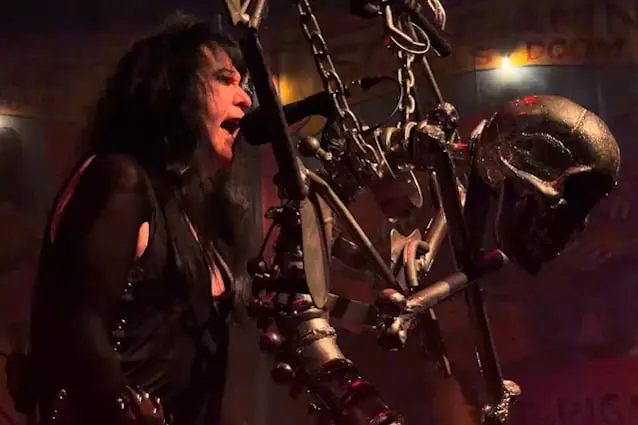
The vibrant energy of W.A.S.P.’s "1984 To Headless" tour, currently captivating audiences across North America, has been underscored by a candid moment of introspection from its iconic frontman, Blackie Lawless. During a recent VIP question-and-answer session preceding the band’s September 30 performance at the historic Hampton Beach Casino Ballroom in Hampton Beach, New Hampshire, Lawless directly confronted the prevalent public perception that he maintains an "antisocial" demeanor. His response, meticulously transcribed by BLABBERMOUTH.NET, offered a nuanced perspective on the challenges faced by individuals thrust into the public spotlight.
"I wouldn’t say I’m antisocial," Lawless stated, articulating a sentiment that resonated with many in attendance. "I’m just a human like anybody else. I’m gonna see things that are gonna aggravate me, but I think anybody that’s in the public eye, they’re not allowed to have regular days a lot of times, and if they get caught doing that, and I underline the word ‘caught,’ then it’s not exactly the same as somebody else. That doesn’t necessarily make it true. I mean, maybe they’re a full-time asshole. I don’t know."
This statement serves as a powerful counterpoint to the often-simplified narratives that surround public figures. Lawless’s assertion suggests that moments of withdrawal or perceived aloofness are not necessarily indicators of an inherent aversion to social interaction, but rather a natural human response to the pressures and unique circumstances of widespread recognition. The emphasis on being "caught" doing something perceived as ordinary highlights the intense scrutiny under which public personalities operate, where even mundane actions can be amplified and misinterpreted.
A Vivid Anecdote Illustrating Public Scrutiny
To further illustrate his point, Lawless shared a vivid personal anecdote that encapsulates the peculiar nature of his public interactions. The story unfolded during a period when he and his father were involved in building a house in the San Fernando Valley area of Los Angeles.
"I’ll give you an example," Lawless recounted. "My dad calls me one day. We’re building a house, and I’m down in what’s the San Fernando Valley of Los Angeles. And he says, ‘Hey, are you close to such and such place? I need something from a plumbing supply house that they have, and it’s the only place in town that has it. Are you pretty close to them?’ And I said, ‘Yeah, I’m actually a couple blocks away.’ He says, ‘Okay.’ He says, ‘Can you go by and pick up this part and bring it on up to the house?’ I said, ‘Okay.’"
The situation took an unexpected turn when Lawless entered the plumbing supply store. "So I go in, and there’s two guys that are waiting there to get whatever it is, part they needed. But there’s a guy behind the counter. He sees me, he jumps up on the counter and starts doing [the classic W.A.S.P. song] ‘L.O.V.E. Machine.’ He’s waving his hands in the air, and the two guys that are trying to get the part they’re waiting on, they don’t look at him. They look at me. What did I do to this guy to make this guy do this? And I politely walked out, and I called my dad, and I said, ‘You ain’t getting your part today.’"
This incident, though seemingly trivial, underscores Lawless’s central argument. The store employee’s flamboyant reaction, inspired by W.A.S.P.’s signature song, disrupted a simple errand and placed Lawless in an uncomfortable spotlight. The fact that the other patrons’ attention immediately shifted to him, rather than the employee’s performance, illustrates the inescapable nature of his public persona. Lawless’s decision to leave without the part, despite his father’s request, reflects a choice to avoid further escalation or discomfort in a situation where he felt unfairly targeted by the fan’s enthusiastic, yet intrusive, recognition.
"And on some days you can handle it better than others, and some days you just don’t want to deal with it," Lawless concluded his anecdote. "So if you were in the same position, you too would do the same." This final statement reiterates the human element, suggesting that even the most seasoned public figures have days where they prefer to navigate life with less fanfare.
The Demanding Nature of W.A.S.P.’s Live Spectacle and Behind-the-Scenes Operations
When questioned about his methods for "winding down" outside of his extensive W.A.S.P. commitments, Lawless offered another insightful glimpse into the relentless demands of his career. He described his downtime as intrinsically linked to the very work that defines him, likening it to an old adage about finding purpose even in idleness.
"You’re looking at it," Lawless replied. "For the last I don’t know how many years, it’s like the old joke when you’re not doing anything, you stick a broom in your rear end and sweep. It’s a lot like that, and especially since COVID, because there was about three years there where nobody worked, so there was huge deficits that people – crew, band members, things like that – had to make up. So there’s not the time that you might think to do this."
The impact of the COVID-19 pandemic on the live music industry, particularly the extended hiatus, has created a backlog of work and financial recovery for artists and their crews. Lawless’s mention of "huge deficits" points to the economic realities faced by those in the touring circuit, necessitating an intensified workload upon their return. This context is crucial for understanding the limited opportunities for true "downtime."
Furthermore, Lawless elaborated on the intricate planning and execution involved in W.A.S.P.’s elaborate stage productions, specifically referencing the "1984 To Headless" fall 2026 North American tour with KK’s Priest.
"To put this [‘1984 To Headless’ fall 2026 North American] tour together [with KK’s Priest], we started working on this in late March," he explained. "So there’s a lot of moving parts to the show that the idea is to make it look like it doesn’t have that. And if you have to think about all the moving parts, it strips away the beauty of simplicity anyway. So we don’t want it to be like that. But it is similar to a play in a lot of ways that the crew members have to know where they need to be at certain times to do certain things, and there’s a lot of moving parts. So to get that from point A to point B, there’s a lot of rehearsal involved, but there’s a lot of planning involved to do that. And it’s not a band that’s just walking out on a stage and playing their little songs and wave their hand and say goodbye when it’s over. It’s not like that at all."
This detailed description highlights W.A.S.P.’s commitment to delivering a comprehensive and theatrical live experience. The comparison to a play emphasizes the synchronized efforts of the entire production team, from musicians to stagehands, all working in concert to achieve a seamless performance. The effort involved in creating an illusion of simplicity requires meticulous organization and extensive rehearsal, a stark contrast to the often-perceived spontaneity of live rock concerts.
The Enduring Project: Lawless’s Book
Beyond the immediate demands of touring, Lawless revealed the significant time commitment dedicated to a long-term personal project: a book. This endeavor, he explained, is a testament to his pursuit of perfection and a desire to create a lasting legacy.
"But I’ve been working on the book, which I talked to different guys that wrote books and I said, ‘How long did it take you?’ And they said, ‘Six months to a year.’ And I’m thinking, ‘Okay, that’s what it’ll take me.’ Well, six years later, I’m still working on it, because I’m gonna do this one time, and I want it to be right," Lawless shared.
The extensive duration of this writing project, spanning six years and counting, underscores Lawless’s meticulous approach. His aim to "do this one time, and I want it to be right" signifies a dedication to quality and a desire to produce a definitive work. This contrasts sharply with the rapid pace of content creation often seen in the digital age, highlighting a more traditional and deliberate creative process.
"So there’s a lot of stuff that people do not see that goes into this," he added. "And it really is like the old question that you run a business and there’s nothing to do, it’s because you’re not running it right. There’s a lot of truth to that. This is a business, just like anything else. The good part of it is there’s a lot of things to do, and most of it the public never sees. But it takes up a lot of time."
Lawless’s perspective on his career as a business, with its inherent responsibilities and unseen labor, provides a mature and grounded outlook. The acknowledgment that "there’s a lot of things to do, and most of it the public never sees" serves as a final, unifying point, connecting the complexities of his touring operations, his writing project, and his personal experiences with the public.
"1984 To Headless" Tour: A Deep Dive into the Setlist and Fan Engagement
The "1984 To Headless" tour, which commenced on September 10 at The Magnolia in El Cajon, California, with KK’s Priest, has been met with considerable enthusiasm from W.A.S.P.’s dedicated fanbase. The tour’s thematic focus, drawing heavily from the band’s foundational albums, signifies a deliberate return to their roots, resonating with long-time followers who cherish their early work.
The 17-song setlist presented by the Lawless-fronted outfit is a carefully curated journey through W.A.S.P.’s formative years, predominantly featuring material from their first four albums: 1984’s self-titled W.A.S.P., 1985’s The Last Command, 1986’s Inside The Electric Circus, and 1989’s The Headless Children. This strategic selection demonstrates a commitment to celebrating the era that established W.A.S.P.’s distinctive sound and provocative image.
A notable highlight of the tour’s musical offerings is the inclusion of Uriah Heep’s "Easy Livin’," a song W.A.S.P. covered on Inside The Electric Circus but had notably never performed live until this tour. This unexpected inclusion serves as a treat for fans, offering a fresh live interpretation of a beloved cover. Additionally, the band has been performing "Mr. Cool," a track with a significant lineage. Originally appearing on a demo from Lawless’s pre-W.A.S.P. band SISTER, it later evolved into the track "Cries In The Night" from The Last Command. This historical deep cut further appeals to the band’s most ardent supporters, who appreciate the exploration of their musical evolution.
Beyond the live performance, W.A.S.P. continues to offer exclusive VIP packages, a strategy that has proven highly successful in fostering a deeper connection with their audience. These packages provide fans with unparalleled access, including opportunities to meet Blackie Lawless himself, receive personal photos, obtain autographs, and explore a W.A.S.P. traveling museum featuring new exhibits since the last U.S. tour. The inclusion of a "very personal Q&A with Blackie" further solidifies the VIP experience as an intimate encounter with the band’s mastermind. These tickets are available for purchase at waspnation.myshopify.com, indicating a well-structured approach to fan engagement and revenue generation.
Future Global Endeavors and the Enduring Legacy of W.A.S.P.
The current North American leg of the "1984 To Headless" tour is merely the prelude to a more extensive global campaign. W.A.S.P. has announced plans to bring their acclaimed show to Europe and the rest of the world in 2027. This confirms the band’s continued commitment to international touring and their enduring appeal across diverse geographical markets. The extended timeline allows for further refinement of the show and provides ample opportunity for fans worldwide to experience this significant chapter in W.A.S.P.’s storied career.
The image credit for accompanying visuals, attributed to RichG LIVE, points to the active presence of media documenting the tour, ensuring that the spectacle reaches a broader audience even beyond the live venue. The inclusion of an embedded YouTube video player further enhances the article’s multimedia capabilities, offering readers a direct visual and auditory connection to the band’s performances and the overall W.A.S.P. experience.
In essence, Blackie Lawless’s reflections during the Hampton Beach Q&A session offer a compelling narrative that transcends the typical rockstar persona. They reveal a thoughtful individual navigating the complexities of fame, deeply committed to his craft, and dedicated to delivering an unparalleled live experience for his fans. The "1984 To Headless" tour stands not only as a celebration of W.A.S.P.’s musical heritage but also as a testament to the enduring passion and meticulous dedication of its iconic frontman. The band’s continued success and ambitious touring plans solidify their position as a formidable force in the heavy metal landscape, with a legacy that continues to expand and captivate new generations of fans.
