

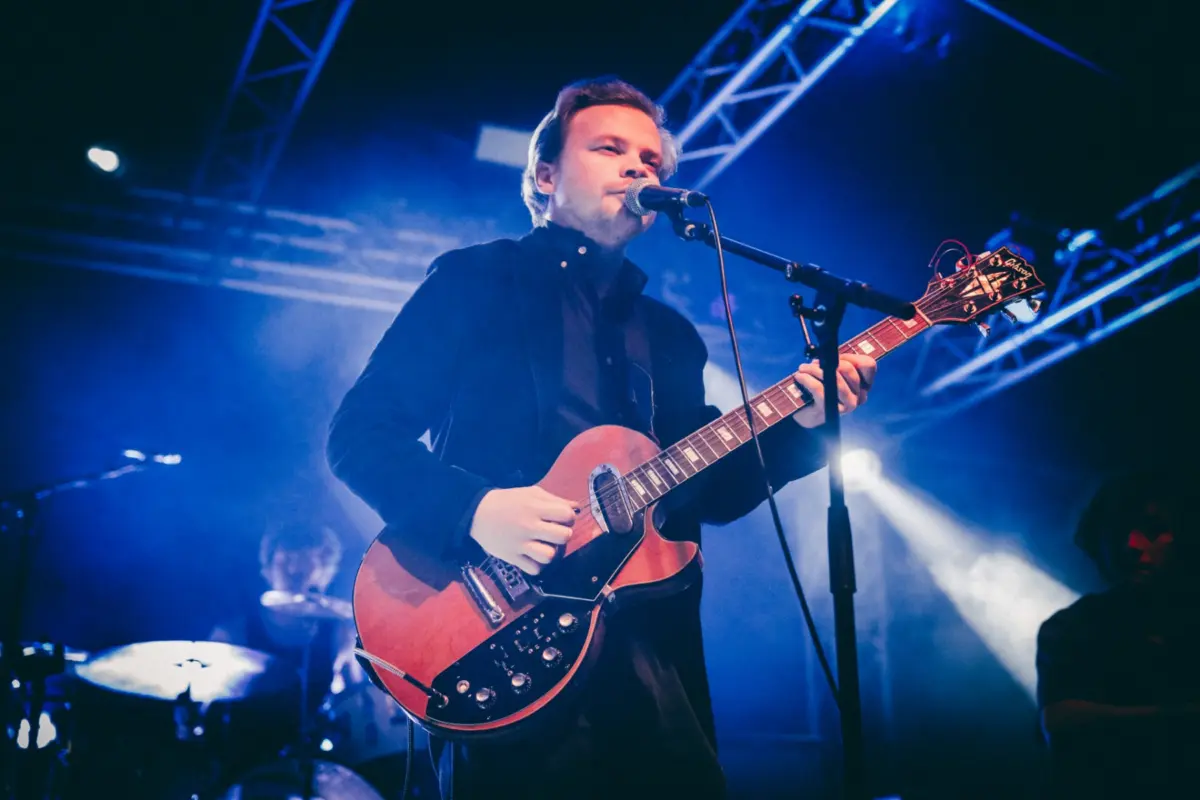
Former Black Midi frontman Geordie Greep has found himself at the center of serious sexual misconduct allegations, issuing denials and providing further context to an incident detailed in a Paste magazine interview with the alleged victim. The controversy initially surfaced during Greep’s Vancouver tour stop, where flyers distributed outside the venue accused him of sexual assault, prompting an on-stage response from the musician. This evolving situation has led to tour cancellations and sparked a broader discussion about accountability within the music industry.
Initial Allegations Emerge in Vancouver
The first public accusations against Geordie Greep surfaced on Thursday, October 8, during his solo performance in Vancouver, British Columbia. As concertgoers arrived at the Pearl venue, they were met with flyers distributed by an anonymous individual. These flyers contained stark accusations, explicitly labeling Greep as a "rapist" and stating, "You know what you did this morning Oct 8th. He thinks he can do what he wants. Let Him Know What Vancouver Thinks of Rapists." The distribution of these highly charged materials immediately cast a shadow over the scheduled performance and drew significant attention to the musician.
Responding to the visible tension and the gravity of the allegations, Greep took the stage approximately an hour later than planned. Notably, he performed without his usual backing band, explaining that he did not want to compel them to play under such circumstances. During his address to the audience, Greep directly confronted the accusations. He recounted his version of events from the previous night, stating, "Essentially what happened last night, me and some of the band we went out to some bars, we went around, we met people, and it ended up in a situation where really late at a house party, I got the wrong end of the stick with someone who was there, and I made a move, and it didn’t come off."
Greep further elaborated on his immediate reaction and perspective: "I really quickly, of course, apologized, and it was a complete misunderstanding on my part. I felt extremely bad, I feel extremely sorry, and extremely upset about the whole situation. I would never rape a woman. I’m not a rapist. It’s not how that went down." He expressed remorse for making someone uncomfortable without intending to, reiterating, "I’m very, very, very sorry. I made someone uncomfortable without meaning to. It’s not a good thing, it’s not good." In a gesture of accountability, Greep announced that proceeds from the Vancouver concert would be donated to an anti-violence organization in British Columbia. He also acknowledged the audience’s right to seek refunds or leave the show if they wished, emphasizing transparency.
The Paste Magazine Investigation and "Laura’s" Account
Days after the Vancouver incident, on Wednesday, October 14, Paste magazine published a significant interview that provided a detailed account from the alleged victim. The woman, identified only by the pseudonym "Laura" for her privacy, came forward to share her experience. Her testimony directly addressed the events alluded to by the flyers and Greep’s on-stage statement, offering a crucial counter-narrative.
Laura explicitly denied any prior knowledge of the flyers distributed outside Greep’s Vancouver concert. Instead, she detailed an alleged incident of sexual harassment, describing waking up to Greep kissing her against her will. Her account states that she then pushed him away. This narrative presents a more explicit allegation of non-consensual physical contact than Greep’s initial public statement, which characterized the event as a "move" that "didn’t come off" and a "misunderstanding." The Paste article aimed to shed light on the victim’s perspective, providing a platform for her voice in a rapidly unfolding public controversy. The detailed nature of Laura’s account underscores the complex and often differing interpretations of consent and interaction.
Greep’s Instagram Response and Further Clarification
Following the publication of Laura’s interview in Paste, Geordie Greep issued a further statement via his Instagram account. This update, posted on Wednesday, October 14, served as a direct response to Laura’s detailed allegations. In his Instagram statement, Greep acknowledged the act of kissing Laura but offered a key clarification from his perspective: he stated that he did not realize she was asleep at the time. This detail is central to his defense, suggesting a lack of malicious intent and a misunderstanding of her state of consciousness, which would inherently impact the assessment of consent.

Greep’s social media post was seen as an attempt to address the new details brought forth by Laura’s account and to reiterate his stance that the incident was a misunderstanding rather than a deliberate act of sexual assault or harassment. The evolving nature of his statements—from a general apology for making someone uncomfortable to a specific acknowledgment of kissing while claiming ignorance of her being asleep—highlights the musician’s efforts to manage the public narrative amidst escalating accusations. The difference in perception of the event remains a core point of contention between the two accounts.
Background on Geordie Greep and Black Midi
Geordie Greep is best known as the distinctive frontman and guitarist of the critically acclaimed experimental rock band Black Midi. Hailing from South London, Black Midi gained significant recognition in the late 2010s for their unique blend of math rock, noise rock, jazz fusion, and avant-garde influences. Their debut album, "Schlagenheim" (2019), was nominated for the Mercury Prize and garnered widespread praise for its innovative sound and intense live performances. Greep’s commanding stage presence, distinctive baritone vocals, and intricate guitar work were central to the band’s identity.
Black Midi continued to push boundaries with subsequent releases like "Cavalcade" (2021) and "Hellfire" (2022), cementing their reputation as one of the most exciting and unpredictable acts in contemporary music. However, in late 2023, Greep announced his departure from the band to pursue a solo career, a move that surprised many fans and critics. His solo work, including the recently released album "The New Sound," showcased a different, often more introspective and melodically focused side of his musicality, though still retaining his signature experimental edge.
Greep’s solo North American tour was intended to support this new artistic direction and introduce his individual sound to audiences. The allegations and subsequent cancellations have therefore cast a significant shadow over this pivotal period in his career, impacting his ability to establish himself as a solo artist following a successful tenure with Black Midi. The rapid transition from critical darling to a figure embroiled in public controversy illustrates the fragility of artistic reputation in the digital age.
Immediate Repercussions: Tour Cancellations and Financial Implications
The allegations against Geordie Greep had immediate and tangible consequences for his ongoing North American tour. Following the Vancouver incident and the intensifying public scrutiny, Greep canceled several upcoming dates. These included shows in Boise, Idaho (scheduled for Friday, October 9), and Salt Lake City, Utah (Saturday, October 10). Subsequently, concerts planned for Boulder and Denver, Colorado, were also called off.
The decision to cancel these performances reflects the severe disruption caused by the allegations. Tour cancellations typically result in significant financial losses, encompassing lost ticket sales, venue fees, travel expenses, and potential contractual penalties. For a solo artist establishing a new career path, such disruptions can be particularly damaging, affecting momentum, fan engagement, and future booking opportunities. While the final two dates of Greep’s North American tour in Des Moines, Iowa, and Omaha, Nebraska, were initially reported as not canceled at press time, the overall trajectory of his tour was severely impacted.
Beyond North America, Greep was also scheduled to embark on a European tour beginning November 1 in the Netherlands, with further dates in France, Spain, and Portugal. The unfolding situation raises questions about the viability of these upcoming international engagements and whether further cancellations or changes to his touring schedule will be necessary as the allegations continue to be processed by the public and potentially by industry stakeholders. The ripple effect of such accusations often extends far beyond immediate concert dates, influencing long-term career prospects and professional relationships.
Broader Industry Context and the Discussion on Consent
The allegations against Geordie Greep emerge within a broader cultural landscape increasingly shaped by the #MeToo movement and a heightened awareness of sexual misconduct across various industries, including music. The music industry, like many creative fields, has faced scrutiny regarding power dynamics, consent, and accountability. Historically, artists have sometimes been afforded a degree of impunity, but recent years have seen a growing demand for transparency and justice for victims.
This incident highlights the ongoing challenges of defining and respecting consent, particularly in social settings that can be ambiguous. Greep’s initial characterization of the event as a "misunderstanding" versus Laura’s account of non-consensual kissing underscores the critical importance of explicit, enthusiastic, and ongoing consent. Legal and ethical frameworks emphasize that consent cannot be given if a person is unconscious or asleep, regardless of intent. The divergence in narratives often requires careful consideration and highlights the different lenses through which individuals experience and interpret interactions.
Moreover, the role of independent media outlets like Paste magazine in providing platforms for alleged victims is crucial. In an era where social media can amplify accusations quickly, traditional journalistic vetting and reporting remain vital for presenting coherent narratives and gathering statements from all parties involved. The public nature of these allegations inevitably leads to a complex interplay between public opinion, legal considerations (if any arise), and the artist’s professional standing.
Challenges of Allegations and Public Perception
Navigating sexual misconduct allegations in the public sphere presents immense challenges for all parties involved. For the alleged victim, coming forward often entails significant emotional distress, potential backlash, and the daunting task of reliving traumatic experiences. For the accused, even denials can lead to immediate reputational damage, career repercussions, and a lengthy battle to clear their name in the court of public opinion.
The differing accounts provided by Greep and Laura illustrate the inherent difficulty in establishing definitive truth in situations often lacking independent witnesses. Greep’s claim that he "didn’t realize she was asleep" introduces a crucial element of his defense, suggesting a lack of criminal intent. However, from a consent perspective, the state of the alleged victim (asleep or otherwise incapacitated) is paramount, as it fundamentally precludes the possibility of valid consent. Public perception in such cases is often shaped by a multitude of factors, including the credibility of each narrative, past behaviors, and broader societal attitudes towards sexual harassment and assault.
Industry stakeholders, including record labels, management teams, and booking agents, often face difficult decisions in such circumstances. Their responses typically range from immediate disassociation to a cautious "wait and see" approach, depending on the severity of the allegations, available evidence, and contractual obligations. The lack of immediate, extensive statements from Greep’s official representatives to Billboard suggests a carefully managed approach, likely involving legal counsel, as the situation unfolds.
Looking Ahead: Future Implications for Geordie Greep
The path forward for Geordie Greep remains uncertain. The immediate impact on his solo career has been significant, with canceled tour dates and a cloud of controversy now associated with his name. The long-term implications could extend to recording contracts, future collaborations, and his overall ability to attract and retain an audience. In an industry increasingly sensitive to ethical conduct, allegations of this nature can have enduring consequences, regardless of formal legal outcomes.
The public will undoubtedly continue to monitor developments, including any further statements from Greep, additional reporting from Paste or other outlets, and potential legal actions. The situation serves as a stark reminder of the responsibilities that come with public visibility and the critical importance of understanding and respecting consent in all interactions. As the music industry continues to grapple with its past and present regarding misconduct, cases like Greep’s contribute to an ongoing, vital dialogue about accountability, victim support, and the standards expected of artists.
