


A landmark collaboration between Queens of the Stone Age frontman Josh Homme and acclaimed boutique luthier Gabriel Currie of Echopark Guitars has culminated in the release of a bespoke signature instrument, set to redefine the standards of artist-designed gear. This unique semi-hollow guitar, meticulously crafted to Homme’s exacting specifications, is not merely an endorsement but the physical manifestation of a decade-long sonic partnership. In a move that emphasizes exclusivity and artisanal precision over mass-market appeal, only 21 of these instruments will be made available for purchase, with an additional guitar designated for a special fan giveaway. This limited production run underscores the bespoke nature of Echopark’s work and the deeply personal connection forged between the artist and the craftsman.
The Genesis of a Sonic Partnership: A Decade in the Making
The extraordinary alliance between Homme and Currie traces its origins back to an unconventional introduction more than ten years ago, around 2013, a pivotal period for Queens of the Stone Age as they finalized their critically acclaimed album, …Like Clockwork. Gabriel Currie, known for his audacious approach and profound belief in his craft, initiated the relationship by walking uninvited into a Queens of the Stone Age rehearsal session. This bold move, which saw him present a selection of his handcrafted guitars, was repeated days later, demonstrating his conviction in the quality and unique voice of Echopark instruments.
Currie, who grew up in East Los Angeles, far from the desert rock scene that birthed Homme’s early projects like Kyuss, nevertheless resonated deeply with the band’s sound. He vividly recalls his initial encounter with Kyuss’s music as "a big, brooding monster of a thing that wasn’t anywhere else," hinting at an innate understanding of the sonic landscape Homme inhabits. This shared appreciation for distinctive, powerful sound laid the groundwork for a collaboration that would transcend typical manufacturer-artist agreements.
While Queens of the Stone Age guitarist Troy Van Leeuwen quickly gravitated towards Currie’s existing "Clarence" designs, Josh Homme articulated an immediate vision for something entirely unique – an instrument that merged elements of classic models like the Trini Lopez and the Gibson Barney Kessel. This initial spark led to an intensive collaborative process where Homme and Currie meticulously reviewed Homme’s existing gear, identifying specific attributes that inspired him and contributed to his comfort and playability. This hands-on, deeply personal approach became the hallmark of their working relationship.

The first custom guitar to emerge from this collaboration was a walnut-topped model, affectionately dubbed the "first Crow" by Currie. Its debut was as unconventional as their meeting: Currie completed the instrument just hours before a critical KCRW session for …Like Clockwork‘s release. Homme, without prior rehearsal, played the "first Crow" for the entirety of the taping, a testament to the immediate connection he felt with the instrument. This success quickly led to an order for a thinner, semi-hollow variant in a distinctive green finish, solidifying Currie’s role as Homme’s trusted luthier.
Echopark Guitars: A Legacy of Bespoke Craftsmanship
Gabriel Currie’s Echopark Guitars has long been celebrated within the industry for its commitment to artisanal quality and unique design. Eschewing mass production, Echopark operates on a philosophy of bespoke creation, tailoring each instrument to the specific needs and artistic vision of the player. This approach has garnered Currie a stellar reputation among discerning musicians and collectors alike. His client roster includes other rock luminaries, notably Joe Perry of Aerosmith, who is frequently seen wielding one of Currie’s distinctive creations. This high-profile patronage reinforces Echopark’s standing as a premier builder of custom instruments, where meticulous attention to detail and a deep understanding of tone converge.
Currie’s methodology involves more than just assembling parts; it’s about translating an artist’s internal sonic landscape into a tangible instrument. As he explains, "I want to know what sound is in their head that they’re not getting out of what they have." With Homme, these insights were gleaned not from formal spec sheets – a format Currie largely eschews – but through countless late-night conversations held in various locations across Los Angeles, often after gigs. These informal discussions allowed Currie to delve into the nuances of Homme’s desired tone, pinpointing the specific midrange punch that defines Queens of the Stone Age’s dense, layered guitar sound. Homme sought an instrument that could consolidate the diverse sonic territories he typically covered with multiple guitars, without compromising on any single aspect.
To achieve this, Currie embarked on an exploration of vintage designs, not merely to combine existing elements, but to re-evaluate historical precedents that remained relevant to contemporary playing. His research led him to instruments like Homme’s own ’64 or ’65 Epiphone Casino, a semi-hollow staple, and an older hollow-body Les Paul model featuring an offset cutaway. These deep dives into the lineage of guitar design informed the unique amalgamation of old-school wisdom, boutique ingenuity, and fearless aesthetic flair that characterizes Homme’s signature model.
Designing for a ‘Giant’: The Homme Signature’s Unique Anatomy
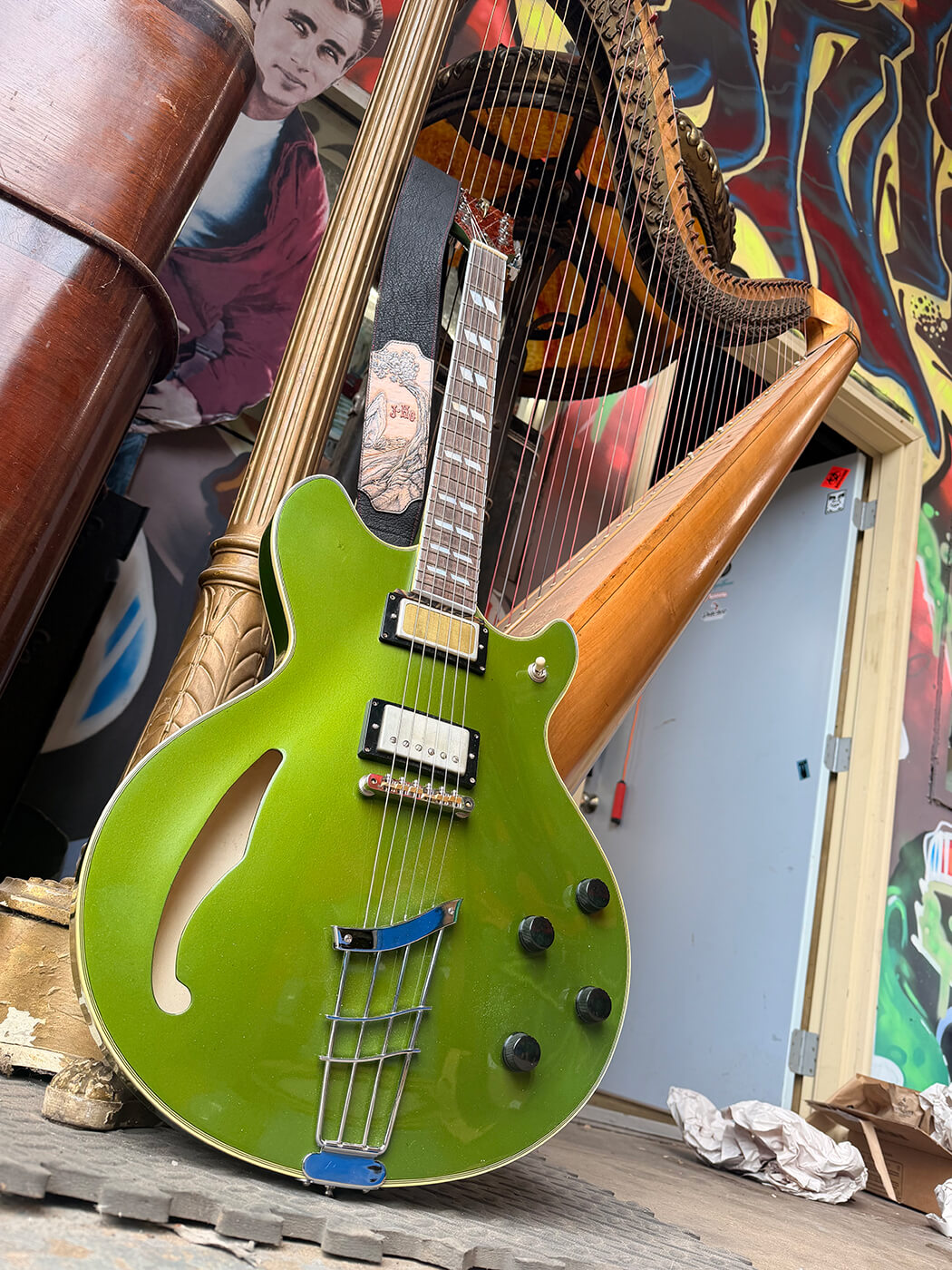
The physical dimensions of Josh Homme himself played a significant role in the guitar’s design. Standing tall, Homme requires an instrument that feels substantial and comfortable in his hands. Currie describes his approach as a "Nudie approach," referring to the famed tailor Nudie Cohn, who custom-designed elaborate suits for larger-than-life country stars. This philosophy extends beyond mere aesthetics, encompassing functionality and tone tailored specifically for Homme’s stature. "It’s got to fit that dude, because he’s a big dude. He’s like a giant," Currie notes, drawing a contrast with the smaller statures of pioneering guitar designers like Les Paul and Leo Fender, whose instruments set many of the industry’s standard dimensions.
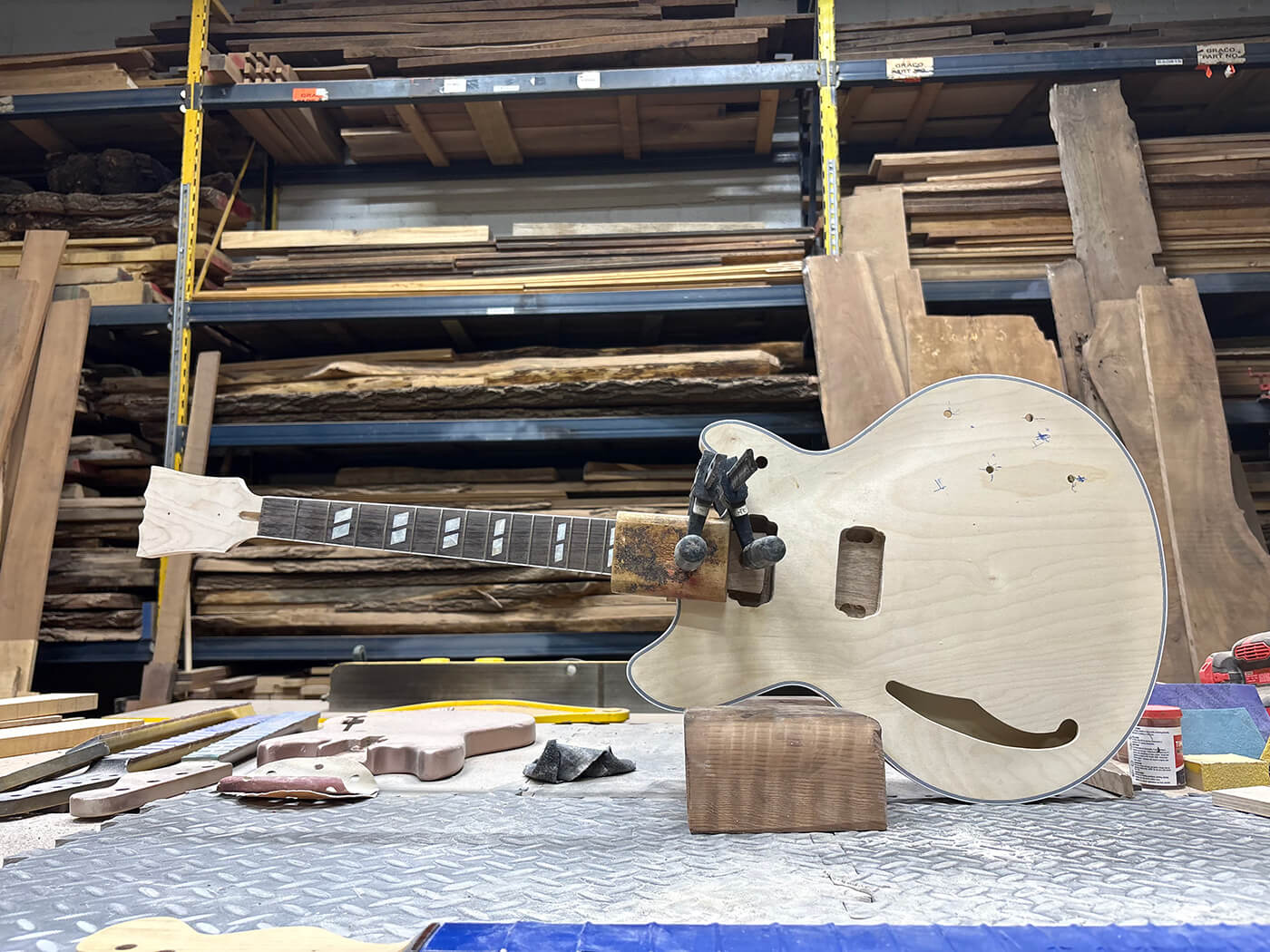
The construction of Homme’s signature Echopark is a masterclass in resonant design. It features a maple body paired with a mahogany center block, and a maple neck topped with a rosewood fretboard. Currie’s personal affinity for the Gibson ES-330, a fully hollow design known for its vocal qualities but prone to feedback on loud stages, influenced his choice to incorporate a center block. However, unlike the dense blocks found in ES-335s which can temper high-end frequencies, Currie opted for mahogany for its specific tonal characteristics. This choice allows the guitar to achieve the desired sustain and feedback resistance necessary for Homme’s powerful stage presence, while retaining an open, articulate midrange. Despite its robust construction, the instrument remains remarkably lightweight, consistently landing just under eight pounds, ensuring player comfort during extended performances.
Visually, the guitar makes a bold statement with a large headstock, which Homme specifically requested to have "a bat kind of look." This distinctive aesthetic, first conceived for the "first Crow" model, has been carried over to the signature instrument. Functionally, the oversized headstock contributes to the guitar’s overall resonance, adding sympathetic vibrations between the nut and the tuners. The 24 3/4-inch scale length, a classic Gibson dimension, was chosen not only for its familiar playability but also for its contributions to improved intonation and a tighter, more focused low end, crucial for Homme’s heavy, downtuned riffs.
The 313 Pickups and the Out-of-Phase Conundrum: Engineering Sonic Consistency
At the heart of the Homme signature guitar’s unique voice lies the Echopark 313 pickup set, a collaboration between Currie and Todd Dozier of Michigan’s Greenville Pickups. This innovative configuration pairs a 1959-spec PAF humbucker in the bridge position with a single-coil Gold Coil pickup in the neck. The Gold Coil further enhances versatility with an additional section of wire, enabling a coil tap function. A defining feature of this setup is the middle pickup position, which incorporates an out-of-phase setting.
Traditionally, out-of-phase settings on guitars, while offering distinct tonal options, often suffer from a noticeable drop in volume and a thinner sound compared to in-phase positions. This inconsistency forces players to adjust their amplifiers or pedals mid-performance, disrupting their flow. Currie and Dozier dedicated significant effort to overcome this common trade-off. Through meticulous experimentation with magnets and wiring configurations, they engineered the 313 set to ensure that every pickup position, including the out-of-phase setting, delivers a consistent output level. This groundbreaking achievement means Homme can seamlessly switch between tones without any discernible volume drops, maintaining a consistent sonic presence across all settings. "I was trying to get past all that shit and just make the thing fucking work exactly like he needs it to work every night," Currie stated, highlighting the practical, performance-driven nature of this innovation. The Echopark 313 pickups are also available separately on the Echopark website, offering other musicians the opportunity to experience this advanced tonal engineering.
The Trapeze Tailpiece: Resonance, Sustain, and Vintage Flair
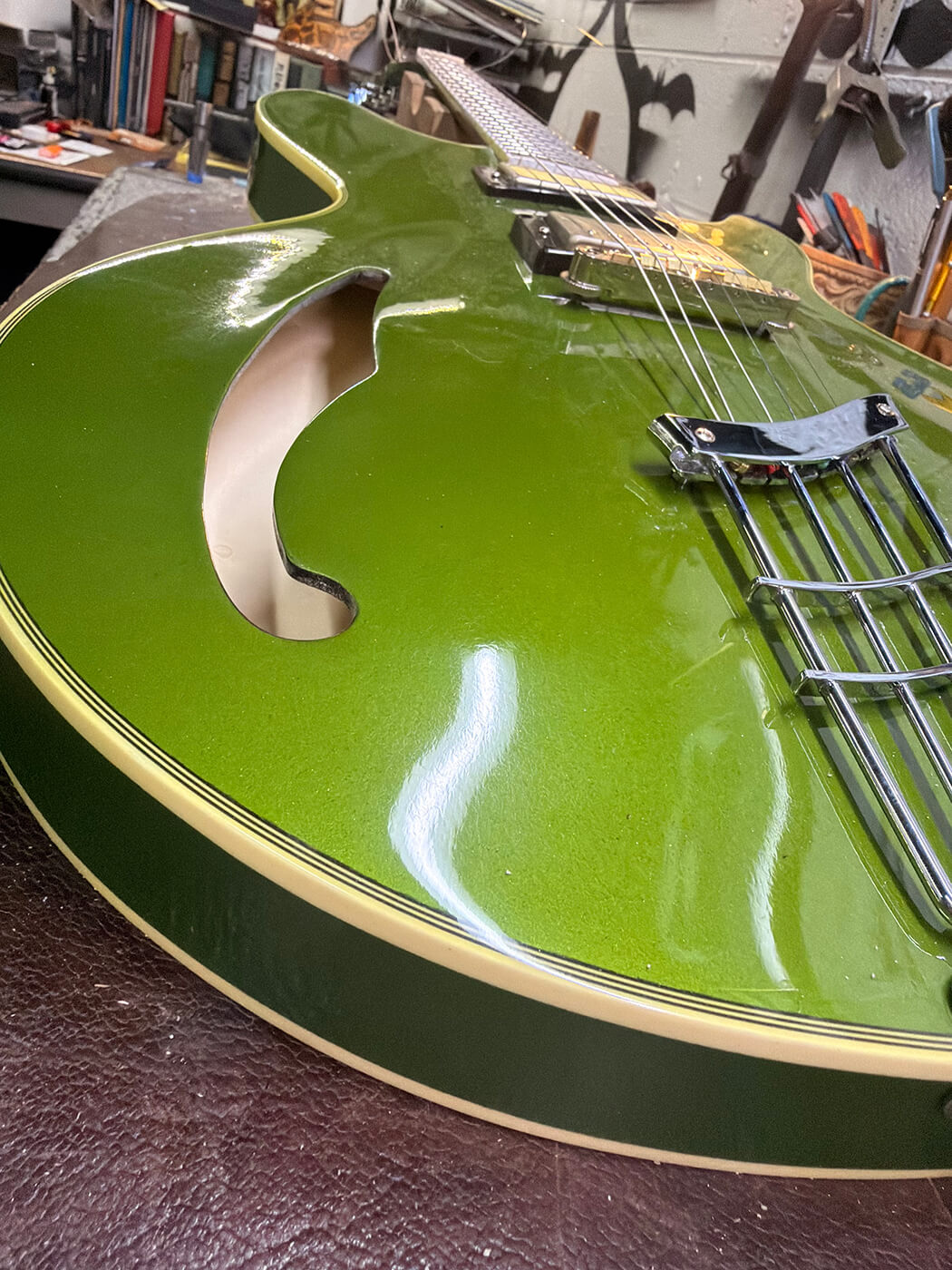
Further enhancing the guitar’s unique sonic profile is the brass harp trapeze tailpiece, a distinct departure from the more common stop bar tailpiece. Currie drew inspiration for this design element from the Epiphone Casino, an instrument Homme frequently utilizes. The trapeze tailpiece creates an extended string length behind the bridge, which actively contributes to the guitar’s overall resonance by allowing sympathetic vibrations. Currie notes that by carefully tuning this extra string length, players can even achieve proper thirds and fourths, adding an intriguing harmonic dimension to the instrument. This resonant quality is further amplified by the oversized headstock, which also contributes to the sympathetic ringing between the nut and the tuners. Homme’s preference for heavier gauge strings, typically 11s, further maximizes this resonant potential.
The choice of brass for the tailpiece was deliberate. Currie expressed a clear preference for brass over aluminum, citing brass’s superior resonant properties compared to steel. Given the scarcity of original brass harp tailpieces, often found on vintage Hofner instruments, Currie went to great lengths to ensure authenticity and quality. He meticulously tracked down the original manufacturer in Germany and commissioned a special batch of these intricate components to be reproduced specifically for this limited signature run, underscoring the commitment to historical accuracy and superior material choice.
Josh Homme’s Sonic Palette and the "Perfecth" Era
Josh Homme’s guitar tone is instantly recognizable: a thick, driving midrange, often heavily fuzzed, yet with remarkable clarity that cuts through Queens of the Stone Age’s dense sonic tapestry. Currie’s mission was to capture and enhance this "real midrange and honky elements" that allow Homme’s guitar to punch through the band’s stacked arrangements. The signature Echopark guitar, with its unique semi-hollow construction, specific wood choices, and meticulously engineered pickups, is designed to be the ultimate vehicle for this distinctive sound.
The significance of this instrument extends beyond its technical prowess; it is already integral to Homme’s current artistic output. The guitar can be heard prominently across Queens of the Stone Age’s highly anticipated new record, Perfecth, which is implied to be released prior to the guitar’s availability in January 2027. Furthermore, fans will have the opportunity to witness the guitar in action live as the band embarks on a tour in the spring of 2027. This immediate integration into Homme’s professional arsenal validates the instrument’s design and its ability to meet the rigorous demands of studio recording and live performance at the highest level.
Exclusivity and the Future of Signature Instruments
Gabriel Currie harbors a candid view on the landscape of most signature guitars, stating, "Let’s just say that they’re a little less than what I would want to have." This sentiment highlights his commitment to creating instruments that are genuine extensions of an artist’s vision, rather than mere branding exercises. The Josh Homme signature model, in Currie’s estimation, represents a significant improvement even on the custom instruments he had previously built for Homme, demonstrating a continuous evolution in their collaborative pursuit of sonic perfection. Currie himself remains somewhat awestruck by the trust placed in him: "That they do entrust me with their signature is pretty amazing."
The extremely limited production run of just 21 units for sale, coupled with a dedicated fan giveaway, positions this instrument as a highly coveted collector’s item. This scarcity enhances its intrinsic value, potentially making it a significant investment for enthusiasts and collectors. It also reinforces Echopark’s identity as a purveyor of high-end, bespoke instruments, distinguishing it sharply from manufacturers focused on mass-market accessibility. This approach champions the artistry of instrument building and the deep, personalized relationship between luthier and musician.
The availability of the Josh Homme Echopark signature guitar is scheduled for January 20, 2027, at 12:01 a.m., with details regarding the fan giveaway expected to be announced a week prior. This highly anticipated release is poised to generate considerable excitement within the guitar community and among Queens of the Stone Age fans, marking a significant moment in both bespoke instrument design and contemporary rock music. It stands as a testament to the power of a true artistic collaboration, where innovation, tradition, and personal vision converge to create an instrument as unique and compelling as the artist who wields it.
