

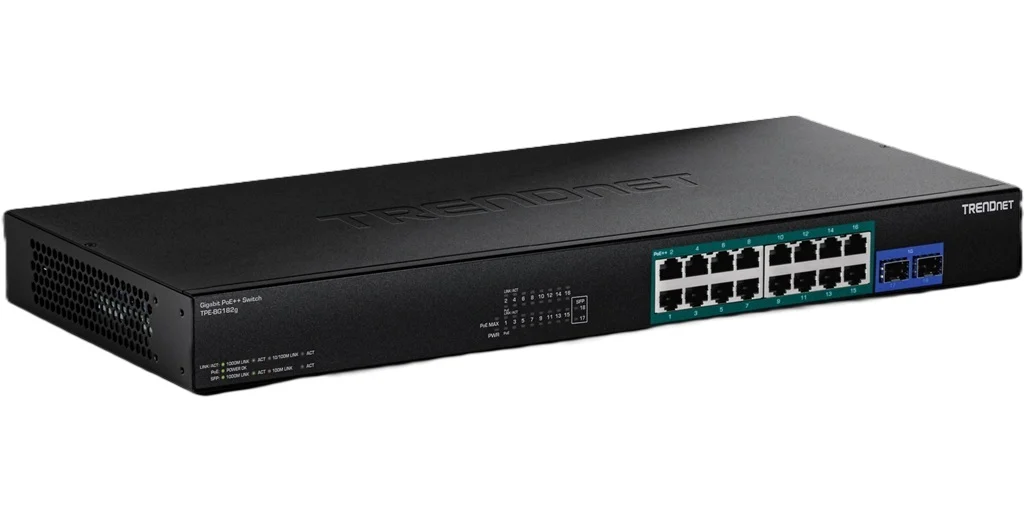
The global networking landscape is undergoing a significant transformation as the demand for high-power, high-bandwidth connectivity continues to surge in the commercial and industrial sectors. In response to these evolving requirements, Trendnet, a prominent leader in reliable SMB and enterprise networking solutions, has officially announced the expansion of its high-performance hardware portfolio with the introduction of the TPE-BG182g. This 18-port Gigabit PoE++ switch represents a strategic advancement for the company, designed specifically to bridge the gap between standard power-over-Ethernet capabilities and the intensive energy demands of modern networked devices. By integrating the latest IEEE 802.3bt standards with robust switching architecture, the TPE-BG182g aims to provide a future-proof foundation for smart buildings, advanced surveillance systems, and next-generation wireless deployments.
Technical Specifications and Architecture of the TPE-BG182g
At the core of the TPE-BG182g is a high-density port configuration designed for maximum flexibility and throughput. The unit features 16 specialized Gigabit PoE++ ports, complemented by two dedicated Gigabit SFP (Small Form-factor Pluggable) slots. These SFP slots are critical for professional environments, as they allow for high-speed fiber optic uplinks over long distances, effectively eliminating the distance limitations inherent in traditional copper cabling. This dual-media approach ensures that the switch can serve as a central distribution point within a larger corporate network or as an edge device in remote facility wings.
The most striking feature of the TPE-BG182g is its power delivery capability. Adhering to the IEEE 802.3bt standard, often referred to as Ultra PoE or PoE++, the switch is capable of delivering up to 95 watts of power per individual port. To support this high output across multiple devices, Trendnet has equipped the device with a substantial total power budget of 440 watts. This level of power density is a significant leap forward from the previous 802.3at (PoE+) standard, which capped power at 30 watts. The ability to push nearly 100 watts through a single RJ45 connection opens the door for a new class of "power-hungry" devices that previously required dedicated electrical outlets and AC adapters.
Performance-wise, the TPE-BG182g is built to handle heavy data traffic without bottlenecks. It boasts a total switching capacity of 36 Gbps, ensuring that even when all 18 ports are operating at full duplex, the backplane can process the data flow with minimal latency. Furthermore, the inclusion of Jumbo Frame support—up to 9 KB—is a vital addition for specialized applications. In environments where large files are frequently moved, such as high-resolution video editing suites or medical imaging departments, Jumbo Frames reduce the overhead on the network by allowing larger data packets to be sent at once, thereby increasing overall efficiency and reducing CPU utilization on connected servers.
The Evolution of PoE Standards and Market Context
The launch of the TPE-BG182g arrives at a pivotal moment in the timeline of Ethernet technology. For decades, Power over Ethernet has been the silent engine behind VoIP phones and basic security cameras. However, the rise of the Internet of Things (IoT) and the "Smart Building" movement has fundamentally altered the power requirements of the edge. We are no longer looking at simple sensors; modern facilities utilize high-performance Pan-Tilt-Zoom (PTZ) cameras with integrated heaters and blowers for extreme climates, large-format digital signage displays, and sophisticated Wi-Fi 6E and Wi-Fi 7 access points that require more than 30 watts to operate their multi-radio arrays.
By supporting the 802.3bt standard, Trendnet is positioning itself to capture the growing market of system integrators who are tasked with reducing installation costs. Traditionally, deploying a high-power device meant hiring an electrician to run high-voltage lines alongside the data cables. With a 95-watt-per-port switch, the TPE-BG182g allows for a "one-cable" installation strategy. This not only lowers the Total Cost of Ownership (TCO) but also provides centralized power management. In the event of a system hang or a scheduled maintenance window, administrators can cycle the power to a specific device via the switch interface, rather than manually unplugging a power brick in a hard-to-reach location.
Fast PoE and Operational Continuity
One of the standout software-driven features of the TPE-BG182g is the "Fast PoE" functionality. In standard managed or unmanaged switches, there is typically a delay between the moment the switch is powered on and the moment it begins delivering power to its downstream devices. This delay occurs because the switch must first boot its internal operating system and complete its POST (Power-On Self-Test) sequences. In time-critical environments, such as a security operations center or a retail floor during a power fluctuation, these few minutes of downtime can be costly.
Trendnet’s Fast PoE technology bypasses this traditional sequence by prioritizing the power delivery circuit. As soon as the switch receives power, it immediately begins supplying electricity to the connected PoE devices, even as the switch’s internal management software continues to load in the background. This ensures that security cameras and critical access points are online and recording or transmitting as quickly as possible. For IT managers, this feature provides peace of mind during emergency reboots or after power outages, ensuring that the most vulnerable parts of the network infrastructure are the first to recover.
Hardware Design and Thermal Management
The physical construction of the TPE-BG182g reflects Trendnet’s commitment to industrial-grade durability. The switch is housed in a robust, 1U 19-inch metal enclosure, making it compatible with all standard server racks and cabinets. This form factor is essential for clean cable management and integration into existing data centers. Because the device manages a significant amount of power (up to 440W), thermal management is a primary engineering concern.
To address this, Trendnet has implemented an intelligent fan control system. These smart fans adjust their speed dynamically based on the internal temperature and the current power load. This approach strikes a balance between keeping the internal components cool to extend their lifespan and minimizing acoustic noise in environments where the rack may be located near office personnel. Additionally, the front panel is equipped with comprehensive LED status indicators, providing at-a-glance information on port link status, speed, and PoE activity. This tactile feedback is invaluable for technicians performing on-site troubleshooting.
Integration and Network Versatility
Beyond raw power and speed, the TPE-BG182g offers features that simplify its integration into complex, multi-layered networks. A key inclusion is VLAN (Virtual Local Area Network) Passthrough. While the TPE-BG182g is designed for streamlined operation, the ability to pass VLAN tags is crucial for maintaining network security and segmentation. In a typical corporate environment, voice traffic, surveillance data, and general internet traffic are separated into different VLANs to prevent interference and enhance security. The TPE-BG182g can sit within these segments and ensure that data packets reach their intended destinations with their security tags intact.

The switch also supports a wide range of Ethernet standards, including IEEE 802.3, 802.3u, 802.3ab, 802.3z, 802.3x, and the aforementioned 802.3af/at/bt. This broad compatibility ensures that the switch can coexist with legacy hardware while still providing the necessary overhead for future upgrades. Whether a business is connecting a ten-year-old IP phone or a brand-new 4K digital signage player, the TPE-BG182g negotiates the appropriate power and data speed automatically.
Economic Implications and Availability
Trendnet has positioned the TPE-BG182g at a competitive price point of €489.99. When analyzed against the cost of purchasing individual PoE injectors or hiring electrical contractors to install power outlets at every device location, the switch offers a clear economic advantage. It is aimed at the mid-market segment—businesses that need enterprise-level features and reliability without the prohibitive costs often associated with tier-one networking giants.
The release of this switch is part of a broader trend where high-capacity networking is becoming democratized. Small to medium enterprises (SMEs) can now deploy the same level of technology used in massive smart-city projects or large-scale industrial warehouses. As of April 12, 2026, the TPE-BG182g is available through Trendnet’s global network of authorized distributors, resellers, and online retailers.
Impact on the Future of Networked Environments
The implications of widespread PoE++ adoption, spearheaded by devices like the TPE-BG182g, extend into the very design of modern architecture. We are moving toward a "DC-powered" building model where the traditional AC wall outlet becomes less relevant for low-to-medium power electronics. Architects and developers are increasingly looking at Ethernet as the universal delivery mechanism for both data and power.
In the retail sector, for instance, the TPE-BG182g can power an entire suite of interactive kiosks and point-of-sale systems from a single rack. In healthcare, it can support the high-speed data needs of diagnostic tools while ensuring they remain powered during critical procedures. The reliability of the 19-inch metal chassis and the efficiency of the 440W budget make this switch a cornerstone for these types of "mission-critical" deployments.
As Trendnet continues to innovate, the TPE-BG182g serves as a benchmark for what professional networking hardware should provide: a blend of high-output power, reliable data throughput, and intelligent features that address the real-world challenges of network administrators. With the digital landscape only becoming more complex, the TPE-BG182g offers a stable, high-performance solution for the infrastructure needs of today and the technological demands of tomorrow.
