

The technical landscape of modern musical theater is undergoing a radical transformation, moving away from traditional analog signal chains toward high-resolution digital environments that prioritize transparency and spatial immersion. At the forefront of this evolution is the Dutch production "Soldaat van Oranje" (Soldier of Orange), a theatrical tour de force that has redefined the boundaries of sound design in a live environment. Staged in the unique TheaterHangaar in Katwijk, a converted aircraft hangar, the production utilizes a revolutionary 360-degree rotating auditorium, presenting a formidable challenge for the audio engineering team. Lead sound designer Jeroen ten Brinke, alongside Jos Diergaarde and Chiel Blaauw, has implemented a system that eschews traditional outboard hardware in favor of a sophisticated digital workflow, leveraging 96 kHz / 24-bit processing to achieve studio-quality audio in a massive, unconventional space.
Digital Integration and the Minimalist Front of House
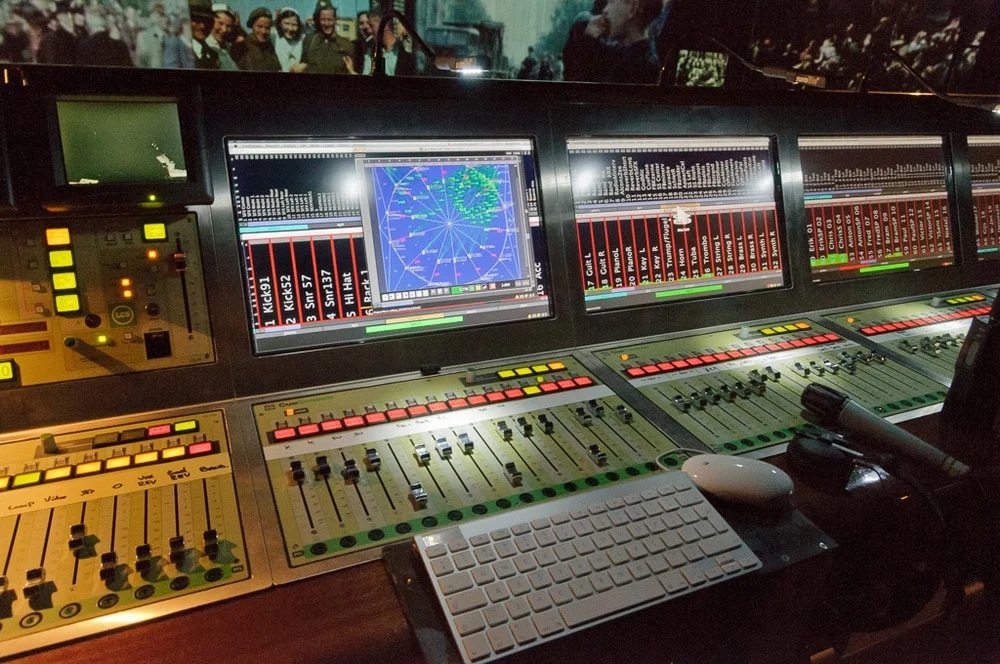
The Front of House (FOH) position at "Soldaat van Oranje" is strikingly sparse, a testament to the power of modern digital signal processing. Aside from the primary mixing console and a standard intercom system, there is virtually no external outboard equipment. This streamlined approach is made possible by the integration of an AES unit with comprehensive input and output capabilities, which originally included a VST connection for external plug-ins. However, ten Brinke notes that the inherent quality of the 96 kHz / 24-bit signal path proved so high that external processors became largely redundant. The console’s internal architecture provides all necessary standard functions, including 10-band parametric EQs, noise gates, compressor/expanders, and limiters on every input, aux, bus, and master channel.
The primary exception to this internal processing is the management of reverberation. To create a realistic sense of space within the acoustically challenging hangar, the team utilizes Altiverb, a convolution reverb known for its high-fidelity room modeling. This is managed through four specific sends: wireless microphones, two separate band groups, and sound effects. To handle the complexity of the 14-output line-array system, the team collaborated with Audio Ease to develop a custom interface. This interface allows the engineers to manage four groups, each addressing seven stereo reverbs. To ensure seamless transitions between scenes and programs, an additional 28 reverbs are utilized for cross-fading, preventing any audible muting or "clicks" during program changes. In total, the production runs 56 simultaneous instances of Altiverb, a staggering number for a live theatrical performance.
Immersive Spatial Mixing and the Rotating Stage
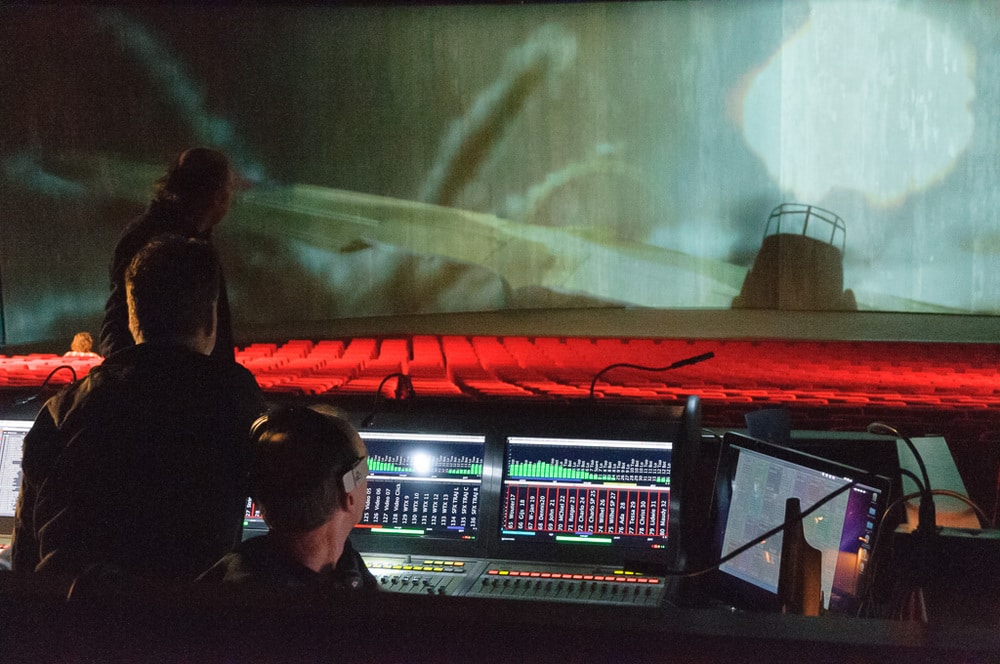
One of the most distinctive features of "Soldaat van Oranje" is the "SceneAround" technology, where the audience sits on a massive turntable that rotates to face different sets arranged in a circle. This physical movement necessitates a highly dynamic approach to sound localization. The band mix is treated with extreme spatiality, designed to cover a full 180-degree field. To achieve this, the team established seven auxiliary sends, allowing them to adjust the "width" of the band mix per cue. These positions are designated as LLL, LL, L, Center, R, RR, and RRR.
This spatial strategy is further augmented by a dedicated computer running Steinberg’s Nuendo software, which handles multi-channel sound effects specifically synchronized with the rotation of the stage. The development of this soundscape was an iterative process; the team initially started with over 500 tracks, many of which were discarded as the production was refined. Nuendo proved to be an essential tool for real-time editing, allowing the audio team to adjust soundscapes even as the film projections and stage movements were being finalized during the rehearsal phase.
Overcoming Environmental and Physical Challenges
The path to a stable production was fraught with technical hurdles, particularly regarding the interaction between the performers and the physical environment. "Soldaat van Oranje" is a physically demanding show, featuring intense coastal scenes and simulated rainfall that leave the actors drenched. Initial attempts to waterproof the Sennheiser wireless transmitters proved unsuccessful, as the protective packaging was too cumbersome for the actors’ movements.
The solution was a logistical masterclass in backstage coordination. During scenes where the cast must submerge in water, they are met off-stage by a crew that rapidly removes their body packs. For the dialogue that must continue during these wet sequences, the team transitioned to stationary microphones. These include a microphone at the pier leading into the water—protected by a small "umbrella" shield—and additional microphones hidden within beach obstacles like tank traps. This hybrid approach ensures that the narrative remains intelligible even when the primary wireless systems are sidelined by environmental conditions.
Technical Specifications and the Pursuit of Transparency
The exceptional audio quality noted by audiences and critics alike—often compared to a studio recording—is the result of a meticulously curated signal chain. The vocal clarity is achieved through the use of Sennheiser Earset 1, MKE 1, and MKE 2 microphones. These signals are processed with a focus on naturalism, avoiding the "over-compressed" sound common in many large-scale musicals.
The output side of the chain is equally critical. The production employs Alcons Audio loudspeaker systems, which utilize pro-ribbon driver technology. Jeroen ten Brinke attributes the transparency of the sound to this specific combination of high-end microphones, sophisticated A/D and D/A converters, and the clean, high-frequency response of the ribbon drivers. This setup allows for a highly analytical sound system that remains stable even during complex choral passages. While professionals might notice subtle acoustic shifts as the audience moves relative to the speakers, the general public experiences a seamless, immersive environment where the technology becomes invisible.
Redundancy and Emergency Protocols
In a production of this scale, technical failure is not an option. The team has implemented several layers of redundancy. Beyond a warehouse-like supply of spare hardware and "boxes of parts," the primary fail-safe for the mixing console is an iPad connected via a dedicated WLAN. The iPad interface is simplified, displaying 16 VCAs and a "Next" button. This allows the engineer to maintain basic control over the show’s levels and cues from anywhere in the theater should the main console experience a localized failure. As ten Brinke puts it, the goal is to ensure the show can always continue, preventing the need to send the audience home due to technical difficulties.
Historical Context and Artistic Impact
"Soldaat van Oranje" is not a typical musical. Based on the life of Erik Hazelhoff Roelfzema, a legendary Dutch resistance fighter and RAF pilot during World War II, the story carries significant emotional weight for the Dutch people. The production avoids the superficial "show-business" tropes often associated with the genre, opting instead for a gritty, realistic portrayal of the Nazi occupation of the Netherlands.
The intensity of the production is amplified by its technical ambition. One of the most striking scenes involves the "Saint Cerque," a merchant ship. As the stage rotates and the background reveals a burning harbor city, the combination of spatial audio, wave machines, and realistic sound effects creates a visceral experience. Ten Brinke highlights the "split-screen" scenes as a personal favorite, where the choir’s sound remains fixed to their physical location while the stage rotates and a new scene begins from a different direction. This creates a cinematic effect in a live space, something ten Brinke notes he has never seen—or heard—in his extensive career in musical theater.
Broader Implications for the Theater Industry
The success of "Soldaat van Oranje" has significant implications for the future of live performance. Since its premiere in 2010, the show has become the longest-running production in Dutch history, seen by millions of spectators. Its success proves that audiences are willing to engage with complex, historically significant material when it is presented with high production values and innovative technology.
The technical innovations developed for this show—particularly the use of massive convolution reverb arrays and 360-degree spatial mixing—are already influencing other large-scale productions worldwide. There have been ongoing discussions regarding exporting the production to international markets, including London and the United States, which would require adapting the "SceneAround" technology to new environments.
Ultimately, the audio production of "Soldaat van Oranje" serves as a benchmark for the industry. It demonstrates that by embracing high-resolution digital workflows and focusing on the transparency of the signal chain, sound designers can create an emotional intensity that rivals the visual spectacle. In Katwijk, the technology does not just support the story; it transports the audience into the heart of the Dutch resistance, making the heavy swells of the North Sea and the biting smoke of a burning harbor feel remarkably, and sometimes uncomfortably, real.
