

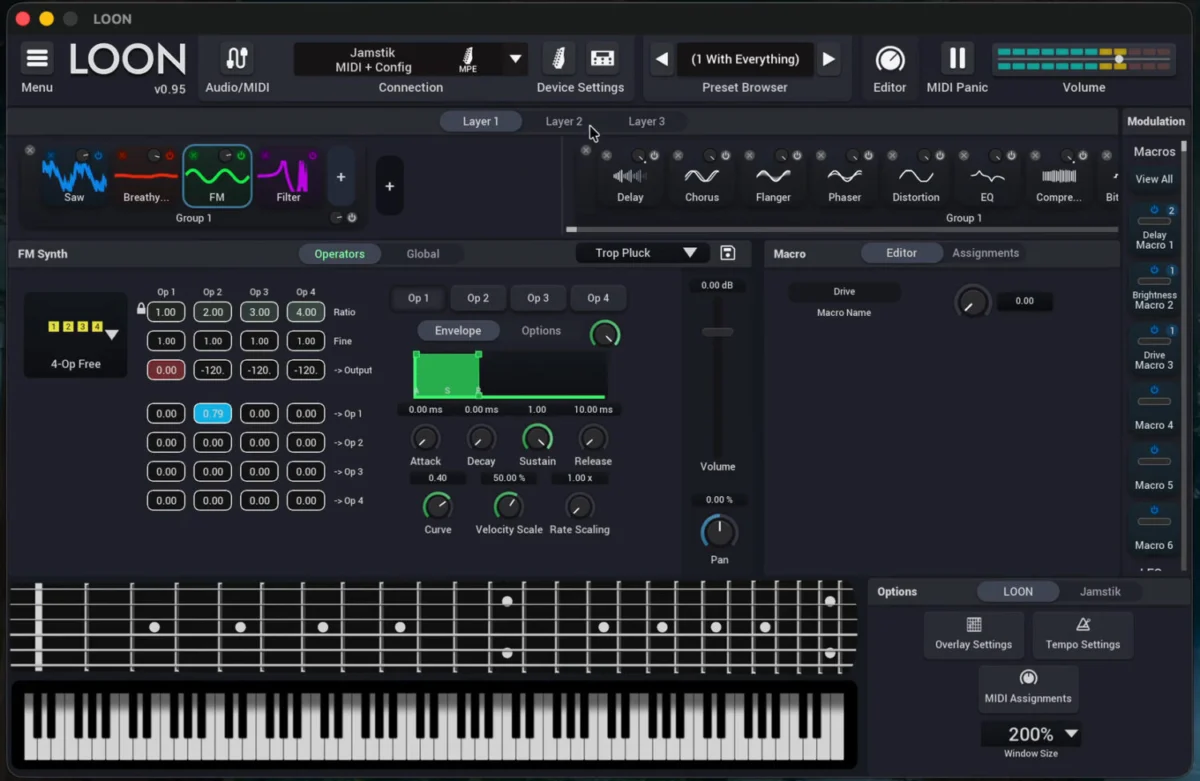
Jamstik, a developer renowned for bridging the gap between traditional stringed instruments and digital music production, has officially expanded its software ecosystem with the release of LOON. This new software instrument represents a significant step for the company, moving beyond dedicated hardware utilities into the realm of high-performance sound design. LOON is engineered as a versatile, three-layer hybrid synthesizer that integrates multiple synthesis methods—including subtractive, frequency modulation (FM), and sample-based synthesis—into a unified workflow. Designed to cater to both traditional keyboardists and the growing community of MIDI Polyphonic Expression (MPE) users, the instrument aims to provide a streamlined yet powerful environment for contemporary music production.
The architecture of LOON is centered on a tri-layered engine, where each of the three independent layers functions as a complete instrument in its own right. This design allows users to stack complex textures, such as a rich analog-style bass, a transient-heavy sampled attack, and a shimmering FM pad, all within a single preset. By providing independent control over instrument groups and effects chains for each layer, Jamstik offers a level of sonic density typically reserved for complex multi-instrument racks in a Digital Audio Workstation (DAW), but contained here within a single, optimized interface.
Technical Architecture and Sound Generation
At the core of LOON’s capabilities is its hybrid synthesis engine. Each of the three layers can be populated with different sound sources, allowing for a diverse palette of tones. The inclusion of traditional oscillators provides the foundation for classic subtractive synthesis, capable of producing the warmth and grit associated with vintage hardware. These oscillators are complemented by a robust FM synthesis module, which allows for the creation of complex, metallic, and percussive timbres that are difficult to achieve through subtractive methods alone.
To ground these synthetic textures in realism, Jamstik has integrated a sampled instrument engine. This allows users to trigger high-quality digital recordings of acoustic instruments or unique found sounds, which can then be processed through the synthesizer’s internal filters and modulators. The synergy between these three methods—oscillators, FM, and samples—enables a "best of all worlds" approach to sound design. For example, a producer can use a sampled grand piano for the initial hammer strike (the "transient"), an FM operator to add a metallic "bell-like" resonance to the body of the note, and a sawtooth oscillator to provide a sub-harmonic foundation.
Beyond the sound sources, each layer features its own dedicated effects chain. This modularity ensures that processing applied to a lead sound in Layer A does not interfere with the clarity of a bass sound in Layer B. The effects suite includes standard production essentials such as reverbs, delays, distortions, and modulation effects, all of which are integrated directly into the layer-based workflow.
Advanced Modulation and MPE Implementation
One of the defining features of LOON is its comprehensive support for MIDI Polyphonic Expression (MPE). As the music industry moves toward more expressive digital instruments, MPE has emerged as a vital standard, allowing for per-note control over parameters such as pitch bend, pressure (aftertouch), and timbre (brightness). While traditional MIDI controllers apply changes to all notes currently being held, MPE-enabled controllers—like the Jamstik MIDI Guitar or high-end MPE keyboards—allow each finger to act independently.
LOON is built to take full advantage of this multidimensional control. Users can map specific gestures to various synthesizer parameters, enabling a level of nuance that mimics the behavior of acoustic instruments. For instance, a user could apply a vibrato effect to only one note in a chord while keeping the others steady, or gradually increase the filter cutoff of a single sustained note while others remain dark. This focus on "performance-grade" software reflects Jamstik’s history as a hardware manufacturer focused on guitarists, who naturally expect a high degree of tactile expression.
To manage this complexity, LOON introduces a macro control system. These macros allow users to assign multiple parameters across different layers to a single performance control. By turning one knob, a user could simultaneously increase the distortion on Layer 1, shorten the decay of a filter envelope on Layer 2, and increase the wetness of a reverb on Layer 3. This makes the instrument highly viable for live performance, where rapid, dramatic shifts in sound are often required without the need for deep menu diving.
Chronology of Development and Context
The launch of LOON marks a pivotal moment in the timeline of Jamstik (developed by Zivix LLC). Based in Minneapolis, the company first gained international attention through successful crowdfunding campaigns for its portable MIDI guitar trainers. Over the last decade, Jamstik has transitioned from producing educational tools to professional-grade instruments, most notably with the release of the Jamstik Studio MIDI Guitar.

The development of LOON appears to be a response to the need for software that is natively optimized for the high-bandwidth data produced by MIDI guitars. While many third-party synthesizers support MPE, they often require complex configuration to work seamlessly with guitar-to-MIDI converters. By developing LOON in-house, Jamstik has created a "plug-and-play" experience for its hardware users while simultaneously offering a competitive standalone product for the broader VST market.
The timeline of LOON’s release follows a period of intensive beta testing and feedback from the Jamstik user community. By including over 200 factory presets, the developers have ensured that the instrument is accessible to those who prefer to browse sounds, while the depth of the modulation matrix satisfies professional sound designers.
Market Positioning and Pricing Strategy
In a market saturated with software synthesizers, Jamstik has positioned LOON as a mid-tier powerhouse with an aggressive entry-level price point. The regular retail price is set at $99.99 USD, but the company has launched the product with a promotional price of $49.99 USD. This strategy places LOON in direct competition with popular synthesizers like Xfer Records’ Serum or Vital Audio’s Vital, though LOON’s unique selling point remains its three-layer architecture and deep MPE optimization.
Furthermore, Jamstik is leveraging its hardware sales by including LOON at no additional cost with eligible Jamstik MIDI Guitar purchases. This "ecosystem" approach—similar to that employed by companies like Arturia or Native Instruments—encourages brand loyalty and provides immediate value to hardware customers. By offering the software in VST3, Audio Unit (AU), and AAX formats, as well as a standalone application for both macOS and Windows, Jamstik ensures maximum compatibility across all major recording platforms, including Ableton Live, Logic Pro, Pro Tools, and FL Studio.
Broader Implications for the Music Industry
The release of LOON highlights several ongoing trends in the digital music technology sector. First, it underscores the continued blurring of the lines between hardware and software companies. As processing power increases, hardware manufacturers are increasingly expected to provide high-quality software "companions" that unlock the full potential of their physical controllers.
Second, the emphasis on MPE in LOON suggests that expressive MIDI is no longer a niche requirement but a standard expectation for new software instruments. As more producers look for ways to make their digital compositions sound more "human" and less "programmed," instruments that offer per-note modulation become essential tools. LOON’s ability to bridge the gap between complex synthesis and intuitive, expressive playability makes it a relevant addition to the modern producer’s toolkit.
Finally, the shift toward hybrid engines—combining samples with synthesis—reflects a move away from "purist" synthesis. Modern music production often requires the organic texture of real-world sounds combined with the flexibility of digital oscillators. By housing these elements in a three-layer system, LOON provides a workflow that mirrors the way modern tracks are often layered in a DAW, but with the added benefit of global modulation and unified control.
Conclusion and Future Outlook
LOON enters the market as a robust and thoughtfully designed instrument that caters to the evolving needs of digital musicians. With its three-layer engine, extensive modulation capabilities, and native MPE support, it offers a compelling solution for those seeking a high degree of expressive control over their sounds. As Jamstik continues to update the factory library and refine the engine, LOON is poised to become a staple for both guitarists looking to explore synthesis and keyboardists seeking a fresh, multi-dimensional approach to sound design.
The availability of the instrument across all major platforms and its competitive pricing suggest that Jamstik is committed to making LOON a mainstay in the industry. Whether used as a standalone performance tool or as a plugin within a complex studio environment, LOON represents a successful fusion of Jamstik’s hardware expertise and a forward-thinking vision for software synthesis. Producers and sound designers can now access a wide array of sonic possibilities, from vintage analog emulations to futuristic, expressive textures, all contained within a single, elegantly designed interface.
