

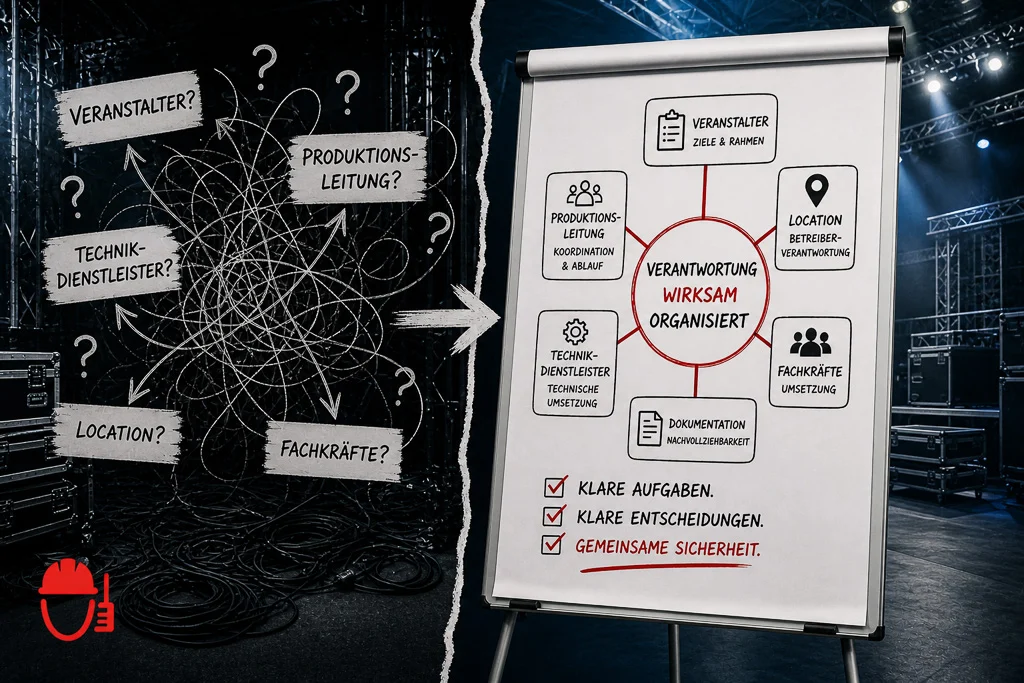
The event technology sector operates at a unique intersection of creative ambition, technical precision, and inherent physical risk. While the industry prides itself on high-level expertise and the ability to execute complex productions under immense pressure, a persistent systemic issue remains: the gap between formal responsibility and practical execution. In many modern productions, the word "responsibility" is frequently invoked but rarely organized with the necessary rigor. Despite the presence of seasoned Technical Directors, Event Managers, and specialized masters of event technology, critical situations often reveal a lack of clarity regarding who makes the final call, who executes specific tasks, and who ultimately stands accountable for the safety of the participants and the public.
The core of the problem is seldom a lack of individual competence. On the contrary, European event productions are often staffed by highly qualified professionals. However, as Ayke Bröcker, a certified Master of Event Technology, points out, responsibility frequently fails not because of personal negligence, but due to a lack of defined roles and boundaries. When roles are not cleanly delineated before the first flight case is opened, the resulting vacuum is often filled by assumptions—a dangerous foundation for high-stakes environments.
The Structural Framework of Accountability
In the practice of event technology, there is often a passive assumption that responsibilities will "sort themselves out" during the natural flow of the project. The venue operator provides the space, the promoter plans the program, the technical service provider brings the equipment, and the production manager coordinates the schedule. On paper, this appears to be a functional ecosystem. However, this decentralized approach often crumbles when subjected to the stressors of a live production environment.
The critical failure points usually manifest during "crunch time"—the hours immediately preceding the doors opening to the public. When technical glitches occur, weather patterns shift, or schedule changes are demanded at the last minute, the difference between an organized structure and a collection of active participants becomes stark. Many stakeholders do not equate to a clear chain of command. Without a pre-defined hierarchy of decision-making, the speed of action is prioritized over the safety of the process, leading to a phenomenon where everyone is busy, but no one is specifically in charge of the interface between different technical disciplines.
Regulatory Standards and the Legal Landscape
To understand why these failures occur, one must look at the regulatory landscape governing the industry. In Germany, the Model Venue Ordinance (Musterversammlungsstättenverordnung or MVStättVO) and standards such as DIN 15750 and IGVW SQO6 provide a blueprint for safety. These regulations do not merely assign blame; they focus on the organizational requirements of the venue and the event.
For instance, the MVStättVO mandates the presence of a "Verantwortlicher für Veranstaltungstechnik" (VfV) for certain event sizes and complexities. The law requires this person to be present during setup, dismantling, and the event itself to ensure technical safety. However, a common industry critique is that this role is often treated as a "checkbox" requirement rather than an empowered position. For a VfV to be effective, they must possess not only the technical knowledge required by law but also the organizational authority to halt a production if safety standards are compromised. If the VfV is hired by a service provider who is under pressure from the promoter to cut costs, a conflict of interest arises that can undermine the very safety the role was designed to protect.
The Chronology of Risk: From Planning to Execution
The erosion of responsibility typically follows a predictable timeline, beginning long before the event date.
- The Planning Phase: During initial budgeting, organizational charts are often omitted to save time. Responsibilities are assigned to companies rather than specific roles.
- The Contracting Phase: Contracts often use vague language regarding "technical management" without specifying the scope of authority or the duty to document safety checks.
- The Load-In: As multiple vendors (lighting, sound, rigging, catering) arrive simultaneously, the interfaces between them—such as the load-bearing capacity of a shared truss or the power distribution for multiple departments—become "no man’s lands."
- The Pre-Show Pressure: Last-minute creative changes are often implemented without a formal risk reassessment, as the decision-makers are often isolated from the technical staff.
- The Event: During the live show, communication chains are often optimized for show-flow rather than emergency response or technical monitoring.
This chronology demonstrates that responsibility is not a static state but a continuous process that must be maintained through every phase of a project’s lifecycle.
Identifying Typical Interface Problems
In the reality of a busy stage, uncertainties arise most frequently where different departments overlap. These "interfaces" are where the most significant risks reside. Industry professionals frequently encounter unresolved questions such as:
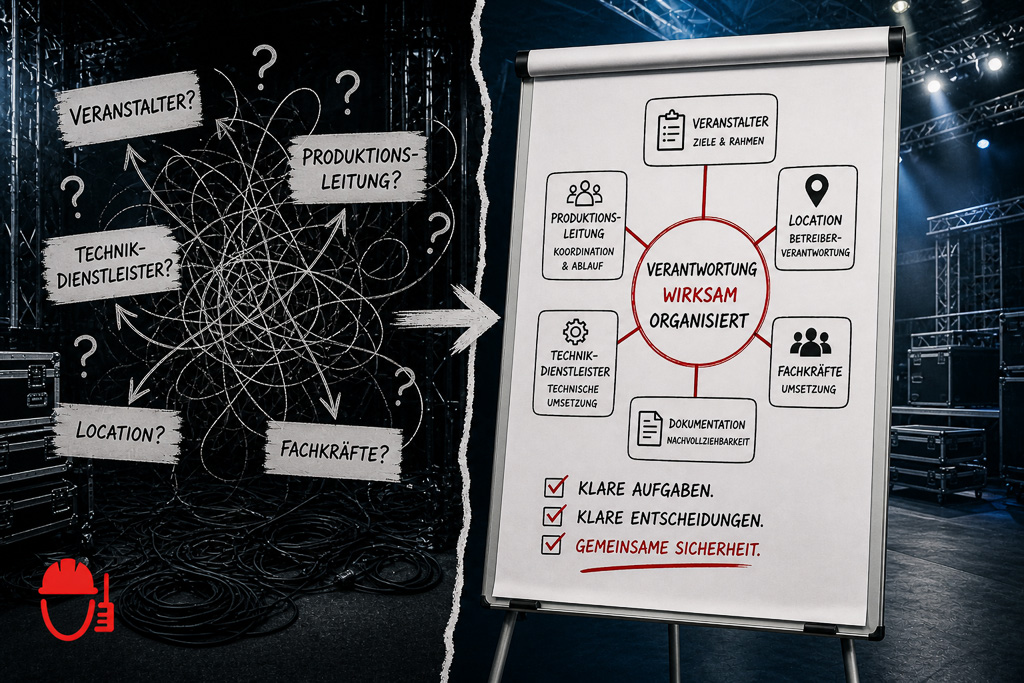
- Who is responsible for the final safety inspection of a truss structure that carries equipment from three different vendors?
- Who has the authority to clear the stage or the hall in the event of a localized technical failure?
- At what point does the responsibility of the venue operator end and that of the external technical provider begin?
- How are safety-relevant instructions from the technical director communicated to non-technical staff or external performers?
When these questions are only asked when a problem arises, it is already too late. Effective responsibility requires that these scenarios are gamed out in advance, with clear "If-Then" protocols established and documented.
The Impact of Economic Pressure and Role Blurring
The modern event industry is characterized by tightening budgets and shorter load-in windows. This economic reality creates a culture of "practical solutions," which is often a euphemism for cutting organizational corners. One of the most dangerous trends identified by experts is the blurring of roles.
In many mid-sized productions, a single individual might act as the technical service provider, the crew boss, and the legally responsible technical head. While this may be cost-effective, it creates a lack of checks and balances. A person responsible for the profit margin of a technical installation may be psychologically disinclined to demand expensive safety upgrades or delays.
Furthermore, the "freelance culture" of the industry means that teams are often assembled for a single project. Without a standardized organizational culture, these teams rely on "industry standard" assumptions, which may vary wildly between individuals. This lack of a unified organizational language is a significant contributor to systemic risk.
Industry Response and Educational Initiatives
Recognizing these gaps, industry leaders are increasingly focusing on the "soft skills" of organizational management alongside technical training. Ayke Bröcker’s upcoming involvement in LEAT Con 26 serves as a primary example of this shift. As a certified Master of Event Technology, Bröcker is advocating for a move away from the "hero culture" of event tech—where individuals "make it happen" regardless of the chaos—toward a structured, transparent organizational model.
The upcoming LEAT Con 26 will feature dedicated workshops and lectures focused on "Responsibility on Events." These sessions are designed to move beyond the theoretical and into the practical, analyzing real-world scenarios where organizational failure led to near-misses or accidents. The goal is to provide technical directors and event managers with the tools to build "resilient organizations"—structures that can withstand the pressure of a live event without sacrificing safety protocols.
Fact-Based Analysis: The Requirement for Effectiveness
For a role to be truly "responsible," it must be "effective." The industry is beginning to adopt a more rigorous definition of what an effective role looks like. It is not enough to be named on a piece of paper; a responsible person must have:
- Information Sovereignty: Access to all structural calculations, site plans, and schedule changes in real-time.
- Authority to Instruct: The recognized right to give safety-related orders to all persons on-site, including the client.
- Resources: The budget and personnel required to implement necessary safety measures.
- Documentation: A standardized method for recording decisions, approvals, and safety briefings that can serve as legal proof of due diligence.
The final point—documentation—is often the most neglected. In the event of a legal dispute, the question is not "What did you know?" but "What can you prove you did?" Transparent documentation of communication chains and decision paths is the only way to transform formal responsibility into a legally and practically sound safety net.
Conclusion: Designing Safety into the Organization
Responsibility in event technology is not a burden to be assigned to the person with the highest qualification; it is a structural element that must be designed into the event from the first day of planning. The complexity of modern productions, with their massive LED walls, kinetic lighting, and intricate pyrotechnics, has outpaced the old-fashioned "handshake" method of coordination.
The industry’s future depends on its ability to professionalize its organizational structures. This means moving toward clear organizational charts, defined interfaces, and the empowerment of technical leaders. As events become more complex and the legal environment more stringent, the organizations that thrive will be those that treat responsibility not as a large, abstract word, but as a series of clear, documented, and actionable steps. Only then can the industry ensure that when everyone is "responsible," someone is actually in charge.
