

The landscape of professional audiovisual and event technology has found a permanent home for its history at the AED Studios in Lint, near Antwerp, where the AED Group has inaugurated a dedicated museum chronicling decades of industry evolution. This initiative, spearheaded by Glenn Roggeman, CEO of the AED Group, represents a significant cultural investment in an industry that is often characterized by its rapid pace of innovation and the swift obsolescence of its hardware. The museum, which opened its doors on April 19, 2016, serves as both a repository of technical milestones and a testament to the growth of one of Europe’s most influential event technology conglomerates.
The AED Group, an international powerhouse spanning dry hire services, financial solutions, sales structures, and studio management, has transformed the former Eurocam Media Center into a multifaceted hub for the media and entertainment industry. The museum is located within the grand entrance portal of the AED Studios, a site that itself carries a complex history of ambition, financial struggle, and eventual rebirth. By situating the museum at the gateway to 17 professional film and television studios, the AED Group has created a bridge between the legacy equipment of the past and the cutting-edge production environments of the present.
The Vision of Glenn Roggeman and the Evolution of AED Group
To understand the significance of the AV museum, one must first look at the trajectory of Glenn Roggeman and the AED Group. Roggeman, an energetic and decisive figure in the industry, began his career in the mid-1980s. In 1985, while working with the Hi-Fi and Beyma distributor Eglantier, he established AED Rent. By 1986, he was already designing and manufacturing his own equipment, most notably the AED Touring Compact PA system.
Under Roggeman’s leadership, AED Group expanded from a small Belgian rental house into a global entity with a presence in multiple countries, including a significant German operation based in Montabaur. The group’s business model is unique in its vertical integration, offering not just equipment rental (Dry Hire), but also specialized financing for production companies, a used-equipment marketplace, and even a helicopter division. The acquisition of the Lint studio complex in 2013 marked a pivotal expansion into the studio and content creation sector.
The museum project was born out of Roggeman’s desire to honor the tools and the professionals who built the industry. He spent years tracking down specific pieces of equipment, scanning international sales portals, and collaborating with manufacturers and former clients to recover iconic hardware. The result is a collection that spans from 1944 to the modern era, providing a physical timeline of how sound, light, and image have been captured and projected over the last seventy years.
From Eurocam to AED Studios: A Site of Industrial Rebirth
The museum is housed within a facility that has witnessed the volatile nature of the media industry. The Lint site, located southeast of Antwerp, was originally a canning factory before being transformed into the Eurocam Media Center (Alfacam Studios) in 2005. At its peak, Alfacam was a leader in high-definition television production, but the company faced financial collapse and went into bankruptcy in 2013.
Recognizing the latent potential of the infrastructure, Glenn Roggeman and his partners took over the 17-studio complex. Since the acquisition, the site has undergone a massive renovation program. Today, AED Studios features state-of-the-art facilities, including a massive 875-square-meter water tank for underwater filming and international show rehearsals, expansive green screens, and auditoriums designed to host large audiences for live TV broadcasts and corporate events.
The creation of the museum was the final stage of this renovation. To make room for a new visitor portal and parking infrastructure, the remaining structures of the old canning factory were demolished. The new entrance now welcomes thousands of visitors who attend TV show recordings, guiding them through a hall of history before they reach the modern production floors. The presence of a decommissioned Starfighter jet at the entrance further emphasizes the site’s connection to cinematic spectacle and grand-scale engineering.
A Chronology of Innovation: Audio, Lighting, and Video
The museum’s collection is meticulously organized to highlight the technological shifts that defined different eras of event production. While the audio section was the first to be fully cataloged, the exhibition covers the full spectrum of AV technology.
The Evolution of Sound Reinforcement
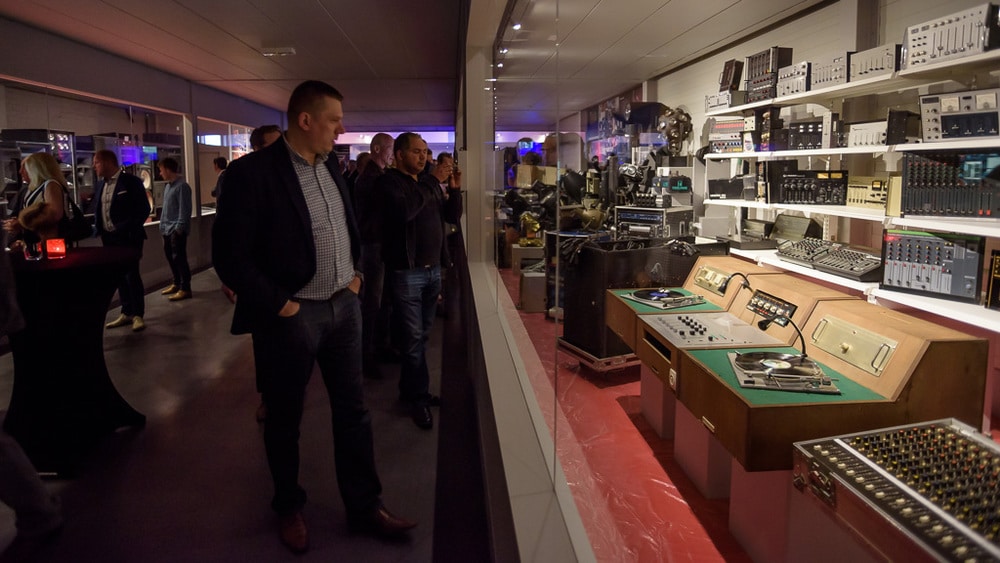
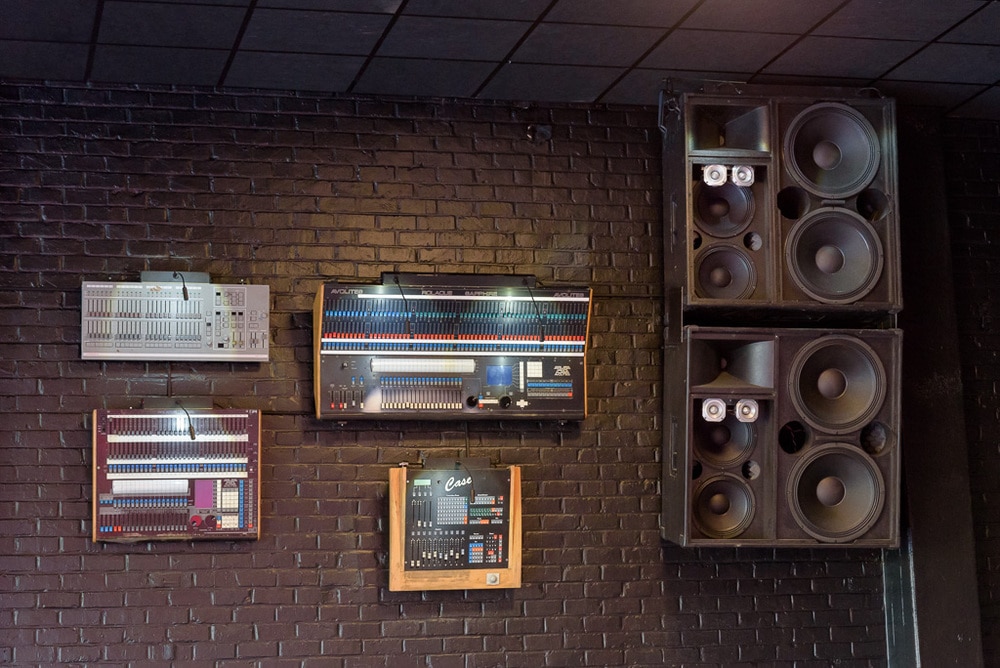
The audio collection begins with hardware dating back to 1944, showcasing the early days of public address systems. Visitors can trace the development of speaker technology from early horn-loaded designs to the high-output systems of the 1970s and 80s. A centerpiece of the audio section is the AED Touring Compact, the first system Roggeman built himself in 1986. The collection also features a vast array of historical mixing consoles, arranged along the walls of the bistro area, illustrating the transition from bulky analog boards to the early precursors of digital control.
The Dawn of Automated Lighting
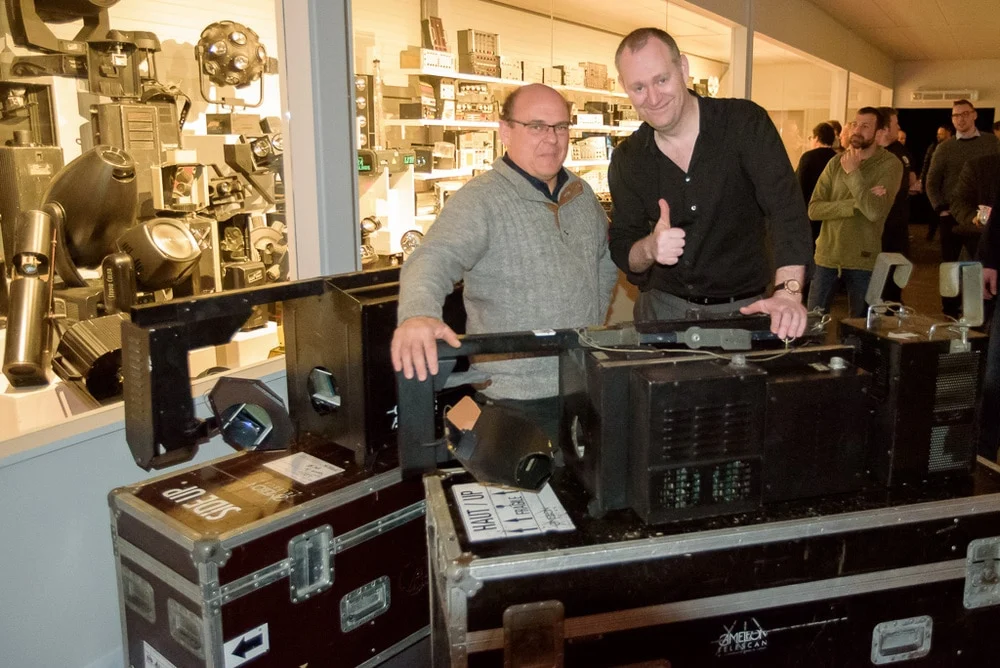
Lighting technology represents another major pillar of the museum. A highlight of the opening ceremony was the contribution of Didier Leclercq, the developer of the Cameleon Telescan. Leclercq presented Roggeman with two original Telescan units, which were among the very first moving-light systems ever developed. These units paved the way for the modern "moving head" fixtures that now dominate every major concert and event. The collection allows visitors to see the rapid progression from static PAR cans and manual follow-spots to the sophisticated, computer-controlled moving lights of the 1990s and 2000s.
Projection and Video History
The museum also houses a variety of vintage projectors and video equipment. This section highlights the shift from film-based projection to the early days of electronic and digital video display. By comparing these early devices with the massive LED walls and 4K laser projectors used in the adjacent AED Studios today, the exhibition provides a stark reminder of the exponential growth in visual fidelity and brightness over the decades.
The Challenge of Curating Industry History
Building a museum of this scale presents unique archival challenges. Unlike art museums, where the focus is often on aesthetic value, an AV museum must deal with hardware that was designed for heavy use and eventual replacement. Much of the equipment in the collection was originally viewed as a "workhorse" and was often discarded or stripped for parts once it became obsolete.
To manage the influx of data and hardware, Roggeman hired a dedicated editor to research and document the specifications and anecdotes associated with each exhibit. This research is vital for providing context; without it, a vintage mixing console is merely a collection of knobs and sliders. Through touchscreens integrated into the exhibition, visitors can access the technical "pedigree" of the items on display.
One of the ongoing challenges for the curators is defining the scope of the collection. With the global nature of the AV market, there is a risk of the museum becoming an unmanageable warehouse of used goods. The focus remains on "typical" products—those that either defined an era, introduced a new technology, or were widely adopted by the industry. While the current collection has a slight emphasis on Benelux-based brands, there is a conscious effort to fill gaps, such as the inclusion of major German manufacturers like d&b audiotechnik, to ensure a truly representative history of European event tech.
Industry Impact and the Value of Heritage
The establishment of the AED Museum comes at a time when the event technology industry is increasingly professionalized. By preserving its history, the AED Group is providing a sense of identity to a sector that has often operated in the shadows of the "talent" it supports.
Educational and Branding Value
The museum serves as an educational resource for young technicians, allowing them to see the mechanical and electronic foundations of the software-driven tools they use today. For the AED Group, the museum is also a powerful branding tool. It positions the company not just as a supplier of equipment, but as a steward of the industry’s legacy. It demonstrates a deep-seated passion for the craft, which fosters trust among long-term clients and partners.
Economic Context
The global entertainment technology market is a multi-billion-dollar industry. In Europe, the Benelux region and Germany are central hubs for innovation and logistics. The revitalization of the Lint studios and the addition of the museum contribute to the regional economy by attracting international film productions and corporate events. The presence of AED at major trade fairs, such as the upcoming LEaT con 25 in Hamburg (Stand A1-A01), further cements its role as a leader in the European market.
Conclusion: A Living Monument to Technical Achievement
The AED Museum at AED Studios is more than a collection of "old gear." It is a reflection of the human ingenuity required to create immersive experiences. As Glenn Roggeman noted during the opening, looking back at these historical products often reveals how forward-thinking many designers were, even with the limited resources of their time.
The museum stands as a reminder that every modern line array, every automated lighting rig, and every high-resolution LED screen has a lineage rooted in the experiments and engineering feats of the past. By opening this collection to the public and the industry, the AED Group has ensured that the "heroes of the backstage"—both the people and the machines—receive the respect and remembrance they deserve. As the industry continues to move toward an increasingly digital and virtual future, the physical presence of these analog and early digital milestones in Lint serves as a vital anchor to the tangible history of audiovisual excellence.
