
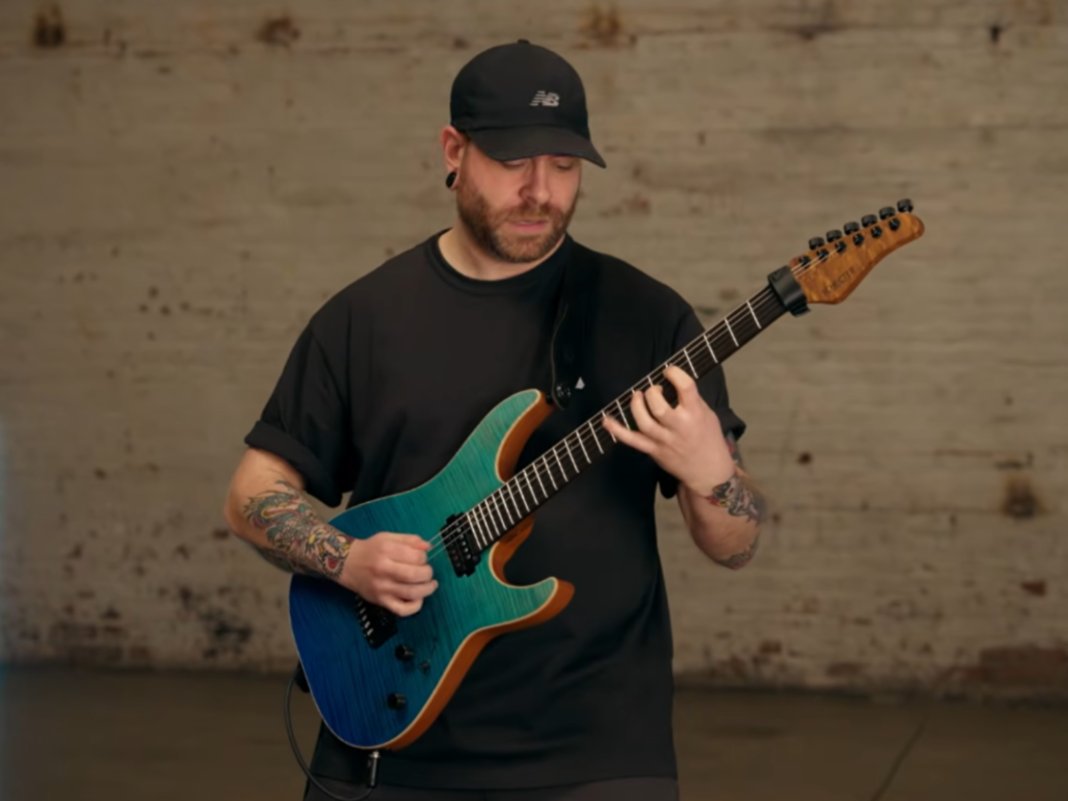
Despite now commanding the stage with his own signature Schecter guitar, renowned Intervals frontman Aaron Marshall recently offered a candid look back at the humble yet powerful setup that ignited his musical journey, asserting that his ninth-grade band rig would “still smoke most rigs these days.” In a revealing interview with D’Addario, Marshall revisited the foundational equipment and pivotal moments that shaped his early artistry, providing valuable insight into the origins of one of modern progressive metal’s most distinctive voices. This nostalgic reflection underscores a timeless truth in music: genuine passion and skill often transcend the sophistication of one’s equipment, laying the groundwork for future innovation.
The Genesis of a Guitarist: From Drums to Santana’s Spell
Marshall’s musical awakening, as he recounts, predated his direct engagement with an instrument. His initial fascination was with music itself, a common starting point for many artists who eventually find their niche. "As a kid, the first thing I fixated on or latched onto was certainly music," Marshall revealed. Interestingly, his path to guitar was indirect, initially driven by a desire for percussion. "Guitar entered the picture after hounding my parents for drums, funny enough, which did happen," he explained, painting a picture of a child intensely drawn to rhythm and sound. This early inclination towards drums suggests a deeply ingrained musicality, a feel for timing and groove that would undoubtedly influence his later guitar playing style, characterized by intricate rhythmic patterns and precise execution.
However, the definitive catalyst for his guitar-playing career arrived not in a music store, but in his living room. The acquisition of his family’s first DVD player proved to be a watershed moment. It was through this new medium that Marshall encountered Carlos Santana’s Supernatural Live concert DVD. The experience of witnessing the legendary guitarist’s performance on screen was transformative. "Watching that at home in the living room was kind of a crazy experience," Marshall recalled. The sheer spectacle and the profound impact the music had on his parents resonated deeply with the young Marshall, compelling him to pay closer attention. This moment, saturated with the vibrant energy of Santana’s iconic fusion of rock and Latin rhythms, sparked an undeniable urge to explore music firsthand.
The cultural impact of live concert DVDs during the late 1990s and early 2000s cannot be overstated. In an era before widespread high-speed internet and ubiquitous streaming platforms like YouTube, these DVDs offered an immersive, high-quality window into the world of live performance. For aspiring musicians, they were not just entertainment but educational tools, allowing for repeated viewing and detailed study of stage presence, technique, and arrangement. For Marshall, Supernatural Live was more than just a concert; it was an invitation into the creative process, a vivid demonstration of what was possible with a guitar. This exposure ultimately led his father to take him to a pawn shop, a common rite of passage for many budding musicians seeking an affordable entry point into the world of instruments. There, Marshall acquired his first acoustic guitar, a pragmatic first step to "see if you like it. See if you commit."
From Acoustic Strides to Electric Dreams: The Stratocaster Era
The journey from a pawn shop acoustic to a signature electric guitar is a narrative arc familiar to countless musicians. Marshall’s initial acoustic, as is often the case for young players, felt immense. "I could barely get my arm over it," he recounted, highlighting the physical challenges beginners often face with instruments not perfectly suited to their stature. This initial struggle, however, is often part of the commitment-building process, forging resilience and determination. After a period of dedicated practice on the acoustic, Marshall transitioned to his first electric guitar: a Stratocaster.
The Fender Stratocaster, introduced in 1954, stands as one of the most iconic and versatile electric guitars ever designed. Its ergonomic contours, three single-coil pickups, and tremolo system have made it a favorite across virtually every genre, from blues and rock to funk and metal. For a young, exploring musician like Marshall, the Stratocaster was an ideal choice, offering a broad sonic palette. "I learned everything from Blink-182 to Slipknot on that thing," he stated, illustrating the instrument’s adaptability and his eclectic early influences.
This period of musical exploration in the late 1990s and early 2000s was marked by a vibrant and diverse music scene. Blink-182 represented the accessible, catchy, and energetic pop-punk movement that dominated airwaves and captivated a generation of teenagers. Their music, characterized by power chords and memorable melodies, provided an excellent foundation for learning basic guitar techniques and song structures. On the other end of the spectrum, Slipknot, with their aggressive nu-metal sound, masked personas, and intricate rhythmic intensity, pushed the boundaries of heavy music. Learning material from both bands on the same instrument speaks volumes about Marshall’s burgeoning technical prowess and his willingness to embrace varied musical styles – a trait that would later define his work with Intervals. The Stratocaster’s ability to handle both the bright, clean tones of pop-punk and the distorted, riff-heavy aggression of metal made it an indispensable tool for his development, proving its enduring utility as a versatile workhorse.
Ninth Grade Revelation: The Quintessential Emo Band and Its Potent Rig
Not long after discovering the electric guitar, Marshall found himself immersed in the quintessential high school band experience. "It was not too long after discovering the guitar. I’d say ninth grade," he recalled. The formation of a first band is a significant milestone for any aspiring musician, marking the transition from solitary practice to collaborative creation. Marshall’s entry into this band was serendipitous, driven by the common high school scenario where talent pools are limited, and opportunities arise for those willing to commit. "I remember a friend who was a drummer who’s a couple grades ahead of me. I guess there weren’t a lot of options… and they wanted someone to come play guitar in their band, and it was like the first time anyone had given me a shot." This moment of acceptance and validation is crucial for young artists, providing the encouragement needed to pursue their passion more seriously.
The band itself, in Marshall’s words, was "your quintessential first emo band." Emo, a genre characterized by expressive, often confessional lyrics, melodic guitar riffs, and dynamic song structures, was hugely popular during the early 2000s. Bands like My Chemical Romance, Taking Back Sunday, and Dashboard Confessional defined the sound and aesthetics of the era, resonating deeply with adolescent experiences. Marshall’s involvement in such a band provided him with invaluable experience in songwriting, arrangement, and live performance, teaching him the dynamics of playing with other musicians.
It was within this context that Marshall assembled the rig he still holds in high regard today. The setup consisted of three core components: "The rig was the midnight blue made-in-Mexico Stratocaster into a [Fender] Hot Rod Deluxe with a [Boss] Metal Zone." This seemingly simple combination, Marshall insists, "That’ll still smoke most rigs these days too." His bold claim invites a closer look at the individual components and their collective power.
-
Midnight Blue Made-in-Mexico (MiM) Stratocaster: As previously discussed, the Stratocaster provided the foundational tone. The "Made-in-Mexico" designation signifies a more affordable yet highly reliable and well-built instrument. MiM Fenders have long been praised for offering excellent value, often serving as dependable workhorses for musicians at all levels. Its midnight blue finish would have given it a distinct visual appeal, embodying the cool factor often associated with electric guitars. For a young guitarist, a MiM Strat was a significant step up, offering professional features without the prohibitive cost of its American-made counterparts.
-
Fender Hot Rod Deluxe: This amplifier is a cornerstone of many guitarists’ setups, celebrated for its robust tube tone and versatility. Introduced in the mid-1990s, the Hot Rod Deluxe quickly became a ubiquitous backline amp in clubs and studios worldwide. Known for its ample clean headroom, the amp provided a solid platform for pedals, allowing Marshall to sculpt his sound with external effects. Its natural tube breakup, when pushed, also offered a rich, organic overdrive. For a ninth-grader playing in an emo band that likely demanded both clean passages and overdriven riffs, the Hot Rod Deluxe was an excellent choice, providing reliable power and classic Fender warmth.
-
Boss Metal Zone (MT-2): This pedal is arguably the most infamous and polarizing distortion pedal in guitar history. The Boss Metal Zone is renowned for its extreme gain, scooped mids, and aggressive, saturated tone. While often criticized by purists for its sometimes "fizzy" or artificial sound, the MT-2 has undeniably been instrumental in the sound of countless metal and hard rock recordings, especially for players seeking an affordable and readily available path to heavy distortion. For a young musician exploring heavier genres and aiming for a powerful, cutting sound, the Metal Zone delivered precisely that. Its powerful EQ section allowed for significant tone sculpting, enabling Marshall to dial in the aggressive, high-gain sounds necessary for progressive metal.
Marshall’s assertion that this rig could "still smoke most rigs these days" is a testament to several factors. Firstly, it highlights the raw, unadulterated power of a well-matched, albeit basic, setup. The combination of a solid guitar, a reliable tube amp, and an aggressive distortion pedal provides a direct and potent signal path. Secondly, it underscores the idea that the player, not just the gear, defines the sound. Marshall’s developing skill and musicality would have maximized the potential of this rig. Finally, it speaks to the enduring quality of classic, accessible gear. While boutique pedals and high-end amplifiers dominate the aspirational market, the foundational strength of products like the MiM Strat, Hot Rod Deluxe, and Metal Zone remains undeniable for their ability to deliver impactful sound without excessive complexity or cost. This period, from the "quintessential emo band" to a stylistic shift towards progressive metal, laid the foundation for his future endeavors. Marshall noted his band progressed into a sound akin to "Between the Buried and Me, Protest the Hero," both titans of the progressive metal scene known for their technicality and genre-bending compositions. This evolution culminated in Marshall leaving that group to form Intervals approximately 15 years ago, a pivotal decision that launched his professional career.
The Enduring Legacy of Humble Beginnings
Aaron Marshall’s journey from a pawn shop acoustic and a ninth-grade band rig to a signature Schecter guitar offers a compelling narrative about artistic development, the power of accessible equipment, and the lasting impact of formative experiences. His reflections are more than just a trip down memory lane; they carry significant implications for aspiring musicians, gear enthusiasts, and the broader music industry.
Implications for Aspiring Musicians: Marshall’s story serves as a powerful reminder that expensive, high-end gear is not a prerequisite for musical excellence or success. His initial setup – a Made-in-Mexico Stratocaster, a Fender Hot Rod Deluxe, and a Boss Metal Zone – represents an accessible and common entry point for countless guitarists. This message is crucial in an era where gear acquisition can often overshadow the importance of practice and musicality. It reinforces the idea that dedication, consistent practice, and a clear musical vision are far more valuable than the latest, most costly equipment. Marshall’s ability to achieve a sound that could "smoke most rigs" with such a basic setup highlights the enduring principle that the hands and mind behind the instrument are the ultimate arbiters of tone.
The Enduring Appeal of Classic Gear: The components of Marshall’s early rig are all iconic in their own right. The Stratocaster is a timeless design, the Hot Rod Deluxe is a staple tube amplifier, and even the often-maligned Metal Zone has a cult following and a significant place in guitar history. Marshall’s endorsement of this rig, even with his current access to state-of-the-art equipment, speaks to the lasting quality and effectiveness of these classic pieces. It suggests that certain combinations of gear possess an intrinsic sonic character that remains relevant regardless of technological advancements. This narrative often resonates with guitarists who cherish the simplicity and raw power of foundational setups.
Nostalgia and Authenticity: There is an inherent authenticity in musicians revisiting their origins. For fans, it provides a connection to the artist’s roots and a deeper understanding of their creative journey. For Marshall, it’s a moment of reflection that grounds his current achievements in his past efforts. This kind of reflection humanizes artists, reminding audiences that even those at the pinnacle of their craft started somewhere humble. It fosters a sense of shared experience with the broader musical community, many of whom likely started with similar modest setups.
The Evolution of Tone and Technique: Marshall’s transition from an emo band to a progressive metal outfit, and eventually to Intervals, demonstrates a continuous evolution in his musical taste and technical proficiency. The ability to adapt his playing and sound from Blink-182 to Slipknot, then to the complexities of Between the Buried and Me, and finally to his distinctive Intervals sound, highlights his versatility and dedication to honing his craft. While his early rig provided a solid foundation, his journey also implies an ongoing exploration of gear and techniques to match his evolving artistic vision. His current signature Schecter guitar is a testament to this evolution, representing the culmination of years of experience and refinement, built upon the lessons learned with his foundational setup.
In conclusion, Aaron Marshall’s look back at his ninth-grade band rig is more than just a nostalgic anecdote. It’s a powerful affirmation of the enduring principle that musical passion, coupled with accessible yet effective tools, can forge the path to greatness. His story underscores that while signature guitars and advanced equipment may mark the pinnacle of a musician’s career, the true essence of artistry often lies in the humble beginnings and the fundamental gear that first ignited the flame. His "midnight blue made-in-Mexico Stratocaster into a Fender Hot Rod Deluxe with a Boss Metal Zone" may have been a simple setup, but in Marshall’s skilled hands, it truly did "smoke" the competition and laid the indispensable groundwork for the innovative progressive metal maestro he is today.