

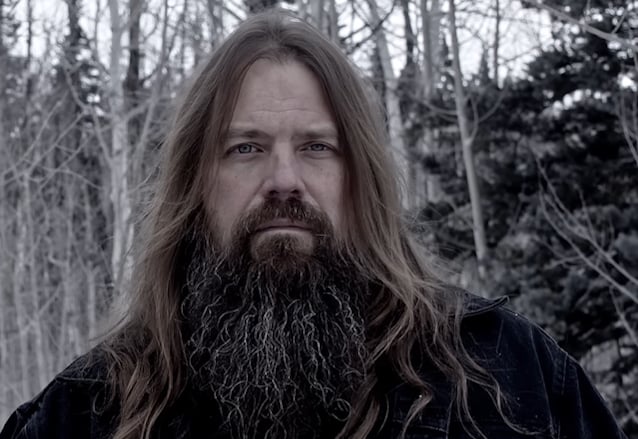
Lamb of God guitarist Mark Morton recently delved into the profound narrative of his memoir, "Desolation: A Heavy Metal Memoir," during an appearance on The Jasta Show. Published in June 2024 by Hachette Books and co-written with Ben Opipari, the book meticulously chronicles Morton’s personal journey through the harrowing landscapes of addiction and recovery, interwoven with the unlikely trajectory of his storied career in heavy metal. The memoir, which has been available for over eighteen months, presents a multifaceted account of Morton’s life, seamlessly blending his formative years as a shy, anxious adolescent who found solace and purpose in music, the improbable rise of his band from its nascent stages as Burn the Priest to the global phenomenon that is Lamb of God, and his deeply personal struggles with alcoholism and drug addiction.
A Multifaceted Narrative of Resilience and Rock Stardom
Morton described the book as a tapestry woven from three distinct yet interconnected narratives. "It’s basically this story of me being this sort of anxious, kind of shy, uncomfortable kid that finds guitar and finds the music and it just takes over my entire psyche," he explained on The Jasta Show. This introspective beginning sets the stage for the remarkable evolution of Burn the Priest into Lamb of God, a band whose success story Morton characterized as almost archetypal in its improbability. "The degree of success we’ve had would’ve never made sense at any point if you’d have tried to have said ‘script that’ or ‘plan that’. And it all sort of happened by accident," he remarked, highlighting the serendipitous nature of their ascent.
Intertwined with these biographical threads is Morton’s candid exploration of his descent into substance abuse and his subsequent arduous path toward sobriety. "And then it also details just my descent into alcoholism and drug addiction, and then my coming out of that," he stated. The memoir does not shy away from the emotional spectrum, encompassing both profound tragedy and moments of unexpected levity. "And all those things, stories kind of intertwine. And there’s some tragedy in there and there’s some comedy in there, some funny stories and some sad stuff, too."
The Personal Weight of Narration: Recording the Audiobook
A significant aspect of the memoir’s release is Morton’s decision to narrate the audiobook himself, foregoing the option of a professional voice actor. This choice was deeply rooted in the personal significance of a particular section of the book. "Really, that boils down to… there is a section of the book where I discuss the birth and death of my first daughter," Morton revealed. "And I frankly just would never want anyone else to tell that story. I wouldn’t have felt comfortable with someone else voicing that story." This profound personal connection underscored his commitment to delivering that narrative with the utmost authenticity and care.
Beyond this pivotal moment, Morton also shared his insights into the unexpected challenges of audiobook narration. "I’ll tell you this, and you know this… I didn’t know this until I did it — doing voice work is tricky," he admitted. The process, which spanned five days of recording in a studio with a producer, revealed a new set of skills and physical considerations. "It’s a skillset that I didn’t have, and by the end of it… It’s a tricky thing. You become very well acquainted with your own sort of speech impediments and idiosyncrasies and throat gurgles. And you learn when to not eat, when to eat, how much to eat, what to eat, when to drink water, when not to drink." The meticulous attention required to manage vocal health and delivery was a revelation for the guitarist.
Clarifying the Collaborative Process: Authorship and Editorial Support
Addressing potential ambiguities surrounding the book’s creation, Morton was unequivocal about his role in its authorship. When asked if he felt like a different person after co-writing and voicing the memoir, he clarified, "I didn’t co-write it — I wrote it. I wrote every single word." He elaborated on the involvement of Ben Opipari, an English professor and writing consultant who became a friend. The genesis of the book began during a casual conversation at Opipari’s beach house in North Carolina. "He was, like, ‘You’ve got a book in you, man. You should write a book,’" Morton recalled Opipari suggesting.
Their initial collaboration involved writing a sample chapter. "And we wrote one chapter, sent it to the one publishing company. We were, like, ‘If we wanted someone to put this out, who would it be?’ So we sent it to that company, and they were, like, ‘Let’s do a book.’ I was, like, ‘Oh, no.’" Morton emphasized that while Opipari provided crucial editorial support, refining grammar and ensuring clarity, the narrative content was entirely his own. "So then I had to decide, like, am I gonna do it? I wrote every word… And the interesting thing about that is I don’t type very well, so I wrote a hundred thousand words [very slowly]." The arduous writing process, which he humorously estimated yielded only about five dollars per hour, was a testament to his dedication.
The Absence of Catharsis and the Presence of Gratitude
Contrary to common perceptions of memoirs as inherently cathartic or therapeutic endeavors, Morton stated that his experience in writing "Desolation" was not characterized by such revelations. "To your question, I did not feel — it wasn’t cathartic. It wasn’t some self-discovery," he asserted. He attributed this to the fact that the events chronicled were experiences he had already lived through and processed. "That makes for good bylines, taglines about a project. But it wasn’t, because everything in there, it’s my story, it’s my life. So all that stuff I’ve lived and I have as learned and lived experience."
In a previous interview with Full Metal Jackie’s nationally syndicated radio show in July 2024, Morton echoed this sentiment. While he had initially wondered if the book project would be cathartic or a process of self-discovery, his primary takeaway was a profound sense of relief and gratitude. "I think the big takeaway for me was just this sense of relief and gratitude that I had gotten past so much of the stuff that happens in the book." He acknowledged the presence of both thrilling and tragic elements in his life, but emphasized that his current position allows him to reflect on these experiences with hope. "And so for me to be sitting where I’m sitting now and being able to reflect on that informs all of those experiences with a sense of hope. And I’d like to think that’s one of the takeaways of the book, is that there’s always hope and there’s always a chance to get better."
Navigating the Delicate Balance of Personal Disclosure
The process of deciding how much personal tragedy and vulnerability to share in the memoir presented a significant challenge. Morton acknowledged the difficulty in balancing the desire for openness with the need for discretion. "Yeah, it’s a scary thing to try and balance how much you wanna let go of," he admitted to Full Metal Jackie. "Cause there’s some really, really personal stories in here. And those can be handled a lot of different ways, and you can go for shocking or you can go for guarded; there’s a lot of different angles you can take with some of those stories." His relative inexperience with writing, particularly beyond the realm of rock memoirs, meant that this was a significant learning curve.
Morton’s approach ultimately centered on authenticity and respect. "The big thing I found was to just be genuine and to try to tell those stories with a sense of respect, not only for the experience that I had, but for people who may have had a similar experience," he explained. The goal was to present his narrative authentically, without sensationalizing or diluting the weight of his experiences.
The Heartbreaking Chapter: The Loss of Madalyn Grace Morton
In a separate LiveSigning discussion with Opipari, Morton identified the chapter detailing the death of his infant daughter, Madalyn Grace Morton, as the most challenging to write. Madalyn passed away in 2009, just one day after her birth, due to complications from an infection sustained during delivery. This profound loss was previously explored by Morton in the Lamb of God song "Embers" from their 2015 album "VII: Sturm Und Drang," and in an essay published by Noisey.
The difficulty in writing this chapter, Morton explained, stemmed not from uncovering new information but from the struggle to honor the event with appropriate language and tone. "It’s not because I discovered anything new about that situation. I just think that I struggled to honor it and word it just right," he stated. He recounted a period of intense emotional turmoil during the writing process. "I was in a really bad mood those few days. So, in that sense, it just drummed up stuff." He reiterated his commitment to not commodifying the tragedy but acknowledged its integral role in his life story. "I didn’t want this to be a book about that, but I can’t tell my story without touching on that. So it was more about finding the balance of all those things and kind of making it feel like I honored that, but didn’t exploit it and told my authentic version of that."
The Joy of Recalling Chaotic Beginnings
Conversely, Morton found immense enjoyment in revisiting the early days of Burn the Priest and the nascent years of Lamb of God. "I really, really enjoyed kind of going through all the memories of the Burn the Priest era of Lamb of God and then the early Lamb of God stuff and just really trying to characterize what an absolute just cyclone of chaos and idiocy we were back then," he shared. The process involved extensive fact-checking and reconnecting with individuals from his past, including a fan who reached out via social media after attending early shows. "We got on the phone and I just checked my memory of that show versus his, and he gave me some real insight. And that was pretty cool. I thanked him in the book." This collaborative recall process added a rich layer of detail and validation to his memories.
Publisher’s Description and Morton’s Initial Intentions
Hachette Books described "Desolation" as the chronicle of Morton’s "lifelong quest for clarity and self-acceptance," detailing how the pressures of his career and personal battles converged. The publisher highlighted the intertwining themes of addiction, self-destruction, and the journey to recovery, alongside the devastating loss of his daughter, which plunged him into "further into hopelessness." The description also noted the moments of triumph, hope, and profound personal connection that punctuated his struggles, including the bonds formed with bandmates and crew, and the meaningful interactions with fans. Ultimately, the book aims to convey Morton’s journey toward finding presence and gratitude, a process he likens to a "spiritual awakening."
When the book was initially announced, Morton articulated his primary motivation: "Initially, I started writing this book just to see if I could do it. But as the writing process unfolded, it quickly took on much more meaning. Unpacking my story, I was able to observe events in my life with an objectivity that I hadn’t experienced while I’d lived them in real time." He expressed his hope that sharing his experiences would foster connection and commonality, acknowledging the blend of "fun stories" and "really sad ones."
A Legacy of Heavy Music and Personal Evolution
Mark Morton, a co-founder of Lamb of God (originally Burn the Priest, formed in 1994), has been a central figure in the heavy metal landscape for decades. His prolific output extends beyond the band, with a solo debut album, "Anesthetic," released in 2019, followed by the EP "Ether" in 2020 and the LP "Without The Pain" in 2025. Lamb of God’s tenth studio album, "Into Oblivion," is slated for release on March 13 via Epic Records, continuing their legacy of delivering impactful heavy music to a global audience. "Desolation: A Heavy Metal Memoir" offers a profound and unflinching look at the man behind the music, revealing a journey marked by extraordinary resilience, hard-won wisdom, and an enduring spirit.