

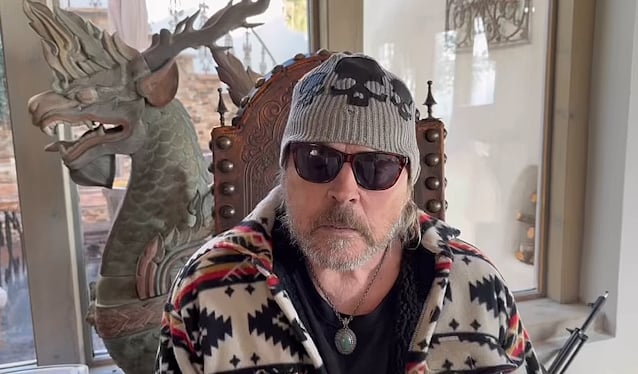
In a candid, multi-part video interview with former Geffen A&R executive Tom Zutaut, Don Dokken, the frontman of the eponymous heavy metal band DOKKEN, has revisited the pivotal 1988 "Monsters of Rock" U.S. stadium tour, an event that prominently featured VAN HALEN, SCORPIONS, METALLICA, and KINGDOM COME. Dokken’s reflections offer a stark perspective on the band’s competitive landscape at the time, particularly their dynamic with a rapidly ascendant METALLICA, and shed light on the internal struggles that ultimately contributed to DOKKEN’s fracturing. The tour, a monumental undertaking in hard rock and heavy metal history, commenced on May 27, 1988, in East Troy, Wisconsin, and spanned 28 dates, concluding on July 30 in Denver.
The Shadow of Metallica: A Battle for Dominance
Don Dokken did not shy away from acknowledging the formidable presence of METALLICA during the "Monsters of Rock" tour. He described the experience as being "crushed" by the thrash metal titans, a sentiment rooted in METALLICA’s electrifying stage presence and their burgeoning global popularity. "It’s hard to play with METALLICA," Dokken stated, as transcribed by BLABBERMOUTH.NET. "They’re the biggest band in the world now. And I remember on ‘Monsters,’ they were going on right before us, and I thought… It is kind of, like, we’re not heavy like them, so I told [our manager]."
The shared management of both DOKKEN and METALLICA by the influential Q Prime, helmed by Cliff Burnstein and Peter Mensch, became a focal point of Dokken’s strategic concerns. "We had the same managers — [Cliff] Burnstein and [Peter] Mensch [of Q Prime] — and I said, ‘Cliff, can you put ’em on after us?’ I go, ‘It’s kind of hard to go on stage and sing ‘In My Dreams’ [after METALLICA’s set].’" This plea underscored Dokken’s perception of a significant stylistic and intensity gap that made it challenging to follow METALLICA’s performance and maintain their own audience’s momentum.
Dokken’s recollection of METALLICA’s creative process during this period is particularly insightful. He mistakenly believed they were in the midst of recording the "Black Album" with producer Robert John "Mutt" Lange. However, corrections indicate that METALLICA was actually in the final stages of mixing "…And Justice for All" at the time of the tour, with the iconic "Black Album" being produced by Bob Rock and released in 1991. This temporal confusion, however, does not diminish the impact of Dokken’s observation regarding METALLICA’s intense focus and evolving sound.
A Candid Assessment of "…And Justice for All"
A personal anecdote shared by Dokken further illustrates his candid, albeit sometimes blunt, assessment of METALLICA’s work. He recounted an instance where Jason Newsted, METALLICA’s bassist at the time, sought his opinion as a producer on a track from "…And Justice for All." Newsted reportedly asked, "Just give me your opinion, as a producer. Do you think the bass is too low?" Dokken’s honest response was, "Honestly, I wouldn’t know ’cause I can’t hear any bass." While he immediately regretted the remark, recognizing its potential to offend, it stemmed from a genuine observation about the mix. The lack of prominent bass on "…And Justice for All" is a well-documented characteristic of the album, a consequence of the mixing decisions made during its production. Dokken’s comment, though perhaps tactless, highlighted a sonic characteristic that set METALLICA apart from many other rock bands, including his own.
Foresight and the Rise of Metallica
Dokken’s connection to METALLICA’s early career predates the "Monsters of Rock" tour, tracing back to the early 1980s. He recalled witnessing METALLICA perform at The Troubadour in West Hollywood during their club days, before they had achieved widespread fame. His manager, Cliff Burnstein, was also considering signing the band at the time. "I saw ’em and I said, ‘You’re gonna sign these guys?’ I go, ‘They’re good. But…’" Dokken admitted, comparing their raw, aggressive sound to the prevailing hard rock of the era, exemplified by bands like AEROSMITH and LOVERBOY. METALLICA’s style, which he described as "a machine gun firing," was a stark contrast. He also noted the presence of Dave Mustaine, the original guitarist who would later form MEGADETH.
Despite his initial reservations about their mainstream appeal, Burnstein’s conviction was unwavering. "These guys are gonna be huge," Burnstein reportedly told Dokken. "They’re gonna be huge." This prescient statement proved to be remarkably accurate, as METALLICA’s trajectory over the next decade, culminating in the colossal success of the "Black Album," cemented their status as global superstars.
Zutaut’s Role in Metallica’s Elektra Signing
Tom Zutaut, who previously worked for Elektra Records, also chimed in on METALLICA’s signing, claiming a degree of credit for bringing the band to the label, though acknowledging the pivotal role of Michael Alago. Zutaut stated, "Don… knows I signed METALLICA. There’s always this controversy with Michael Alago. But I was leaving Elektra, so I turned the band over to Michael Alago, and it’s kind of a complicated story and I won’t get into all that right now." This suggests a complex behind-the-scenes negotiation and transfer of responsibility that contributed to METALLICA’s early career development.
Internal Strife and the Unraveling of Dokken
The immense pressure and competitive environment of the "Monsters of Rock" tour, coupled with pre-existing internal issues, significantly exacerbated the tensions within DOKKEN. Don Dokken explicitly linked the tour’s intensity to the band’s eventual breakup. "Yeah, that was a tough tour, because they hadn’t done the ‘Black Album’ yet," he stated in a prior appearance on the Battleline podcast. "I mean, METALLICA’s now the biggest band in the world… And that was kind of maybe the reason we broke up, because of METALLICA."
Dokken described METALLICA’s unwavering commitment to their performance: "They just gave it 100 percent, 110 percent. They were kicking ass… METALLICA had this mindset that, ‘If this is our last show, we die. So be it.’ They gave it 110 percent." This level of dedication stood in stark contrast to the internal struggles plaguing DOKKEN.
The Shadow of Substance Abuse
The root of DOKKEN’s unraveling, as described by Don Dokken, was deeply intertwined with substance abuse among his bandmates, particularly during the demanding stadium tour environment. "We’d been on the road for a year and a half. And I think we just kind of got full of ourselves," he admitted. "We weren’t playing well, in my opinion, because the drugs."
Dokken painted a harrowing picture of guitarist George Lynch’s drug use on stage: "The camera would go to George [Lynch, DOKKEN guitarist] during a solo, and I’d look over and there’s no George on stage. Where’s George? I hear him playing, but he wasn’t on stage, because he was standing behind his Marshall amplifiers doing coke." This behavior not only compromised the band’s performance but also deeply affected Dokken’s morale. "I begged and pleaded and said, ‘Is there any way you guys can’t do drugs for 90 minutes?’ And basically they said no. They were doing coke on stage and it was really, for me, depressing."
Dokken’s profound disappointment stemmed from the perceived erosion of the band’s core identity. "I started the band, the band’s called DOKKEN, and everybody was doing coke on stage. And I was, like, ‘Jesus Christ.’ And that’s when the band unraveled."
George Lynch’s Perspective on the Tour and Internal Conflict
George Lynch, in an April 2021 interview with MetalTalk, offered his own perspective on the "Monsters of Rock" tour and the internal dynamics of DOKKEN. He characterized the tour as a "pinnacle" and "end of an era" for the style of giant rock arena tours. However, he also highlighted a disturbing management strategy revealed shortly before the tour’s commencement. "The management called a meeting before the tour started and informed the band that Don was gonna be breaking the band up and trying to just hire us as musicians on the band," Lynch revealed. "Or else, if that didn’t work, we didn’t agree to that, he was just gonna leave, keep the name and kick us out."
Lynch expressed his commitment to the band as a collaborative unit, stating, "We built this thing as a family, as friends, as a band of brothers. And that was really the struggle between Don and I." He contrasted Dokken’s perceived self-serving approach with his own collaborative ethos. "Don was kind of out for himself and used people as best he could." Lynch acknowledged that this mentality, while perhaps contributing to their success, also created deep divisions.
The prospect of renegotiating their record contract, which would have been a moment of significant financial and professional leverage for the band, became a point of contention. Lynch believed that DOKKEN, having experienced substantial sales growth, was poised for a lucrative renegotiation, similar to bands like MÖTLEY CRÜE and VAN HALEN. Instead, he felt Dokken viewed this opportunity as a chance to consolidate power and financial gain for himself. "Don saw the writing on the wall, and with the managers’ help, decided that he wanted the whole thing for himself."
This realization deeply affected Lynch’s ability to perform. "I had to go on stage knowing that every night. And it depressed me, and I kind of just fell into drugs and alcohol and just went out and went through the motions. I was quite dispirited." He described himself as a person who wears his heart on his sleeve, making it difficult to maintain a facade of enthusiasm while grappling with the internal turmoil.
DOKKEN’s Reunions and Recent Activity
Despite the acrimonious circumstances surrounding their 1980s breakup, the classic lineup of DOKKEN—Don Dokken, George Lynch, Jeff Pilson, and Mick Brown—reunited on stage on several occasions. Their first reunion in over a decade occurred in November 2009 in Anaheim, California. A decade later, they embarked on a short Japanese tour, marking their first time on the road together in 21 years.
A concert DVD, "Return To The East Live (2016)," documented their reunion tour, featuring footage from their Japanese shows and a U.S. performance in Sioux Falls, South Dakota. The release also included newly recorded acoustic versions of "Heaven Sent" and "Will The Sun Rise," as well as "It’s Just Another Day," the first track by the classic lineup since 1997’s "Shadowlife."
Since these reunion efforts, DOKKEN has continued to perform with its current lineup, which includes bassist Chris McCarvill, guitarist Jon Levin, and drummer BJ Zampa. The band released their 13th studio album, "Heaven Comes Down," in October 2023, produced by Bill Palmer and Don Dokken, and mixed by Kevin Shirley.
The narrative of DOKKEN’s participation in the 1988 "Monsters of Rock" tour serves as a compelling case study in the dynamics of the music industry, the pressures of fame, and the profound impact of internal band relationships on artistic output and longevity. Don Dokken’s reflections, while often pointed, provide a valuable historical account of a tumultuous period for both his band and the broader heavy metal landscape, highlighting the meteoric rise of METALLICA and the internal struggles that ultimately defined DOKKEN’s legacy.