

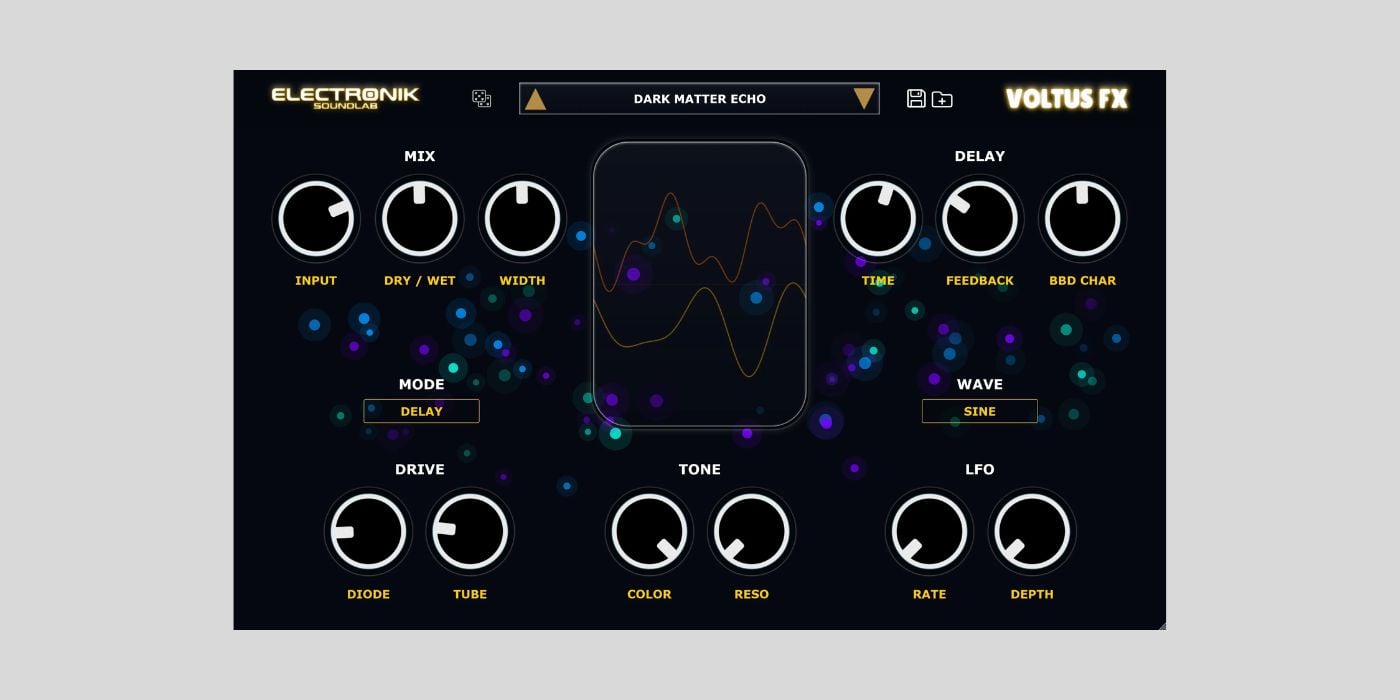
Electronik Sound Lab, a developer previously recognized for its extensive catalog of sample-based virtual instruments, has announced the immediate release of Voltus FX, a sophisticated and entirely free multi-effect plugin. This new offering, available for Windows operating systems (64-bit VST3), integrates a quartet of essential audio processing modules: a Bucket Brigade Device (BBD)-style delay, a dual-stage saturation unit, a versatile six-waveform Low-Frequency Oscillator (LFO), and a state variable filter. The launch of Voltus FX represents a notable strategic expansion for Electronik Sound Lab, signaling their entry into the competitive realm of audio effects processing, a departure from their established focus on instrument development.
A New Direction for Electronik Sound Lab
Historically, Electronik Sound Lab has cultivated a reputation within the music production community for crafting meticulously designed sample-based instruments. Their previous releases, frequently built using the Maize Sampler platform, have garnered attention for their sonic quality and accessibility, often provided at no cost. Recent examples include "Arctic Dreams Lite," a virtual instrument that showcased their expertise in sound design and sampling. This consistent output of high-quality, free instruments has fostered a loyal user base, accustomed to the developer’s commitment to providing valuable tools without financial barriers.
The introduction of Voltus FX marks a significant pivot in the company’s product development trajectory. While the underlying philosophy of providing robust, accessible tools remains consistent, the transition from instrument creation to effect processing broadens Electronik Sound Lab’s potential impact on the creative workflows of producers and musicians. This move allows them to address a different segment of the audio production chain, offering tools that shape and transform sounds rather than solely generating them. The decision to make their inaugural effect plugin a multi-effect unit, combining several distinct processing types, suggests an ambition to offer comprehensive solutions rather than isolated utilities. This integrated approach can often streamline workflows and encourage deeper sonic experimentation within a single plugin interface.
Chronology of Development and Market Context
The development of virtual studio technology (VST) plugins has seen continuous evolution since its inception by Steinberg in 1996. Initially, effects plugins were often standalone units designed for specific tasks. Over time, the trend shifted towards multi-effect units that combined various processors, offering convenience and often intricate routing possibilities within a single interface. The freeware VST market, in particular, has experienced exponential growth, becoming a vital resource for aspiring and professional producers alike. This ecosystem of free tools often serves as an entry point for new users, democratizing access to professional-grade audio processing capabilities. Developers like Electronik Sound Lab contribute significantly to this ecosystem, often building brand loyalty and providing essential utilities that might otherwise be cost-prohibitive for many.
While the exact development timeline for Voltus FX has not been publicly detailed, its release follows a consistent pattern of innovation within the freeware sector. The announcement of macOS support as "coming soon" indicates a phased rollout strategy, typical for smaller developers managing resource allocation. This approach allows for focused initial development and support for a primary platform (Windows) before expanding to others, ensuring stability and performance. The article’s timestamp, "Last Updated on March 2, 2026," suggests a forward-looking release or a future-dated publication, indicating the ongoing relevance and anticipation for such tools in the production community.
Deep Dive into Voltus FX’s Core Modules
Voltus FX is distinguished by its quartet of integrated effects, each meticulously designed to offer both classic tonality and modern flexibility. The synergy between these modules is a core design principle, intended to facilitate complex sound design within a single instance.
-
Dual-Stage Saturation:
The saturation section is a cornerstone of Voltus FX, offering two distinct circuit models that cater to a wide range of tonal coloration needs. Saturation, in audio processing, refers to the deliberate introduction of harmonic distortion, often used to add warmth, presence, or aggressive bite to sounds.- Tube Mode: This mode is engineered to emulate the characteristics of an asymmetric triode topology, a hallmark of classic valve-driven hardware. Triode tubes, when driven into their non-linear operating regions, exhibit a characteristic clipping behavior where positive and negative peaks of an audio waveform are processed differently. This asymmetry introduces a rich spectrum of even-order harmonics, often perceived as warm, smooth, and harmonically pleasing. The effect is particularly sought after for its ability to add perceived loudness and character without necessarily increasing peak levels, making it ideal for vocals, bass, and master buses. The developer’s implementation aims to capture the nuanced dynamic response and harmonic richness associated with high-end analog tube preamplifiers and compressors.
- Diode Mode: In contrast, the Diode mode employs an algebraic soft-clipping algorithm, meticulously modeled after the behavior of germanium diodes. Germanium diodes are known for their relatively "softer" clipping knee compared to silicon diodes, but still produce a harder and often more aggressive distortion than tube circuits. This mode generates a higher proportion of odd-order harmonics, which can impart a more edgy, gritty, or "fizzy" character to the sound. It is particularly effective for pushing instruments like guitars, drums, or synthesizers into more extreme sonic territories, offering a distinct alternative to the warmer tube saturation.
The input gain stage for both modes is critical, operating across a broad range from -12 dB to +48 dB with an exponential mapping. This exponential curve ensures that the character of the distortion evolves significantly and dynamically as the gain is increased, allowing for subtle coloring at lower settings and pronounced, character-defining drive at higher levels. This nuanced gain control is crucial for achieving a wide palette of saturation effects, from gentle enhancement to aggressive fuzz.
-
BBD-Style Delay:
The delay module within Voltus FX is modeled after the iconic Bucket Brigade Device (BBD) circuits, a fundamental technology behind many revered analog delay and chorus effects from the 1970s and 80s. BBDs operate by passing discrete analog charge packets through a series of capacitors and switches, effectively delaying the audio signal. This process inherently introduces subtle degradation, such as high-frequency rolloff and minor noise, which contribute to the distinctive warm, dark, and often slightly gritty character of BBD delays.
Electronik Sound Lab’s implementation faithfully captures this analog essence. A notable design choice is the intentional operation at zero oversampling. While oversampling is often used in digital effects to mitigate aliasing (unwanted harmonic frequencies), its absence in Voltus FX is a deliberate artistic decision. The developer’s rationale is to allow the harmonics generated by the saturation and delay circuits to interact directly and organically, mimicking the complex intermodulation that occurs in analog hardware. This approach can result in a more "alive" and less clinically sterile sound, where the imperfections contribute positively to the overall texture.
To ensure smooth and artifact-free delay time changes, Voltus FX employs Hermite interpolation. Unlike simpler linear interpolation, Hermite interpolation uses not only the value of adjacent samples but also their slopes, resulting in significantly smoother transitions and preventing audible clicks or zipper noise when parameters like delay time are modulated in real-time. This is a critical detail for maintaining sonic integrity during performance or automation.
Further enhancing the analog authenticity is the "Analog Character" knob. This control allows users to seamlessly transition the delay tone from cleaner, more pristine repeats towards a noisier, more degraded sound, reminiscent of aged analog units. This feature provides creative flexibility, enabling the user to dial in anything from subtle spatialization to heavily colored, lo-fi echoes.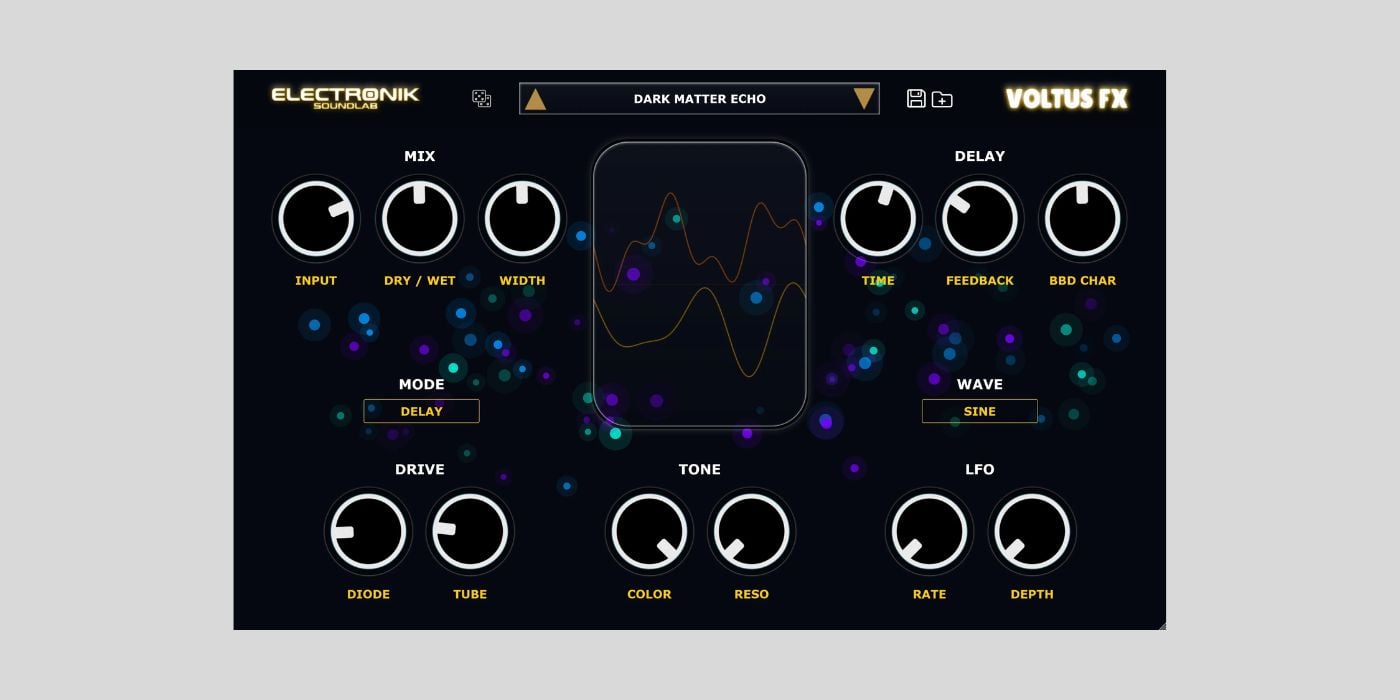
-
Versatile Modulation (LFO):
Modulation is a key element for adding movement and dynamic interest to any effect, and Voltus FX’s LFO module is designed for comprehensive control. It features a continuous LFO with six distinct waveforms, each offering unique rhythmic and sonic possibilities:- Sine: Produces smooth, undulating modulation, ideal for subtle pitch shifts, tremolo, or wah-like filter sweeps.
- Triangle: Offers a linear up-and-down movement, creating a more pronounced and predictable rhythmic feel than sine waves.
- Saw: Generates an asymmetric, ramp-like modulation, useful for rhythmic swells or aggressive, repeating effects.
- Square: Provides abrupt, on/off switching, perfect for rhythmic gating, choppier tremolo, or stepped filter modulation.
- Sample and Hold: Creates random, stepped values, often used for classic synth-style filter modulation or chaotic rhythmic effects. Crucially, Voltus FX’s Sample and Hold mode is internally smoothed to prevent clicks and pops, ensuring musicality even with sudden value changes.
- Drift: This unique mode introduces slow, random pitch movement, designed to emulate the subtle, organic fluctuations found in vintage analog tape machines or unstable oscillators. It imparts a sense of "wow and flutter," adding an authentic, nostalgic character to the sound.
The ability to route this versatile LFO to various parameters within the saturation, delay, and filter sections unlocks a vast array of creative possibilities, from subtle animation to extreme sonic transformation.
-
State Variable Filter:
The filter section of Voltus FX is built upon the Chamberlin state variable filter topology. This filter type is highly regarded for its stability, musicality, and versatility. A key characteristic of state variable filters is their ability to simultaneously provide low-pass, band-pass, and high-pass outputs from a single core circuit, offering immense flexibility in sound sculpting.
The Chamberlin topology is specifically known for its smooth high-frequency rolloff, which contributes to a more natural and less harsh filtering effect, even at extreme settings. This makes it particularly suitable for shaping the tonal character of instruments or for creating expressive filter sweeps without introducing undesirable artifacts.
Furthermore, the filter incorporates adaptive resonance limiting. Resonance, while crucial for creating expressive peaks and sweeps, can lead to instability and self-oscillation at high settings, particularly with certain input signals. Adaptive resonance limiting intelligently manages the feedback loop, preventing the filter from becoming unstable or generating ear-splitting peaks, thus ensuring reliable and predictable performance across all settings. This feature is invaluable for live performance and automated parameter changes, where unexpected sonic spikes must be avoided.
Technical Implementation and Performance Considerations
Electronik Sound Lab has engineered Voltus FX with real-world production scenarios in mind, particularly emphasizing performance and usability. The plugin operates at zero latency with no look-ahead processing. This technical specification is critical for applications requiring immediate audio feedback, such as live performances, monitoring during recording, or for precise synchronization in a mix. The absence of look-ahead means the plugin does not introduce any processing delay, maintaining tight timing relationships between tracks.
The factory library includes over 30 professionally designed presets, providing immediate access to a wide range of sonic textures and starting points for creative exploration. This curated selection helps users quickly grasp the plugin’s capabilities and serves as an excellent foundation for customization. Beyond the factory offerings, Voltus FX facilitates the creation and storage of custom presets, which are saved and loaded as portable XML files via the built-in browser. This open format ensures future compatibility and ease of sharing among users.
System Compatibility and Future Outlook
Currently, Voltus FX is available exclusively in VST3 format for Windows 10 and 11 (64-bit architectures). This ensures compatibility with a vast majority of modern Digital Audio Workstations (DAWs) on the Windows platform. The developer has explicitly tested the plugin across leading DAWs including FL Studio, Ableton Live, Reaper, Studio One, Cubase, and Bitwig, confirming its stable operation within these professional environments. Minimum system requirements are set at a dual-core processor running at 2.0 GHz and 4 GB of RAM, making it accessible to a broad range of contemporary computer systems without demanding excessive resources.
The announcement of macOS support as "coming soon" indicates a clear roadmap for expanding the plugin’s reach to Apple users. This will be a significant development, as the macOS platform hosts a substantial segment of the professional audio production community. Expanding to macOS will significantly increase the plugin’s user base and cement its position as a universally accessible free tool.
Broader Impact and Implications for the Production Community
The release of Voltus FX is likely to have several significant implications for both Electronik Sound Lab and the broader music production community.
- Democratization of Tools: As a free, high-quality multi-effect plugin, Voltus FX lowers the barrier to entry for aspiring producers who may not have the budget for expensive commercial effects. It provides access to sophisticated delay, saturation, modulation, and filtering capabilities that are essential for modern sound design and mixing.
- Electronik Sound Lab’s Strategic Position: This release diversifies Electronik Sound Lab’s portfolio beyond sample-based instruments, positioning them as a more comprehensive developer of audio tools. This strategic expansion could lead to future commercial effect plugins or further free releases, strengthening their brand recognition and market footprint. It also demonstrates their technical prowess in digital signal processing (DSP), moving beyond purely sample playback engines.
- Creative Empowerment: The integrated nature of Voltus FX’s modules encourages creative experimentation. Users can modulate delay times with the LFO, saturate filtered sounds, or apply a characterful delay to a distorted signal, all within a single plugin instance. This workflow efficiency can spark new ideas and streamline complex sound design tasks.
- Industry Trends: The continuous release of high-quality freeware like Voltus FX underscores a growing trend in the audio software industry. Developers often use free plugins as a way to showcase their capabilities, build community goodwill, and potentially introduce users to their wider product ecosystems. This benefits the entire community by fostering innovation and competition, pushing the boundaries of what is offered at no cost.
- Educational Value: For those learning about audio effects, Voltus FX serves as an excellent educational tool. Its distinct modules allow users to understand the individual impact of delay, saturation, LFOs, and filters, as well as how they interact when combined. The clear design philosophy, such as zero oversampling for harmonic interaction, also provides insights into advanced DSP considerations.
In conclusion, Voltus FX by Electronik Sound Lab is more than just another free plugin; it is a meticulously engineered multi-effect unit that combines essential audio processing capabilities with a distinct analog-inspired character. Its release marks a significant milestone for the developer, signaling a successful foray into the effects processing domain. For producers on the Windows platform, Voltus FX offers a powerful, versatile, and entirely free tool that promises to enrich sound design possibilities and streamline creative workflows, with the anticipation of broader accessibility for macOS users in the near future.