

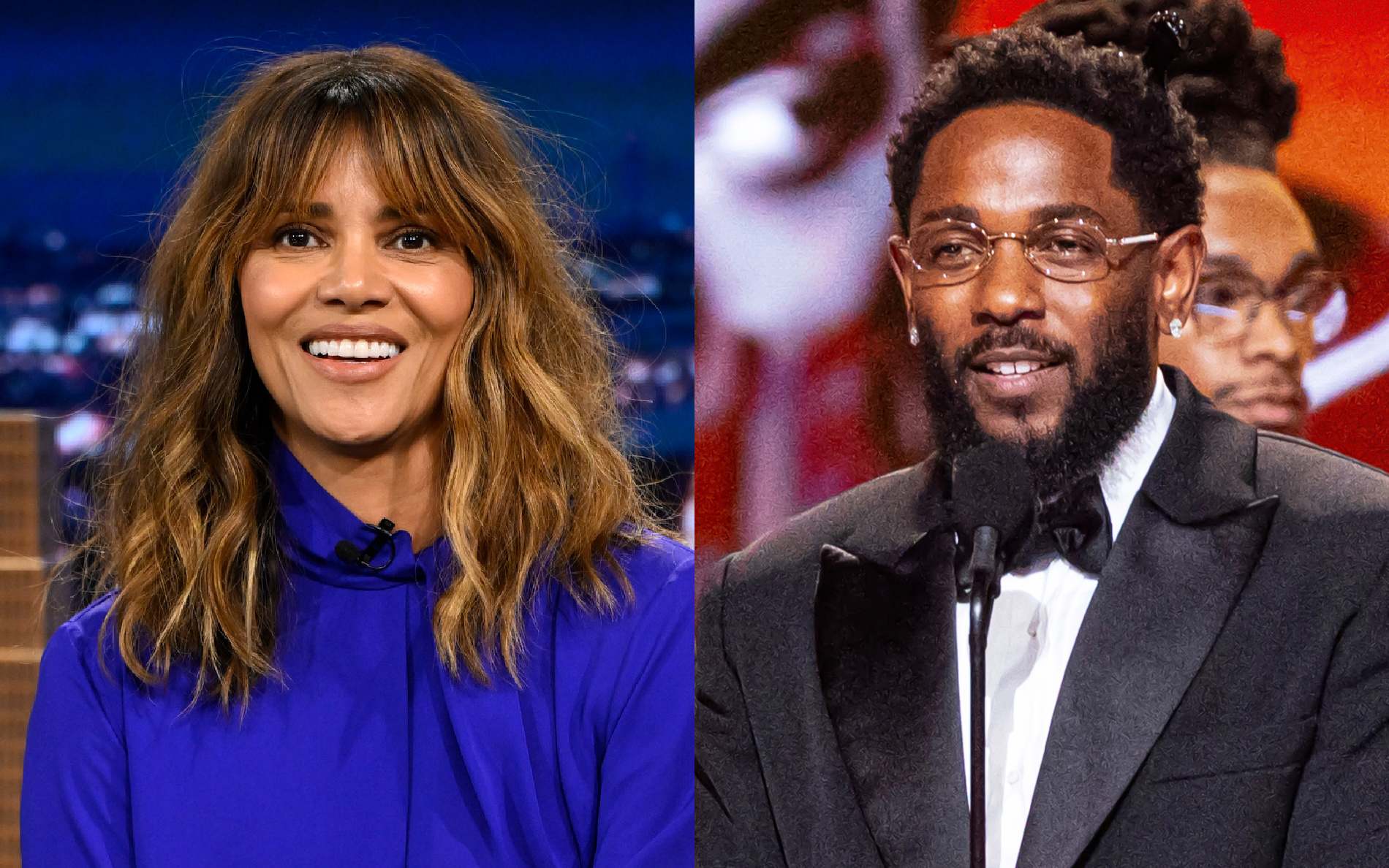
Oscar-winning actress Halle Berry has publicly declared her affinity for Kendrick Lamar’s music, specifically identifying a track that underscores her strong allegiance to the Compton rapper, potentially at the expense of his ongoing lyrical feud with Drake. Berry made these revelations during a recent appearance on UPROXX’s “That Tracks” series, a segment designed to gauge celebrities’ reactions to various music-related scenarios.
The segment, which featured Berry alongside her Crime 101 co-stars Chris Hemsworth and Mark Ruffalo, presented the trio with a series of hypothetical situations centered around music consumption. The question that specifically ignited Berry’s enthusiastic response was posed by Hemsworth: “If I’m stuck in traffic in the 101, I’m listening to my favorite L.A. based artist, Kendrick Lamar. Does that track?”
Berry’s immediate and emphatic affirmation, “Absolutely, hell yes!” left no room for doubt about her admiration for Lamar. She then escalated her endorsement by not only confirming her choice but also playfully referencing a pivotal moment in Lamar’s recent career. With a discernible chuckle, she declared, “Say Drake!” This interjection was a direct nod to the memorable opening line of Kendrick Lamar’s immensely popular diss track, “Not Like Us,” which rapidly became a cultural phenomenon during the height of his public dispute with Drake. Berry’s concise yet potent declaration, “That’s all I’m gonna say,” served as a clear signal of her chosen side in the highly publicized rap battle.
Further solidifying her stance, Berry also championed Lamar’s artistic achievements by highlighting his performance at the 2025 Super Bowl halftime show, asserting it as “the number one-performing halftime show ever.” While Ruffalo offered a somewhat hesitant agreement, stating, “Crazy! … Yeah, let’s go with that – just because,” Hemsworth also acknowledged his appreciation for Lamar’s music, responding to the traffic scenario with a more measured, “On certain days, for sure.” The exchange underscores Lamar’s significant cultural impact, extending beyond the hip-hop community to resonate with mainstream Hollywood figures.
A History of Mutual Respect and Unexpected Friction
The mutual respect between Halle Berry and Kendrick Lamar is not a recent development. Lamar himself paid homage to the acclaimed actress in his 2012 hit song, “Money Trees,” where he name-dropped her in the chorus, solidifying her presence in his artistic narrative. This prior acknowledgment from Lamar likely contributed to Berry’s strong and vocal support during the UPROXX segment.
However, the landscape of Berry’s relationship with Drake presents a stark contrast. Their interactions have been marked by a notable degree of tension, particularly following Drake’s unauthorized use of Berry’s image for the cover art of his 2023 single, “Slime You Out,” featuring SZA. The artwork, a visual representation of the song’s title, depicted Berry drenched in green slime, a reference to her appearance at the 2012 Nickelodeon Kids’ Choice Awards.
The "Slime You Out" Controversy: A Public Disagreement
The controversy surrounding the "Slime You Out" artwork erupted shortly after the single’s release. Halle Berry took to Instagram to express her displeasure, posting a cryptic message that read, “Sometimes you have to be the bigger guy… even if you’re a woman!” accompanied by a middle finger emoji. This initial statement, while indirect, clearly conveyed her dissatisfaction.
Her frustration was further articulated in the comments section of the same post, where she directly addressed the issue of consent. Berry wrote, “Didn’t get my permission. That’s not cool I thought better of him!” She also responded to a fan’s comment, stating, “When people you admire disappoint you you have to be the bigger person and move on!” These comments left no doubt about Berry’s feelings regarding Drake’s actions, highlighting a perceived breach of respect and artistic integrity.
Broader Implications of Celebrity Endorsements and Artistic Disputes
Halle Berry’s vocal preference for Kendrick Lamar’s music over Drake’s, particularly within the context of their public dispute, carries significant weight in the ongoing cultural discourse surrounding hip-hop. The “Not Like Us” track, released in April 2024, became a viral sensation, dominating social media and streaming charts. Its success was amplified by its direct lyrical jabs at Drake, positioning it as a pivotal moment in Lamar’s career and the broader rap landscape. Berry’s endorsement, therefore, serves as a high-profile validation of Lamar’s artistic output and his strategic engagement in lyrical confrontations.
The "Slime You Out" incident, conversely, highlights the complexities of celebrity image rights and the potential for conflict when an artist’s likeness is used without explicit permission. Berry’s reaction underscores the importance of consent and respect in the digital age, where images can be widely disseminated and repurposed with ease. The legal and ethical implications of such actions are increasingly scrutinized, particularly when public figures are involved. The incident also raises questions about the responsibilities artists have towards the individuals whose images they utilize, even for artistic purposes.
The ongoing public perception of the feud between Kendrick Lamar and Drake has become a significant cultural talking point. Celebrities, by expressing their allegiances, whether through direct statements or subtle nods, often amplify the narratives and influence public opinion. Halle Berry’s choice to align herself with Lamar, particularly by invoking a key phrase from his diss track, signals a clear preference and a tacit disapproval of Drake’s past actions. This dynamic illustrates how the influence of prominent figures can intersect with and impact the narratives surrounding major cultural events, such as high-profile rap feuds. The entertainment industry, with its interconnected web of artists and public figures, frequently sees these intersections, shaping not only music consumption but also broader conversations about respect, artistry, and digital consent.