

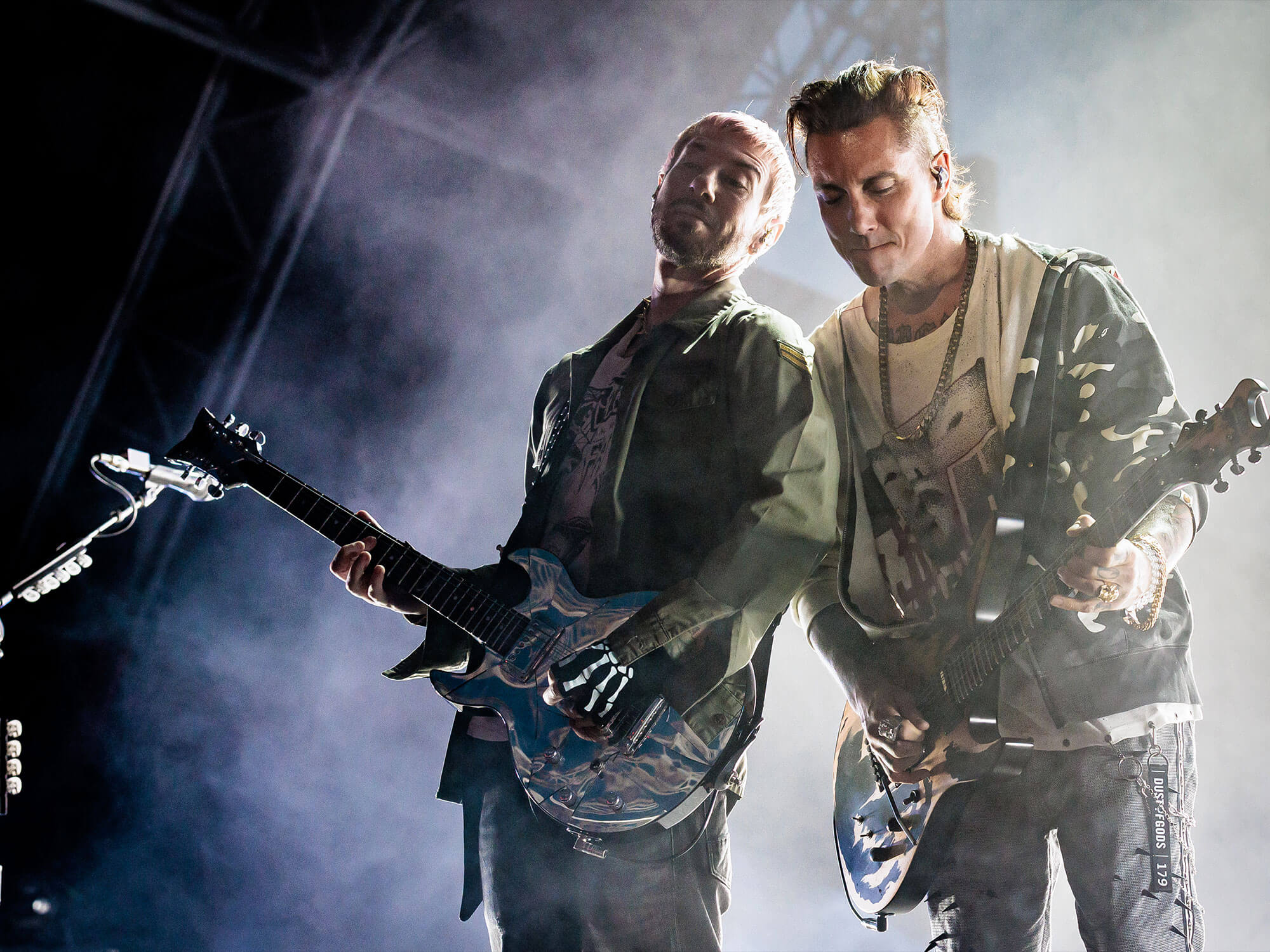
Avenged Sevenfold’s rhythm guitarist, Zacky Vengeance, has offered an insightful look into the intricate dynamics of creating the band’s latest album, Life Is But A Dream…, highlighting the formidable technical challenges posed by co-guitarist Synyster Gates. In a recent podcast interview with YouTuber Nik Nocturnal, Vengeance candidly discussed the rigorous demands of keeping pace with Gates’s virtuosity, a testament to the latter’s standing as one of the most technically proficient and wildly creative guitarists in contemporary rock and metal. This reflection comes as Vengeance himself prepares for a significant new chapter, announcing his debut solo record under his birth name, Zachary Baker, titled Dark Horse, slated for release in April 2026. His remarks paint a vivid picture of the relentless pursuit of musical excellence within Avenged Sevenfold, a journey that spans from the raw energy of early metalcore anthems to the sprawling, progressive soundscapes of their most recent work.
Synyster Gates: A Virtuoso’s Influence and Avenged Sevenfold’s Evolving Sound
Synyster Gates, born Brian Haner Jr., has long been lauded for his distinctive guitar work, which has become a cornerstone of Avenged Sevenfold’s sound. His style is characterized by a unique blend of technical precision, emotive phrasing, and adventurous harmonic exploration. Renowned for his devilishly accurate sweep picking, intricate legato runs, and fretboard-spanning rapid-fire solos, Gates has consistently pushed the boundaries of modern metal guitar playing. His contributions are evident across the Huntington Beach metallers’ discography, from the aggressive crunch of their early material to the orchestral grandeur and progressive leanings of their later albums. Critics and fans alike frequently cite Gates in discussions of the genre’s elite guitarists, often earning him accolades such as ‘Best Metal Guitarist’ from publications like Guitar World and multiple Revolver Golden Gods Awards. His signature Schecter guitars, often adorned with his distinctive skull bat inlays, are a common sight in the hands of aspiring guitarists, further cementing his influence.
The band’s musical trajectory has seen a remarkable evolution since their formation in 1999. Beginning with a raw, aggressive metalcore sound on albums like Sounding the Seventh Trumpet (2001) and Waking the Fallen (2003), Avenged Sevenfold gradually incorporated elements of classic heavy metal, hard rock, and progressive rock. This evolution was heavily influenced by Gates’s expanding musical vocabulary, which drew from diverse sources ranging from jazz fusion to classical music. Albums such as City of Evil (2005) showcased a dramatic shift towards a more melodic and technically ambitious style, featuring intricate guitar harmonies and extended instrumental passages. This continuous drive for innovation culminated in Life Is But A Dream…, an album that boldly ventures into experimental territories, incorporating elements of jazz, classical, and even avant-garde influences, pushing the band’s sonic boundaries further than ever before. This backdrop is crucial for understanding the challenges Vengeance articulated during its recording.
Navigating the Progressive Labyrinth: Life Is But A Dream…
The recording of Life Is But A Dream…, released in June 2023, represented a significant artistic undertaking for Avenged Sevenfold. The album, characterized by its sprawling compositions, complex time signatures, and genre-bending explorations, marked a deliberate departure from the band’s more conventional heavy metal roots. It garnered considerable attention for its ambitious scope and willingness to challenge listener expectations, receiving both critical praise for its audacity and some polarizing reactions for its experimental nature. This was an album designed to test the band’s own limits, and perhaps no member felt this more acutely than Zacky Vengeance, the band’s steadfast rhythm guitarist.
Vengeance’s remarks to Nik Nocturnal underscore the demanding nature of this album’s material. "Dude, I’ve got to be in a band with fing Synyster Gates!" he quipped, a humorous yet telling admission of the constant pressure to elevate his own playing. He elaborated on Gates’s unique compositional style: "That dude, he comes up with the craziest jazz chords — and he’s got long-ass fing fingers… He can span seven, eight frets. And he can play faster than almost anyone. He just can." This observation highlights Gates’s physical advantages and his deep understanding of advanced harmonic theory, enabling him to construct chords and melodies that are often beyond the typical metal guitarist’s repertoire. For Vengeance, whose role as rhythm guitarist traditionally involves providing a solid foundation, this meant venturing into unfamiliar harmonic and technical landscapes.
Vengeance drew an evocative parallel to illustrate the sheer speed and dexterity of Gates’s playing: "I always say there’s certain shit I cannot do. The same as you can’t run faster than [Jamaican sprinter] Usain Bolt at the Olympics. I can’t play shit as fast as he can play it, no matter how hard I try. I can set the metronome, I can try and try and try." This comparison vividly conveys the natural talent and years of dedicated practice that distinguish Gates’s abilities. It also speaks to the humble self-awareness of Vengeance, who, despite his own considerable skill and two decades of experience, acknowledges the rare caliber of his bandmate.
The process of mastering the new material for Life Is But A Dream… was not without its moments of intense frustration for Vengeance. He admitted, "Even with Life Is But A Dream, I had to learn stuff that I’ve never even fathomed and chords I can’t even — but it’s fun! But at first, I mean, honestly, I wanted to grab my guitar and smash it through the wall. But once you’ve got it, you’re happy you did it." This sentiment resonates with countless musicians who push past their comfort zones, experiencing moments of despair before achieving a breakthrough. The eventual satisfaction of mastering such challenging material is a testament to Vengeance’s dedication and the band’s collective commitment to artistic growth.
A standout example of Synyster Gates’s intricate work on the album, which undoubtedly contributed to Vengeance’s challenges, is the "ludicrous solo" at the end of the third track, "Nobody." This particular solo is a masterclass in modern guitar virtuosity, featuring blistering runs, complex arpeggios, and melodic phrases that weave through shifting harmonic structures. Its technical demands are immense, requiring exceptional finger independence, speed, and a sophisticated understanding of music theory. For the rhythm section, including Vengeance, maintaining a cohesive and dynamic backdrop for such a performance demands an equally high level of precision and musicality. This collaborative pushing of boundaries ensures that Avenged Sevenfold’s music remains fresh, complex, and continually evolving, solidifying their reputation as innovators in the metal scene.
From Punk Roots to Metalcore Icon: The "Unholy Confessions" Legacy
Beyond the contemporary challenges of Life Is But A Dream…, Vengeance also took time in the interview to reflect on his earlier career, specifically the creation of the iconic riff for "Unholy Confessions" from the 2003 album Waking the Fallen. This track remains one of Avenged Sevenfold’s biggest songs and is widely considered a quintessential metalcore riff, deeply ingrained in the genre’s history. Its driving aggression, melodic sensibility, and memorable structure helped define Avenged Sevenfold’s early sound and left an indelible mark on the burgeoning metalcore scene of the early 2000s.
"It kind of blows my mind because having written that riff, I was a kid, you know? I was, like, 20 years old," Vengeance recalled, highlighting the often-unforeseen impact of creative endeavors. "And you have no idea that it’s gonna have an impact when you’re writing it. It was a riff I was playing when I lived in my parents house, when we were touring in a van — running through it at soundcheck." This narrative offers a glimpse into the humble beginnings of a band that would eventually achieve global fame, emphasizing the organic, unpretentious process through which many enduring musical ideas are born. The image of a young Vengeance crafting a riff in his childhood home, only for it to become a foundational piece of metal history, underscores the unpredictable nature of artistic legacy.
Vengeance further elaborated on the origins of his guitar playing style, revealing a journey rooted in punk rock. "I was a punk rock guitarist in high school — I grew up learning punk songs, like Bad Religion songs, Pennywise songs, and stuff like that." This background provided him with a strong sense of rhythm, aggression, and the foundational understanding of power chords and fast-paced strumming characteristic of punk. However, his musical world expanded significantly with the formation of Avenged Sevenfold, largely influenced by his bandmates, particularly vocalist M. Shadows.
"And then when me and Matt started Avenged, he started showing me stuff like At The Gates, Children of Bodom, In Flames, Pantera — shit that I wasn’t fully used to. And I was like this shit’s f***ing awesome. I don’t know how to play it though. I can’t play this shit." This pivotal moment marked a crucial turning point in Vengeance’s musical development. The bands introduced by Shadows represented a heavier, more technically demanding spectrum of metal – At The Gates and In Flames being pioneers of melodic death metal, Children of Bodom known for their neoclassical shredding, and Pantera for their groove metal intensity and Dimebag Darrell’s distinctive riffage. These influences challenged Vengeance to transcend his punk roots and delve into the complexities of metal guitar playing, incorporating faster tempos, intricate palm-muting, more complex riff structures, and advanced lead techniques.
His response to this challenge was characteristic of a dedicated musician: "So I was practicing and practicing. I’ve never taken any lessons but I was just trying to play what I heard and come up with riffs, and it was still a full learning phase. And honestly, with guitar, I don’t think there’s ever not a learning phase. I’m still learning." This statement highlights a common ethos among many successful self-taught musicians: a perpetual state of learning and refinement. It underscores that even after decades in a hugely successful band, the pursuit of mastery is ongoing. This philosophy of continuous improvement has undoubtedly contributed to his ability to adapt to the demanding material of Life Is But A Dream… and remain a vital component of Avenged Sevenfold’s evolving sound. The enduring popularity of "Unholy Confessions," which has amassed hundreds of millions of streams and views, and remains a staple in Avenged Sevenfold’s live set, is a testament to the raw talent and dedication that characterized the band’s formative years. Waking the Fallen itself achieved Gold certification in the U.S., cementing its status as a landmark album in the metalcore genre and a crucial stepping stone in Avenged Sevenfold’s ascent.
Zachary Baker: Charting a New Artistic Course with Dark Horse
Looking ahead, Zacky Vengeance is embarking on a significant personal artistic endeavor, announcing his debut solo record, Dark Horse, under his birth name, Zachary Baker. The album is scheduled for release on April 3, 2026. This decision to release music under his given name rather than his established stage persona suggests a desire for a more personal and perhaps unconstrained artistic expression, separate from the Avenged Sevenfold brand.
The implications of a solo project for an artist deeply embedded in a successful band like Avenged Sevenfold are multifaceted. It offers an opportunity for Baker to explore musical avenues that might not fit within the collective vision of his primary band. This could mean experimenting with genres outside of metal, delving into more introspective songwriting, or collaborating with different musicians. While Avenged Sevenfold provides a powerful platform for his rhythm guitar work and songwriting contributions, a solo project allows him to take the helm entirely, showcasing his full range as a songwriter, vocalist (if he chooses), and instrumentalist.
Such ventures are not uncommon among members of high-profile bands. Synyster Gates himself has engaged in various side projects and collaborations outside of Avenged Sevenfold, and M. Shadows has lent his vocals to numerous guest appearances. These solo or side projects often serve as creative outlets, allowing artists to pursue passion projects or develop ideas that diverge from their band’s established sound. For Zachary Baker, Dark Horse could reveal new facets of his musical identity, offering fans a deeper understanding of his individual artistic voice. The choice of the title Dark Horse itself could hint at an unexpected direction or a hidden talent waiting to be fully unleashed. Fans will undoubtedly be keen to discover how his solo work might distinguish itself from the signature Avenged Sevenfold sound, and what new dimensions of his musicianship will be brought to light in this highly anticipated release. This solo venture not only marks a personal milestone for Baker but also highlights the continuous artistic evolution and diverse creative pursuits that define the careers of accomplished musicians in the modern era.
In conclusion, Zacky Vengeance’s recent reflections offer a compelling narrative of continuous growth, artistic challenge, and enduring dedication. From his candid admission of the rigorous demands posed by Synyster Gates’s unparalleled technical prowess on Life Is But A Dream… to his nostalgic journey back to the genesis of a metalcore classic like "Unholy Confessions," Vengeance provides invaluable insights into the life of a musician at the pinnacle of his craft. His forthcoming solo project, Dark Horse, under his given name Zachary Baker, signifies a new chapter of personal exploration, promising to further enrich his multifaceted legacy within the broader landscape of rock and metal music. His career trajectory serves as a testament to the power of perseverance, the thrill of artistic collaboration, and the perpetual quest for musical evolution.