

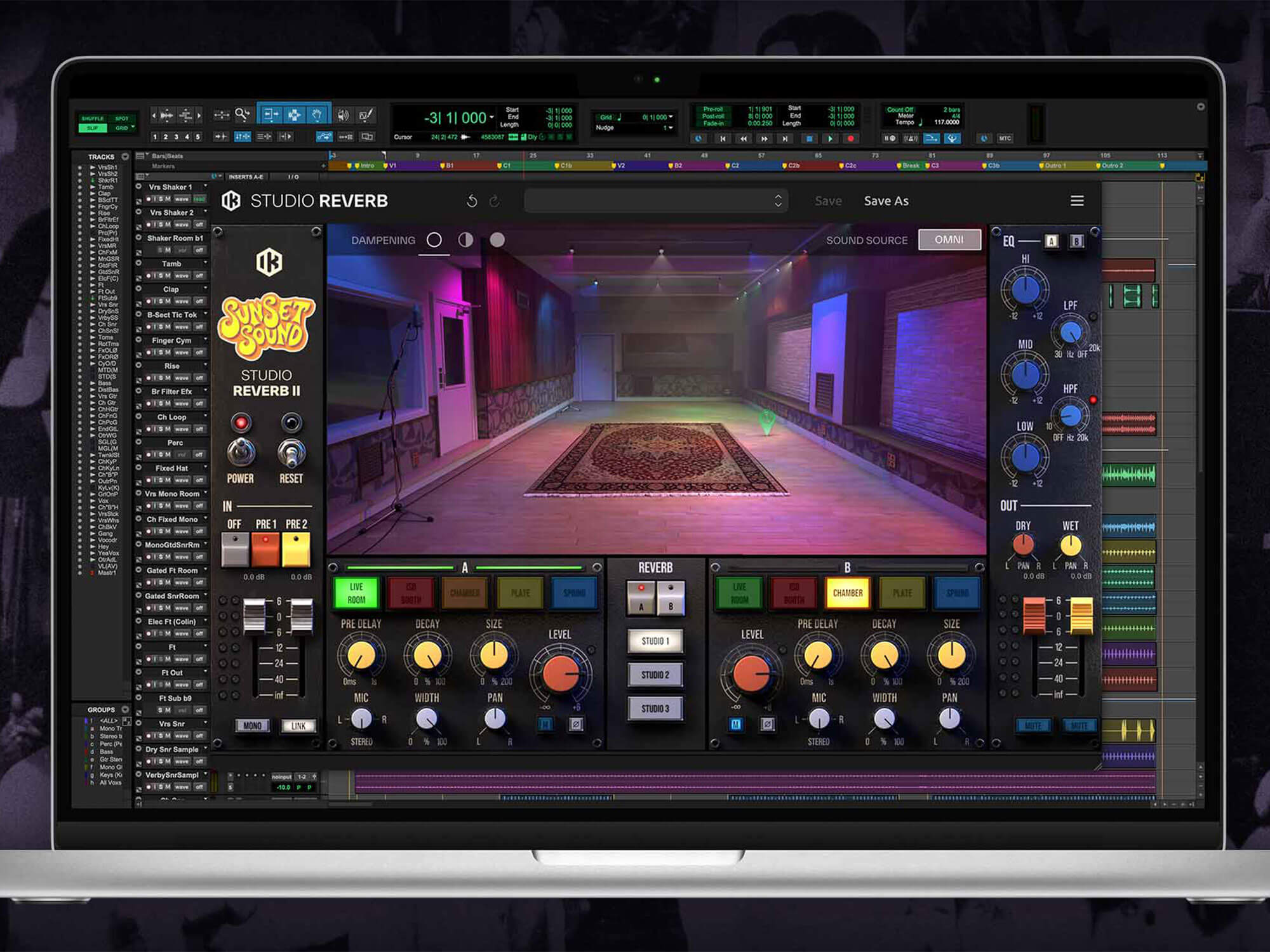
The hallowed Sunset Strip in West Hollywood was instrumental in shaping the sound of the ’70s and ’80s hard rock and hair metal, serving as a crucible where legends like Eddie Van Halen, Randy Rhoads, and Slash honed their craft in its now-legendary nightclubs and venues. Just a few miles away, at 6650 Sunset Boulevard, lies Sunset Sound, the iconic recording studio that has presided over the creation of countless classic albums, including Van Halen’s landmark debut, The Rolling Stones’ Exile on Main St., and Led Zeppelin’s seminal second album. Now, the distinctive sonic footprint of this celebrated studio is being made accessible to a global audience of producers and musicians with the release of Sunset Sound Studio Reverb II, a new standalone reverb plugin from IK Multimedia. This expanded version of IK’s popular T-RackS plugin leverages advanced Volumetric Response Modelling (VRM) technology to meticulously capture the acoustic essence of Sunset Sound’s three primary studios, offering an unprecedented level of authenticity and control to digital audio workstations worldwide.
The Enduring Legacy of Sunset Sound: A Cornerstone of American Music
Sunset Sound’s story is deeply intertwined with the fabric of American popular music. Founded in 1958 by Tutti Camarata, a former Disney musical director and renowned arranger, the studio initially served as a recording facility for Walt Disney Productions, producing soundtracks for films like Mary Poppins and Bambi. However, it quickly evolved beyond its initial purpose, becoming a beacon for rock, pop, and R&B artists seeking its unparalleled acoustics and state-of-the-art equipment. The studio’s prime location, nestled just off the vibrant Sunset Strip, cemented its status as a creative hub during one of the most fertile periods in music history.
Over the decades, Sunset Sound has hosted an extraordinary roster of talent. Beyond the hard rock icons, the studio’s hallowed walls have witnessed the birth of masterpieces from The Beach Boys (Pet Sounds), The Doors (Strange Days, Waiting for the Sun), Prince (Purple Rain, 1999), and countless others. Its unique architecture, custom-built consoles, and carefully designed live rooms contributed to a distinct sonic character that became synonymous with the "California sound" – a blend of warmth, clarity, and spaciousness that lent itself perfectly to everything from intricate vocal harmonies to thunderous drum tracks.
The studio is famously divided into three distinct spaces: Studio 1, Studio 2, and Studio 3, each possessing its own acoustic signature. Studio 1, the largest, is known for its expansive, natural sound, ideal for tracking drums and large ensembles. Studio 2 offers a slightly tighter, more controlled environment, while Studio 3, designed specifically for mixing and overdubs, provides a more intimate and focused acoustic space. This diversity in room acoustics, combined with a meticulous approach to signal chain and engineering, has allowed Sunset Sound to adapt to the evolving demands of music production while maintaining its core sonic integrity. The studio’s commitment to analog excellence, even as digital technology emerged, further solidified its legendary status, making its sound one of the most coveted in the industry.
IK Multimedia’s Quest for Sonic Authenticity: The Volumetric Response Modelling Technology
The challenge of digitally replicating a legendary studio’s acoustic environment is immense. Traditional impulse response (IR) technology, while effective, often struggles to fully capture the complex, multi-dimensional nature of sound propagation within a physical space. IK Multimedia addresses this through its proprietary Volumetric Response Modelling (VRM) technology, which forms the core of Sunset Sound Studio Reverb II.
VRM goes beyond static impulse responses by dynamically mapping the acoustic landscape of a room from numerous vantage points. Instead of simply capturing a single "snapshot" of the room’s reverb, VRM models the three-dimensional space by recording up to 27 distinct live room source positions per studio. Each of these positions is meticulously captured as a unique acoustic event, ensuring that the plugin preserves the authenticity of the impulse response, including its crucial early reflections and precise spatial perspective. IK Multimedia emphasizes that these captures are not mathematically interpolated, but rather genuine recordings, a critical distinction that contributes significantly to the plugin’s realism. This granular approach allows the software to accurately simulate how sound originates from different points within the room, interacts with its surfaces, and ultimately reaches the virtual microphone, providing a sense of depth and realism often lacking in simpler reverb emulations.
Unpacking the Plugin’s Advanced Features and Architectural Design
Sunset Sound Studio Reverb II is engineered with a sophisticated dual-engine architecture, offering unparalleled flexibility in shaping the desired reverberant spaces. This architecture allows for the combination of various classic reverb types and studio spaces, including the distinct Live Rooms of Studios 1, 2, and 3, alongside dedicated Chambers, Iso Booths, and emulations of legendary hardware reverbs such as EMT plates and AKG spring reverbs. Each of these components comes equipped with its own EQ, stereo control, and routing options, empowering users to craft complex and nuanced reverb textures. For instance, a producer could combine the natural ambience of Studio 1’s live room with the dense, smooth decay of an EMT plate, or add the characteristic metallic shimmer of an AKG spring reverb to specific elements, achieving intricate sonic layers that would traditionally require multiple hardware units and dedicated spaces.
A standout feature is the advanced size control, which dynamically scales the impulse response from 0% to 200%. Crucially, this scaling is performed while "preserving the original capture’s tonal fingerprint and spatial behaviour." This means that unlike simple time-stretching, which can often degrade the audio quality and alter the spectral balance, IK Multimedia’s technology maintains the sonic integrity of the original room, allowing users to fine-tune the perceived size of the space without sacrificing authenticity. This provides immense creative freedom, enabling a producer to make a large room sound smaller and more intimate, or to exaggerate the grandeur of a space for dramatic effect, all while retaining the unique character of Sunset Sound.
The plugin also boasts an expanded capture library featuring an impressive 336 live room stereo impulse responses, each meticulously capturing the classic sound heard on countless albums recorded at Sunset Sound. Further enhancing the realism, Sunset Sound Studio Reverb II includes variable acoustic damping modelling for Studios 1 and 3. This feature mimics the adjustable absorption panels found in the real Sunset Sound studios, allowing users to virtually alter the room’s liveness and decay characteristics. This level of detail provides an authentic emulation of how engineers at Sunset Sound would have fine-tuned the room’s acoustics during a session, offering a powerful tool for shaping the overall sonic signature.
Emulating the Legendary Signal Path: Preamps and Consoles
Beyond the rooms themselves, the character of Sunset Sound is also defined by its legendary signal path, particularly its custom-built mixing consoles and preamplifiers. IK Multimedia has meticulously modelled two of these iconic signal paths for Sunset Sound Studio Reverb II, allowing users to infuse their audio with the same coloration and harmonic richness that defined so many classic recordings.

The first emulation is the API/DeMedio Sunset Sound Custom. The American console manufacturer API (Automated Processes Inc.) is revered for its punchy, forward sound, characterized by its 2520 op-amps and proportional Q EQs. At Sunset Sound, these consoles were often custom-built or heavily modified by chief engineer Richard "Dick" DeMedio, making them unique to the studio. This emulation captures the robust low-end, clear midrange, and distinct transient response associated with these bespoke API-based desks, imparting a sense of authority and presence to any signal.
The second emulation is the Class-A Discrete NEVE 8880. Rupert Neve’s designs are synonymous with warmth, clarity, and musicality, largely due to their Class-A discrete circuitry and high-quality transformers. The Neve 8880, while perhaps less widely known than some of Neve’s more famous models, represents a pinnacle of his design philosophy, offering a pristine yet harmonically rich signal path. This emulation provides the smooth, luxurious sound often associated with vintage Neve consoles, adding depth and a subtle sheen to tracks, particularly suited for vocals and acoustic instruments. By offering both these distinct preamp and signal path options, the plugin empowers users to experiment with different sonic textures and dial in the precise character that defined so many of Sunset Sound’s legendary recordings.
User Interface and Workflow Enhancements
The user experience is further enhanced by a redesigned 3D interface. This visual representation offers "immediate feedback while maintaining precise control," allowing engineers and producers to intuitively navigate the various parameters and understand the spatial relationships within the emulated studios. A well-designed graphical interface not only improves workflow but also helps users visualize the impact of their adjustments, making the process of shaping reverb more engaging and efficient.
From T-RackS to Standalone: Accessibility and Evolution
Sunset Sound Studio Reverb II arrives as an expanded and standalone version of IK Multimedia’s popular T-RackS plugin. The T-RackS platform is IK’s comprehensive mixing and mastering suite, offering a wide array of high-quality processors, including compressors, EQs, limiters, and other studio effects. While the original Sunset Sound Reverb was a component within this ecosystem, its release as a standalone plugin signifies a broader commitment to accessibility and integration.
This standalone version means that users who may not require the full T-RackS suite can still purchase and utilize this powerful reverb in any compatible digital audio workstation (DAW) that supports VST, AU, or AAX formats. This move aligns with a broader industry trend towards modularity and user choice, allowing producers to integrate specific, high-quality tools into their preferred workflow without being tied to a larger, potentially unnecessary, bundle. IK Multimedia has a strong track record in studio emulation, having previously released acclaimed plugins based on other legendary facilities like Abbey Road and FAME Studios, underscoring their expertise and dedication to preserving the sonic heritage of music production through advanced digital modelling.
Broader Implications for Modern Music Production
The release of plugins like Sunset Sound Studio Reverb II holds significant implications for the landscape of modern music production. Firstly, it represents a continued democratization of classic studio sounds. Historically, access to legendary studios like Sunset Sound was reserved for major label artists with substantial budgets. Now, home studio producers and independent musicians can infuse their tracks with the same iconic acoustics for a fraction of the cost, leveling the playing field and fostering greater creative freedom.
Secondly, these tools play a crucial role in preserving sonic heritage. As physical studios face economic pressures and the industry evolves, meticulously modelled plugins ensure that the unique acoustics and legendary gear of these hallowed spaces are immortalized and remain accessible to future generations of musicians. It allows for the study and replication of classic sounds, providing a bridge between historical production techniques and contemporary digital workflows.
Finally, the increasing sophistication of modelling technology, as exemplified by VRM, pushes the boundaries of what is possible in digital audio. The ability to dynamically scale room size, combine diverse reverb types, and emulate specific signal paths with such accuracy offers engineers and artists unprecedented control and flexibility. This not only facilitates the creation of music that sounds professionally mixed and mastered but also inspires new creative approaches, allowing for experimentation with spatialization and tonal coloration that were once the exclusive domain of elite studios.
Pricing and Availability
Sunset Sound Studio Reverb II is available now for $/€149.99. This investment grants users access to a meticulously crafted emulation of one of the most iconic recording studios in history, offering a powerful and versatile tool for shaping the spatial and tonal characteristics of their audio. For more information and to purchase the plugin, interested parties can visit IK Multimedia’s official website.
In conclusion, IK Multimedia’s Sunset Sound Studio Reverb II is more than just a reverb plugin; it is a digital portal to a legendary era of music production. By combining deep historical reverence with cutting-edge Volumetric Response Modelling technology, IK Multimedia has created a tool that not only replicates the hallowed acoustics of Sunset Sound but also empowers a new generation of producers to infuse their music with the magic and timeless quality of one of the industry’s most revered sonic temples.