

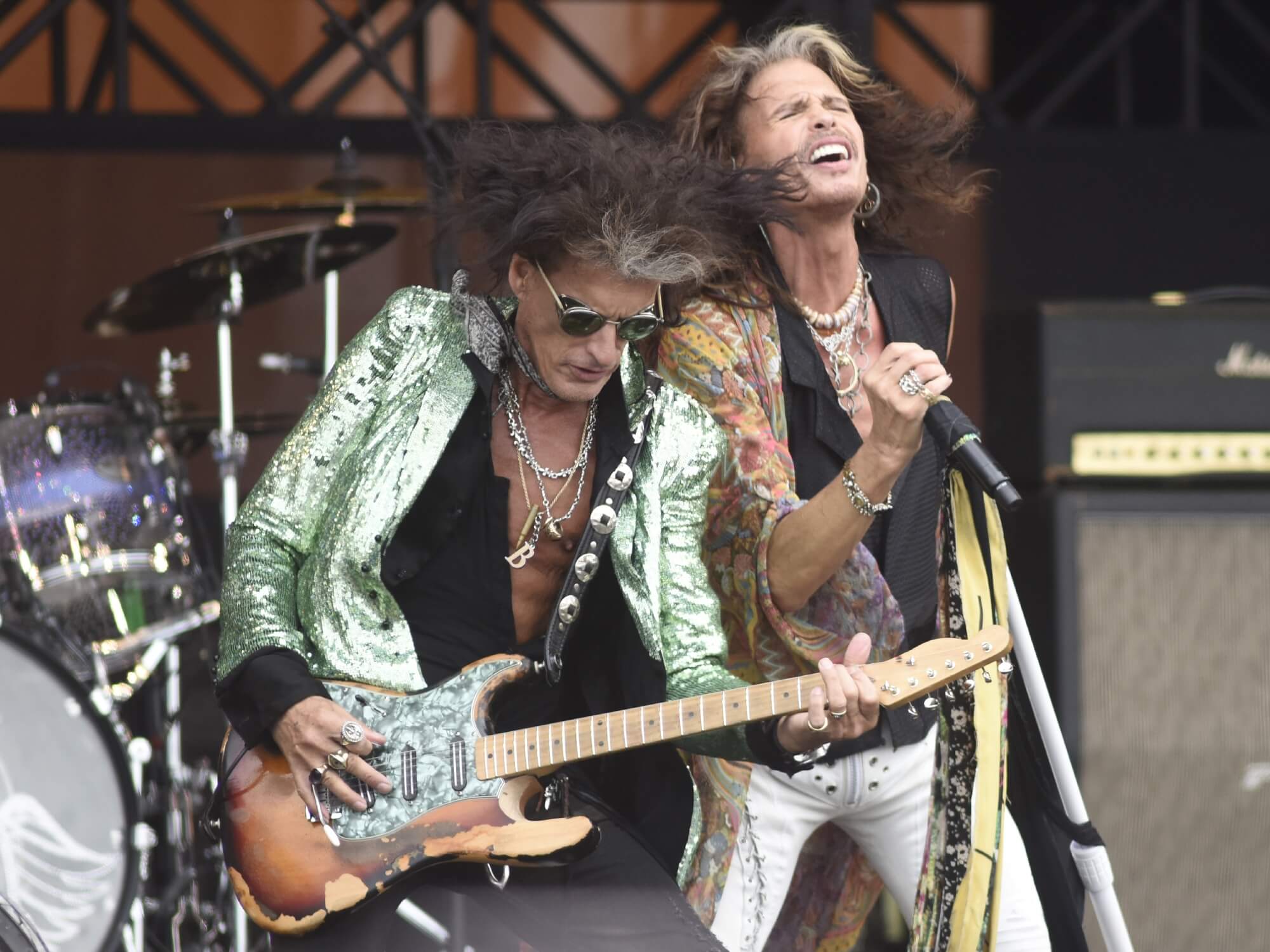
Aerosmith guitarist Joe Perry, a veteran of over five decades in the tumultuous world of rock and roll, recently shared an account of one of his most memorable on-stage mishaps: the dramatic destruction and subsequent resurrection of a cherished vintage instrument. This incident, involving a black 1956 Gibson Les Paul Junior double-cutaway, occurred during a festival performance in the pre-wireless era, highlighting both the unpredictable nature of live rock shows and Perry’s deep connection to his instruments. The acclaimed guitarist also shed light on the personal narrative behind another prized possession, a custom Gibson BB King Lucille dedicated to his wife, Billie Paulette Montgomery, showcasing the profound sentimental value that can be imbued into a musician’s tools of the trade.
The Airborne Incident: A ’56 Gibson Junior’s Untimely Descent
The incident Perry described, recounted in an interview with Guitar World, centered on a specific guitar that holds a special place in his collection. "I’m pretty sure it’s a ’56," Perry stated, detailing his black Gibson Les Paul Junior double-cutaway. This particular model, characterized by its original cherry stain finish (not a sunburst), features a single P90 pickup—a configuration renowned for its raw, powerful tone. Perry emphasized its appeal, noting, "It’s just volume, tone and a P90, and it screams. I was lucky enough to get two of them." He acquired these Juniors in the mid-Seventies, drawn to their formidable sound and the legacy of other iconic players like Johnny Thunders of the New York Dolls and Leslie West of Mountain, who famously wielded similar instruments to great effect.
The chaotic moment unfolded during a festival performance. In an impromptu burst of rock and roll exuberance at the conclusion of a song, Perry tossed the Gibson Junior into the air. What began as a seemingly cool, spontaneous gesture quickly devolved into a moment of horror. "This was before wireless, so it went to the end of the patch cord and came down on the neck — and the headstock snapped off," Perry recalled, a hint of wry amusement now tempering the memory of initial panic. His internal monologue shifted dramatically mid-air: from "Wow, I can’t believe it. That looks so cool," to a frantic "Holy shit, what did I do?" as gravity asserted its undeniable force.
The immediate aftermath saw an escalation of the chaos. Aerosmith frontman Steven Tyler, known for his flamboyant stage presence and impulsive actions, reportedly grabbed the now-broken instrument with the intention of tossing it into the audience. This act, while perhaps stemming from a desire to amplify the moment’s raw energy, posed a significant threat to the guitar’s potential for repair. Perry, recognizing the intrinsic value and fixability of his instrument, intervened swiftly. "After it came down and was broken, Steven grabbed it and wanted to throw it out into the audience, so I had to wrestle him for it," Perry recounted, underscoring his quick thinking and dedication to his gear. His conviction that the guitar could be salvaged proved correct; he recovered the pieces and entrusted them to his guitar technician, ensuring that the show, and the instrument’s life, could indeed go on.
The Enduring Appeal of the Gibson Les Paul Junior
The 1956 Gibson Les Paul Junior, the victim of Perry’s airborne misadventure, is far more than just a simple "student model" as it was originally conceived. Introduced by Gibson in 1954, the Les Paul Junior was designed to be an affordable, no-frills entry point for aspiring guitarists. However, its straightforward design—a solid mahogany body and neck, a single P90 pickup, and minimalist volume and tone controls—belied a powerful sonic capability that quickly endeared it to professional musicians seeking raw, unadulterated tone.
Perry’s particular model, a double-cutaway from 1956, represents an evolution from the initial single-cutaway design. The double-cutaway, introduced that year, offered improved access to the upper frets, enhancing playability. The P90 pickup, a Gibson innovation from the late 1940s, is a single-coil design with a fatter, more aggressive sound than traditional Fender single-coils, yet it retains a clarity and bite distinct from humbuckers. Its output is robust, allowing it to drive amplifiers into natural overdrive with ease, hence Perry’s description that it "screams." This characteristic made it a favorite among blues, punk, and hard rock players who valued its directness and refusal to be polite.
The influence of musicians like Johnny Thunders and Leslie West on Perry’s appreciation for the Junior is significant. Thunders, with his raw, rebellious style in the New York Dolls and The Heartbreakers, epitomized the punk ethos of stripping down rock and roll to its essentials, a philosophy perfectly embodied by the Junior. West, known for his thick, blues-infused hard rock riffs with Mountain, showcased the Junior’s capability for massive, sustaining tones. These artists demonstrated that the Junior, despite its humble origins, was a serious rock and roll machine, capable of delivering immense musical impact with minimal fuss. The cherry stain finish, typical of many Gibson models of the era, further adds to its vintage authenticity and aesthetic appeal, making Perry’s ’56 Junior a truly iconic piece of gear.
The Perils of Performance: A Pre-Wireless Era Perspective
Perry’s recollection of the incident being "before wireless" technology provides crucial context for understanding the dynamics of live performances in the mid-Seventies. The absence of wireless guitar systems meant that musicians were tethered to their amplifiers and pedalboards by physical patch cords. These cables, while essential for transmitting the guitar’s signal, also imposed significant limitations on a performer’s movement and stage antics. A typical guitar cable length might range from 10 to 20 feet, defining a relatively restricted radius for a guitarist.
In an era defined by raw energy and theatricality, artists often pushed these boundaries. The act of throwing a guitar, a gesture popularized by pioneers like Pete Townshend of The Who and Jimi Hendrix, was a powerful visual statement—a blend of artistic expression, frustration, and rock and roll abandon. However, when executed with a wired instrument, the cable became a dangerous tether, capable of snapping, pulling, or, as in Perry’s case, acting as a pendulum that dictates the instrument’s catastrophic return to earth. The sudden jolt of the guitar reaching the end of its cable, combined with the momentum of the throw, placed immense stress on the instrument’s structural weakest points, particularly the headstock-to-neck joint, a notoriously vulnerable area for many Gibson models due to their angled headstock design.
Festival settings further amplified the potential for such mishaps. Large stages, expansive crowds, and the heightened adrenaline of performing to thousands of fans often led to more uninhibited and spontaneous actions. The sheer energy of an Aerosmith performance in the mid-Seventies, a period where they were cementing their status as rock titans with albums like Toys in the Attic and Rocks, would have been immense. Such an environment, while electrifying, also increased the margin for error, making Perry’s "horrifying and hilarious" moment a quintessential example of the controlled chaos inherent in live rock music before technological advancements offered greater freedom of movement. Modern wireless systems, which became increasingly common from the late 1970s and 1980s onwards, would have largely mitigated the specific mechanics of Perry’s accident, allowing the guitar to travel freely without the cable acting as a destructive anchor.
The Art of Repair and the Value of Preservation
Perry’s immediate decision to "wrestle" Steven Tyler for the broken guitar, coupled with his certainty that "we could fix it," speaks volumes about the value he places on his instruments and the professional ecosystem surrounding touring musicians. For a vintage guitar like a 1956 Gibson Les Paul Junior, the damage, while severe, was not necessarily irreparable. Headstock breaks are a relatively common ailment for many Gibson guitars due to the specific angle of their headstock and the grain of the mahogany wood. However, a skilled luthier or guitar technician can often perform a repair that restores the instrument’s structural integrity, playability, and even much of its original tone.
The role of a dedicated guitar technician in a high-profile touring band like Aerosmith is indispensable. These professionals are responsible not only for routine maintenance and setup but also for crisis management, including emergency repairs. Perry entrusting the "pieces" to his "guy" highlights the specialized expertise required to undertake such a restoration. A professional repair would involve carefully gluing the broken parts, often reinforcing the joint with splines or other internal supports, and then meticulous finishing to blend the repair visually. While a repaired headstock might affect an instrument’s collector value slightly, for a working musician, a professionally repaired guitar remains a vital tool, often retaining its sonic characteristics and sentimental significance. Perry’s foresight prevented the guitar from being lost to the audience and ensured its continued life as a part of his legendary arsenal, transforming a moment of destruction into a testament to resilience and craftsmanship.
Beyond the Fray: The "Billie Lucille" – A Tribute in Six Strings
Beyond the tale of the broken Junior, Perry also shared the origins of another treasured instrument: a custom Gibson BB King Lucille, affectionately named "Billie Lucille" in honor of his wife, Billie Paulette Montgomery. This guitar, acquired in the 1990s, is a deeply personal piece that marries Perry’s love for history with his devotion to his wife. The inspiration behind its unique artwork stems from the "nose art" tradition of World War I and II. Pilots during these conflicts would adorn the noses of their aircraft with personalized artwork—often images of pin-up girls, cartoon characters, or portraits of their wives or sweethearts—naming their planes after these figures. This practice served as a morale booster, a personal talisman, and a unique form of self-expression in the high-stakes environment of aerial combat. Perry, fascinated by this historical custom, saw a parallel opportunity to personalize his own "vehicle" of expression: his guitar. "I thought, ‘Why not do that with my guitar?’" he mused, translating a wartime tradition into a rock and roll tribute.
The choice of a Gibson BB King Lucille as the base for this custom creation is noteworthy. The Lucille model, famously played by the legendary bluesman B.B. King for decades, is a distinctive instrument. Unlike standard ES-335-style guitars, Lucille models typically feature no f-holes, which B.B. King preferred to reduce feedback at high volumes. They also often include a Varitone switch for tonal variations, stereo output, and a fine-tuning tailpiece. While Perry’s custom version is undoubtedly modified to his specifications, the underlying Lucille platform signifies a connection to blues heritage and a robust, versatile instrument.
The intricate artwork, featuring Billie’s face on the lower bout of the guitar, was skillfully executed by John Douglas, who notably served as Joey Kramer’s drum technician. This detail highlights the collaborative and often multi-talented nature of a band’s crew, where various members contribute to the overall artistic and technical needs of the group. The unveiling of the "Billie Lucille" to Billie herself was a memorable occasion. "She had no idea this was going on!" Perry recounted. "Billie just stood there for a second, and they came out with this guitar case and said, ‘Close your eyes.’ We opened it up, and she turned beet red."
Billie’s initial reaction was one of profound embarrassment, reflecting her preference for a life away from the intense glare of the spotlight. "Long story short, she wouldn’t come out when I’d put the guitar on; she’d kind of leave the side of the stage because she was so embarrassed about it," Perry explained. However, over time, she reportedly grew accustomed to the unique tribute. The "Billie Lucille" thus stands as a powerful testament to the enduring bond between Joe and Billie Perry, a public declaration of affection integrated into his professional life, embodying the intersection of personal narrative and rock and roll mythology. It is not merely an instrument but a deeply personal artifact, a symbol of enduring love etched into wood and wire.
Joe Perry’s Legendary Collection and the Culture of Guitars
Joe Perry’s anecdote about the broken Junior and the "Billie Lucille" offers a glimpse into the extensive and deeply personal relationship he maintains with his instruments. As a collector with over 600 guitars, Perry embodies a significant aspect of rock and roll culture: the musician’s profound connection to their gear. For artists of Perry’s caliber, guitars are not merely tools; they are extensions of their artistic voice, historical artifacts, and tangible repositories of memories.
The phenomenon of rock stars amassing large guitar collections is multifaceted. Firstly, it stems from practical necessity; different guitars offer distinct tonal palettes and feel, allowing musicians to achieve specific sounds for various songs or recording sessions. Perry’s diverse array of instruments, likely including his iconic Gibson Les Pauls, Fender Stratocasters, Telecasters, and numerous other vintage and custom pieces, enables him to explore a vast sonic landscape. Secondly, guitars hold immense historical value. Many of Perry’s instruments are likely vintage models, representing significant eras in guitar manufacturing and design. Owning such pieces connects him directly to the lineage of rock and roll and blues history.
Furthermore, guitars become investments. Rare and vintage instruments appreciate in value, making them tangible assets. More importantly, for musicians like Perry, they are deeply personal passions. Each guitar often carries its own story, its own set of memories from performances, recordings, or simply the circumstances of its acquisition. The "Billie Lucille" is a prime example of an instrument infused with deeply personal meaning, transforming it from a mere object into a cherished symbol. Perry’s status as a guitar icon is not solely derived from his distinctive playing style, which blends blues, hard rock, and raw energy, but also from his profound appreciation for the instruments themselves—their history, their craftsmanship, and their unique capacity to inspire and convey emotion. His stories underscore the enduring allure of the electric guitar, both as a powerful instrument of musical expression and as a canvas for personal narrative within the grand tapestry of rock and roll.