

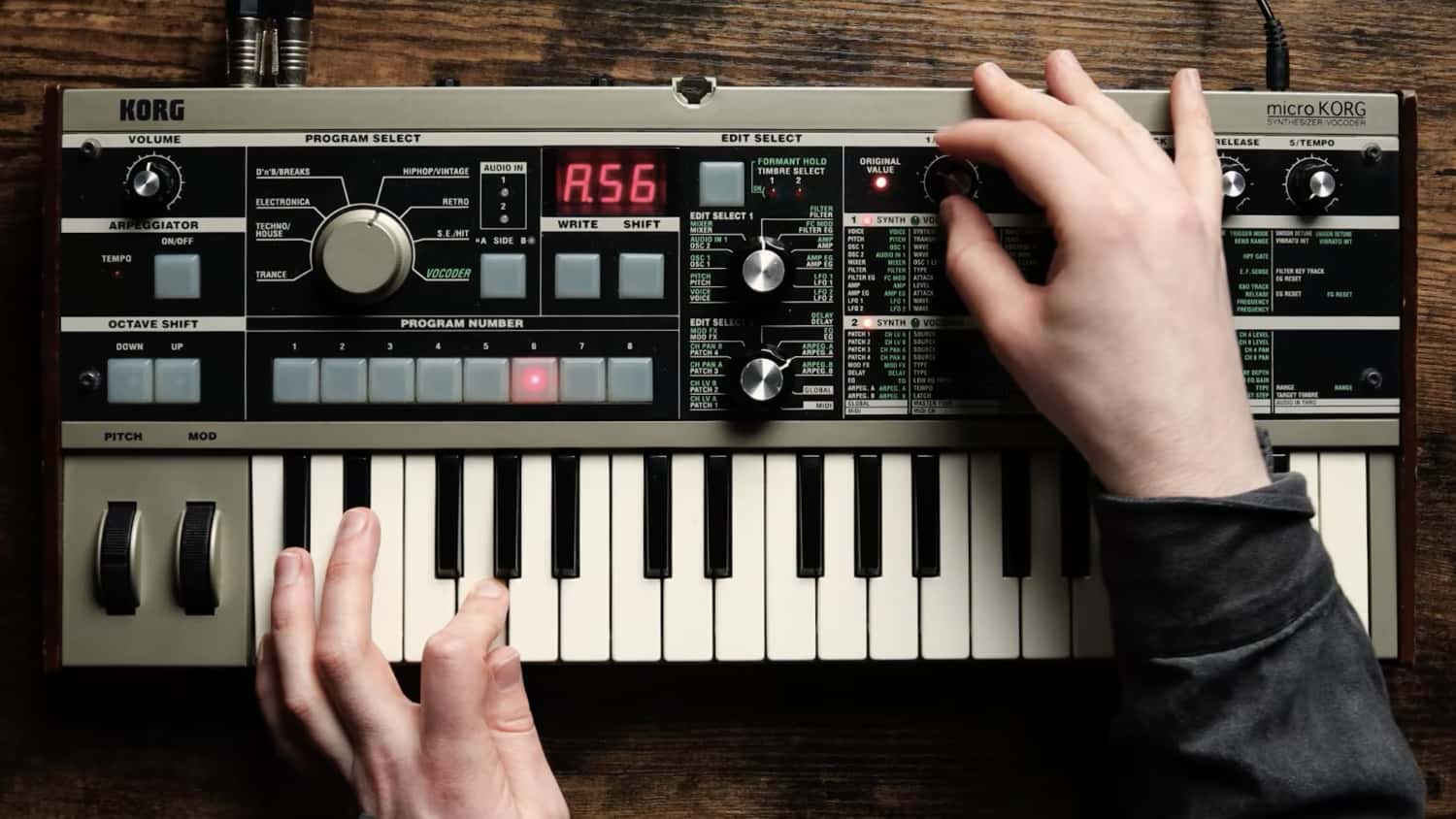
The Genesis and Historical Context of the microKorg
To understand the impact of the microKorg, one must look back at the landscape of the synthesizer market at the turn of the millennium. In the late 1990s, the "Virtual Analog" (VA) revolution was in full swing, led by high-end instruments like the Clavia Nord Lead and the Roland JP-8000. These machines sought to replicate the behavior of classic voltage-controlled oscillators and filters using digital signal processing (DSP). In 2000, Korg released the MS-2000, a physically large, knob-laden synthesizer that utilized the Multi-Modeling Technology (MMT) engine. While the MS-2000 was a critical success, it was bulky and relatively expensive for the burgeoning bedroom producer market.
In 2002, Korg engineers made the strategic decision to take the internal sound engine of the MS-2000 and transplant it into a much smaller, portable chassis. The result was the microKorg. By utilizing a "matrix-based" editing system instead of a dedicated knob for every function, Korg was able to reduce the manufacturing costs significantly. The instrument debuted with a retro-futuristic aesthetic, featuring wooden side panels and a beige interface that paid homage to the classic Korg MS-20 and VC-10 vocoder. It was an immediate commercial success, bridging the gap between professional synthesis and the consumer electronics market.
Technical Specifications and Sound Architecture
The core of the microKorg’s longevity lies in its flexible sound engine. It is a four-voice polyphonic synthesizer (two-voice when layered) that employs a dual-oscillator system. The first oscillator (Osc 1) is surprisingly robust, offering more than just the standard sawtooth and square waves. It includes 7 basic analog-modeled waveforms and a suite of 64 DWGS (Digital Waveform Generator System) waves, which were originally developed for Korg’s DW-8000 in the mid-1980s. These digital waveforms allow the microKorg to produce bell-like tones, electric pianos, and complex digital textures that standard analog synthesizers struggle to replicate.
The second oscillator (Osc 2) adds further complexity through ring modulation and synchronization options, allowing for the aggressive, harmonically rich lead sounds synonymous with early 2000s electronic music. The filter section features a multi-mode resonant filter capable of -24 dB/octave low-pass, -12 dB/octave low-pass, band-pass, and high-pass configurations. This versatility is augmented by two ADSR envelope generators and two MIDI-syncable LFOs.
One of the most praised aspects of the microKorg, as noted in the recent review by The Unperson, is its modulation matrix. Despite the limited physical controls, the internal routing allows for four "Virtual Patches." This enables users to route sources like LFOs or envelopes to various destinations such as pitch, filter cutoff, or pan, providing a level of sound design depth that belies the instrument’s simple appearance.
The Iconic Vocoder and Arpeggiator
A defining feature of the microKorg is its integrated eight-band vocoder. Shipped with a specialized gooseneck microphone that plugs directly into the top panel, the vocoder became the instrument’s "killer app." At the time of its release, affordable hardware vocoders were rare. The microKorg’s vocoder allowed musicians to achieve the "robot voice" effects popularized by artists like Daft Punk and Kraftwerk with minimal setup.
The vocoder also includes a "Formant Hold" function, which allows the user to freeze the vocal characteristics of a sound and play them across the keyboard. This feature, combined with the flexible arpeggiator—which offers six different patterns (Up, Down, Alt1, Alt2, Random, and Trigger) and adjustable gate times—made the microKorg a favorite for live performers in the electro-clash and indie-rock scenes of the mid-2000s.
A Chronology of the microKorg Product Line
The original microKorg’s success was so sustained that Korg was hesitant to replace it, choosing instead to iterate on the design over the subsequent two decades:
- 2002: The Original microKorg. The classic beige model with the MS-2000 engine.
- 2007: microKorg BK. A limited-edition "Black" version released to celebrate its ongoing popularity.
- 2009: microKorg XL. A significant update featuring the MMT engine from the Korg Radias and R3. It offered 8-voice polyphony and a more modern "Rhodes-style" aesthetic but lacked the exact sonic grit of the original.
- 2011: microKorg XL+. An incremental update to the XL with improved internal PCM sounds, focusing on vintage keyboards and strings.
- 2016: microKorg S. This version reintroduced the original sound engine but added built-in speakers and an expanded memory bank for 256 presets (192 presets and 64 user locations).
- 2022: 20th Anniversary Edition (Crystal). A commemorative model featuring a translucent chassis and knobs, highlighting the instrument’s status as a design icon.
- 2024: microKorg 2. Announced as the first true generational successor, featuring a full-color screen, a loop recorder, and a vocal processor with pitch correction.
Despite these updates, the original 2002 model remains in production and continues to sell, a feat almost unheard of in the tech-heavy world of digital synthesis.
Cultural Impact and Professional Adoption
The microKorg’s influence extends far beyond the hobbyist market. It became a ubiquitous presence on stage for some of the most successful acts of the 21st century. Bands such as The Killers, LCD Soundsystem, Arcade Fire, and Tame Impala have all utilized the microKorg for both studio recordings and live performances. Brandon Flowers of The Killers famously used the microKorg for the iconic synth lines on "Hot Fuss," proving that the "toy" synth was capable of stadium-filling sound.
The instrument’s appeal in the professional sphere is attributed to its reliability and portability. In an era where software synthesizers and laptops became common on stage, the microKorg offered a dedicated, crash-proof hardware solution that could easily fit into a backpack or a carry-on suitcase. Its ability to run on six AA batteries further cemented its reputation as the ultimate "go-anywhere" synthesizer.
Critical Analysis: Nostalgia vs. Performance
In the video review by The Unperson, the creator addresses a common debate: is the microKorg’s current popularity driven by nostalgia, or does it still hold up against modern competitors? The analysis concludes that the microKorg’s sound engine possesses a unique "character" that modern, more polished virtual analogs often lack. The slight aliasing and the specific "crunch" of the early-2000s Korg converters contribute to a sound that sits well in a mix without requiring excessive processing.
The review also highlights the "hands-on" limitations as a hidden strength. While the matrix editing system is often criticized for being slow, it encourages a different type of sound design—one based on intentionality rather than aimless knob-twiddling. The Unperson notes that the depth of the engine, particularly the FX section (which includes three types of modulation effects, three types of delay, and a two-band EQ), allows the microKorg to compete with contemporary synths like the Arturia MicroFreak or the Novation Bass Station II.
Market Longevity and Economic Implications
The microKorg represents a rare case of "perfect design" in the musical instrument industry. From an economic standpoint, Korg’s ability to keep the same basic hardware in production for over 20 years has allowed them to amortize the research and development costs to an extreme degree. This has kept the price point stable and accessible, usually hovering around the $400 mark, making it a frequent "first synth" for many musicians.
Furthermore, the secondary market for microKorgs remains incredibly active. Unlike many digital synthesizers from the early 2000s that have depreciated significantly, the microKorg maintains a high resale value due to its iconic status and the ease of finding replacement parts.
Broader Industry Implications and Future Outlook
The success of the microKorg fundamentally changed how synthesizer manufacturers approached the market. It proved that there was a massive demand for "mini" instruments, leading to the creation of entire product lines like the Roland Boutique series, the Yamaha Reface series, and Korg’s own Volca line. The industry realized that portability and ease of use were just as important to many consumers as raw voice count or complex front-panel layouts.
As Korg prepares to push the "microKorg 2" into the mainstream market, the original unit stands as a testament to the power of a well-executed idea. Whether viewed through the lens of the "The Unperson" review or through the history of modern pop music, the microKorg has transcended its original purpose. It is no longer just a budget-friendly virtual analog synthesizer; it is a cultural artifact that defined the sound of an era and continues to provide a gateway for new generations of synthesists to explore the world of electronic sound design. The consensus among experts and users alike is clear: the microKorg’s iconic status is not merely the result of nostalgia, but a byproduct of a deep, high-quality sound engine that remains as relevant today as it was in 2002.