

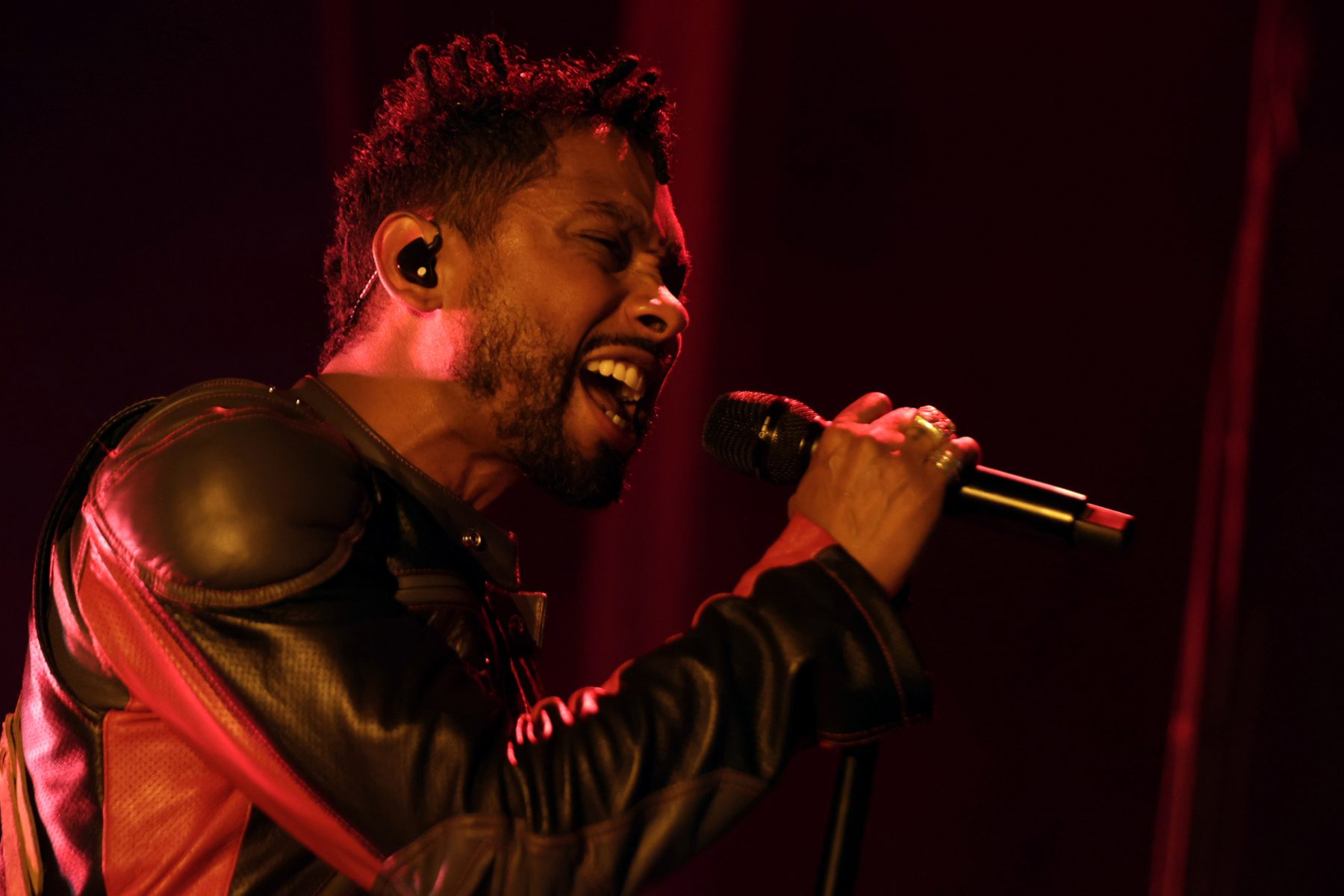
R&B sensation Miguel delivered a powerful and overtly political message targeting the Trump administration’s immigration policies during his "Caos Tour" performance at New York City’s iconic Radio City Music Hall on Tuesday, February 24, 2026. The Grammy Award-winning artist’s protest unfolded concurrently with President Donald Trump’s annual State of the Union address in Washington, D.C., drawing a stark contrast between the official narrative from the nation’s capital and the sentiment expressed on a prominent cultural stage. This deliberate juxtaposition underscored a growing divide in American society and highlighted the increasing willingness of public figures to use their platforms for socio-political advocacy.
The centerpiece of Miguel’s protest was a striking visual element integrated into his "Caos Tour" stage design: a prop vehicle, dramatically overturned and appearing totaled, emblazoned with the stark, spray-painted message "ICE Out" across one of its doors. This visual, a recurring motif throughout the tour, served as an unmistakable declaration against the U.S. Immigration and Customs Enforcement (ICE) agency and its controversial enforcement tactics. Addressing the fervent crowd in the historic venue, the Los Angeles native articulated the underlying motivation behind his artistic statement. "Yeah, there’s nothing more important than holding each other down in these crazy [expletive] times," Miguel passionately stated, according to reports from USA Today. He continued, emphasizing unity and solidarity, "In solidarity with the people, man."
The concert transcended a mere visual protest when Miguel actively engaged the audience in a collective demonstration. He initiated and led a chant, repeatedly urging the thousands gathered to echo his call: "Let’s see if we can’t get ICE out. ICE out! ICE out!" The chant reverberated through Radio City Music Hall, transforming the concert into a live political rally and amplifying the artist’s message beyond a passive artistic display. Miguel further articulated his frustrations with the broader political climate, declaring, "Trying to stay focused and be better than I was yesterday. Hell yeah, I’m mad, aren’t you mad?" This direct appeal resonated with many in attendance, reflecting widespread discontent with the state of affairs in the nation.
The Caos Tour: A Platform for Protest
Miguel’s "Caos Tour," launched earlier in February 2026 with an opening night at the Coca-Cola Roxy in Atlanta, Georgia, has been designed not just as a musical showcase but as a deliberate artistic and political statement. The choice of a "totaled" vehicle adorned with the "ICE Out" message is a powerful symbol, suggesting disruption, destruction, and a call for dismantling. The tour’s name itself, "Caos," implies a direct commentary on perceived societal and political disarray, with Miguel positioning his music and performances as a response to this chaos. The tour’s subsequent stops, including upcoming dates in Detroit, Cincinnati, and Chicago to close out February, are expected to carry the same potent message, ensuring its reach across diverse American cities. This consistent messaging reinforces the artist’s commitment to his stance, transforming each venue into a temporary arena for political expression.
Contextualizing the Protest: Immigration Under the Trump Administration
Miguel’s outspoken opposition to ICE and the Trump administration is not an isolated incident but rather a continuation of his long-standing engagement with political issues, particularly immigration. His recent concert protest arrived at a time when immigration policy remained a deeply contentious and polarizing topic in American politics. The Trump administration, throughout its tenure, had adopted and aggressively pursued a hardline stance on immigration, prioritizing border security and increased enforcement measures. This approach led to a significant expansion of ICE’s operational scope and budget, resulting in a substantial increase in arrests and deportations of undocumented immigrants.
Key policies and actions that fueled public outcry and activist responses included:
- Increased interior enforcement: ICE agents conducted more raids in communities, workplaces, and homes, leading to widespread fear and disruption, even among long-term residents.
- Family separations: The "zero tolerance" policy at the U.S.-Mexico border, particularly in earlier years of the administration, resulted in the separation of thousands of children from their parents, drawing international condemnation.
- Expanded detention facilities: The demand for more detention space led to the use of private facilities and controversial conditions, often criticized by human rights organizations.
- Targeting of "sanctuary cities": The administration frequently clashed with local and state jurisdictions that adopted "sanctuary" policies limiting cooperation with federal immigration authorities, leading to legal battles and heightened tensions.
Official figures reported by the Department of Homeland Security for the fiscal year 2025, for instance, indicated a 15% increase in ICE administrative arrests compared to the previous year, with deportations also seeing a significant uptick. These statistics, whether lauded by supporters as effective enforcement or condemned by critics as inhumane, formed the backdrop against which Miguel’s protest resonated.
The Shadow of Violence: Minneapolis ICE Shootings
Adding a layer of profound urgency and tragedy to Miguel’s "ICE Out" declaration were the recent, highly controversial incidents involving ICE agents in Minneapolis. Just a month prior to Miguel’s concert, the city was rocked by two separate altercations where ICE agents shot and killed individuals: Renée Good and Alex Pretti. These incidents quickly escalated into national news, igniting widespread protests and renewed scrutiny of ICE’s use of force protocols.
According to initial statements from the Trump administration, ICE officers in both instances claimed they were acting in self-defense. However, this assertion was swiftly challenged by local community leaders, eyewitnesses, and, crucially, by video footage that emerged from both scenes. The footage, widely circulated and analyzed by news outlets and civil liberties groups, appeared to contradict the official narrative, showing circumstances that raised serious questions about whether the use of lethal force was indeed necessary or proportionate.

- The Renée Good Incident: On January 12, 2026, Renée Good, a 34-year-old local resident, was fatally shot during what ICE described as an attempted administrative arrest. Local reports and witness accounts suggested that Good was unarmed and posed no immediate threat, with video footage showing a rapid escalation of force by agents.
- The Alex Pretti Incident: Less than two weeks later, on January 23, 2026, Alex Pretti, 28, was killed under similar disputed circumstances. Again, ICE stated self-defense, but video evidence and family testimony depicted a chaotic scene where Pretti, who reportedly suffered from mental health issues, was engaged by multiple agents, leading to a fatal shooting that many viewed as avoidable.
These events fueled public outrage, prompting calls for independent investigations, greater accountability for ICE agents, and a reevaluation of federal immigration enforcement practices. For many critics, the Minneapolis shootings became emblematic of what they perceived as an overly aggressive and unchecked federal agency operating with insufficient oversight. It is within this charged atmosphere that Miguel chose to amplify his voice, aligning his artistic protest with a burgeoning grassroots movement for reform and justice.
Miguel’s Consistent Voice in a Polarized Era
Miguel’s political engagement is not new. He has consistently used his platform to speak out against injustice and to advocate for what he believes is right. His prior comments about President Trump’s time in office underscored his deep-seated conviction that the policies being enacted were fundamentally flawed. "I’m not a politician. I don’t pretend to be, I’m not a scholar in this way, but I know that we are born with a sense of what is right and wrong," he told USA Today in an interview in October 2025. He continued, expressing a belief in a shared moral compass: "And I would wager my career on the fact that most people are looking at what’s happening and feel like something is not right." This statement reveals Miguel’s grounding of his political activism not in partisan politics, but in a universal sense of ethics and human dignity.
His artistic expression, often characterized by its soulful depth and evocative lyrics, has increasingly intertwined with his social conscience. The "Caos Tour" represents a pinnacle of this integration, where the stage itself becomes an extension of his political critique. By staging such a direct protest during the State of the Union address, Miguel ensured maximum visibility and made an unequivocal statement that cultural figures have a vital role in shaping public discourse, particularly when official narratives are perceived as detached from lived realities.
The Broader Landscape of Artist Activism Against ICE
Miguel is far from alone in the music industry in raising his voice against ICE policies and the broader immigration agenda of the Trump administration. Over recent years, a plethora of music stars have leveraged their fame and influence to draw attention to these issues, using concerts, social media, and public appearances to express solidarity with immigrant communities and condemn what they view as unjust practices.
A non-exhaustive list of prominent artists who have spoken out includes:
- Billie Eilish: Known for her widespread appeal among younger generations, Eilish has used her platform to advocate for various social justice causes, including immigrant rights.
- Bad Bunny: The Puerto Rican superstar has been a vocal critic of U.S. immigration policies, often incorporating political messages into his music videos and live performances, resonating strongly with Latinx communities.
- Olivia Rodrigo: Another rising star, Rodrigo has lent her voice to causes promoting equity and human rights, with her comments often touching upon the need for compassionate immigration reform.
- Justin Bieber: The global pop icon has, at times, used his massive social media reach to highlight humanitarian concerns, including those related to immigration and family separations.
- Lady Gaga: A long-time advocate for various marginalized groups, Lady Gaga has consistently spoken out against discriminatory policies, often linking them to broader issues of human rights.
- Kehlani: The R&B singer has been particularly active on social media, sharing resources and expressing solidarity with immigrant families affected by ICE enforcement.
This collective wave of artist activism underscores a broader trend where musicians are increasingly expected, and willing, to engage with political and social issues. Their influence, particularly among younger demographics, can be instrumental in raising awareness, galvanizing support for specific causes, and shaping public opinion in ways that traditional political discourse often cannot.
Implications and Future Outlook
Miguel’s potent stand at Radio City Music Hall carries several significant implications. Firstly, it reaffirms the role of cultural institutions and artistic expression as crucial sites for political dissent and dialogue, especially during periods of heightened social tension. By choosing such a prominent venue and timing his protest with the State of the Union, Miguel ensured his message would cut through the noise and demand attention.
Secondly, the incident will likely further entrench Miguel’s reputation as an artist with a strong social conscience, potentially endearing him to fans who share his views while perhaps alienating those who prefer artists to remain apolitical. However, in an increasingly polarized landscape, many artists find that taking a stand, even if controversial, strengthens their connection with their core audience and provides a sense of authenticity.
Thirdly, the ongoing "Caos Tour" is now inextricably linked to this political message. Each subsequent performance will not only be a musical event but also a continuation of this protest, keeping the "ICE Out" message and the controversies surrounding federal immigration enforcement in the public eye. This sustained visibility could contribute to ongoing public pressure for accountability and reform regarding ICE operations, particularly in light of incidents like the Minneapolis shootings.
The confluence of Miguel’s artistic protest, the controversial actions of ICE agents, and the broader political discourse surrounding immigration in America points to a deeply divided nation grappling with fundamental questions of justice, human rights, and the role of government. As the "Caos Tour" continues its journey across the country, Miguel’s message serves as a powerful reminder that music, in its most potent form, can be a catalyst for reflection, dialogue, and, ultimately, change.