

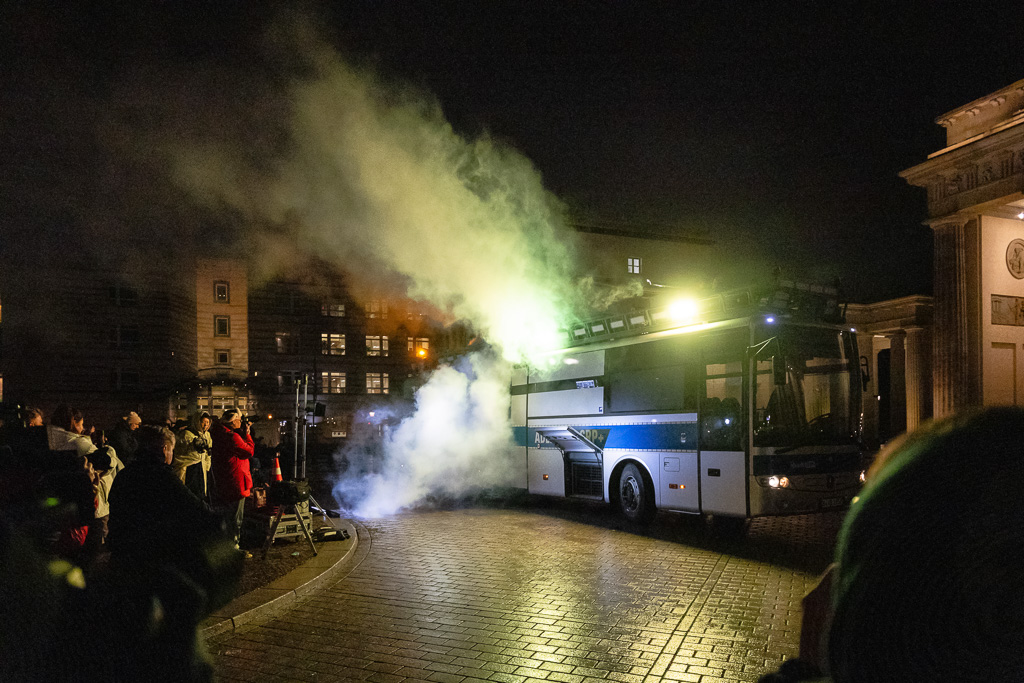
The intersection of professional event technology and political activism has reached a new milestone with the deployment of the Adenauer SRP+, a mobile tactical unit and exhibition space designed to advocate for a ban on the Alternative for Germany (AfD) party. Developed by the Center for Political Beauty (Zentrum für Politische Schönheit, or ZPS), the vehicle represents a departure from traditional political campaigning, replacing standard brand briefings with artistic freedom and meticulous technical engineering. Since its launch in January 2025, the project has evolved from a temporary roadshow into a permanent fixture of German civil society activism, utilizing state-of-the-art stage technology to broadcast its message across the federal republic.
Conceptual Framework and Historical Context
The Adenauer SRP+ is not merely a promotional vehicle; it is designed as a "command post for civil society." The name itself is a deliberate historical reference to the early years of the Federal Republic of Germany. In 1952, under the chancellorship of Konrad Adenauer, the Federal Constitutional Court banned the Socialist Reich Party (SRP), a neo-Nazi organization, following a ten-day trial. By appending "SRP+" to Adenauer’s name, the ZPS highlights what it views as a contemporary necessity: the use of constitutional mechanisms to protect democracy from far-right movements.
Visually, the vehicle is modeled after a prisoner transport bus, a choice intended to provoke reflection on the legal consequences of anti-constitutional activity. The aesthetic is heavily influenced by the transport units used in high-profile criminal cases, such as the incarceration of NSU member Beate Zschäpe. To achieve this, the team repurposed a French school bus, undergoing an intensive six-week conversion process that integrated high-end audio-visual equipment into a rugged, industrial frame.
Technical Specifications: A Masterpiece of Custom Engineering
The technical complexity of the Adenauer SRP+ rivals that of major corporate product launches or large-scale music festivals. The project was executed by a team of industry professionals—including creative directors, lighting designers, and sound engineers—who applied their expertise to a non-commercial cause.
Audio and Sound Reinforcement
The audio system is a central component of the vehicle’s "Aktionsmodus" (Action Mode). The team integrated a high-performance sound system featuring top-tier components from Lambda Lab. Because the vehicle must adhere to a four-meter height restriction for road travel, the top-mounted speakers are installed on a pneumatic system. These units can be raised and stacked vertically for directional projection during rallies or festivals, or deployed on both sides for wide-area coverage.
For low-frequency reinforcement, custom-made subwoofers were built into the bus’s side storage compartments—spaces originally designed by Mercedes-Benz for luggage but now housing powerful bass units. In mid-2025, the team further expanded these capabilities by developing a "bass trailer" featuring twelve double-18-inch subwoofers, powered by high-performance amplification sought from within the event industry.
Lighting and Projection Technology
The vehicle utilizes professional-grade theater and concert lighting to maximize its visual impact. A notable addition to the arsenal is the Robert Juliat Aramis follow spot, typically used in large-scale theatrical productions. The ZPS team repurposed this unit as a gobo projector, citing its "brutal" exterior aesthetic and its ability to project crisp, high-intensity images over long distances. Plans are currently underway to permanently mount a similar spot on the roof, controllable from the interior like a tank turret.
To minimize friction during police inspections, the lighting arrays are motorized. When the vehicle is in transit, all external lights are folded inward and disconnected from power, ensuring they cannot be classified as illegal auxiliary vehicle lighting.
Pneumatics and Automation
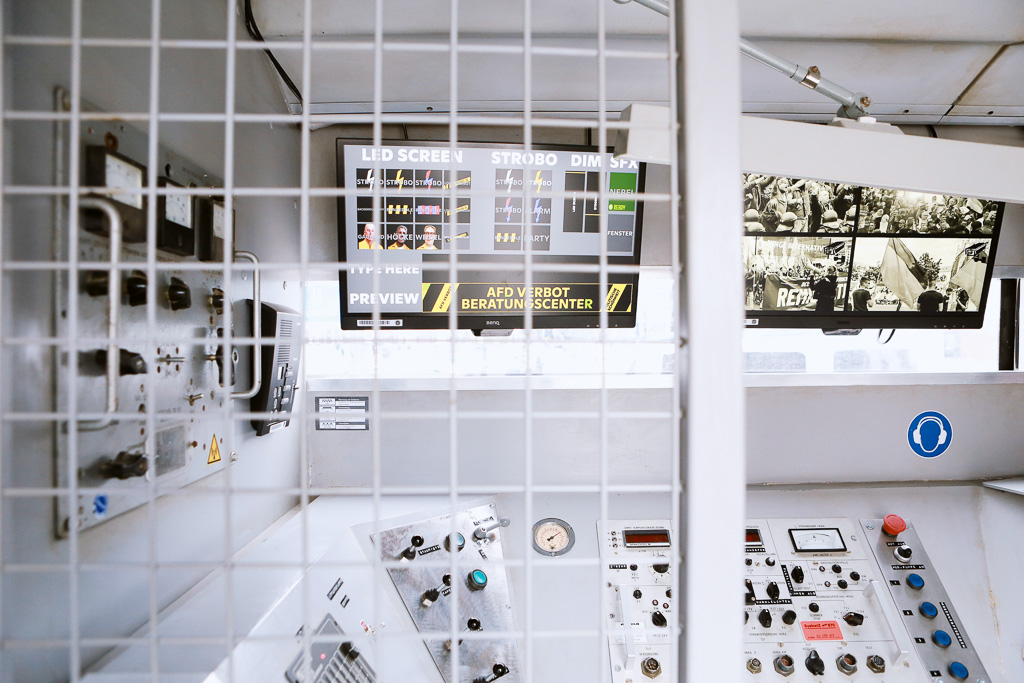
A defining feature of the Adenauer SRP+ is its ability to transition from a standard-looking bus to a fully operational stage in seconds without personnel having to exit the vehicle. This is achieved through a complex system of pneumatic actuators and crane-style remote controls. The LED walls, speaker stacks, and floodlights are all deployed via internal controls, a safety measure designed to protect the crew in potentially hostile environments.
Chronology of Operations and Conflict
The deployment of the Adenauer SRP+ has been marked by a series of high-profile "missions" and significant pushback from law enforcement agencies.
January 10, 2025: Berlin Premiere
The vehicle was first presented to the public at the Brandenburg Gate. The presentation was described as a "disaster scenario" simulation, featuring a soundscape of sirens, Nazi-era marches, and contemporary quotes from AfD leadership juxtaposed with historical quotes from the Third Reich. The event utilized the bus’s LED screens to display thousands of pieces of evidence collected by the ZPS regarding the party’s alleged anti-constitutional activities.
January 11, 2025: The Riesa Standoff
The bus traveled to Riesa for an AfD party congress. After a three-hour police inspection, the crew engaged in an act of civil disobedience. During a moment of police inattention, the bus was positioned across the main access road for delegates. The crew claimed a "mechanical failure," preventing the bus from being moved and delaying the start of the congress by several hours. This incident cemented the vehicle’s reputation as a tool for tactical disruption.
November 2025: Gießen and Technical Refinement
During an intervention in Gießen, the team tested new projection techniques. The success of these tests led to the current phase of technical upgrades, focusing on long-range optical projection and autonomous power systems that allow the bus to operate for extended periods without external generators.
Legal Hurdles and Official Responses
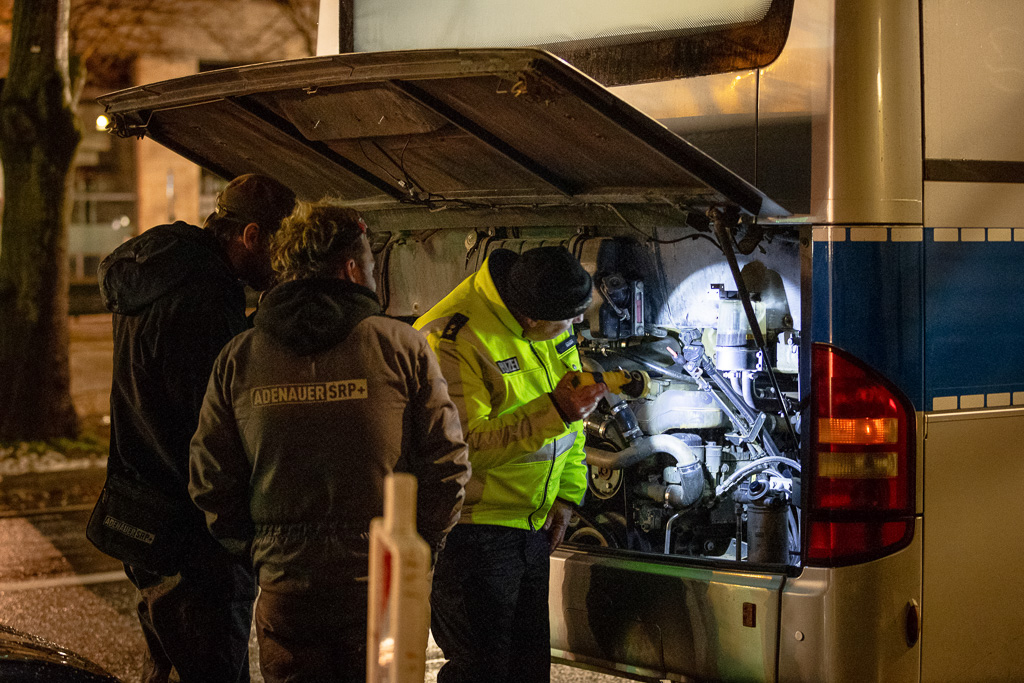
The Adenauer SRP+ has faced unprecedented scrutiny from transport authorities and law enforcement. In its first six weeks of operation, the vehicle was subjected to over 20 police inspections. It was towed twice, confiscated once, and on one occasion, law enforcement officers broke a window to gain entry.
The Center for Political Beauty has accused the police of using "administrative harassment" to stifle political protest. In response to these claims, five separate full inspections (Vollgutachten) were conducted by DEKRA and other regulatory bodies. These inspections—the fifth of which was attended by parliamentary observers and media representatives—consistently found the vehicle to be roadworthy and compliant with safety regulations, provided the roof-mounted "cargo" remained retracted during transit. The legal battle over the bus eventually reached the Berlin Senate, highlighting the tension between public safety regulations and the right to artistic and political expression.
Funding and Civil Support
The project’s financial model serves as a case study in modern political crowdfunding. The purchase of the bus, its initial conversion, and the first phase of the tour were funded by more than 10,000 individual investors. The initial funding goal was reached in less than 24 hours, demonstrating significant public appetite for direct-action political art.
The bus also serves as a "mobile exhibition." The interior features a "prisoner wing" where visitors can interact with a database of evidence against the AfD. This dual-purpose design—part tactical tool, part educational center—has led to hundreds of booking requests from civic groups across Germany.
Analysis of Broader Impact on the Event Industry
The Adenauer SRP+ project offers several critical takeaways for the professional event and communications industry. Creative Director Arne Heyen, who played a central role in the project, suggests that the event industry’s obsession with DIN norms and bureaucratic planning often stifles innovation.
"In the corporate world, these processes are often painstakingly slow and over-complicated," Heyen noted. "With the Adenauer, we bought a bus, converted it, and got it through a rigorous technical inspection in six weeks. That is almost unthinkable in our traditional industry."
Furthermore, the project challenges communication professionals to consider the social utility of their skills. The Adenauer SRP+ demonstrates that the tools of high-end brand staging—audio-visual immersion, narrative storytelling, and logistical precision—are equally effective when applied to constitutional defense and political discourse.
Conclusion and Future Outlook
Originally intended to conclude with the federal elections, the tour of the Adenauer SRP+ has been extended indefinitely. As of March 2026, the vehicle continues to receive upgrades, including a modular "multifunction port" on the roof for live performances and a new "studio" for media representatives and podcasters.
The project remains a polarizing but undeniable force in German political life. By combining the "perfection of German engineering" with the unpredictability of performance art, the ZPS has created a mobile monument to the "militant democracy" (wehrhafte Demokratie) envisioned by the founders of the German constitution. Whether it will ultimately influence the legal proceedings for a party ban remains a matter of intense debate, but its impact on the methodology of political protest and event technology is already firmly established.