

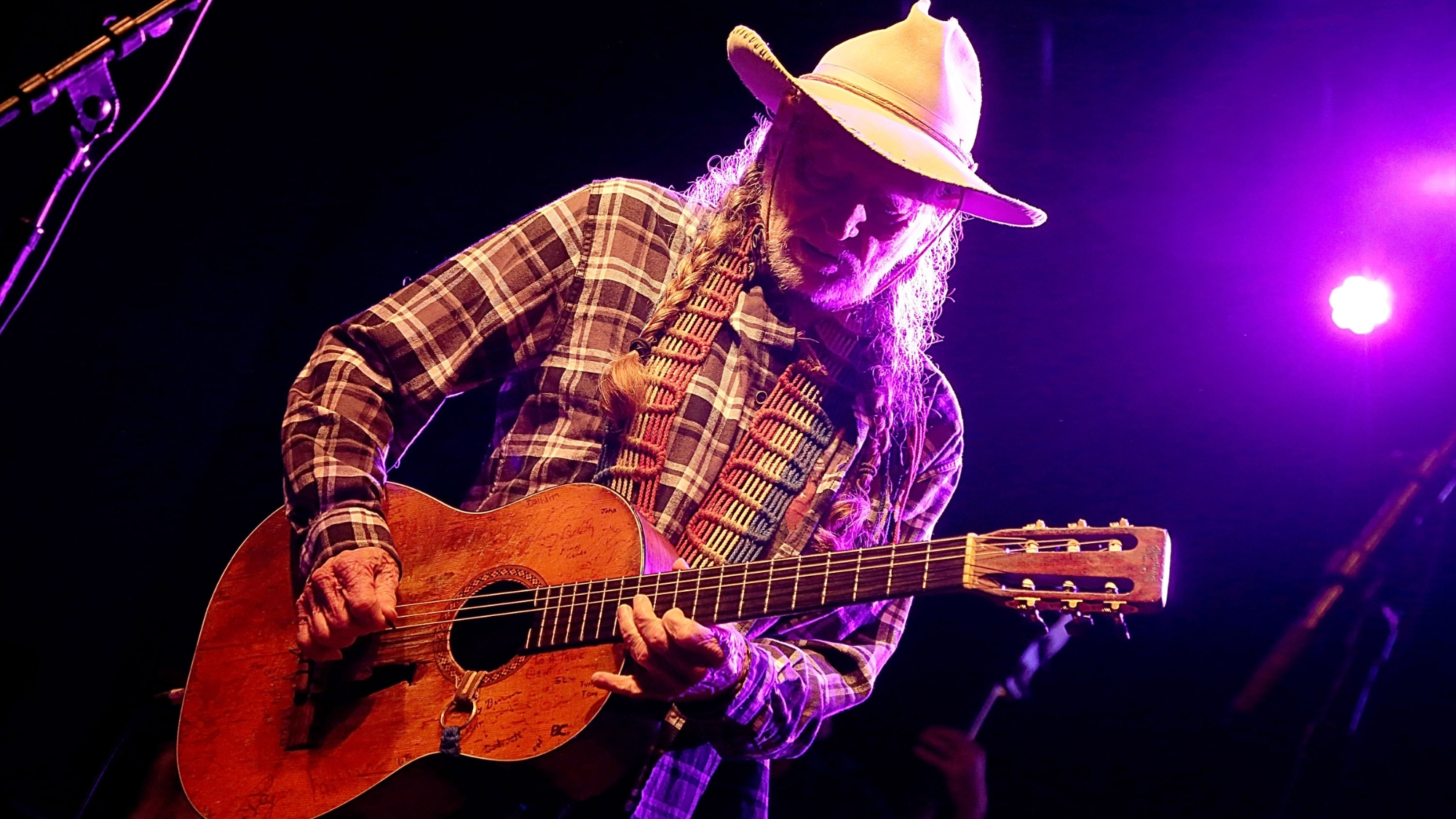
The history of American country music is often told through the lens of its iconic vocalists, yet the sonic landscape of the genre was largely constructed by a handful of master craftsmen and session musicians who worked behind the scenes. Among the most influential of these figures was Harold “Shot” Jackson, a luthier, inventor, and virtuoso whose contributions fundamentally altered the trajectory of the “Nashville Sound.” While Jackson is perhaps most widely recognized by the general public for providing Willie Nelson with his legendary guitar, “Trigger,” his impact on the industry spans decades of technical innovation and instrumental mastery that helped define the golden era of country music.
The 1969 Incident: The Genesis of Trigger
In 1969, the course of music history was altered during a performance at Floore’s Country Store in Helotes, Texas. At the time, Willie Nelson was utilizing a Baldwin 800C nylon-string acoustic guitar equipped with a Prismatone pickup. During the set, a heavily intoxicated audience member accidentally stepped on the instrument, causing catastrophic structural damage. Nelson, who had become reliant on the specific amplified tone of the Baldwin, sent the guitar to Nashville with two members of his road crew to seek repairs.
The instrument was delivered to the workshop of Harold “Shot” Jackson. Upon inspection, Jackson determined that the Baldwin’s spruce top and internal bracing were damaged beyond the point of a viable or cost-effective restoration. However, Jackson possessed a keen understanding of Nelson’s stylistic requirements, specifically his desire to emulate the gypsy-jazz tonalities of Django Reinhardt while maintaining the volume necessary for honky-tonk environments.
Jackson offered Nelson a compromise: a 1969 Martin N-20 nylon-string classical guitar. The N-20 featured a solid Sitka spruce top and back and sides crafted from Brazilian rosewood—a material now highly regulated and prized for its exceptional resonance. Crucially, Jackson salvaged the Prismatone pickup and the bridge from the shattered Baldwin and installed them into the Martin. This hybrid instrument, which Nelson subsequently named “Trigger” after Roy Rogers’ horse, has remained Nelson’s primary instrument for over 55 years. The unique combination of a classical body with a specific electric pickup created a signature sound—mellow yet biting—that became the cornerstone of the “Outlaw Country” movement.
The Early Life and Formative Years of Harold Jackson
Harold Bradley Jackson was born on September 4, 1920, in Wilmington, North Carolina. His early years were spent in Blackshear, Georgia, where his family relocated shortly after his birth. It was during his childhood in Georgia that he earned the nickname “Buckshot,” a moniker reportedly given to him by a family member due to his energetic and precocious nature. Over time, the name was shortened to “Shot,” a handle that would follow him throughout his professional life in Nashville.
Jackson’s entry into the world of professional music was driven by the burgeoning influence of the Grand Ole Opry. Like many rural Southerners of the era, the weekly radio broadcasts from Nashville served as a primary source of inspiration. By 1941, Jackson had secured his first professional engagement as a member of a house band for a local country radio station. His proficiency on the guitar and his developing interest in the steel guitar quickly marked him as a talent to watch.
In 1944, Jackson made the pivotal move to Nashville. He was hired by Cousin Wilbur Westbrooks to perform at the Grand Ole Opry, marking his debut on the world’s most prestigious country music stage. Although his career was briefly interrupted by service in the United States Navy during World War II, he returned to the music industry with renewed focus, eventually landing a position with the Bailes Brothers on the Louisiana Hayride. This Shreveport-based program was a significant rival to the Opry and served as a launchpad for legends like Elvis Presley and Hank Williams.
Innovation and the Birth of Sho-Bud Guitars
While Jackson’s reputation as a performer was formidable, his legacy as an innovator is perhaps even more significant. In the mid-1950s, the steel guitar was undergoing a radical evolution. Musicians were looking for ways to change the pitch of strings mid-performance to achieve more complex chords and fluid transitions.
In 1955, Jackson partnered with fellow steel guitarist Buddy Emmons to found the Sho-Bud Guitar Company. Operating initially out of a small garage in Madison, Tennessee, the company focused on the design and manufacture of pedal steel guitars. The name “Sho-Bud” was a portmanteau of their first names—Shot and Buddy.
Sho-Bud became a revolutionary force in the industry. Jackson and Emmons developed the permanent linkage system, which allowed for greater tuning stability and more intricate pedal configurations. These instruments were essential to the development of the “Nashville Sound” of the 1960s—a style characterized by smooth, sophisticated arrangements, background vocals, and the distinctive, weeping glissando of the pedal steel.
By the time Emmons left the company in 1963, Sho-Bud had established itself as the premier brand for professional steel players. Jackson transitioned the business into a family-run operation, bringing his sons, Harry and David, into the fold. The Sho-Bud shop, located near the Ryman Auditorium, became a cultural hub for Nashville’s elite. It was common for Opry stars to cross the alley after their performances to congregate in the shop, discussing technical specifications and sharing stories of life on the road.
A Prolific Career in the Studio and on Stage
Throughout the 1950s and 60s, Shot Jackson was one of the most sought-after session musicians in Nashville. His versatility allowed him to move seamlessly between the Dobro (a resonator guitar) and the electric steel guitar.
In the late 1940s and early 1950s, Jackson was a core member of Johnnie & Jack’s Tennessee Mountain Boys. His Dobro playing on hits like “Poison Love” provided a rhythmic and melodic texture that bridged the gap between traditional mountain music and modern country. During this same period, he contributed to the early recordings of Kitty Wells, the “Queen of Country Music.” His work on her 1952 breakthrough “It Wasn’t God Who Made Honky Tonk Angels” helped establish the instrumental standard for female country vocalists.
In the 1960s, Jackson’s career reached new heights as a member of Roy Acuff’s Smoky Mountain Boys. Acuff, often called the “King of Country Music,” relied on Jackson’s instrumental prowess to maintain the group’s traditional yet polished sound. Jackson also recorded a series of successful duets and albums with Melba Montgomery and George Jones, further cementing his status as a pillar of the Nashville recording community.
Technical Implications and Historical Analysis
The collaboration between Shot Jackson and Willie Nelson regarding the Martin N-20 serves as a case study in the importance of luthier intervention in musical history. The N-20 was not a common instrument in country music; it was a classical guitar designed for fingerstyle performance of European art music. Jackson’s decision to modify it for Nelson’s needs was a radical departure from the norm.
The longevity of Trigger—which has undergone dozens of repairs over the decades to keep its fragile cedar top from collapsing—is a testament to the initial quality of Jackson’s work. The guitar now features a large hole worn through the wood above the bridge, caused by decades of Nelson’s flatpicking on a surface not protected by a pickguard. This "second sound hole" has become part of the instrument’s acoustic identity, a phenomenon that many modern luthiers attribute to the specific way Jackson braced the internal components during the 1969 modification.
Furthermore, the Sho-Bud legacy continues to influence instrument design. Modern pedal steels still utilize the fundamental mechanical principles popularized by Jackson. His ability to translate the needs of a performer into the language of a machinist allowed country music to transition from a regional folk style into a globally competitive commercial genre.
Legacy and Final Years
Harold “Shot” Jackson continued to work in the industry until health issues slowed his output. He suffered a stroke in 1983, which limited his ability to perform, though he remained a respected figure in the Nashville community. On January 24, 1991, Jackson passed away at the age of 70 following a second stroke.
His death marked the end of an era, but his influence remains ubiquitous. Every time Willie Nelson takes the stage with Trigger, or a pedal steel player executes a soaring bend on a modern recording, the ghost of Jackson’s craftsmanship is present. He was more than just a repairman or a backup musician; he was an architect of the sound that defined the American South for the better part of a century.
Today, Shot Jackson is remembered not only for the instruments he built but for the integrity and technical curiosity he brought to the craft. His life story reflects the broader evolution of Nashville from a small radio town into the "Music City" of the world, a transformation he helped engineer one string and one pedal at a time.
