

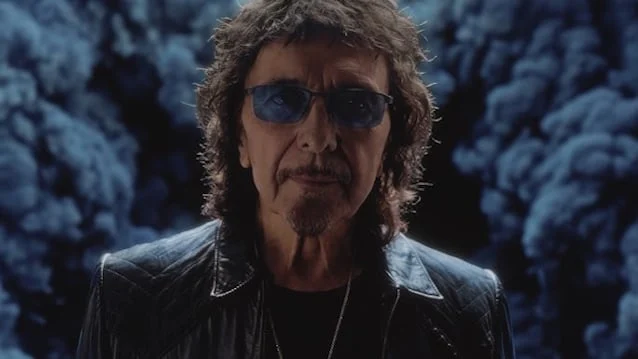
Tony Iommi, the legendary guitarist and founding member of Black Sabbath, has revealed a significant piece of the band’s later history: he turned down the chance to record a final Black Sabbath album with the original lineup, a potential follow-up to their 2013 comeback LP, "13." The revelation, made in an interview with Classic Rock magazine, sheds new light on the band’s final years and the internal dynamics that ultimately led to their farewell tour rather than a final studio offering.
The circumstances surrounding "13" itself were already marked by internal discord. Original Black Sabbath drummer Bill Ward was notably absent from the album due to a contractual dispute. While Ward had initially been part of the 2011 reunion of the band’s core members, he withdrew in early 2012. At the time, Ward described the offered contract as an "unsignable contract" that he felt did not adequately reflect his contributions and historical significance to Black Sabbath. His absence meant that "13" featured the vocal talents of Ozzy Osbourne, the guitar prowess of Tony Iommi, and the basslines of Geezer Butler, but with Rage Against the Machine’s Brad Wilk handling the drum duties and Ozzy’s regular touring drummer, Tommy Clufetos, filling in for live performances.
Iommi explained to Classic Rock that the proposition for a new album came in the early 2020s from Andrew Watt, a producer who had recently collaborated with Osbourne on his solo albums, "Ordinary Man" (2020) and "Patient Number 9" (2022). Watt, described by Iommi as "very keen and a bit too excited," approached the guitarist with the idea of bringing the original lineup back into the studio. However, Iommi expressed reservations, citing his past experiences and a general sentiment of finality after "13."
"I’d met Andrew Watt when he was producing Ozzy," Iommi stated. "He was very keen and a bit too excited. He also didn’t know what it was like working with the original Sabbath, working with Bill. Also, we’d done ’13,’ and I didn’t like the idea of: ‘Now here’s another album.’" This sentiment suggests a desire to avoid repeating past difficulties and perhaps a feeling that the band had already achieved a fitting conclusion with "13."
The Triumphant Return and Its Aftermath
The release of "13" in June 2013 marked a significant moment for Black Sabbath. It was the first studio album in 35 years to feature the original trio of Osbourne, Iommi, and Butler. The album achieved considerable commercial success, topping the Billboard album chart and marking the band’s first-ever number one album in the United States. In the United Kingdom, "13" also debuted at number one, a feat not achieved by Black Sabbath since their iconic album "Paranoid" in October 1970, a gap of 43 years. This success underscored the enduring appeal and legacy of the band.
Despite the critical and commercial acclaim for "13," the path forward was not straightforward. While the band initially hinted at the possibility of recording a follow-up and even suggested they had songs in development, these discussions eventually faded. Instead, Black Sabbath announced and embarked on their farewell tour, "The End," which commenced in early 2016.
Ozzy Osbourne himself had previously alluded to the scrapped album plans. In comments to The Pulse Of Radio, he explained the decision to prioritize the farewell tour over another album. "We were gonna do one before the tour, but it would take three or four years to write and record an album," Osbourne stated. "And so we decided just to do a farewell tour. If we did an album and it went to No. 2, people would go, ‘It’s over.’ There’s only one more place you can go after No. 1 and that’s No. 2, you know." This perspective highlights a strategic consideration of maintaining the band’s peak legacy rather than risking a perceived decline in chart performance.
Osbourne had also expressed caution regarding future album possibilities in earlier interviews. In 2015, speaking to NOLA.com, he remarked, "I don’t want to say there’s going to be another album, because I don’t want you to ask me in another year, ‘What happened when you said you were going to do another record?’" This indicates a desire to manage expectations and avoid making promises that might not be fulfilled.
However, there were periods where the possibility of another album seemed more concrete. In May 2014, Osbourne told The National in Abu Dhabi that he was open to the idea. "You know what? If we have another album in us, I would do it," he said. "To be honest with you, I haven’t talked to the rest of the guys about whether they want to do another album with me. We didn’t sit down and plan our next move. But I am up for it. If they say, ‘Let’s do another album,’ then I don’t mind. But at the same time, I have my own solo career, which is doing great, so I always want to work on that. Time is not on my side anymore, so I want to put all my irons in the fire and whatever comes out the hottest, then I will just go for it."
At a similar time, bassist Geezer Butler also indicated a willingness to explore further studio work. He revealed that the band had a head start on new material, noting, "We’ve still got four tracks left over from [’13’]. So maybe we’ll fill in the other four or five tracks and put out another album – if it’s right. We wouldn’t do it just for the sake of it, or the money or whatever. But yeah, maybe." This suggests that creative material was not necessarily the barrier to a potential follow-up.
Reflections on "13" and Producer Dynamics
Ozzy Osbourne’s reflections on the "13" album itself have been nuanced, with some reservations. In a 2022 interview with Stereogum, when asked if he felt good about how "13" concluded the band’s studio output, he responded, "Not really, because, to be perfectly honest, I didn’t really get a charge from the album." He elaborated on his experience working with producer Rick Rubin, stating, "Although [producer] Rick Rubin is a good friend of mine, I wasn’t really… I was just singing. It was like stepping back in time, but it wasn’t a glorious period." Osbourne also expressed regret over Bill Ward’s absence, feeling that "It wasn’t really a Black Sabbath album" in the truest sense due to the drumming situation. He further critiqued the recording process, noting, "We’d gone right back past the point where we took charge, back to when someone else had full control of our recording. Which we never did from ‘Vol. 4’ onwards."
Geezer Butler also shared his perspective on Rubin’s production approach in an April 2022 appearance on SiriusXM’s "Trunk Nation With Eddie Trunk." Butler described the experience as "weird," particularly Rubin’s instruction to "forget that you’re a heavy metal band." He recounted Rubin playing them their very first album and suggesting they imagine the new record as a follow-up to that early sound, a concept Butler found "ridiculous."
Butler detailed the often frustrating creative process with Rubin, noting, "I still don’t know what he did. It’s, like, ‘Yeah, that’s good.’ ‘No, don’t do that.’ And you go, ‘Why?’ [And he’d say], ‘Just don’t do it.’" He shared an anecdote where Osbourne became frustrated after being asked to re-record vocals multiple times, questioning the need for further takes if the initial ones were deemed "great." Butler also mentioned Iommi’s dissatisfaction with Rubin’s attempts to influence his guitar playing and amp choices, with Rubin insisting on vintage 1968 amplifiers. "It’s mad," Butler commented, "But it’s good for publicity and it’s good for the record company. If you’ve got Rick Rubin involved, then it must be good, kind of thing."
Conversely, in an official documentary about the making of "13," Butler offered a more complimentary view of working with Rubin, stating, "It’s great with Rick Rubin in charge. He’s got a great track record and he comes up with some great ideas. Some work, some don’t, but it’s worth trying." This highlights a potentially evolving perspective or a recognition of the collaborative effort.
Tony Iommi’s own recollections of working with Rubin, shared in a 2013 interview with Guitar Player magazine, painted a picture of a producer who was hands-off during the writing phase but intensely involved during recording. "It was fine once we got used to him," Iommi said. "We didn’t know how he was going to work, because through the writing period, we didn’t see a lot of him." He described Rubin’s brief studio visits, where he would offer concise feedback or direct the band to try variations. Iommi admitted the band struggled to accept criticism from someone they hadn’t worked with before, but ultimately found the process beneficial. "He just pushes that much more, and that’s difficult for a band like us," Iommi explained. "We’ve been around so long, it’s hard to accept criticism from somebody we’ve never worked with. But we did, and it was good. It was really good." He also detailed how Rubin would sometimes direct them to rework parts extensively, only to discard them, leaving the band uncertain about his ultimate choices.
In a 2021 interview with SPIN, Iommi humorously reflected on his takeaways from working with Rubin, quipping, "Yeah, I learned how to lie on the couch with a mic in my hand and say ‘Next!’ … It was just different, the way he works." He recounted Rubin’s insistence on using original 1960s amplifiers to recapture the band’s early sound, a concept Iommi found impractical. "So, I get to the studio, and there are 20 different bloody amps there. He goes, ‘They’re vintage amps.’ I said, ‘That doesn’t mean they sound good; they’re just old.’ I tried them, and I didn’t like any of them." Iommi concluded that the process was a period of mutual adjustment. He also noted that the album’s sound, under Rubin’s direction, was intentionally "very bare and very basic," a departure from his own preference for more layered arrangements.
The Shadow of Bill Ward and the End of an Era
The absence of Bill Ward from the "13" album remains a poignant point of discussion. In May 2012, Ward officially announced his decision not to participate in the recording or touring for the new album, citing the unresolved contractual issues. Black Sabbath reportedly rejected Rick Rubin’s suggestion to replace Ward with Cream drummer Ginger Baker, a move Iommi found surprising. Ultimately, Brad Wilk was brought in to record the drum tracks for "13."
The original lineup of Black Sabbath – Tony Iommi, Ozzy Osbourne, Bill Ward, and Geezer Butler – played their final concert over a year ago. This charity event, titled "Back To The Beginning," took place at Villa Park in Birmingham, United Kingdom, on July 5, 2025. This performance marked the last time the iconic quartet would share a stage together.
Tragically, Ozzy Osbourne passed away on July 22, 2025. The beloved frontman of Black Sabbath died from a heart attack at his family home near Chalfont St. Giles in Buckinghamshire, England. He was 76 years old. His passing brought a definitive and somber end to an era, leaving behind an unparalleled legacy in the annals of heavy music.
Tony Iommi’s decision to decline the opportunity for another album with the original lineup, coupled with the subsequent events, underscores the complex trajectory of Black Sabbath’s later years. While the band achieved a monumental comeback with "13," the internal challenges and the eventual passing of Ozzy Osbourne meant that a final studio album featuring all original members would remain an unfulfilled possibility. The narrative of Black Sabbath’s conclusion is thus one of both triumphant return and profound finality.
