

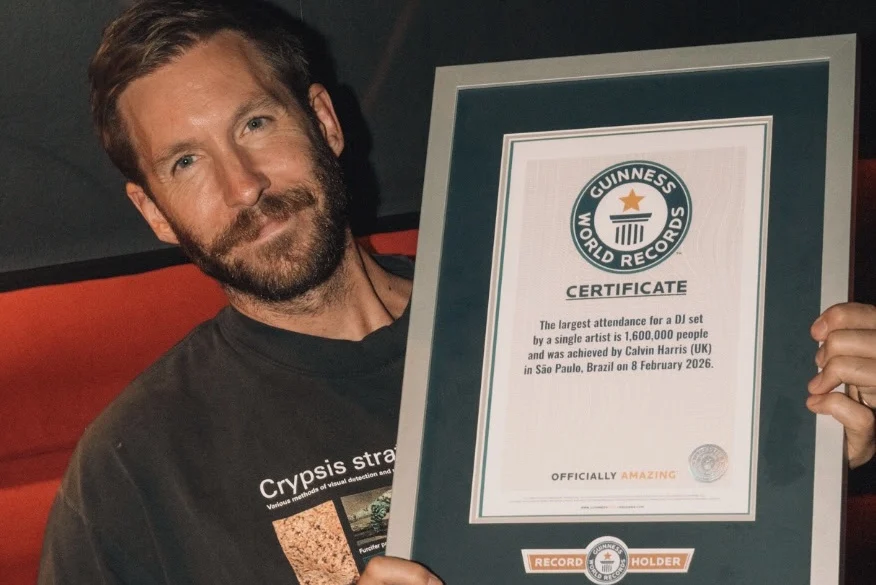
Adam Wiles, globally recognized as Calvin Harris, has etched his name deeper into music history, securing the Guinness World Record for the largest attendance at a DJ set by a single artist. The Scottish electronic dance music (EDM) luminary commanded an estimated 1.6 million revelers in São Paulo, Brazil, during a monumental performance in February 2026. This extraordinary feat not only underscores Harris’s unparalleled drawing power but also highlights São Paulo’s capacity for hosting events of immense scale, further solidifying the global reach and enduring appeal of electronic music.
The record-breaking spectacle unfolded on February 8, 2026, transforming Rua da Consolação, one of São Paulo’s bustling thoroughfares, into an epicenter of sound and movement. Harris, performing from an elaborately designed float, curated an electrifying set that spanned his illustrious career, captivating the colossal crowd with a string of his most iconic anthems. Among the tracks that reverberated through the urban landscape were global chart-toppers such as "This Is What You Came For," "One Kiss," "I Need Your Love," and the seminal "We Found Love." The atmosphere was described by attendees as a vibrant fusion of festival energy and carnival spontaneity, a testament to both Harris’s musical prowess and the infectious spirit of the Brazilian public. In a gesture of appreciation that resonated deeply with the local audience, Harris donned a Brazilian national soccer team shirt, emblazoned with the number "00" and the affectionate nickname "Calvinho" across the back, endearing himself further to the enthusiastic masses.
A Monumental Achievement in Electronic Music History
The sheer scale of 1.6 million attendees for a single DJ’s performance is unprecedented in recorded history, significantly surpassing previous benchmarks for electronic music events. While large-scale concerts and festivals are common globally, a single artist drawing such an immense, concentrated crowd for a DJ set marks a new chapter in live music events. The previous unofficial records for large DJ sets often involved multi-artist festivals or events where the primary draw wasn’t a singular DJ. For instance, events like the Love Parade in Berlin or various major techno festivals have seen attendance in the hundreds of thousands, but rarely attributed to a single artist’s set. This achievement by Harris establishes a new paradigm, demonstrating the immense individual brand power an artist can cultivate within the EDM genre. The precise estimation of such a vast crowd typically involves sophisticated crowd-counting technologies, including aerial photography analysis, mobile network data aggregation, and ground-level density estimations provided by local authorities and event security, all contributing to the meticulous verification process required by Guinness World Records.
São Paulo: A Global Hub for Grand Spectacle
São Paulo, Brazil’s economic powerhouse and most populous city, provided the perfect backdrop for this historic event. Renowned for its vibrant cultural scene and its ability to host massive public gatherings, São Paulo frequently transforms its streets for events that draw millions. The city’s annual Carnival celebrations, for example, are legendary for their colossal street parades and block parties, known as "blocos," which attract multi-million strong crowds. This inherent capacity for managing and accommodating vast numbers of people, coupled with a deep-seated cultural appreciation for communal celebrations and music, made São Paulo an ideal location for Harris’s record-setting performance. The event likely leveraged existing urban planning and crowd management strategies perfected during the city’s traditional festivals, ensuring a relatively smooth execution despite the immense numbers. The municipal government and various city agencies would have played a crucial role in permitting, security, sanitation, and logistical support, underscoring the collaborative effort required to stage an event of this magnitude. This synergy between a global music icon and a city accustomed to grand spectacles created an unparalleled moment in live entertainment.
The Architect of Global Beats: Calvin Harris’s Enduring Legacy
Calvin Harris’s journey to this record-breaking moment is a narrative of relentless innovation, strategic collaborations, and an astute understanding of the global music landscape. Born Adam Wiles in Dumfries, Scotland, his career trajectory from an aspiring bedroom producer to a multi-platinum, Grammy-winning superstar is a testament to his talent and business acumen. He burst onto the scene in the mid-2000s with a distinctive blend of electro-pop and dance, evolving over the years to become a dominant force in mainstream EDM. His early albums, I Created Disco (2007) and Ready for the Weekend (2009), showcased his knack for catchy melodies and synth-driven beats.
However, it was his pivot towards collaborating with mainstream vocalists that truly propelled him into the global stratosphere. Tracks like "We Found Love" featuring Rihanna (2011), "Summer" (2014), "Blame" featuring John Newman (2014), and "This Is What You Came For" featuring Rihanna again (2016) became ubiquitous anthems, dominating airwaves and dance floors worldwide. These collaborations cemented his reputation as a hitmaker capable of blending electronic production with pop sensibilities, making EDM accessible to a broader audience.
Harris’s career has been punctuated by numerous accolades and record-breaking achievements even before his São Paulo triumph. He has notched two No. 1 albums and an astounding 11 No. 1 singles on the Official U.K. Singles Chart, a feat unmatched by any other dance act. In the 2010s alone, he bagged the most U.K. No. 1 singles with eight chart-toppers, demonstrating his consistent dominance throughout the decade. He also holds the distinction of being the first British solo artist to surpass one billion streams on Spotify. As of 2026, his combined streams across all platforms reportedly exceed 56 billion, a staggering figure that highlights his immense global reach and the enduring popularity of his catalog. His trophy cabinet boasts two Brit Awards, an Ivor Novello Award, and a Grammy Award, recognizing his profound impact on contemporary music. The São Paulo record is not merely an addition to this impressive list but a crowning achievement that underscores his status as one of the most successful and influential artists of his generation.
Guinness World Records: Verifying the Unbelievable
The validation of such a colossal record falls under the stringent scrutiny of Guinness World Records, the universally recognized authority on record-breaking achievements. Official Guinness World Records adjudicator Will Munford was present to acknowledge the feat and personally present Harris with a special certificate, a testament to the meticulous verification process involved. "Calvin Harris has spent years creating music that brings people together, so to see that reflected on this scale is really quite remarkable," commented Munford. He further elaborated, "An estimated 1.6 million people came out to be part of his performance in São Paulo, which is an extraordinary achievement and a testament to the global reach of his music. We’re delighted to officially recognize him with the Guinness World Records title for the largest attendance for a DJ set by a single artist."

The process of certifying a record of this magnitude involves a rigorous methodology. Adjudicators work closely with event organizers, local authorities, and independent experts to gather and analyze various data points. This includes, but is not limited to, official police estimates, aerial drone footage analyzed with crowd-counting software, turnstile data (if applicable for enclosed spaces, though less relevant for open street events), mobile phone network density analysis, and expert testimony. Every detail, from the duration of the set to the clear identification of the artist as the sole performer responsible for drawing the crowd, is meticulously documented and cross-referenced to ensure accuracy and impartiality. The integrity of the Guinness World Records title relies on this comprehensive verification, making Harris’s achievement an undeniable historical fact.
Logistics of a Million-Strong Audience
Managing an estimated 1.6 million people in a single urban space presents an unparalleled logistical challenge. The successful execution of Harris’s São Paulo set speaks volumes about the meticulous planning and coordination between event organizers, local law enforcement, emergency services, and municipal authorities. Key considerations for such an event include:
- Crowd Control and Security: Thousands of security personnel and police officers would have been deployed to manage crowd flow, prevent crushes, and ensure public safety. Designated entry and exit points, along with clear signage and barricades, would have been crucial for directing the massive influx and outflow of people.
- Emergency Services: A robust presence of medical teams, ambulances, and first-aid stations strategically positioned throughout the route would have been essential to respond to any health emergencies or incidents.
- Infrastructure and Utilities: Ensuring adequate access to hydration, public restrooms, and waste management facilities for such a vast crowd is a monumental undertaking. Temporary structures and services would likely have been erected to supplement existing city infrastructure.
- Sound and Visuals: Distributing high-quality sound and visual feeds to an audience spanning several kilometers requires an intricate network of speakers, screens, and repeaters to ensure everyone feels part of the experience, regardless of their position. The float itself would have been a mobile command center for audio-visual production.
- Traffic Management: Rerouting traffic and closing major arteries like Rua da Consolação for an extended period demands extensive planning and public communication to minimize disruption to daily city life.
The seamless operation of these complex logistical elements underscores São Paulo’s expertise in handling mega-events and the collaborative spirit that brought this record-breaking performance to fruition.
The Global Resonance of EDM
Calvin Harris’s record-breaking performance is not just a personal triumph but also a powerful testament to the continued global ascendance of electronic dance music. What began as an underground movement in clubs and warehouses has evolved into a mainstream cultural phenomenon, capable of uniting diverse audiences across continents. EDM’s infectious rhythms, uplifting melodies, and emphasis on collective experience translate seamlessly across linguistic and cultural barriers. Brazil, with its vibrant party culture and deep appreciation for rhythm, has long been a fertile ground for electronic music, hosting numerous festivals and attracting top-tier DJs. The sheer size of the crowd in São Paulo demonstrates that EDM, far from being a niche genre, is a potent force in contemporary music, capable of drawing audiences comparable to the largest rock concerts or pop festivals. This event further solidifies its position as a dominant genre in the global entertainment landscape.
Beyond the Numbers: Cultural and Economic Impact
The ripple effects of an event of this magnitude extend far beyond the immediate thrill of the performance. Culturally, it reinforces São Paulo’s image as a dynamic, open city capable of hosting world-class events, enhancing its reputation as a global cultural destination. For the attendees, it creates a shared memory, a collective experience of joy and unity that can foster a sense of community.
Economically, the impact would have been substantial. An influx of 1.6 million people, even if many are local, translates into significant revenue for local businesses. Restaurants, bars, street vendors, hotels, and transportation services would have experienced a considerable boost in activity. The event also generates tourism, as fans from other parts of Brazil and even neighboring countries would have traveled to witness the spectacle. This economic injection, coupled with the global media attention generated by the Guinness World Record, serves as invaluable promotion for both Calvin Harris and the city of São Paulo. It positions Harris as an artist of unparalleled draw and São Paulo as a premier destination for large-scale cultural events.
Future Implications for Live Music
Calvin Harris’s São Paulo record sets a new precedent for live music events, particularly within the DJ and electronic music sphere. It raises questions about the future of mass gatherings and the increasing ambition of event organizers. This achievement demonstrates that with careful planning, robust infrastructure, and the right artist, audiences of truly staggering proportions can be successfully managed. It also highlights the evolving role of public spaces in urban centers, transforming them into temporary cultural arenas. As technology continues to advance, enabling more sophisticated crowd management, sound distribution, and visual experiences, it is plausible that even larger gatherings might become feasible. The record also underscores the enduring human desire for collective experience, for sharing moments of joy and connection through music on an epic scale. Calvin Harris, through his extraordinary performance in São Paulo, has not only claimed a world record but has also provided a glimpse into the potential future of live entertainment.
In conclusion, Calvin Harris’s unprecedented DJ set in São Paulo stands as a landmark event in music history. Drawing an estimated 1.6 million people, it not only secured him a prestigious Guinness World Record but also underscored his enduring legacy as a global music icon. The event showcased São Paulo’s remarkable capacity for grand spectacles and reaffirmed the profound, unifying power of electronic dance music on a global scale. This monumental achievement will undoubtedly be remembered as a pivotal moment, shaping perceptions of what is possible in live music and solidifying Harris’s place among the pantheon of music’s greatest crowd-pullers.
