

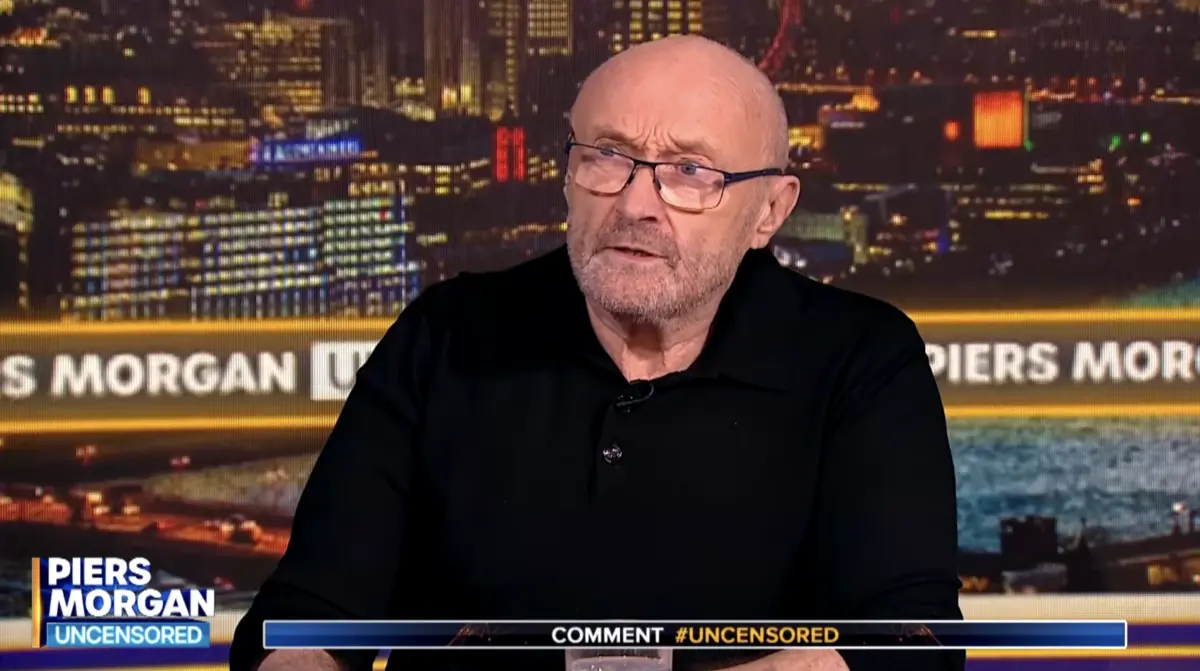
In a candid and wide-ranging interview on Piers Morgan Uncensored, legendary musician Phil Collins offered insights into his health struggles, sharp political opinions, enduring musical preferences, and the resolution of long-standing celebrity feuds, all set against the backdrop of his impending induction into the Rock & Roll Hall of Fame as a solo artist. The multifaceted discussion provided a rare glimpse into the mind of an artist who has spent decades at the pinnacle of global music, revealing a period of profound personal reflection amidst professional milestones.
Collins, already enshrined in the prestigious institution as a member of Genesis since 2010, is poised to receive his second induction next month, a testament to his unparalleled success and influence as a solo performer. His prolific career, spanning over five decades, has seen him transition from a groundbreaking progressive rock drummer to a global pop sensation, selling over 150 million albums worldwide as a solo artist and an estimated 100 million with Genesis. This dual recognition places him in an elite group of musicians, including Eric Clapton, Jeff Beck, and Stephen Stills, who have been honored multiple times for their contributions across different musical endeavors. The Rock & Roll Hall of Fame, established in 1983, aims to recognize the most influential artists, producers, engineers, and other figures who have had a significant impact on the development of rock and roll. A second induction underscores not just longevity, but a distinct artistic identity that transcended his band roots.
Political Perspectives: "Fat People With Guns" and Donald Trump
A significant portion of Collins’ interview delved into his observations on the United States, revealing a critical perspective informed by his experiences as an international observer. At the 26:40 mark, while discussing his songwriting process, Collins shared a provocative idea for a new track: "I’ve got a song that’s waiting to be written called ‘Fat People With Guns,’ which is about America." He explained his practice of jotting down such phrases, hoping they will "germinate into new tunes," indicating a continued creative impulse despite his health challenges. This proposed title immediately signals a commentary on prevalent American issues, potentially touching upon gun culture, public health, and societal divisions, themes that resonate deeply in contemporary political discourse.
His critique extended to former President Donald Trump, a subject he revisited at the 36:25 mark. When asked his opinion on Trump, Collins responded with an unequivocal, "Not a lot." He recounted watching Trump’s testimony during the E. Jean Carroll rape lawsuit, expressing profound distaste for his demeanor. "His whole manner is unattractive. Even when he’s saying he did nothing," Collins stated, emphasizing a perceived lack of grace. He contrasted Trump with historical presidential figures, suggesting that previous leaders, regardless of political alignment, possessed an "eloquent and elegant" quality that commanded respect. "You feel like even if you don’t agree with them, you still respect them. But when someone like Trump is as nasty as he is, you end up feeling dislike from him." This observation speaks to a broader sentiment among some international figures and a segment of the American public who found Trump’s communication style and approach to governance unconventional and abrasive, diverging from traditional political decorum.
Collins further echoed sentiments expressed by actor Robert De Niro, noting the Hollywood icon’s "disdain for the current American enterprise" and fears regarding the nation’s governance. Collins articulated his concern that Trump "plays politics like a businessman," fundamentally misunderstanding the nature of leadership. "And it’s not really a business at all. It’s diplomacy. Sometimes you can lose but still come out winning, if you know what I mean. But he sees everything as a deal won or lost." This analysis highlights a common criticism of Trump’s transactional approach to both domestic and international relations, where traditional diplomatic protocols were often secondary to perceived "deals." Collins concluded with a stark warning, "I think it’s [a] very scary time. It wouldn’t surprise me if he just tries to overrule the two-term rule." This concern, while legally unfounded given the 22nd Amendment to the U.S. Constitution which limits presidents to two terms, reflects a profound anxiety about the erosion of democratic norms and institutions that permeated political discussions during and after Trump’s presidency. Such comments from an internationally recognized artist can influence public discourse and draw attention to global perceptions of American leadership.
Health Battles and the Future of Music
The interview also provided crucial updates on Collins’ ongoing health struggles, which have significantly impacted his ability to perform and create music. The past few years have been a tumultuous period for the artist. In early 2024, Collins faced a severe health crisis, reportedly "nearly dying" from alcohol abuse, a stark reminder of the challenges many public figures confront. This critical incident prompted a period of intense recovery and reflection.
Following this near-death experience, Collins shared a hopeful update in the summer of 2024, announcing that he was actively working on his first new music in over two decades. His last original song release dates back to the soundtrack of the 2003 Disney movie Brother Bear. This announcement generated considerable excitement among fans eager for new material from the celebrated songwriter. However, this optimism was tempered in early 2025 when Collins revealed he was "too sick to make new music," a candid admission that underscored the unpredictable nature of his condition.
During a subsequent interview on the Sodajerker podcast over the summer, Collins offered a more encouraging, albeit cautious, update. He stated, "I’ve got some things that are finished" and "I’ve got a lot of ideas," suggesting that his creative spark remains, even if the physical capacity to execute fully is limited. It’s well-established that Collins can no longer play drums due to nerve damage and spinal issues that have severely impacted his motor skills, a profound loss for an artist renowned for his percussive genius. His final tour with Genesis, "The Last Domino?", saw him performing seated, with his son Nic Collins ably taking over drumming duties. This physical limitation also means he won’t be performing at his upcoming Rock & Roll Hall of Fame induction ceremony, a decision he confirmed over the summer, despite noting an improvement in his overall health. The fluctuating nature of his health status paints a picture of an artist grappling with the realities of aging and chronic illness, yet still driven by an insatiable desire to create, leaving fans to wonder if and when new music might finally see the light of day. The implications of these health challenges are significant, potentially limiting his future touring and recording capabilities, yet his continued presence in the public eye demonstrates an enduring resilience and commitment to his legacy.
The Enduring Oasis Rivalry
Another highlight of the Morgan interview was Collins’ discussion of his long-standing, often humorous, rivalry with Oasis, particularly Noel Gallagher. Oasis, who are also being inducted into the Rock Hall this year, were known for their provocative comments during the height of the Britpop era in the 1990s. Noel Gallagher famously dubbed Collins the "antichrist" and, in archival footage from the pre-Definitely Maybe era, declared his desire for "the severed head of Phil Collins in my fridge by the end of this decade." This fiery rhetoric was symptomatic of the Britpop movement’s rejection of perceived "establishment" acts, with Collins, by then a global pop juggernaut, often becoming a symbol of what they opposed.
Collins has addressed the conflict intermittently over the years, often with a bemused detachment. This summer, he expressed an unexpected eagerness, stating he was "looking forward to running into Oasis at the ceremony." In the Morgan interview, at the 39:28 mark, Collins reiterated his approach to a potential encounter with Noel Gallagher: "I’m gonna be quite jovial, quite nice to him." However, his cordiality does not extend to an appreciation of their music. When pressed on whether he likes Oasis’s work, Collins offered a blunt, "Not particularly. I prefer to listen to the Beatles." He then employed a classic rock star retort, recalling Mick Jagger’s legendary dismissal of U2: "Mick Jagger once said, when someone asked him, ‘What do you think of U2?’ he said, ‘I don’t think of U2.’ And I think that’s really what I think about Oasis." This statement, delivered with characteristic dry wit, underscores Collins’ continued indifference to the band’s output, despite the historical animosity. It highlights how some rivalries, particularly among rock titans, can persist for decades, often evolving from genuine animosity to a more playful, yet still pointed, form of mutual acknowledgment within the industry. The upcoming Rock Hall induction ceremony presents a unique opportunity for these two iconic, albeit disparate, figures to share a stage, potentially offering a symbolic closure to a chapter of rock history.
Musical Tastes and Influences
Beyond the feuds and political commentary, Collins also offered insights into his own musical tastes and influences. At the 46-minute mark, he identified his favorite Genesis song as "Apocalypse In 9/8," a complex, instrumental-heavy track from the band’s 1972 album Foxtrot. This choice is significant, as it harks back to Genesis’s progressive rock roots, a period where Collins’ drumming was a central, innovative force, and predates his more pop-oriented solo career. It showcases his appreciation for intricate musical structures and showcases his own foundational contribution to the band’s early avant-garde sound. Interestingly, his daughter, actress Lily Collins, offered a more contemporary and perhaps less specific response when asked her favorite Genesis song: "pass."
The interview also touched upon his admiration for contemporary artists. At 48:05, an obligatory discussion of Taylor Swift emerged. Swift famously covered Collins’ rendition of "Can’t Stop Loving You" (originally by Leo Sayer), calling it "literally the most sad, beautiful song ever." Collins reciprocated the admiration, having previously identified Swift’s "White Horse" as one of his own all-time favorites. This mutual appreciation between artists from vastly different generations and musical genres underscores Swift’s pervasive influence and Collins’ open-mindedness to modern music. Finally, Collins revealed a wish-list song, expressing that he wishes he had written Bonnie Raitt’s iconic ballad "I Can’t Make You Love Me," a testament to its enduring lyrical and melodic power. These musical reflections paint a picture of an artist with a deep, diverse appreciation for songwriting craft, extending beyond his own celebrated discography.
Reconciliation with Paul McCartney
Perhaps one of the most surprising and heartwarming revelations from the interview was the resolution of Phil Collins’ long-standing feud with Paul McCartney. The conflict, which had simmered for years, stemmed from an incident detailed in Collins’ 2016 memoir, Not Dead Yet. The memoir recounted an awkward encounter at Buckingham Palace in 2002, in the run-up to the Queen’s Jubilee concerts. Collins had brought a rare first edition Hunter Davies book, given to him by Lily’s mother, Jill, hoping McCartney would sign it.
Collins vividly recalled the moment: "I was sitting on the side of the stage, and Paul came up with Heather Mills, who he was married to at that point. And I said, ‘Paul, could you sign this?’ And he said, ‘Oh yeah. Yeah.’ And he probably didn’t mean it like it sounded, but he said, ‘He’s a big Beatle fan is our little Phil.’ And I thought, ‘You asshole.’ I couldn’t help it. It’s what I thought." Collins admitted to potentially overreacting to the tone, but emphasized that he knew McCartney, having played on one of his albums, performed live with him at the Prince’s Trust, and even presented him with an award. This history made the seemingly dismissive remark particularly jarring for Collins, who felt a sense of camaraderie that was not reciprocated in that moment.
The incident gained public traction when McCartney reportedly came across an interview where Collins recounted this story from his book. McCartney subsequently sent Collins an email, describing the account as "sanctimonious," to which Collins never replied, leaving the perceived slight unresolved for years.
However, the feud recently came to an unexpected and amicable end. Collins revealed that a couple of months prior, McCartney initiated contact, reaching out to request Collins’ phone number. The initial purpose of the call was for advice regarding donating items to a charity auction. But during the conversation, McCartney bravely brought up the past altercation. This direct approach spurred Collins to apologize for "making it a thing," acknowledging that his public recounting of the incident had clearly bothered McCartney. Collins reflected on McCartney’s motivation, stating, "Obviously this had been bugging him. Because he likes to be liked, as we all do. Maybe him more than some other people." This resolution highlights the complexities of celebrity relationships and the potential for perceived slights to fester, even among global icons. It also speaks to the maturity and mutual respect that can ultimately lead to reconciliation, even years after the initial incident. The willingness of McCartney, a figure of immense global adoration, to initiate contact and address a past grievance underscores the importance of maintaining positive relationships within the close-knit world of music legends.
Phil Collins’ interview on Piers Morgan Uncensored provided a comprehensive update on the life of an enduring music icon. From his forthcoming Rock & Roll Hall of Fame induction to his frank political opinions, ongoing health challenges, revisited rivalries, and a heartwarming reconciliation, Collins continues to navigate a public life filled with both triumphs and personal struggles. His candidness offers a valuable perspective on the realities of fame, health, and human connection, underscoring his continued relevance and enduring appeal to audiences worldwide. The full interview provides a deeper dive into these topics, offering fans a rich tapestry of reflection from one of music’s most distinctive voices.
