

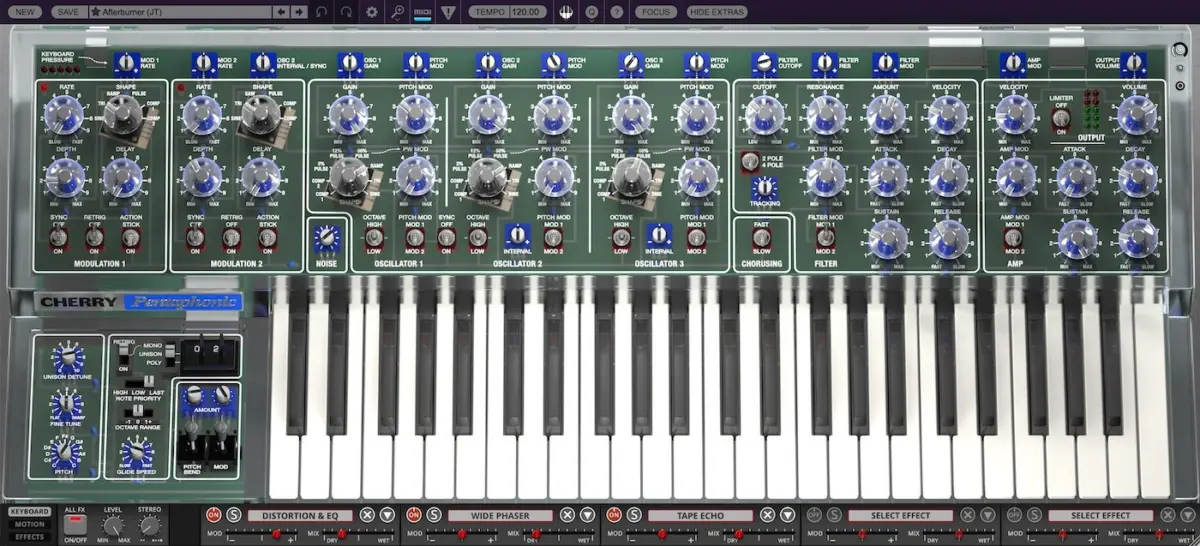
Cherry Audio has officially announced the release of Pentaphonic, a comprehensive virtual instrument for Mac and Windows platforms that meticulously emulates the Gleeman Pentaphonic Clear, one of the rarest and most distinctive synthesizers of the early 1980s. Originally debuted in 1982 by Gleeman Instrument Co., the hardware version of the Pentaphonic was a five-voice polyphonic analog synthesizer that occupied a unique niche in the market, blending a futuristic aesthetic with a robust, three-oscillator-per-voice architecture. Cherry Audio’s digital recreation aims to preserve the idiosyncratic character of the original machine while significantly expanding its technical capabilities to meet the demands of contemporary music production. Available at an introductory price of $59, the Pentaphonic virtual synthesizer represents the latest entry in Cherry Audio’s portfolio of "lost" or "rare" hardware emulations, providing musicians with access to sounds that were previously confined to a handful of private studios and high-end collectors.
Historical Context: The Legacy of the Gleeman Pentaphonic
To understand the significance of the Pentaphonic release, one must look back to the early 1980s, a period of rapid transition in the synthesizer industry. Founded by Al Gleeman in Clear Lake, California, Gleeman Instrument Co. sought to compete in a market dominated by giants like Sequential Circuits and Roland. The Gleeman Pentaphonic was introduced at a time when polyphonic synthesizers were the cutting edge of technology, but also prohibitively expensive for many musicians.
The original hardware was notable for several reasons. First, its architecture was surprisingly powerful for its size, offering three digitally controlled oscillators (DCOs) per voice. This was a significant step up from the one or two oscillators commonly found in competing five-voice synthesizers of the era, such as the Prophet-5 or the Korg Polysix. Second, the Gleeman was famous for its "Clear" edition—a version of the synthesizer housed in a transparent acrylic chassis that showcased the internal circuitry, complete with a built-in speaker.
Despite its impressive specifications and unique visual appeal, the Gleeman Pentaphonic never achieved mass-market success. Production was extremely limited, with estimates suggesting that only about 30 to 50 units were ever manufactured. This rarity turned the Pentaphonic into a "holy grail" for synthesizer enthusiasts. Cherry Audio’s decision to model this specific instrument follows their established pattern of reviving obscure but sonically interesting hardware, ensuring that the Pentaphonic’s unique sonic signature is not lost to time.
Technical Specifications and Architectural Enhancements
While the original Gleeman Pentaphonic was limited by the hardware constraints of 1982, Cherry Audio has utilized modern digital signal processing (DSP) to remove these barriers. The virtual Pentaphonic retains the core identity of the original—specifically the three-oscillator-per-voice structure—but expands the polyphony from the original five voices to a modern standard, allowing for much denser chords and complex textures without voice stealing.
The Oscillator Section
The heart of the Pentaphonic lies in its three oscillators. In the original hardware, these were DCOs, which provided better tuning stability than the voltage-controlled oscillators (VCOs) of the time but maintained an analog signal path for the filters and amplifiers. Cherry Audio has modeled these oscillators to replicate the specific waveforms and harmonic content of the Gleeman hardware. New to the software version is the inclusion of oscillator sync and pulse-width modulation (PWM) for all oscillators, features that were either limited or absent in the original design. This allows for the creation of aggressive, "tearing" lead sounds and evolving, harmonically rich pads that go beyond the capabilities of the 1980s unit.
Filter and Modulation
The original Pentaphonic utilized the Curtis CEM 3320 filter chip, a legendary component also found in the Sequential Prophet-5 (Rev 3), the Oberheim OB-Xa, and the Elka Synthex. This filter is known for its resonant "bite" and musicality. Cherry Audio’s engineers have focused heavily on replicating the 24dB/octave low-pass filter characteristics, ensuring that the resonance behaves authentically when pushed to self-oscillation.
In terms of modulation, the virtual Pentaphonic introduces a far more flexible system than the hardware. While the original featured a basic LFO and envelope generators, the software version includes additional modulation sources and a streamlined interface for routing them. This includes support for MIDI Polyphonic Expression (MPE), allowing performers to control parameters like pitch bend, filter cutoff, and amplitude on a per-note basis using compatible controllers.
Modern Features: Sequencer and Effects Engine
One of the standout features of the original Gleeman was its built-in sequencer, which was considered advanced for 1982. Cherry Audio has completely overhauled this section, transforming it into a modern polyphonic sequencer that can be synchronized to a host DAW (Digital Audio Workstation). Users can now program complex patterns, transpose them in real-time, and store them as part of the instrument’s presets.
Furthermore, the software includes a dedicated effects section, a standard requirement for modern virtual instruments that was entirely absent from the original hardware. The effects chain includes:
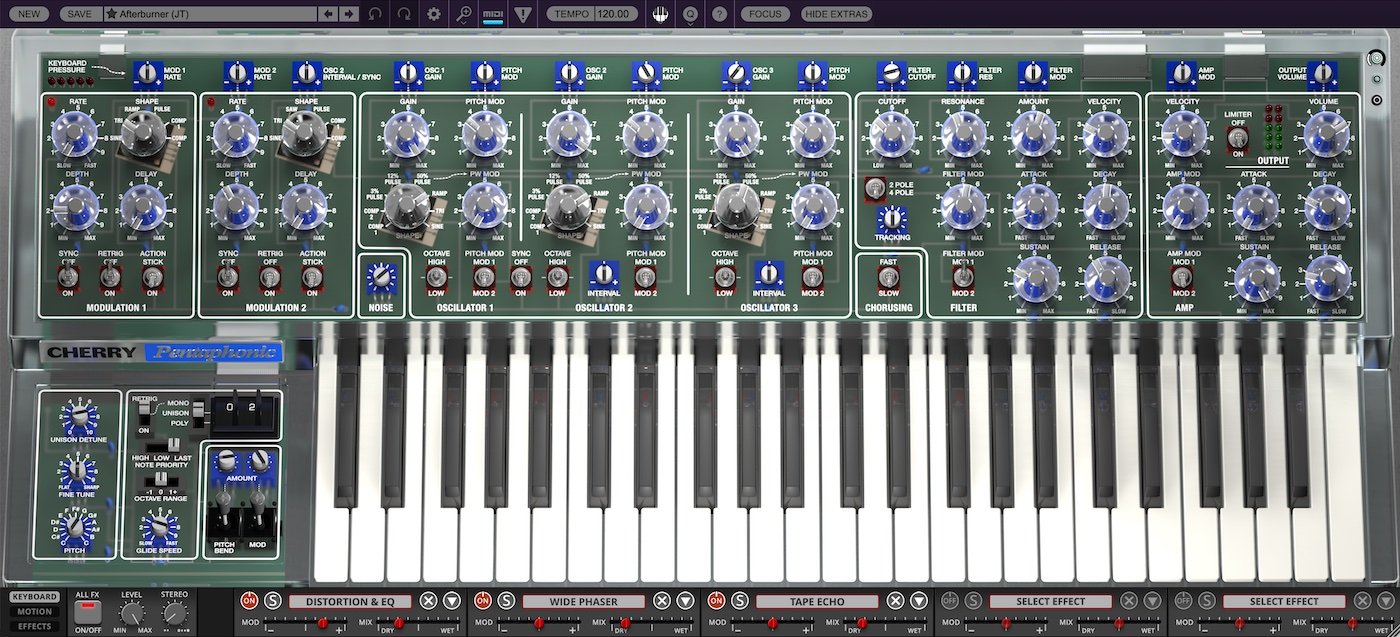
- Chorus: A lush, bucket-brigade style chorus modeled after classic 80s hardware.
- Delay: A versatile delay unit with sync-to-host capabilities and feedback controls.
- Reverb: A high-quality reverb engine featuring multiple algorithms, from intimate rooms to expansive plates and halls.
- Distortion: A drive circuit designed to add warmth or grit to the oscillators before they hit the filter.
Comparison: Original Hardware vs. Cherry Audio Pentaphonic
| Feature | Original Gleeman (1982) | Cherry Audio Pentaphonic (2024) |
|---|---|---|
| Polyphony | 5 Voices | Up to 16 Voices (Expandable) |
| Oscillators | 3 DCOs per voice | 3 Modeled DCOs with Sync/PWM |
| Filter | Analog 4-pole Low-pass (CEM 3320) | Meticulously Modeled 24dB/octave LPF |
| Sequencer | Basic 2-track polyphonic | Modern Syncable Polyphonic Sequencer |
| Modulation | Limited LFO/Envelopes | Expanded Matrix + MPE Support |
| Effects | None | Chorus, Delay, Reverb, Distortion |
| Price (Adjusted) | ~$3,000 USD in 1982 | $59 USD |
The data illustrates that while the software version respects the source material, it is designed to function as a primary tool in a modern production environment rather than just a museum piece. The addition of MPE and an expanded effects suite positions the Pentaphonic as a competitor to modern wavetable and subtractive synthesizers, despite its vintage roots.
Official Responses and Industry Impact
Industry experts have noted that Cherry Audio’s strategy of targeting rare instruments provides a unique value proposition. By emulating a machine that almost no one has ever played in person, they create a sense of novelty that is often missing from the tenth or eleventh emulation of a Minimoog or Juno-106.
"The Gleeman Pentaphonic was a fascinating footnote in synthesizer history," said a representative from a prominent music technology publication. "By bringing it to the software domain, Cherry Audio is allowing a new generation of producers to explore a specific California-born sound that was previously inaccessible. The inclusion of MPE and modern sequencing makes it more than just a nostalgia trip; it’s a functional instrument for 21st-century composition."
From a market perspective, the $59 price point continues Cherry Audio’s trend of aggressive pricing. This low barrier to entry has historically forced other developers to reconsider their pricing models for vintage emulations. The release also signals the continued growth of the VST market, where high-fidelity modeling of analog components has reached a point of near-indistinguishable accuracy from the original hardware.
Broader Implications for Sound Design
The release of the Pentaphonic underscores a broader trend in the music industry: the democratization of rare hardware. In the 1980s, the Pentaphonic was a boutique item, often viewed as a "working man’s" alternative to the more expensive poly-synths, yet its low production numbers made it an elite rarity. Today, the digital version offers the same sonic palette to anyone with a laptop.
For sound designers, the Pentaphonic offers a specific "mid-80s" texture that differs from the more common Roland or Moog sounds. The combination of three oscillators per voice allows for detuned stacks that are particularly effective for synthwave, cinematic scoring, and electronic dance music. The ability to use the joystick—a signature physical feature of the original Gleeman—via MIDI mapping provides a tactile way to interact with the sound, encouraging expressive performance over static programming.
As the software synthesizer market continues to mature, the focus is shifting from "how many features can we add" to "how can we capture a specific character." Cherry Audio’s Pentaphonic is a testament to this shift, prioritizing the unique quirks and tonal qualities of a 42-year-old rarity and translating them into a tool that is relevant for the modern era.
Availability and System Requirements
The Cherry Audio Pentaphonic is currently available for purchase through the Cherry Audio website and authorized retailers. It supports AU, VST, VST3, and AAX formats, as well as a standalone version for both macOS and Windows.
System requirements include:
- macOS: 10.13 or above, macOS 13 recommended. Native Apple Silicon (M1/M2/M3) support is included.
- Windows: Windows 7 or above (64-bit), Windows 10 or 11 recommended.
- Hardware: Quad-core computer with 8GB of RAM is recommended for optimal performance, particularly when utilizing high voice counts and multiple instances of the effects engine.
As of the date of this report, the Pentaphonic is being offered at its introductory price of $59, with a standard retail price expected to follow after the initial launch period. The package includes over 300 presets designed by professional sound designers, covering a wide range of categories from classic leads and pads to experimental textures that leverage the new modulation capabilities.
