

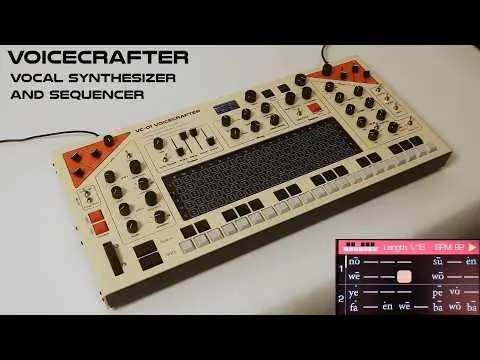
Olydian Musical Instruments has officially announced the development and upcoming release of Voicecrafter, designated as the VC-01, a specialized vocal musical synthesizer and sequencer designed to bridge the gap between digital computation and human linguistic expression. Described by its creators as an "unholy union" between computers and the human voice, the Voicecrafter represents a significant departure from traditional subtractive synthesis, focusing instead on the manipulation of phonetic building blocks to create a unique, hybrid auditory experience. At the core of the instrument lies a comprehensive library of 380 distinct syllables, which users can select, arrange, and sequence to generate a rudimentary yet rhythmically complex computer-human language.
The introduction of the VC-01 comes at a time when the music technology industry is increasingly fascinated by the intersection of organic textures and digital precision. While modern vocal synthesis often leans toward the hyper-realistic capabilities of artificial intelligence and deep learning, Olydian Musical Instruments appears to be charting a different course. The Voicecrafter prioritizes the "instrumentalization" of the voice, treating phonemes not just as a means of communication, but as raw oscillators that can be pitched, timed, and modulated within a musical framework. This approach recalls the early experimental days of speech synthesis while utilizing contemporary processing power to offer a level of control previously unavailable to sound designers and electronic musicians.
The Evolution of Vocal Synthesis and the Path to Voicecrafter
To understand the significance of the Voicecrafter VC-01, one must look at the history of vocal synthesis, which spans nearly a century of innovation. The journey began in earnest with Homer Dudley’s Voder (Voice Operation Demonstrator), showcased at the 1939 World’s Fair. The Voder was a manually operated electronic speech synthesizer that required a highly skilled operator to manipulate a series of keys and pedals to mimic human speech patterns. Following the Voder, the development of the Vocoder (Voice Coder) during World War II—initially intended for secure telecommunications—eventually found its way into the hands of musicians like Wendy Carlos and Kraftwerk, becoming a staple of the electronic music genre.
In the decades that followed, the industry saw the rise of linear predictive coding (LPC), which powered iconic devices such as the Texas Instruments Speak & Spell in the late 1970s. By the 1990s and 2000s, software-based solutions like Yamaha’s Vocaloid introduced the concept of "singing synthesis," allowing users to input melodies and lyrics to be performed by a virtual singer. However, these technologies often required significant manual labor to sound "natural."
The Voicecrafter VC-01 positions itself as a successor to this lineage but with a focus on sequencing rather than realistic performance. By providing 380 syllables, Olydian is offering a palette of "phonetic oscillators." This design choice suggests that the instrument is less concerned with replicating a human singer and more interested in creating a "cyborg" aesthetic where the mechanical nature of the sequencer is celebrated alongside the recognizable textures of human speech.
Technical Architecture and Syllabic Sequencing
The fundamental innovation of the Voicecrafter lies in its syllabic engine. Traditional synthesizers use waveforms—such as sine, square, or sawtooth waves—as their primary sound source. The VC-01 replaces these mathematical functions with recorded or modeled human syllables. These 380 components are categorized to allow for intuitive navigation, enabling the user to construct words, phrases, or entirely new percussive languages.
The sequencing aspect of the VC-01 is what transforms it from a simple playback device into a true musical instrument. Based on the preliminary demonstrations, the sequencer allows for the manipulation of several key parameters per step:
- Syllable Selection: Choosing from the internal library of 380 sounds.
- Pitch Modulation: Adjusting the fundamental frequency of the syllable to create melodies or harmonic structures.
- Duration and Gating: Controlling how long a syllable is held, allowing for staccato, glitch-like effects or sustained, drone-like vocalizations.
- Formant Shifting: Manipulating the resonant frequencies of the "vocal tract" to change the character of the voice from deep and masculine to high-pitched and feminine, or into entirely inhuman territories.
By sequencing these parameters, a composer can create "sentences" that follow the tempo and key of a musical composition. This creates a rhythmic "chatter" that sits somewhere between a lead vocal and a percussive element, a technique that has become increasingly popular in genres such as glitch-hop, IDM (Intelligent Dance Music), and avant-garde pop.
Market Positioning and Artistic Utility
The announcement of the Voicecrafter has generated considerable interest among niche segments of the music production community. Sound designers for film and video games, in particular, are likely to find the VC-01 a valuable tool for creating alien languages or robotic dialogue that retains a sense of organic "soul." In the realm of contemporary music, artists who operate within the "uncanny valley"—the aesthetic space where something is almost human but clearly artificial—are expected to be the primary adopters of this technology.
Industry analysts suggest that Olydian is tapping into a growing "hardware-first" movement. Despite the prevalence of powerful software plugins, there is a sustained demand for dedicated hardware instruments that offer tactile control and a specialized workflow. By housing this unique synthesis engine in a standalone unit, Olydian provides a distraction-free environment for phonetic experimentation.
While Olydian has yet to release a full specification list regarding MIDI implementation or CV (Control Voltage) connectivity, the inclusion of a sequencer implies that the VC-01 will be capable of integrating into larger studio setups. The ability to sync the vocal sequences to an external clock or trigger individual syllables via a MIDI keyboard would vastly expand its utility, allowing it to function as a "vocal drum machine" or a monophonic lead synth.
Chronology of the Announcement and Expected Availability
The unveiling of the Voicecrafter VC-01 followed a series of cryptic teasers from Olydian Musical Instruments, which hinted at a project involving "reconstructed speech." The official introduction included a demonstration video showcasing the instrument’s ability to transition from rhythmic, percussive vocalizations to haunting, melodic phrases.
As of the current announcement, Olydian has maintained a degree of mystery regarding the final production timeline. The company’s official statement noted that "Details are still to be announced," referring to the specific pricing tiers and the global shipping schedule. Historically, boutique manufacturers like Olydian follow a trajectory of a public reveal, followed by a pre-order period for early adopters, with general retail availability occurring six to twelve months later.
Observers of the synthesizer market speculate that the VC-01 will likely be positioned in the mid-range price bracket, appealing to professional producers and serious hobbyists. The complexity of the 380-syllable engine and the integrated sequencer suggests a high level of internal processing power, which will influence the final cost.
Broader Implications for Computer-Human Interaction in Music
The Voicecrafter VC-01 represents more than just a new piece of gear; it is a manifestation of the evolving relationship between humans and their tools. By calling the device an "unholy union," Olydian acknowledges the tension inherent in synthesizing the human voice—the most personal and expressive instrument in existence.
In a broader cultural context, the VC-01 arrives during a period of intense debate regarding the role of AI in creative fields. Unlike generative AI models that can mimic specific famous singers with startling accuracy, the Voicecrafter is an "additive" tool. It requires the user to manually construct the language, ensuring that the human artist remains the architect of the sound. This distinction is crucial for many creators who are wary of the "black box" nature of modern AI and prefer instruments that offer granular, hands-on control.
Furthermore, the "rudimentary computer-human language" mentioned by Olydian suggests an interest in the "glitch" aesthetic—the beauty found in the failure of technology to perfectly replicate humanity. When a computer tries to speak and fails, it creates a new form of expression that is neither purely human nor purely machine. The Voicecrafter appears designed to live in that failure, providing a platform for artists to explore the boundaries of communication.
Conclusion and Future Outlook
As the industry awaits further details on the Voicecrafter VC-01, the initial reception has been one of cautious excitement. The instrument’s focus on a fixed set of 380 syllables provides a structured yet flexible framework that could define a new sub-genre of vocal synthesis. By prioritizing sequencing and "unholy" textures over realistic imitation, Olydian Musical Instruments is offering a tool that challenges musicians to rethink how they incorporate the human voice into their work.
The success of the VC-01 will likely depend on its ease of use and its ability to play well with other instruments. If the sequencing interface is intuitive and the sound quality is sufficiently distinct, the Voicecrafter could become a staple in the kits of experimental composers worldwide. For now, the music technology community remains watchful, waiting for the next update from Olydian regarding when this bridge between silicon and the larynx will finally be available for the public to play.
