

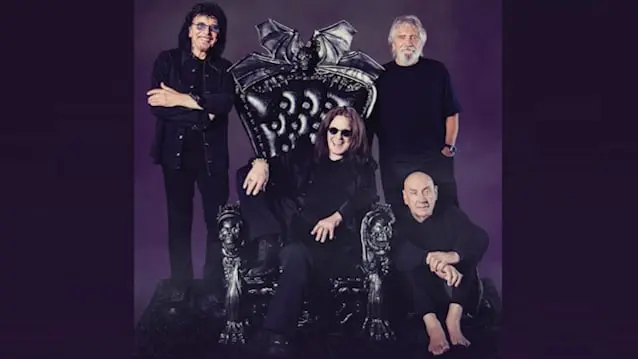
Producer Andrew Watt has revealed that the original members of Black Sabbath – Ozzy Osbourne, Tony Iommi, and Geezer Butler – were all keen to record one final album as a group, following their successful 2013 comeback LP "13." However, the highly anticipated project never materialized, according to Watt, due to the unavailability of original drummer Bill Ward. Watt, who has helmed Osbourne’s last two solo endeavors, "Ordinary Man" (2020) and "Patient Number 9" (2022), shared these details during an interview on the Lipps Service podcast hosted by Scott Lipps.
The Unfulfilled Promise of a Final Sabbath Offering
Watt’s account suggests a significant window of opportunity for a full original lineup reunion of Black Sabbath, a prospect that had been largely dormant since the contractual disputes that led to Bill Ward’s absence from the "13" sessions. Ward, who was initially on board for the band’s 2011 reunion announcement, departed in early 2012, citing an "unsignable contract" that he felt did not adequately recognize his contributions. This departure paved the way for Brad Wilk of Rage Against the Machine to record the drums for "13," with Ozzy Osbourne’s regular touring drummer, Tommy Clufetos, handling live duties.
According to Watt, it was "less than four years ago" when the idea of a new Black Sabbath album with the original lineup gained traction. Following the success of Osbourne’s solo albums, which Watt produced, the legendary vocalist expressed an interest in returning to his iconic band for a final musical statement. "Ozzy wanted to make another album," Watt explained to Lipps. "He didn’t want to do exactly the same thing that we had done before, so he was into the idea of doing a Sabbath album."
A Chain of Consent and a Single Roadblock
The responsibility then fell to Watt, at the behest of Ozzy and his wife and manager, Sharon Osbourne, to gauge the interest of the other original members. Watt contacted Tony Iommi, who expressed his enthusiasm, but with a crucial caveat: "as long as Bill was there." This condition, Watt emphasized, was universal among the core members. "Ozzy was, like, ‘If Bill does it, we’ll do it.’ And Geezer said, ‘If the other guys are in it, I’m in to do it.’"
The pivotal moment, according to Watt, was a lengthy phone call with Bill Ward. While Watt described the conversation as "one of the weirdest and funniest phone calls just ever, of all time," he alluded to personal matters discussed that led to amusement for Ozzy and Sharon. Ultimately, however, the call revealed Ward’s inability to participate. "It ended up that Bill was not gonna be able to make the record. Like, he wasn’t able to do it for a multitude of different reasons," Watt stated. This inability proved to be the insurmountable obstacle, leading to the abandonment of the project. "So that’s why that didn’t happen. But the other guys were all into doing it. And then Bill sent us all this long e-mail, and then it was over."
Divergent Perspectives on the Unrealized Album
While Watt’s account places Bill Ward’s unavailability as the sole reason for the project’s demise, Tony Iommi offered a slightly different perspective in a recent interview with Classic Rock magazine. Iommi confirmed that Andrew Watt had indeed approached him about a potential new Black Sabbath album with the original lineup in the early 2020s.
"I’d met Andrew Watt when he was producing Ozzy," Iommi recalled. "He was very keen and a bit too excited. He also didn’t know what it was like working with the original Sabbath, working with Bill." Iommi also expressed a degree of weariness regarding the prospect of another album so soon after "13," stating, "Also, we’d done ’13,’ and I didn’t like the idea of: ‘Now here’s another album.’" This suggests that while Iommi might have been open to the idea, his enthusiasm may have been tempered by past experiences and the band’s recent output.
The Legacy of "13" and the Shadow of Producer Rick Rubin
The album "13" marked a significant milestone for Black Sabbath. It was the first studio album in 35 years to feature the original lineup of Ozzy Osbourne, Tony Iommi, and Geezer Butler. Released in June 2013, it achieved critical and commercial success, topping the Billboard album chart and becoming the band’s first-ever U.S. number one album. In the United Kingdom, "13" also debuted at number one, a feat not achieved by the band since their iconic 1970 album "Paranoid."
However, the recording process for "13" was not without its complexities, particularly concerning the involvement of producer Rick Rubin. Both Osbourne and Butler have expressed reservations about Rubin’s methods and the overall recording experience. Osbourne, in a 2022 interview with Stereogum, stated he "didn’t really get a charge from the album" and felt he was "just singing," likening the experience to "stepping back in time, but it wasn’t a glorious period." He also lamented Ward’s absence, calling "13" "not really a Black Sabbath album" due to the recording methods. Osbourne felt the band had relinquished too much control, returning to a production style reminiscent of their earliest days when an outside producer held significant sway.
Geezer Butler echoed these sentiments in a 2022 appearance on SiriusXM’s "Trunk Nation With Eddie Trunk." He described Rubin’s instructions to forget they were a heavy metal band and to channel the sound of their debut album as "ridiculous." Butler also detailed instances where Rubin’s demands led to frustration, such as Ozzy re-recording vocals multiple times. Butler also noted Rubin’s insistence on using vintage amplifiers from 1968, a choice he found perplexing and ineffective in recreating the past. Despite these criticisms, Butler acknowledged in an official documentary that Rubin’s involvement was "great" and that he "comes up with some great ideas," even if not all of them worked.
Tony Iommi, in a 2013 interview with Guitar Player magazine, described his experience with Rubin as a gradual process of adjustment. He noted Rubin’s somewhat detached approach during the writing phase and his tendency to offer feedback in brief, decisive moments. Iommi admitted that accepting criticism from someone the band hadn’t worked with extensively was challenging, but ultimately acknowledged the process yielded positive results. He also recounted Rubin’s pursuit of an authentic 1968 sound, which involved sourcing vintage amplifiers, a quest Iommi found impractical, given the obsolescence of such equipment.
A History of Near Reunions and Divergent Paths
The idea of a follow-up to "13" had been discussed by the band members at various points. In 2015, Ozzy Osbourne expressed a cautious optimism to NOLA.com, stating, "I don’t want to say there’s going to be another album, because I don’t want you to ask me in another year, ‘What happened when you said you were going to do another record?’" He also indicated that the timeframe for writing and recording a new album might be too lengthy, leading to the decision to embark on a farewell tour instead. "We were gonna do one before the tour, but it would take three or four years to write and record an album," Osbourne told The Pulse Of Radio. "And so we decided just to do a farewell tour."
In May 2014, Osbourne told The National that he was "up for it" if the other members were also inclined to make another album, while also acknowledging his burgeoning solo career. Around the same time, Geezer Butler revealed that the band had four unused tracks from the "13" sessions, suggesting a potential foundation for a new record if the circumstances were right. "We’ve still got four tracks left over from [’13’]," Butler explained. "So maybe we’ll fill in the other four or five tracks and put out another album – if it’s right. We wouldn’t do it just for the sake of it, or the money or whatever. But yeah, maybe."
Black Sabbath officially embarked on their farewell tour in early 2016, ultimately concluding their live performances. Ozzy Osbourne’s passing on July 22, 2025, at the age of 76, marked the definitive end of any possibility for a reunion of the original lineup. The band’s final concert as an original lineup, titled "Back To The Beginning," was a charity event held at Villa Park in Birmingham, United Kingdom, on July 5, 2025.
The revelations from Andrew Watt underscore the enduring desire among the surviving members of Black Sabbath to deliver one last collective effort. While the circumstances surrounding Bill Ward’s inability to participate remain a point of discussion, Watt’s testimony highlights the band’s internal alignment on the matter, painting a picture of a lost opportunity that could have provided a poignant final chapter for one of rock music’s most influential bands. The shadow of past contractual disputes and the complexities of producer relationships also loom large, adding layers of context to the band’s journey and the challenges inherent in reuniting legendary musicians for new creative endeavors.
