

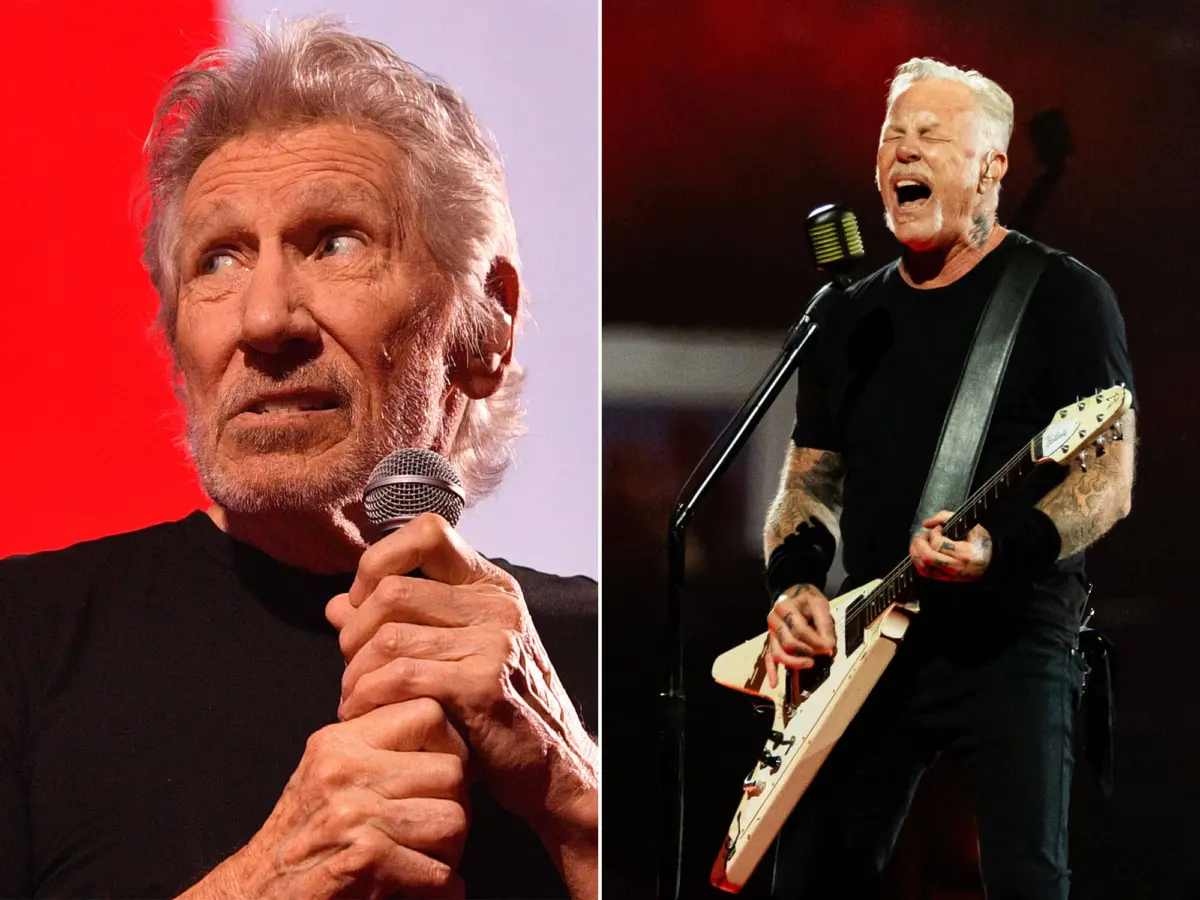
Former Pink Floyd bassist and co-founder Roger Waters has launched a scathing verbal attack on Metallica frontman James Hetfield, following Hetfield’s recent declaration at the Las Vegas Sphere that Metallica is "not here to influence you with any bullshit." Waters, known for his outspoken political views, unequivocally dismissed Hetfield’s stance, questioning his intellect, character, and even his musical abilities in a recent podcast appearance, thereby intensifying an ongoing discussion within the music industry regarding the role of artists in political discourse.
Hetfield’s "Apolitical" Stance at the Sphere
The controversy originated from James Hetfield’s comments during Metallica’s performance at the cutting-edge Sphere venue in Las Vegas. Addressing the audience, Hetfield articulated a clear position on the band’s intent: "Metallica is not here, like some other entertainers, to influence you with their bullshit. Okay? We are here… no bullshit… we’re here to forget about all the outside shit, okay? Metallica’s agenda is love, energy and heavy music, baby." These remarks were widely interpreted as a direct response to a growing trend among musicians who have increasingly used their stage time to make political statements, a practice that has sometimes led to repercussions, such as Macklemore’s reported removal from an Ed Sheeran tour after making pro-Palestinian comments. Other artists, including Hayley Williams of Paramore, have also utilized their platforms to address various socio-political issues, highlighting a broader industry discussion about the boundaries of artistic expression and activism.
Immediate Backlash and Historical Discrepancies
Hetfield’s "apolitical" declaration quickly drew criticism from various segments of the fanbase and music commentators. Many pointed to Metallica’s extensive discography, which includes numerous songs with overt political and social commentary, as a direct contradiction to the frontman’s recent statement. Tracks like "One," a powerful anti-war anthem inspired by Dalton Trumbo’s novel Johnny Got His Gun, "Disposable Heroes," which critiques the military-industrial complex, and "Don’t Tread on Me," a song with clear libertarian and anti-government undertones, stand as prominent examples of the band’s historical engagement with political themes. This perceived inconsistency fueled the initial wave of backlash, suggesting that Hetfield’s statement either ignored or actively recontextualized a significant part of Metallica’s artistic legacy.
Roger Waters’ Unfiltered Response
The debate escalated dramatically with Roger Waters’ entry into the discussion. During a recent podcast interview, Waters did not mince words when asked about Hetfield’s comments. His response was characterized by extreme vitriol and personal attacks, leaving no ambiguity about his contempt for Hetfield’s position. "Can we stop talking about this prick? I’m so bored with him," Waters began, setting a harsh tone. He continued, "He’s just showing that he’s a complete prick. He’s got an IQ of about three, and why we’re talking about him, I honestly don’t know because he’s a nobody and he’ll always be. He may have a few hundred million dollars or whatever, but he’s a prick."
Waters’ critique extended beyond personal insults to question Hetfield’s fundamental musicality. He asserted that Hetfield was "no musician," further elaborating, "I heard them playing acoustic instruments and they couldn’t. It was appalling." This particular claim has been met with skepticism by many who are familiar with Hetfield’s work, particularly his well-regarded acoustic performances on tracks such as "Fade to Black" and "The Unforgiven," which showcase a proficient understanding of melodic and rhythmic acoustic guitar playing within a heavy metal context. These performances are often cited as examples of the band’s versatility and Hetfield’s skill beyond his iconic rhythm guitar work. Waters’ sweeping dismissal of Hetfield’s musical talent appears to be a hyperbole intended to underscore his broader disdain rather than a factually grounded assessment.
Metallica’s Enduring Legacy of Social Commentary
To fully appreciate the context of the criticism leveled against Hetfield, it is essential to examine Metallica’s long-standing tradition of weaving social and political themes into their music. From their early thrash metal days, the band distinguished itself not only through its aggressive sound but also its thoughtful, often critical, lyrical content.

- "One" (1988): Released on …And Justice for All, this Grammy-winning track is arguably their most famous protest song. It vividly depicts the horror of a soldier who loses all his limbs and senses in war, trapped in his own body. Its anti-war message is undeniable and universally recognized.
- "Disposable Heroes" (1986): From Master of Puppets, this song is a scathing indictment of the military-industrial complex and the dehumanization of soldiers, portraying them as expendable pawns in political conflicts.
- "…And Justice for All" (1988 – album title track): The entire album, particularly its title track, is a profound critique of injustice, corruption, and hypocrisy within legal and governmental systems.
- "Don’t Tread on Me" (1991): Featured on The Black Album, this song takes its title and imagery from the Gadsden flag, a symbol associated with American libertarianism and anti-government sentiment. Its lyrics express themes of individual liberty and resistance to perceived overreach by authority.
- "Blackened" (1988): The opening track of …And Justice for All, addresses environmental destruction and humanity’s impact on the planet, showcasing an early concern for ecological issues.
These examples, among others, demonstrate that Metallica has, for decades, engaged with complex societal issues through their art. This historical record makes Hetfield’s recent assertion of an "apolitical" stance particularly contentious and provides the factual basis for much of the criticism he has received.
Roger Waters: A History of Uncompromising Activism and Controversy
Roger Waters’ aggressive response to Hetfield is entirely consistent with his own long and often controversial history of political activism. Throughout his career, both with Pink Floyd and as a solo artist, Waters has been an unwavering advocate for various causes, often using his music and public platform to express strong political opinions. His work frequently addresses themes of war, corporate greed, government oppression, and human rights.
Waters’ commitment to political expression has, however, also led to significant controversies. In 2023, he garnered widespread international condemnation for dressing in a Nazi-like uniform during a concert in Berlin, an act he claimed was a critique of fascism but was widely perceived as antisemitic and insensitive. This incident led to investigations by German police and drew sharp criticism from the US State Department, which described his actions as "deeply offensive" and accused him of having a "long track record of using antisemitic tropes." His outspoken pro-Palestinian views and criticisms of Israeli policies have also frequently placed him at the center of heated debates, further solidifying his reputation as an artist who is unafraid to court controversy in the pursuit of his political convictions.
Given this background, Waters’ attack on Hetfield can be seen as more than a personal insult; it represents a clash of ideologies regarding the very purpose and responsibility of art. For Waters, art is inherently political, a tool for social commentary and change. Hetfield’s desire for music to be an escape, devoid of "bullshit" influence, directly challenges Waters’ core belief system.
Broader Implications: The Artist’s Platform in a Divided World
The highly public confrontation between Waters and Hetfield underscores a larger, ongoing debate within the music industry and society at large: what is the responsibility of an artist? Should musicians use their platforms to influence public opinion on political or social matters, or should their art remain a sanctuary from such divisive topics?
- The Argument for Engagement: Proponents of artistic engagement argue that artists, by virtue of their visibility and cultural influence, have a moral obligation to speak out on issues they believe are important. They contend that art has historically been a powerful medium for social change and that remaining silent in times of injustice is a form of complicity. This perspective aligns with Waters’ philosophy.
- The Argument for Apolitical Art: Conversely, those who advocate for apolitical art, like Hetfield’s stated position, argue that music’s primary purpose is entertainment, escapism, and emotional connection. They believe that injecting politics can alienate fans, dilute the artistic message, and turn concerts into political rallies, thereby detracting from the shared experience of music. Some fans actively seek refuge from the constant bombardment of political news and appreciate artists who offer a temporary reprieve.
- The Gray Area of Interpretation: A significant challenge lies in the subjective nature of "political." While some songs overtly state political positions, others carry implicit social commentaries that might be interpreted differently by listeners. Metallica’s own history exemplifies this ambiguity; while "One" is unequivocally anti-war, other tracks might be seen as less directly political, yet still reflective of societal issues.
The clash between Waters and Hetfield also highlights generational and stylistic differences. While Waters hails from an era where rock music often served as a vehicle for counter-culture and protest, and progressive rock was known for its deep conceptual and often critical themes, Hetfield fronts a band whose roots are in heavy metal, a genre that, while often rebellious, has seen various stances on explicit political engagement.
Conclusion and Future Outlook
Roger Waters’ incendiary remarks against James Hetfield have reignited a fundamental debate about artistic responsibility and the role of musicians in public life. While Hetfield’s stated desire for an "apolitical" stage resonates with some fans seeking pure escapism, it stands in stark contrast to Metallica’s own lyrical history and the deeply ingrained activism of figures like Waters. This incident serves as a stark reminder that in an increasingly polarized world, the decision of whether and how artists engage with political issues remains a complex and often contentious one, with high-profile figures on both sides prepared to defend their positions with passionate, and at times, aggressive rhetoric. The conversation is far from over, ensuring that the intersection of music and politics will continue to be a fertile ground for discussion, disagreement, and dramatic pronouncements from its most prominent voices.
