

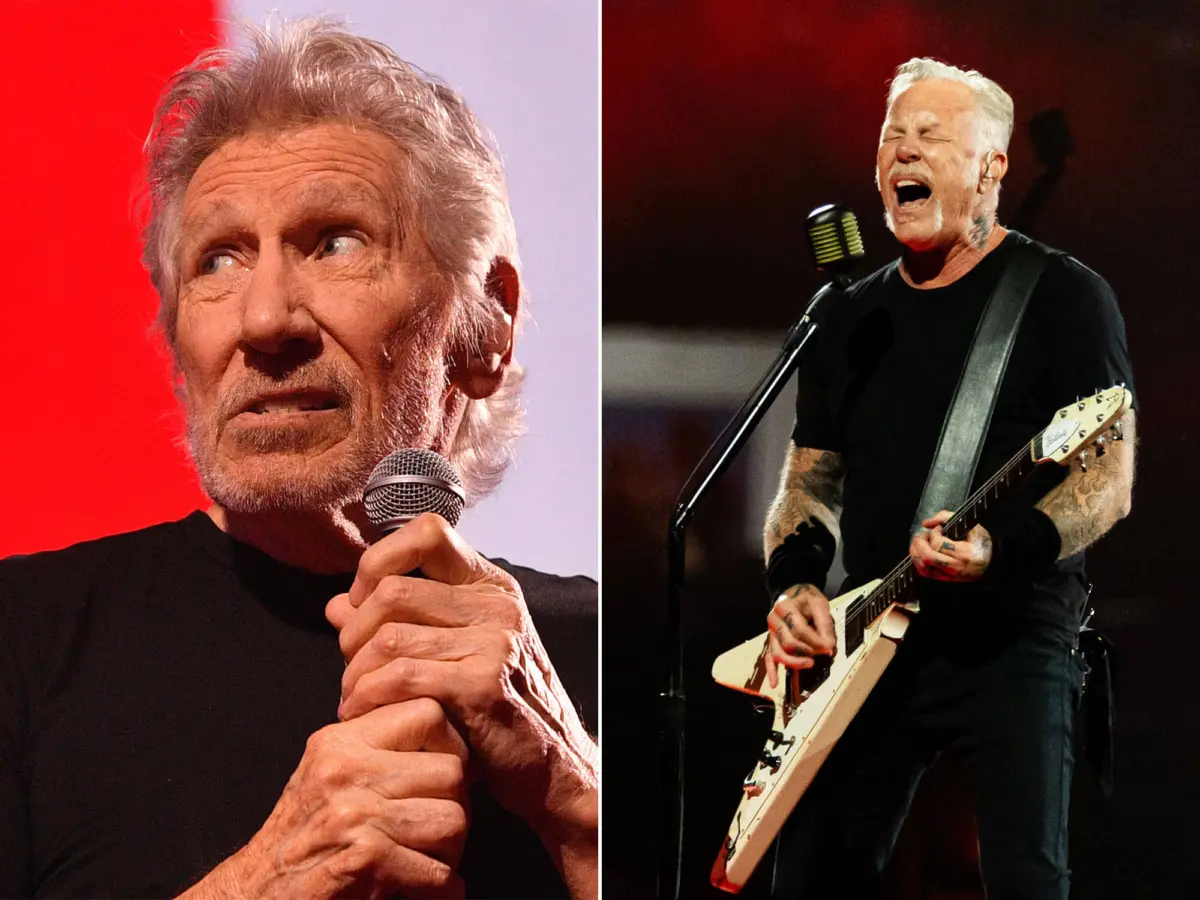
A significant public feud has erupted within the rock music community, pitting two iconic figures against each other: former Pink Floyd bassist Roger Waters and Metallica frontman James Hetfield. The catalyst for this high-profile clash was Hetfield’s recent statements at a performance at the Sphere in Las Vegas, where he declared that Metallica was "not here to influence you with any bullshit" and aimed to provide an escape from "outside shit." Waters, renowned for his own deeply political artistry and outspoken views, responded with a blistering, highly personal attack on Hetfield, questioning his intelligence and musical prowess. This exchange has reignited a perennial debate within the entertainment industry regarding the role of artists and their platforms in addressing political and social issues.
Hetfield’s "Apolitical" Stance at the Sphere
During a recent performance at the innovative Sphere venue in Las Vegas, James Hetfield addressed the audience directly, asserting Metallica’s intention to offer an experience devoid of political messaging. "Metallica is not here, like some other entertainers, to influence you with their bullshit," Hetfield stated emphatically. He continued, "Okay? We are here… no bullshit… we’re here to forget about all the outside shit, okay? Metallica’s agenda is love, energy and heavy music, baby." This declaration came amidst a growing trend of artists using their stage time to voice political opinions, a practice that has seen mixed reactions from audiences and industry figures alike. Notable examples include Paramore’s Hayley Williams and rapper Macklemore, the latter of whom reportedly faced consequences, including being dropped from a leg of Ed Sheeran’s tour, for making political statements during performances. Hetfield’s comments appeared to position Metallica firmly in the camp of entertainment as escapism, a stark contrast to the increasing politicization of cultural spaces. The Sphere itself, a state-of-the-art venue designed to offer immersive experiences, might also be seen as a backdrop conducive to an "escape" narrative, with its advanced visual and auditory technology creating a world apart from daily realities.
Metallica’s Historical Engagement with Political Themes
Hetfield’s assertion that Metallica is not in the business of influencing with "bullshit" immediately drew criticism from various quarters, with many fans and commentators pointing to the band’s extensive catalog, which features numerous songs with clear political and socio-critical undertones. This perceived contradiction fueled much of the initial backlash.
For decades, Metallica has explored themes of war, injustice, censorship, and societal decay, often through the lens of individual struggle and systemic oppression.
- "One" (1988): Perhaps their most iconic political statement, "One" is a harrowing narrative inspired by Dalton Trumbo’s novel Johnny Got His Gun. It tells the story of a World War I soldier who loses all his limbs and senses, becoming a prisoner within his own body, a stark anti-war anthem that critiques the horrors and senselessness of armed conflict. The song’s graphic lyrics and music video convey a powerful message about the human cost of war.
- "Disposable Heroes" (1986): Featured on the seminal Master of Puppets album, this track directly criticizes military recruitment and the dehumanization of soldiers, portraying them as expendable tools in the hands of politicians and generals. The lyrics, "Back to the front / You will do what I say / When I say / Back to the front / You will die when I say / You must die," are a direct indictment of the military-industrial complex.
- "And Justice for All" (1988): The title track of their fourth album is a sprawling epic that lambasts corruption in the legal and political systems. It addresses themes of injustice, censorship, and the erosion of individual rights, painting a bleak picture of a society where truth and justice are subverted by power.
- "Don’t Tread on Me" (1991): While often interpreted as a statement of American patriotism, the song’s title directly references the Gadsden flag, a symbol associated with libertarianism and resistance to government overreach. Its message can be seen as a broader commentary on individual freedom and self-reliance against external control, a political stance in itself.
- "The Struggle Within" (1991): This track, while more introspective, touches on the internal conflicts arising from external pressures and societal expectations, reflecting a critical perspective on the human condition shaped by broader forces.
These examples highlight a consistent thread of social and political commentary woven into Metallica’s lyrical fabric throughout their career. Critics argued that to suddenly claim an "apolitical" stance was either disingenuous or a selective reinterpretation of their own artistic legacy, potentially alienating segments of their fanbase who connected with these deeper meanings.
Roger Waters’ Vehement Rebuttal
The perceived inconsistency in Hetfield’s statements did not go unnoticed by Roger Waters, who unleashed a furious tirade against the Metallica frontman during a recent podcast appearance. Waters, known for his unvarnished and often provocative opinions, did not mince words, delivering a scathing personal attack that extended beyond ideological disagreement.
"Can we stop talking about this prick? I’m so bored with him," Waters began, setting a combative tone. He continued, "He’s just showing that he’s a complete prick. He’s got an IQ of about three, and why we’re talking about him, I honestly don’t know because he’s a nobody and he’ll always be. He may have a few hundred million dollars or whatever, but he’s a prick." This intensely personal assault on Hetfield’s character and intelligence immediately garnered significant attention, characteristic of Waters’ confrontational style.
Beyond the ad hominem attacks, Waters also directly challenged Hetfield’s musical abilities, a highly unusual and potent criticism from one veteran musician to another. "I heard them playing acoustic instruments and they couldn’t. It was appalling," Waters claimed. This specific critique, however, appears to be an over-exaggeration or potentially a mischaracterization. James Hetfield’s acoustic playing, particularly on tracks like the introspective intro to "Fade to Black" or the nuanced passages in "The Unforgiven," is widely regarded as competent and integral to Metallica’s sound, showcasing a dynamic range beyond their signature heavy riffs. Waters’ assertion in this regard struck many as an attempt to discredit Hetfield entirely, even on grounds where his skill is generally accepted.

Waters’ Own History of Provocation and Political Activism
Waters’ vehement criticism of Hetfield’s "apolitical" stance carries significant weight given his own career, which has been inextricably linked with overt political and social commentary. Throughout his time with Pink Floyd and in his extensive solo career, Waters has consistently used his music and platform to address global conflicts, human rights, and geopolitical issues.
- "The Wall" (1979): As the primary creative force behind Pink Floyd’s iconic album, Waters crafted a powerful narrative exploring themes of isolation, war, fascism, and the oppressive structures of society. The character of Pink, a rock star driven to madness by childhood trauma and societal pressures, becomes a symbol of rebellion against authoritarianism. The live shows for "The Wall," particularly the legendary 1990 Berlin concert commemorating the fall of the Berlin Wall, were massive political statements in themselves.
- Solo Career and Activism: Waters’ solo work has continued this trajectory, often focusing on anti-war sentiments, critiques of capitalism, and advocacy for various social justice causes. He has been a vocal critic of Israeli policy towards Palestinians, often drawing strong condemnation and accusations of antisemitism. His support for the Boycott, Divestment, and Sanctions (BDS) movement against Israel has been a particularly contentious aspect of his activism.
- Recent Controversies: In 2023, Waters sparked international outrage during his "This Is Not a Drill" tour. At a concert in Berlin, he appeared on stage dressed in a trench coat with red armbands, reminiscent of a Nazi SS officer, and simulated firing a machine gun. This theatrical portrayal, intended as an anti-fascist statement, was widely condemned as antisemitic by organizations including the US State Department and German police, leading to a criminal investigation. Waters defended his actions as a critique of fascism, but the imagery and context were deemed deeply offensive and harmful. This incident underscores Waters’ consistent willingness to employ controversial and often shocking imagery and rhetoric to convey his political messages, making his critique of Hetfield’s neutrality particularly ironic to some observers.
Waters’ history demonstrates a profound conviction that art and politics are inseparable, and that artists have a moral obligation to use their platforms to challenge power and advocate for change. This philosophical bedrock informs his apparent disdain for artists who choose to remain silent or claim neutrality in the face of societal issues.
The Broader Debate: Art, Activism, and the Artist’s Role
The exchange between Waters and Hetfield serves as a microcosm of a much larger and ongoing debate within the cultural sphere: what is the artist’s responsibility in a world grappling with complex social and political issues?
One perspective, championed by Waters and many other activist artists, argues that art is inherently political, whether explicitly stated or not. They believe that by virtue of their visibility and influence, artists have a moral imperative to speak truth to power, challenge injustice, and inspire critical thought. To remain silent, in this view, is to implicitly endorse the status quo or to shirk a vital responsibility. This stance often highlights the historical role of artists as commentators, provocateurs, and agents of change, from protest singers of the civil rights era to contemporary activists.
Conversely, the "apolitical" stance, as articulated by Hetfield, suggests that the primary purpose of entertainment is to provide an escape, a space where audiences can temporarily forget their worries and connect through shared passion for music. Proponents of this view argue that forcing political agendas onto audiences can alienate fans, dilute the artistic experience, and turn entertainment into a lecture. They may also argue that an artist’s personal political views do not necessarily enhance their artistic output and that their craft should speak for itself. Furthermore, some believe that artists, like any individuals, are entitled to their privacy and should not be pressured to take public stances on every issue. This perspective often appeals to fans who seek solace and unity in music, irrespective of political divides.
The current cultural climate, marked by heightened political polarization and constant digital discourse, amplifies this debate. Every public statement or performance is scrutinized, and the line between personal expression and public responsibility becomes increasingly blurred for high-profile figures.
Reactions and Implications
The stark contrast between Hetfield’s desire for an apolitical space and Waters’ aggressive insistence on political engagement has predictably drawn varied reactions. Many who sided with Waters lauded his uncompromising stance, viewing Hetfield’s comments as a cop-out or a naive understanding of Metallica’s own impact. Conversely, Hetfield’s supporters praised his commitment to providing pure entertainment, arguing that music should unite people, not divide them through political discourse.
The long-term implications of this public spat are multifaceted. For Metallica, it forces a re-evaluation of their historical legacy in light of their frontman’s recent statements. It might also lead to further introspection within the band about their collective identity and message. For Waters, it solidifies his image as a tireless, albeit often controversial, political activist, further cementing his place as one of rock’s most outspoken figures. However, his highly personal and aggressive attack on Hetfield’s intelligence and musicianship also risks alienating some who might otherwise agree with his broader message, potentially overshadowing the substance of his argument with the perceived harshness of his delivery.
Ultimately, this clash between two titans of rock music highlights a fundamental tension in contemporary culture: the expectation placed upon artists to be more than just entertainers, balanced against the desire for art to offer a respite from the world’s complexities. As the lines between art, politics, and personal branding continue to blur, this debate is unlikely to find a definitive resolution, ensuring that the dialogue around the artist’s role in society remains as dynamic and contentious as ever.
