

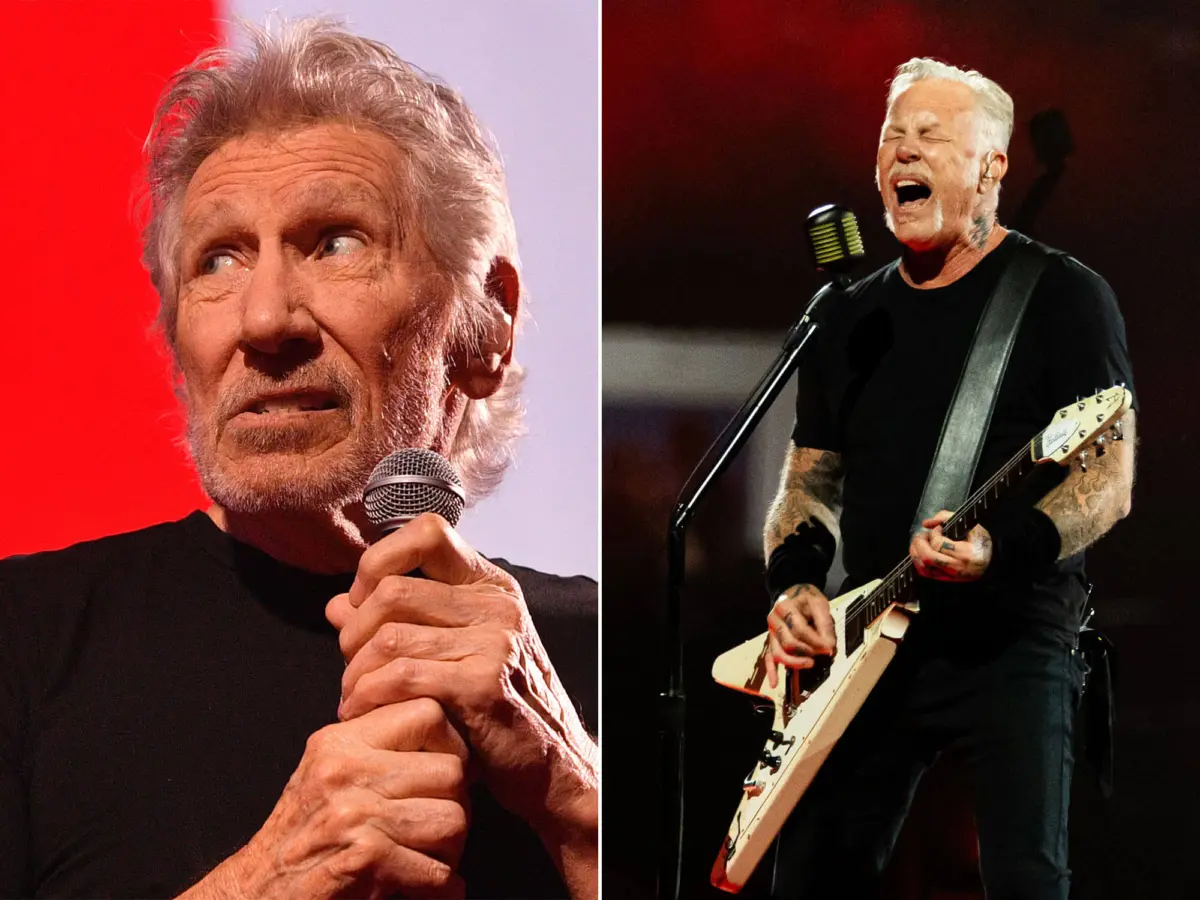
The long-standing debate concerning the intersection of music and political expression in the performing arts has been reignited with formidable intensity, following a recent and exceptionally sharp rebuke from former Pink Floyd bassist Roger Waters directed at Metallica frontman James Hetfield. Waters’ comments, delivered during a podcast appearance, were a direct response to Hetfield’s public declaration at a recent Sphere performance in Las Vegas, where he asserted that Metallica was "not here to influence you with any bullshit" and that the band’s agenda was solely "love, energy and heavy music." This statement, perceived by many as a deliberate disavowal of political engagement, has drawn significant scrutiny, not least from Waters, a musician renowned for his uncompromising and often polemical political activism.
The Catalyst: Hetfield’s "Apolitical" Stance at The Sphere
The genesis of this latest musical skirmish traces back to a highly anticipated Metallica concert at the cutting-edge Sphere venue in Las Vegas. The Sphere, known for its immersive visual experiences and advanced acoustics, served as the backdrop for Hetfield’s remarks, which quickly circulated across social media and music news outlets. Addressing the vast audience, Hetfield explicitly stated, "Metallica is not here, like some other entertainers, to influence you with their bullshit. Okay? We are here… no bullshit… we’re here to forget about all the outside shit, okay? Metallica’s agenda is love, energy and heavy music, baby."
These comments were widely interpreted as a direct reference to a growing trend among contemporary artists who have increasingly utilized their live platforms to articulate political and social viewpoints. Recent examples include Hayley Williams of Paramore and rapper Macklemore, both of whom have openly engaged in political commentary during their performances. Macklemore, in particular, faced consequences for his outspokenness, reportedly being dropped from a segment of Ed Sheeran’s tour after making political statements. Against this backdrop, Hetfield’s assertion of an "apolitical" stance from a band with Metallica’s storied history immediately raised eyebrows and sparked a considerable online discussion regarding the role of artists in public discourse. The Sphere performances themselves were part of Metallica’s broader touring schedule, showcasing their enduring appeal and mastery of the live spectacle, yet it was this specific verbal interjection that transcended the musical performance itself to become a headline.
Historical Context: Metallica’s Political Oeuvre
The immediate backlash against Hetfield’s comments largely stemmed from what many perceived as a glaring inconsistency with Metallica’s own extensive discography. Far from being apolitical, the band has, throughout its nearly four-decade career, woven intricate and often scathing social and political commentary into the fabric of its music. Several of their most iconic and enduring tracks stand as testaments to this engagement.
"One," a Grammy-winning masterpiece from their 1988 album …And Justice for All, is perhaps the most prominent example. Inspired by Dalton Trumbo’s anti-war novel Johnny Got His Gun, the song graphically depicts the horrors of war and the devastating psychological and physical toll on soldiers. Its powerful lyrics and accompanying music video – featuring clips from the film adaptation – leave no ambiguity regarding its anti-war message, a profoundly political statement.
Similarly, "Disposable Heroes," from the same album, offers a fierce critique of military recruitment and the dehumanizing nature of warfare, painting soldiers as expendable pawns in geopolitical games. The lyrics, "Back to the front / You will do what I say, when I say / Back to the front / You will die when I say, when I say," directly challenge authority and highlight the plight of those caught in conflicts.
Even "Don’t Tread on Me" from their 1991 self-titled "Black Album," while often interpreted as a patriotic anthem, carries significant political undertones, drawing inspiration from the Gadsden Flag and its historical association with American libertarianism and resistance to governmental overreach. While its specific political alignment might be debated, its very existence as a commentary on national identity and individual freedom demonstrates a clear departure from an "apolitical" stance. These examples, among others, underscore a pattern of engagement with complex societal issues that directly contradicts Hetfield’s recent pronouncement, leading many fans and critics to question the sincerity or accuracy of his statement.
Roger Waters’ Unfiltered Condemnation
It was into this already charged atmosphere that Roger Waters injected his characteristically unvarnished and explosive commentary. Appearing on a recent podcast, the former Pink Floyd leader launched an astonishingly personal and vitriolic attack on James Hetfield, leaving no doubt as to his disdain for the Metallica frontman’s remarks.
Waters began his tirade with an exasperated plea: "Can we stop talking about this prick? I’m so bored with him." He continued, escalating his personal assault, "He’s just showing that he’s a complete prick. He’s got an IQ of about three, and why we’re talking about him, I honestly don’t know because he’s a nobody and he’ll always be. He may have a few hundred million dollars or whatever, but he’s a prick." The use of such inflammatory language, particularly the repeated derogatory term and the dismissive assessment of Hetfield’s intelligence and worth, immediately captured attention and generated significant debate across music communities.
Waters did not confine his criticism to Hetfield’s perceived intellectual capacity or character, extending it to his musical abilities as well. He asserted that Hetfield was "no musician," a staggering claim given Hetfield’s status as one of heavy metal’s most influential guitarists and vocalists. Waters further elaborated on this point, stating, "I heard them playing acoustic instruments and they couldn’t. It was appalling." This particular criticism, however, appears to be an exaggeration or possibly a misremembered observation. James Hetfield’s acoustic performances, notably on tracks such as "Fade to Black," "The Unforgiven," "Nothing Else Matters," and various "S&M" (Symphony & Metallica) performances, are widely regarded by fans and critics alike as solid and integral to Metallica’s sound, showcasing a nuanced side to his musicianship that goes beyond the raw power of electric thrash. The stark contrast between Waters’ assessment and the widely accepted perception of Hetfield’s skill highlights the extremity of Waters’ rhetoric.

A History of Confrontation: Roger Waters’ Public Persona
Roger Waters’ aggressive response to Hetfield’s comments is entirely consistent with his long-established public persona, one defined by unwavering political conviction and a willingness to confront perceived injustices or ideological opponents with unsparing directness. Throughout his illustrious career, both with Pink Floyd and as a solo artist, Waters has consistently leveraged his platform to articulate deeply held political beliefs, often at the cost of public controversy.
With Pink Floyd, Waters was the principal lyricist and conceptual architect behind some of rock’s most politically charged and socially critical albums. The Wall (1979) is a monumental work that critiques the psychological and societal barriers individuals construct, touching upon themes of war, authoritarianism, and alienation. Animals (1977) offered a scathing allegorical critique of capitalism and class division, categorizing people into "dogs," "pigs," and "sheep." The Final Cut (1983), dedicated to his father who died in World War II, was an overtly anti-war album, particularly critical of the Falklands War and then-Prime Minister Margaret Thatcher. These works cemented Waters’ reputation as a musician deeply engaged with the political landscape.
In his extensive solo career, Waters has continued this tradition, becoming an increasingly vocal advocate for various causes, most notably the Palestinian struggle and broader anti-war movements. His concerts often incorporate powerful visual and thematic elements that reinforce his political messages, transforming musical performances into platforms for activism. However, this commitment to political expression has not been without significant controversy.
In 2023, Waters drew international condemnation and faced legal scrutiny from German police and the U.S. State Department after dressing in a Nazi-esque uniform during a concert in Berlin. While Waters maintained the costume was a theatrical critique of fascism, a recurring motif in The Wall, critics, including Jewish groups and government officials, deemed it antisemitic and deeply offensive. This incident, among others related to his outspoken views on the Israeli-Palestinian conflict, has frequently placed Waters at the center of heated debates, highlighting the fine line between artistic expression, political commentary, and perceived hate speech. His willingness to provoke and challenge, often employing confrontational language, has become a defining characteristic of his public identity, making his recent attack on Hetfield less of an anomaly and more of a predictable manifestation of his consistent approach to public discourse.
The Broader Discourse: Music and Political Engagement
The exchange between Waters and Hetfield serves as a microcosm of a much larger and perennial debate within the music industry: should artists be political, or should they "stick to the music"? This discussion often polarizes audiences and musicians alike, with compelling arguments on both sides.
Proponents of artistic political engagement argue that musicians, by virtue of their public platform and ability to connect emotionally with audiences, have a unique responsibility and opportunity to comment on social injustices, advocate for change, and serve as a voice for the voiceless. Throughout history, music has been a powerful vehicle for protest and social commentary, from the folk songs of the American civil rights movement to the punk rock anthems challenging governmental authority. Artists are often seen as barometers of cultural sentiment, reflecting and shaping societal dialogue. To remain silent, for some, is to be complicit. Moreover, the act of creating art is inherently an act of expression, and for many artists, separating their personal worldview, which often includes political convictions, from their creative output is an impossible or even disingenuous endeavor.
Conversely, those who advocate for an "apolitical" stance in music argue that live concerts and musical recordings should primarily serve as an escape from the often-divisive realities of politics. For many fans, music offers solace, entertainment, and a space for unity, where political differences can be temporarily set aside. When artists introduce overtly political messages, it can alienate segments of their audience who may hold differing views or who simply wish to enjoy the music without ideological instruction. This perspective suggests that the primary "agenda" of a band like Metallica should indeed be "love, energy, and heavy music," as Hetfield stated, fostering a sense of community through shared musical experience rather than political alignment. Furthermore, some argue that an artist’s expertise lies in music, not necessarily in political science or international relations, and therefore their political opinions carry no more inherent weight than those of any other citizen.
Hetfield’s statement, in this context, can be seen as an attempt to cater to the latter perspective, seeking to create a unifying space for his audience. However, the ensuing backlash and Waters’ fierce denunciation underscore the complexity of this aspiration, particularly for a band with a legacy of politically resonant material. Indeed, even the declaration of being "apolitical" can, paradoxically, be interpreted as a political statement in itself, aligning with a particular worldview that prioritizes escapism or disengagement from public discourse.
Implications and Future Outlook
The public spat between Roger Waters and James Hetfield carries several implications for the artists involved and the broader music landscape. For Waters, this incident further solidifies his image as an uncompromising, albeit often controversial, political figure in music. It reinforces his commitment to using his voice for activism, even if it means alienating peers or courting public censure. For Hetfield and Metallica, the controversy highlights the challenges faced by long-standing bands with complex histories. Attempting to redefine a public image, particularly in an era of instant information and archival access, can lead to charges of hypocrisy and inconsistency. The debate will undoubtedly continue to shape fan perceptions of Metallica’s authenticity and their legacy of social commentary.
Beyond the individuals, this episode serves as a potent reminder of the ongoing tension between entertainment and activism in the arts. As the world navigates an increasingly polarized political climate, the expectation for public figures, including musicians, to take stances on critical issues continues to grow. This incident underscores that an artist’s past work often dictates future expectations, and attempts to declare neutrality or disengagement can be met with as much scrutiny as outright political endorsement. The Sphere, with its innovative technology, offered a vision of immersive entertainment, but even within its futuristic confines, the fundamental questions about the artist’s role in society persist. As musicians from different generations and genres continue to grapple with these issues, the Waters-Hetfield exchange will likely be referenced as a significant moment in the evolving dialogue about artistic integrity, freedom of expression, and the enduring power of music to both unite and divide.
