

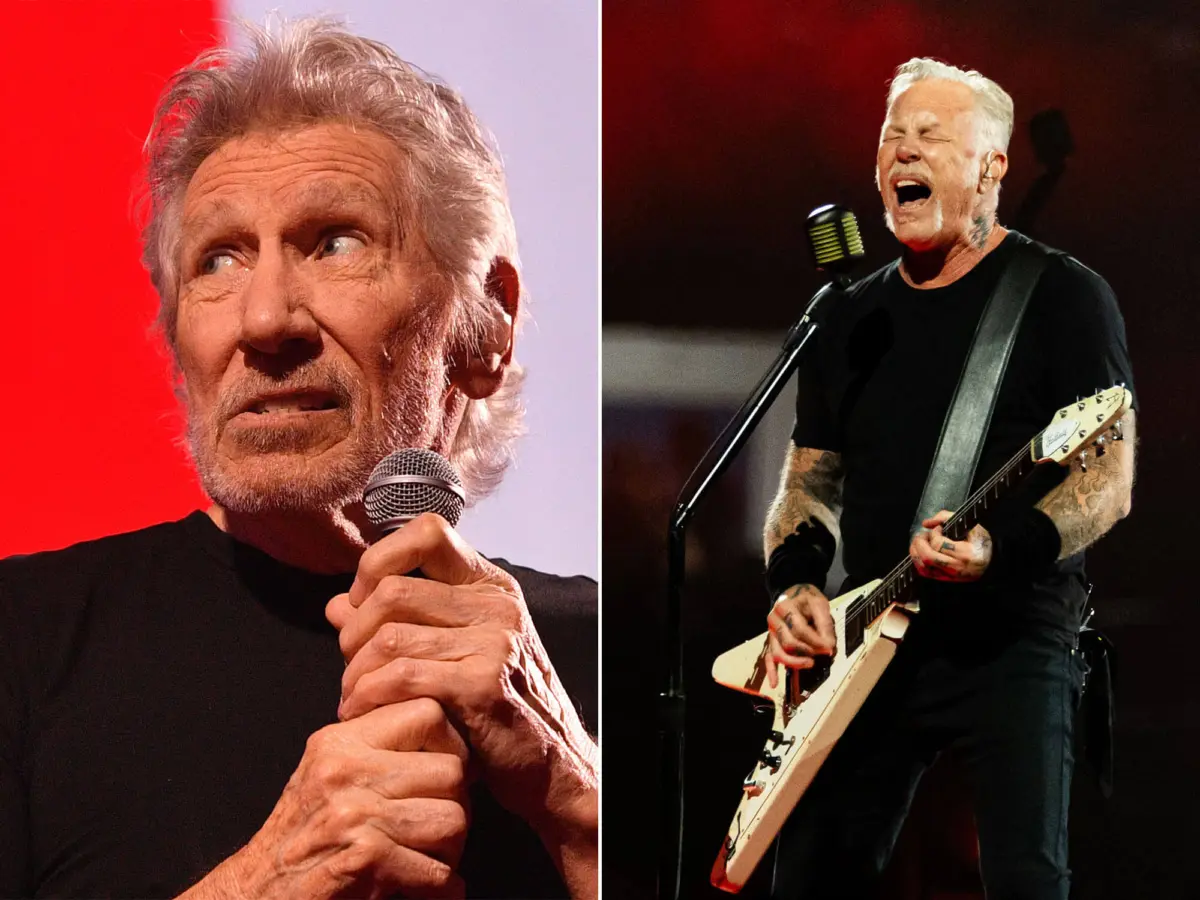
The music world has been rocked by a deeply personal and vitriolic attack from legendary Pink Floyd co-founder Roger Waters directed at Metallica frontman James Hetfield. The outburst, delivered during a recent podcast appearance, came in response to Hetfield’s recent comments at a performance at the Sphere in Las Vegas, where he stated that Metallica was "not here to influence you with any bullshit" and that the band’s "agenda is love, energy and heavy music." Waters’ unreserved condemnation has not only reignited long-standing debates about the role of artists in political discourse but has also drawn sharp scrutiny due to the extreme nature of his personal insults and his own controversial history.
The Catalyst: Hetfield’s "Apolitical" Stance at the Sphere
The controversy originated from James Hetfield’s on-stage declaration during Metallica’s residency at the innovative Sphere venue. Addressing the audience, Hetfield explicitly articulated a desire to keep the band’s performances free from political or social messaging, asserting, "Metallica is not here, like some other entertainers, to influence you with their bullshit. Okay? We are here… no bullshit… we’re here to forget about all the outside shit, okay? Metallica’s agenda is love, energy and heavy music, baby." This statement was perceived by many as a deliberate distinction from a growing trend among contemporary artists who frequently use their platforms to vocalize political opinions or advocate for various causes.
Hetfield’s remarks resonated with a segment of the audience and the broader public who prefer to compartmentalize their entertainment experiences from political activism, seeking live music as an escape or a source of pure enjoyment rather than a forum for social commentary. His message underscored a desire for unity through music, transcending the divisive political landscape that often permeates public discourse. However, it also sparked immediate debate, particularly among those who believe that artists, given their considerable influence, have a moral imperative to speak out on pressing societal issues.
The Broader Context: Musicians and Political Platforms
Hetfield’s comments did not occur in a vacuum. They arrived amidst a period where numerous high-profile musicians have increasingly integrated political and social statements into their performances and public personas. This trend has seen artists like Paramore’s Hayley Williams and rapper Macklemore openly addressing political topics during their concerts, sometimes to critical acclaim and other times to significant backlash. A notable recent incident involved Macklemore being reportedly dropped from Ed Sheeran’s tour following his vocal support for Palestinian rights during a live show, illustrating the tangible professional consequences that can accompany such public stances.
This environment has created a palpable tension within the music industry: the expectation from some for artists to be socially conscious voices versus the desire from others for music to remain a sanctuary from political strife. Artists navigate a complex landscape where their personal beliefs, public image, and commercial interests are constantly intertwined. Hetfield’s statement at the Sphere can be seen as an attempt to define Metallica’s position within this ongoing debate, opting for an ostensibly "apolitical" performance space.
Metallica’s Political Legacy: A Perceived Contradiction
Despite Hetfield’s recent assertion of an apolitical stance, many critics and long-time fans were quick to point out what they perceived as a significant contradiction in Metallica’s own discography. The band, often celebrated for its lyrical depth and thematic exploration, has a history replete with songs that delve into profound social, political, and historical subjects.
One of their most iconic tracks, "One," from the 1988 album …And Justice for All, is a powerful anti-war anthem inspired by Dalton Trumbo’s novel Johnny Got His Gun. The song graphically depicts the horrors of war through the eyes of a soldier who loses all his limbs and senses, becoming a prisoner within his own body. Its stark portrayal of suffering and the futility of conflict is undeniably a potent political statement.
Similarly, "Disposable Heroes," from the 1986 album Master of Puppets, offers a scathing critique of military recruitment and the dehumanizing nature of warfare, portraying soldiers as expendable pawns in geopolitical games. The lyrics "Back to the front / You will do what I say / When I say / Back to the front / You will die when I say / You have no say" leave little room for interpretation regarding its anti-establishment and anti-war message.
Even "Don’t Tread on Me," from their self-titled 1991 "Black Album," while often misinterpreted, draws on the historical "Don’t Tread on Me" flag associated with American libertarianism and early revolutionary sentiment. While some might argue it’s a statement of individual liberty rather than partisan politics, its imagery and historical context carry distinct political undertones related to self-reliance and resistance against perceived tyranny. Other songs like "Harvester of Sorrow" touch upon themes of child abuse and societal decay, while "And Justice for All" itself is a sprawling concept album dissecting legal corruption and injustice.
This historical body of work makes Hetfield’s recent "apolitical" claim challenging for many to reconcile, leading to accusations of hypocrisy or a selective memory regarding the band’s own creative output. The band’s evolution from a thrash metal pioneer known for its critical lyrics to a global stadium act often prompts questions about the consistency of its artistic messaging.
Roger Waters’ Vehement Response: A Barrage of Insults
It was against this backdrop that Roger Waters launched his blistering attack on James Hetfield. Appearing on a podcast, Waters minced no words, unleashing a torrent of personal insults that transcended mere critical disagreement. "Can we stop talking about this prick? I’m so bored with him," Waters began, setting the tone for what would follow. He continued, "He’s just showing that he’s a complete prick. He’s got an IQ of about three, and why we’re talking about him, I honestly don’t know because he’s a nobody and he’ll always be. He may have a few hundred million dollars or whatever, but he’s a prick."
Waters’ remarks went beyond character assassination, extending to a dismissive critique of Hetfield’s musical abilities. He asserted, "He’s no musician," and recounted an anecdote: "I heard them playing acoustic instruments and they couldn’t. It was appalling." This particular criticism struck many as particularly unfounded, given Hetfield’s established reputation as a skilled rhythm guitarist and vocalist, whose contributions to Metallica’s sound are foundational.
The sheer ferocity and personal nature of Waters’ comments have been widely noted. While artistic disagreements are common, Waters’ choice to resort to such demeaning language has fueled further debate about the boundaries of public discourse, especially between figures of such significant cultural standing. His words have been interpreted by some as a reflection of his own deeply entrenched political convictions and his uncompromising stance on artists’ responsibility to engage with societal issues.

A Deeper Look at Waters’ Accusation of Musical Incompetence
Waters’ claim regarding Hetfield’s supposed lack of musicality, particularly on acoustic instruments, stands in stark contrast to the readily available evidence within Metallica’s own catalog and live performances. James Hetfield is widely regarded as one of metal’s most influential rhythm guitarists, but his proficiency extends to acoustic work as well.
Classic Metallica tracks such as "Fade to Black" (from Ride the Lightning, 1984) feature prominent and intricate acoustic guitar intros and interludes, showcasing Hetfield’s melodic sensibilities and clean playing. The song’s structure, moving from delicate acoustic passages to heavy electric riffs, is a testament to his versatility. Similarly, "The Unforgiven" (from Metallica, 1991) opens with a memorable and atmospheric acoustic guitar arpeggio, a signature element that defines the track’s emotional weight. Throughout Metallica’s career, particularly during their Symphony & Metallica concerts and numerous acoustic charity events, Hetfield has consistently demonstrated solid and often compelling acoustic performances. His acoustic playing is a vital component of the band’s dynamic range, providing textural contrast and emotional depth to their often-heavy sound.
Therefore, Waters’ dismissal of Hetfield’s musicianship, particularly his acoustic capabilities, appears to be an exaggerated claim, potentially employed as a rhetorical device to underscore his overall contempt rather than a factual assessment of Hetfield’s skills. This specific point of criticism has led many to question the objectivity and factual basis of Waters’ broader rant.
Waters’ History of Controversy and Political Activism
Roger Waters himself is no stranger to controversy, nor is he a newcomer to using his platform for strong political statements. In fact, his career, both with Pink Floyd and as a solo artist, has been largely defined by his deeply held political and philosophical convictions, which frequently manifest in his lyrical themes and elaborate stage shows. Albums like Pink Floyd’s The Wall and The Final Cut are overtly political, critiquing war, societal oppression, and corporate greed.
However, Waters’ activism has often courted significant controversy. In 2023, he drew international condemnation, including from the US State Department and German police, following a concert in Berlin where he appeared on stage dressed in a costume resembling a Nazi SS officer. While Waters claimed the costume was a theatrical representation of a satirical character from The Wall meant to criticize fascism, critics denounced it as antisemitic and insensitive, particularly given the historical context of Germany. This incident led to investigations by German authorities and widespread accusations of antisemitism, which Waters vehemently denied.
Waters has also been a vocal critic of Israeli policies towards Palestinians, frequently using his concerts to express solidarity with the Palestinian cause, leading to accusations of anti-Zionism crossing into antisemitism – charges he consistently refutes, asserting his criticism is of the Israeli government, not Jewish people. His unyielding stance on these issues has made him a polarizing figure, admired by some for his courage and conviction, and condemned by others for what they perceive as offensive and inflammatory rhetoric. This long history of outspoken political engagement and often provocative actions provides crucial context for understanding the intensity of his reaction to Hetfield’s "apolitical" remarks.
The Philosophical Divide: Art, Entertainment, and Activism
The public exchange between Waters and Hetfield underscores a fundamental philosophical divide within the arts and entertainment industry: what is the true purpose and responsibility of an artist?
One perspective, championed by Waters and many other socially conscious artists, posits that art is inherently political, or at the very least, carries a moral obligation to reflect and critique the world it inhabits. From this viewpoint, artists are not merely entertainers but potential shapers of public opinion, endowed with a unique platform to speak truth to power, challenge injustice, and foster empathy. To remain "apolitical" is seen by proponents of this view as a dereliction of duty, or worse, a tacit endorsement of the status quo.
Conversely, the stance articulated by Hetfield represents a perspective that prioritizes art as a means of escape, unity, and shared human experience, separate from the often-divisive realm of politics. For those who hold this view, music’s power lies in its ability to transcend differences, offering solace, joy, and a temporary reprieve from the pressures of daily life, including political anxieties. Forcing political messages into every artistic expression can, from this viewpoint, alienate audiences and dilute the universal appeal of music. This perspective often argues that the primary function of an entertainer is to entertain, and individual political views, while valid, should not necessarily be conflated with the artistic product.
This ongoing debate highlights the complex relationship between artistic expression, public influence, and personal responsibility. There is no single consensus, and the public’s reception of an artist’s political engagement often depends on the specific issue, the artist’s perceived sincerity, and the prevailing socio-political climate. The Waters-Hetfield spat serves as a high-profile illustration of this enduring tension.
Reactions and Implications
The fallout from Waters’ remarks has been immediate and varied. Fans of both artists have taken to social media, largely polarizing along pre-existing lines of support or opposition. Waters’ ardent supporters have applauded his uncompromising stance and willingness to "speak his mind," seeing his attack as a righteous defense of artistic integrity and political engagement. Conversely, many Metallica fans and others critical of Waters have condemned his personal insults as unprofessional, unwarranted, and hypocritical given his own controversies. The incident has certainly generated significant media attention, drawing renewed focus on both musicians and their respective legacies.
For Metallica, Hetfield’s "apolitical" stance, now challenged by Waters and historical band lyrics, may force further introspection or clarification regarding their public image. For Waters, the incident adds another chapter to his already extensive history of highly vocal and often incendiary political commentary, further cementing his image as an artist who prioritizes conviction over diplomatic language.
Ultimately, this public spat underscores the ever-present tension between art and politics, and the diverse expectations placed upon public figures. While Waters’ comments were undeniably harsh and personal, they have inadvertently fueled a broader discussion about the role of music in a politically charged world, prompting both fans and critics to re-evaluate what they expect from their musical icons. The question of whether artists should entertain, enlighten, or incite remains a deeply contested terrain, with Roger Waters and James Hetfield now standing on opposing ends of a very public battlefield.
