

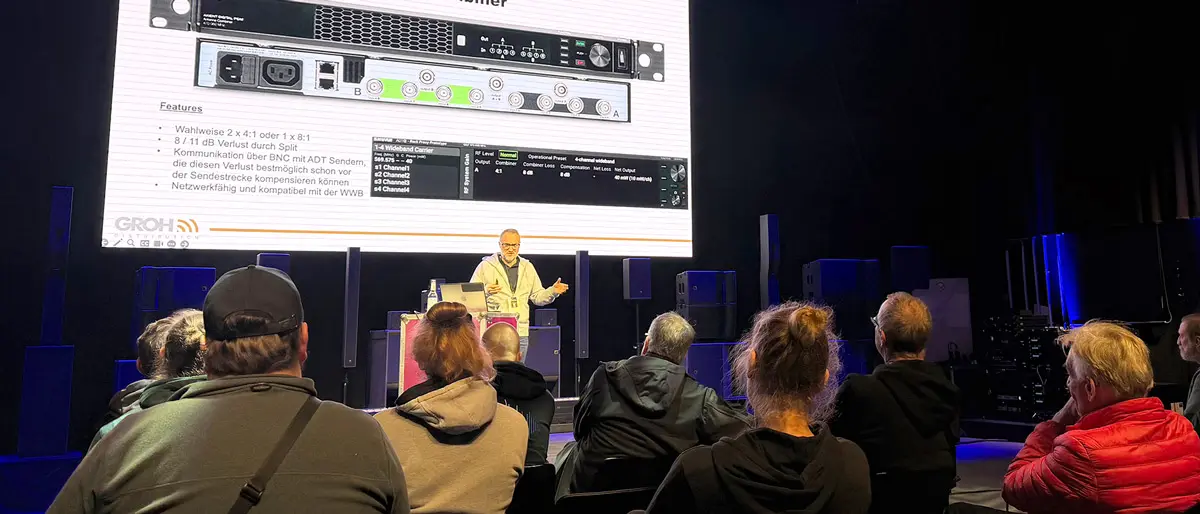
The professional audio and event technology landscape is set to converge in Buchholz in der Nordheide as Groh Distribution prepares to host the Groh Power Days 2026. Scheduled to take place from November 2 to November 4, 2026, at the company’s dedicated training center, this three-day intensive symposium is designed to address the evolving technical demands of sound engineers, rental companies, event production firms, system integrators, and technical staff operating in theaters, multi-purpose halls, and houses of worship. As the industry moves toward increasingly complex digital ecosystems, the event aims to bridge the gap between theoretical product knowledge and practical, on-site application. Participation in the workshops, specialized training sessions, and catering, as well as the evening networking events, is provided free of charge to registered professionals, underscoring Groh Distribution’s commitment to industry-wide education and professional development.
A Strategic Response to Technological Evolution in Pro-Audio
The timing of the Groh Power Days 2026 reflects a critical juncture in the professional audio sector. By late 2026, the industry has seen a massive shift toward networked audio, sophisticated wireless spectrum management, and the integration of software-driven control interfaces. Groh Distribution, a key player in the European distribution market, has structured the event to provide a comprehensive deep dive into these advancements. Rather than a traditional trade show format, the Power Days are designed as a hands-on educational forum where attendees can interact directly with the hardware and software that define modern production standards.
The event structure is partitioned into three distinct thematic focuses, each dedicated to a specific pillar of contemporary audio engineering: high-end mixing console workflows, system integration and control, and the complexities of the modern digital signal chain. By focusing on these areas, the organizers aim to equip professionals with the skills necessary to navigate the high-pressure environments of live performance and fixed installations.
Day One: Mastering the Allen & Heath dLive Ecosystem
The inaugural day of the event, Monday, November 2, focuses exclusively on the Allen & Heath dLive platform. As one of the most widely adopted digital mixing systems in the touring and installation markets, the dLive ecosystem represents a benchmark for flexibility and processing power. The session will be led by Sascha Kohl of Audio-Technica, a recognized expert in high-end mixing workflows.
The "Expert Training" session is intended to go beyond basic operation. Attendees will explore the 96kHz XCVI core architecture, deep-dive into the DEEP processing suite, and examine the integration of Dante and Waves networking. In an era where latency and phase coherence are paramount, the training will provide practical insights into optimizing the dLive’s FPGA-based processing. For sound engineers, the ability to master the dLive’s Director software and its hardware surfaces (S Class and C Class) is essential for managing the high channel counts and complex routing required in modern theatrical and concert productions.
Day Two: The Convergence of Control and Console Innovation
On Tuesday, November 3, the focus shifts to a broader comparative analysis of mixing technologies and the integration of third-party control systems. This day is particularly relevant for system integrators and production managers who must balance performance with operational efficiency.
The curriculum features a detailed look at the Yamaha ecosystem, including the DM5, DM7, and the flagship Rivage PM series. Arthur Koll from Yamaha will provide technical insights into the "Genius Lab," a specialized environment designed to test the limits of console functionality. A highlight of the day will be a direct comparison between the Allen & Heath dLive and the Yamaha DM7, two consoles that often compete for space on technical riders. This comparison will focus on workflow ergonomics, sonic characteristics, and I/O scalability.
Furthermore, the second day addresses the growing trend of unified control. Workshops will cover the use of the Avantis Ultra and the integration of Stream Decks with Bitfocus Companion. This represents a significant shift in the industry; technical staff are no longer just operating audio consoles but are managing integrated environments where a single button press might trigger audio cues, lighting presets, and video playback. The inclusion of the L-Acoustics CS1—a dedicated control and monitoring interface—further emphasizes the importance of hardware-software synergy in modern system design.
Day Three: Navigating the Digital Signal Chain and RF Management
The final day, Wednesday, November 4, is dedicated to the "Front End" and "Back End" of the signal chain, with a heavy emphasis on wireless technology and microphone placement. As the available radio frequency (RF) spectrum continues to shrink globally, the transition to digital wireless systems has become a necessity rather than a luxury.
Steffen Kuhlebrock from Shure will lead sessions on the Axient Digital platform, currently the industry standard for high-stakes wireless applications. A major focal point will be the introduction and practical application of WMAS (Wireless Multi-Channel Audio Systems). WMAS represents a paradigm shift in RF technology, moving away from narrow-band transmissions to wide-band architectures that offer greater spectrum efficiency and stability. For engineers working in congested urban environments or large-scale festivals, understanding WMAS is critical for future-proofing their equipment rosters.
Complementing the wireless discussion, Benny Breuning from DPA Microphones will conduct practical workshops on the DPA 6388 headset. This session will focus on the nuances of microphone placement and its direct impact on speech intelligibility—a vital topic for theater technicians and corporate event producers. Additionally, Rainer Clasani from L-Acoustics will present on "Source Intelligence," exploring how advanced acoustic modeling and intelligent signal processing can enhance the clarity and spatial accuracy of sound reinforcement systems.
The Importance of Hands-on Pedagogy
A recurring theme throughout the Groh Power Days is the "hands-on" approach. Manuel Knigge, Sales Manager at Groh Distribution, emphasizes that the value of the event lies in its intimacy and practical accessibility. In many large-scale trade shows, attendees are often limited to observing equipment behind barriers or listening to theoretical presentations in large auditoriums.
"The special thing about the Power Days is the proximity," Knigge stated. "You aren’t sitting in a lecture hall; you are standing directly at the console, you have the wireless system in your hand, and you can ask the manufacturers the questions that really occupy you in your daily work."
This pedagogical philosophy is particularly relevant for emerging technologies like digital In-Ear Monitoring (IEM) and Axient Digital PSM. These systems involve complex menus and configuration steps that are best learned through direct interaction. By providing a low-pressure environment for experimentation, Groh Distribution facilitates a deeper level of technical literacy among its client base.
Industry Implications and Market Analysis
The Groh Power Days 2026 arrive at a time when the pro-audio industry is grappling with several macro-trends. First is the "IT-ification" of audio. As systems move toward IP-based networking (Dante, AVB, Milan), the line between an audio engineer and a network administrator is blurring. The inclusion of Bitfocus Companion and networked console training suggests that Groh is actively preparing its partners for this transition.

Second is the increasing demand for "Turnkey" solutions. Venue owners and production houses are looking for integrated ecosystems where microphones, consoles, and PA systems communicate seamlessly. By bringing together brands like Yamaha, Shure, DPA, and L-Acoustics, Groh Distribution demonstrates how these disparate components can be unified into a cohesive technical infrastructure.
Third is the critical issue of spectrum management. With the 2026 rollout of new WMAS-compatible hardware, the industry is entering a new era of wireless reliability. The educational focus on Axient Digital and WMAS at the Power Days suggests that the transition to these high-density wireless systems will be a primary driver of capital expenditure for rental firms in the 2026/2027 season.
Networking and Community Building
Beyond the technical training, the Groh Power Days serve a vital social function. The event includes a "Network Evening" featuring a BBQ, providing a relaxed atmosphere for professionals to exchange experiences and discuss industry trends. In the event production world, peer-to-peer networking is often where the most significant business deals and collaborative partnerships are forged.
The Buchholz location, situated in the Nordheide region, offers a focused environment away from the distractions of major metropolitan centers, allowing attendees to immerse themselves fully in the curriculum. Groh Distribution has also provided hotel recommendations to facilitate the stay of international and out-of-town guests, acknowledging the event’s appeal beyond the local German market.
Registration and Logistics
Due to the hands-on nature of the workshops and the limited number of consoles and wireless units available for testing, the organizers have announced that capacity is strictly limited. Professional interest is expected to be high, particularly given the no-cost nature of the training.
The deadline for registration is October 30, 2026. Interested parties, including sound engineers, system integrators, and technical directors, are encouraged to register early via the official Groh Distribution website. The comprehensive nature of the program—covering everything from the microphone capsule to the mixing engine and the final output—makes the Groh Power Days 2026 a seminal event for the professional audio community in Northern Europe.
As the industry looks toward the 2027 season, the knowledge disseminated during these three days in Buchholz will likely set the standard for technical excellence in live sound and fixed installations across the region. The event underscores a broader trend in the industry: as technology becomes more automated and complex, the value of the highly trained human operator becomes more significant than ever before.
