

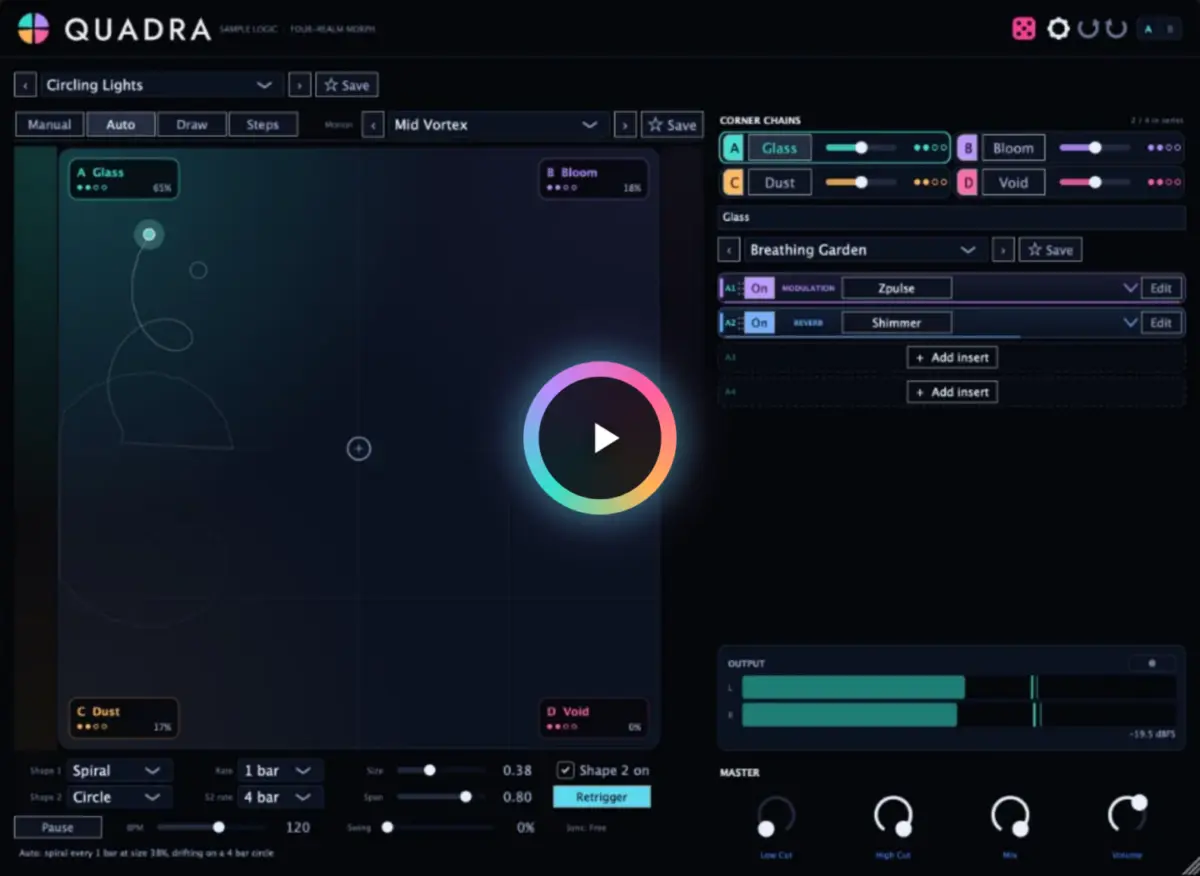
Sample Logic, a developer long recognized for its contributions to the world of virtual instruments and cinematic sound design, has officially announced the release of Quadra, a sophisticated morphing multi-effect plugin. This new tool represents a significant departure from traditional static effects processing, offering a dynamic environment where four distinct effect chains can be blended seamlessly through a centralized XY morphing interface. By placing a complete suite of processors in each of the four corners of its graphical interface, Quadra allows users to navigate complex sonic transitions with a single gesture, transforming dry input signals into intricate, evolving textures.
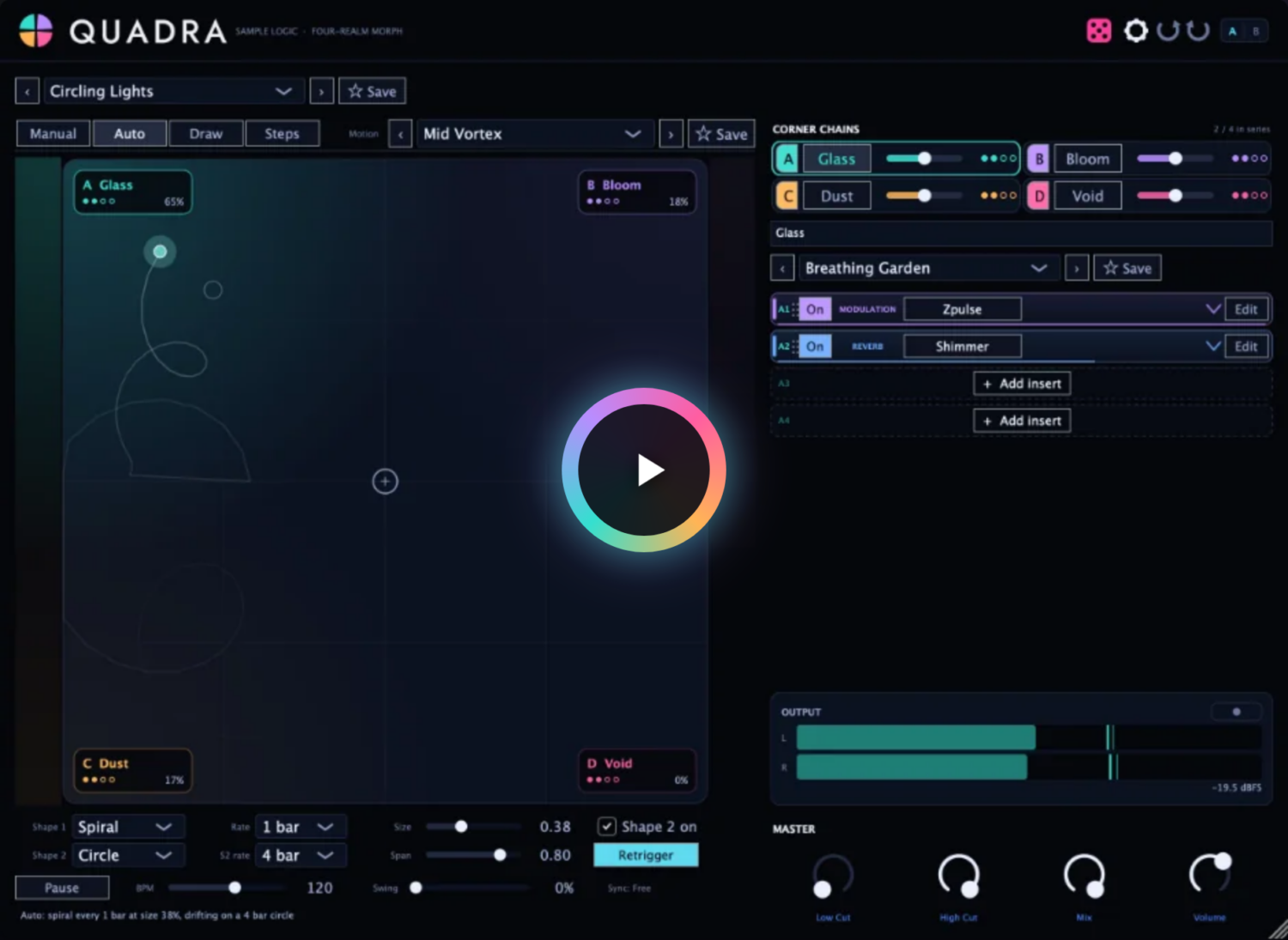
The core philosophy behind Quadra is the democratization of complex signal routing. In a traditional digital audio workstation (DAW) environment, creating a morphing effect between four different signal paths would require extensive automation, bus routing, and precision timing. Quadra internalizes this complexity, providing a "glowing XY Morph Pad" that serves as the command center for the entire plugin. As the user moves the cursor—or "puck"—across the pad, the plugin calculates the interpolation between the four corners, adjusting the gain and parameter influence of each effect chain in real-time. This allows for fluid transitions, such as moving a vocal track from a tight, dry room sound into a shimmering cathedral reverb, or transitioning a drum loop from a clean state into a crushed, stuttering machine-like output.
Technical Architecture and Processing Power
At the heart of Quadra lies a robust engine capable of hosting up to 16 simultaneous effects at any given time—four per corner. The plugin includes a library of 22 high-quality processors, ranging from standard utility tools to creative manglers. These processors cover the full spectrum of audio manipulation, including time-based effects like delays and reverbs, modulation effects such as phasers and choruses, and harmonic distortion tools like bitcrushers and saturators.
One of the standout technical features of Quadra is its integration of convolution technology. The plugin comes equipped with 81 impulse responses (IRs), which provide the foundation for its spatial and tonal characteristics. These IRs allow the "cathedral" and "evolving soundscape" presets to achieve a level of realism and depth that is often missing from purely algorithmic multi-effect units. By stacking these convolution-based processors within the four-corner architecture, users can effectively morph between different physical or imagined spaces, creating a sense of movement that is both organic and otherworldly.
To facilitate immediate productivity, Sample Logic has included over 630 factory presets. These presets are categorized to suit various production needs, from subtle mixing enhancements to radical sound design transformations. The "Layered Randomize" feature further expands the creative potential, allowing users to generate new combinations of effects and settings with a single click, ensuring that the tool remains a constant source of inspiration even for those who prefer not to build effect chains from scratch.
Advanced Modulation and Automation
While manual control via the XY pad is a primary draw, Quadra is designed to function as an automated "set-and-forget" tool as well. The plugin features several layers of modulation that can drive the movement of the morphing puck. Users can select from various looping shapes—such as circles, squares, or erratic zig-zags—to have the sound drift automatically over time. For more precise control, Quadra allows users to draw their own custom paths, which the plugin will then follow at a user-defined speed.
For electronic music producers and film composers working with rhythmic material, Quadra includes a 16-step sequencer. This sequencer is fully syncable to the DAW’s host tempo, allowing the morphing position to jump or glide in perfect time with the track. This capability turns Quadra into a rhythmic performance tool, capable of creating gated effects, rhythmic filtering, and timed spatial expansions that would be nearly impossible to perform manually with such accuracy.
Contextualizing the Launch: Sample Logic’s Evolution
The release of Quadra marks an important milestone in Sample Logic’s corporate chronology. Founded with a focus on high-end Kontakt-based libraries such as Morphestra and Cinematic Guitars, the company has spent nearly two decades defining the "cinematic" sound of modern media. In recent years, however, there has been a noticeable shift in the industry toward standalone plugins that offer more flexibility than traditional sample libraries.
By moving into the dedicated multi-effect space, Sample Logic is competing with established giants like Soundtoys, Arturia, and Output. However, Quadra distinguishes itself through its specific focus on the XY morphing workflow—a technique that Sample Logic perfected in its instrument interfaces and has now successfully ported to a general-purpose audio effect. This transition reflects a broader trend in the music technology industry where the line between "instrument" and "effect" is becoming increasingly blurred.
Market Implications and Professional Utility
Industry analysts and early adopters suggest that Quadra’s primary impact will be felt in the sectors of film scoring, game audio, and experimental electronic music. In these fields, the ability to create "movement" within a sound is often more important than the raw tone itself. A static pad sound can become a centerpiece of a film score if it evolves subtly over a three-minute scene; Quadra provides the exact mechanism needed to achieve this without the tedious process of drawing hundreds of automation nodes in a DAW.
Furthermore, the plugin’s efficiency is a significant factor for professional workflows. By consolidating 22 processors and four parallel chains into a single interface, Quadra reduces the CPU overhead and the visual clutter associated with loading multiple individual plugins. For composers working on massive orchestral templates where every millisecond of latency and every megabyte of RAM counts, such consolidation is a practical necessity.
Statements and Industry Reaction
While formal reviews are still pending, the initial reception from the sound design community has focused on the plugin’s "performative" nature. Sound designers have noted that Quadra feels less like a clinical mixing tool and more like an instrument in its own right. The ability to "play" the effects in real-time using a MIDI controller mapped to the XY coordinates is expected to make it a favorite for live performers who wish to add studio-grade complexity to their stage shows.
A spokesperson for Sample Logic emphasized the product’s versatility during the launch announcement: "Quadra is about more than just adding reverb or delay; it’s about creating a sonic journey. We wanted to give users a tool where the movement between effects is just as important as the effects themselves. Whether you are working on a delicate vocal or a massive cinematic impact, Quadra provides a way to make that sound live and breathe."
Chronology of Availability and Pricing
Quadra is available for immediate download through the Sample Logic website. The product is launched with a dual-tier pricing strategy designed to reward early adopters. The standard retail price for the plugin is set at $99 USD. However, from the launch date through November 5, Sample Logic is offering an introductory price of $69 USD.
The plugin is compatible with modern production environments, supporting AU and VST3 formats for macOS and VST3 for Windows systems. This broad compatibility ensures that users across all major DAWs—including Ableton Live, Logic Pro, Cubase, and FL Studio—can integrate Quadra into their existing setups without friction.
Technical Specifications and System Requirements
To ensure optimal performance, Sample Logic has outlined the following technical requirements for Quadra:
- Operating Systems: macOS 10.15 or higher (including native support for Apple Silicon); Windows 10 or 11.
- Formats: 64-bit VST3 and AU.
- Storage: Minimal disk space required for the plugin itself, though the factory preset library and impulse responses are optimized for fast loading from SSDs.
- Internet: An active internet connection is required for product activation.
Final Analysis: The Future of Morphing Effects
The introduction of Quadra suggests a continuing shift toward "macro" control in music production. As software becomes more powerful, the challenge for developers is no longer just about the quality of the DSP (Digital Signal Processing), but about the elegance of the user interface. Quadra’s success will likely be measured by how well it simplifies the complex task of multi-dimensional blending.
In an era where "loop-based" production can sometimes lead to static arrangements, tools like Quadra provide an antidote by injecting constant, controllable change into audio signals. By allowing four "worlds" to coexist and interact within a single interface, Sample Logic has provided a new palette for the modern audio professional, bridging the gap between traditional mixing and avant-garde sound synthesis. As the introductory period concludes on November 5, the industry will be watching to see how Quadra settles into the toolkit of the contemporary producer.
