

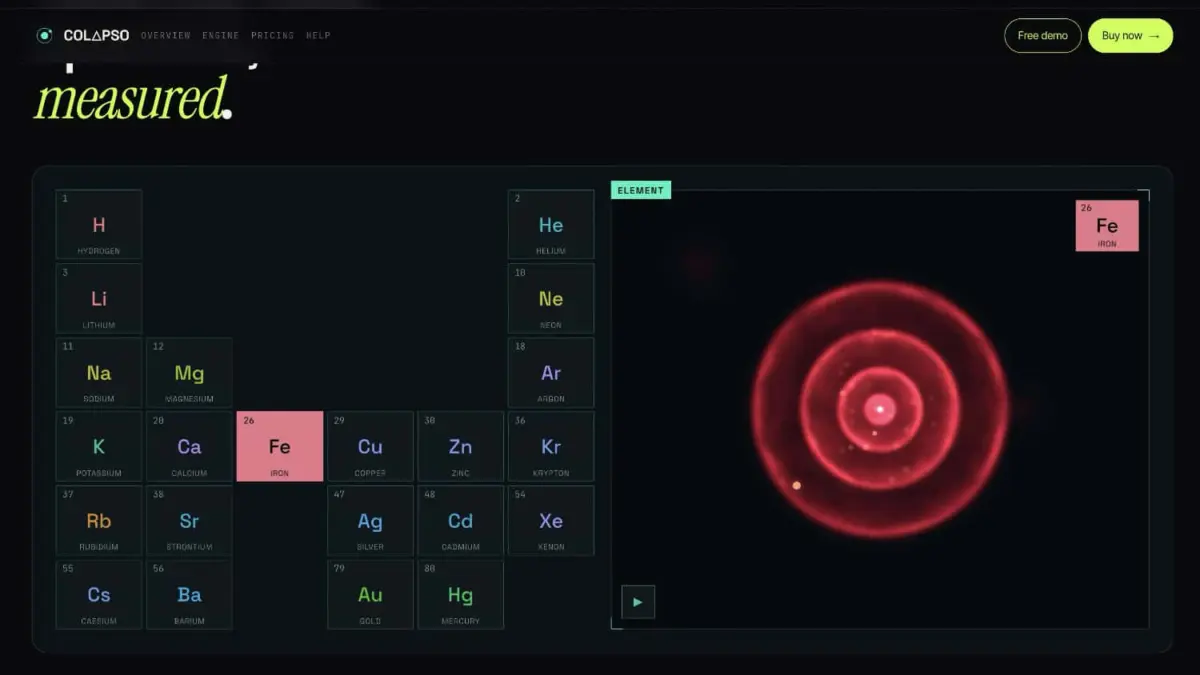
The landscape of digital signal processing has witnessed a significant evolution with the release of COLAPSO, a groundbreaking software synthesizer developed by the Portuguese audio technology firm Imaginando. Unlike traditional subtractive or FM synthesizers that rely on standard geometric waveforms, COLAPSO derives its sonic identity from the fundamental building blocks of matter. By utilizing measured atomic emission spectra as the cornerstone of its additive synthesis engine, the plugin offers a unique intersection between quantum physics and contemporary sound design. This instrument represents a departure from conventional synthesis methods, providing musicians and sound designers with a palette of tones rooted in the physical properties of the chemical elements.
The Scientific Foundation of Atomic Synthesis
At the heart of COLAPSO lies an additive synthesis engine that is fundamentally different from those found in mainstream virtual instruments. Additive synthesis typically involves the summation of multiple sine waves, or partials, to create complex timbres. While most additive synths allow users to manually draw in these partials or generate them through mathematical algorithms, COLAPSO sources its data from the physical world. Specifically, the engine utilizes 422 measured emission lines associated with 22 different chemical elements.
In the realm of physics, an emission spectrum is the spectrum of frequencies of electromagnetic radiation emitted due to an atom or molecule making a transition from a high energy state to a lower energy state. Each element possesses a unique spectral "fingerprint." Imaginando has translated these electromagnetic wavelengths into the audio frequency domain. Each of the 422 emission lines contributes specific characteristics to the sound, including frequency, level, and decay. This results in a harmonic (and often inharmonic) structure that is naturally occurring in the universe but previously difficult to access in a musical context.
The 22 chemical elements included in the initial release provide a diverse range of spectral data. Elements such as Hydrogen, Helium, and Neon offer distinct sets of partials that dictate the fundamental timbre of the oscillator. Because these emission lines do not always follow the standard integer-based harmonic series found in vibrating strings or air columns, the resulting sounds often possess an "unearthly" yet organic quality that is difficult to replicate with standard oscillators.
Technical Architecture and Feature Set
COLAPSO is not merely a data-to-sound converter; it is a fully realized production environment that combines its atomic engine with several layers of advanced processing. The instrument’s architecture is designed to take the raw, complex spectra generated by the atomic engine and shape them into musically useful textures.
Granular Processing and Waveform Manipulation
In addition to its additive core, COLAPSO incorporates a sophisticated granular processing module. Granular synthesis functions by breaking an audio signal into tiny fragments called "grains," which can then be rearranged, pitched, and layered. When applied to the atomic spectra, this allows for the creation of evolving soundscapes and dense textures. Users can manipulate the size, density, and position of these grains to move from smooth, ethereal pads to jagged, rhythmic glitches.
Nine Filter Circuits and Modulation
To further refine the raw spectral output, Imaginando has equipped COLAPSO with nine distinct filter circuits. These filters range from standard low-pass and high-pass models to more exotic arrangements designed to interact specifically with the dense partials of the additive engine. The inclusion of multiple filter types allows for precise tonal shaping, enabling users to isolate specific frequency bands of an element’s emission spectrum or sweep through the entire frequency range for dramatic resonant effects.
The modulation system in COLAPSO is extensive, featuring multiple LFOs, envelopes, and a modulation matrix. This allows nearly every parameter within the synth—from the "atomic" partial levels to the granular grain size—to be animated over time. This level of control is essential for creating the shifting, "collapsing" sounds that give the plugin its name.
The Observation Control: Navigating the Uncertainty Principle
One of the most innovative features of COLAPSO is the "Observation" control. This macro-parameter is inspired by the trade-off between time and frequency precision, a concept rooted in the Heisenberg Uncertainty Principle and digital signal processing theory. By adjusting the Observation control, users can shift the instrument’s output between two extremes:
- Short, Noise-like Transients: In this state, the synthesizer prioritizes temporal precision, resulting in percussive, staccato, or chaotic noise bursts.
- Sustained, Pitched Tones: As the control is moved toward the other extreme, the engine prioritizes frequency precision, allowing the individual emission lines to stabilize into clear, recognizable pitches.
This control provides a unique workflow for sound designers, allowing them to find the "sweet spot" between a recognizable musical note and a complex physical texture.
Chronology and Development Context
The release of COLAPSO marks a significant milestone in Imaginando’s decade-long history of audio software development. Founded in 2014 and based in Portugal, Imaginando first gained international recognition with the DRC (Polyphonic Synthesizer) and FRMS (Granular Synthesizer). While FRMS explored the boundaries of granular and FM synthesis, COLAPSO represents a deeper dive into experimental synthesis methods.
The development of COLAPSO reflects a growing trend in the music technology industry toward "sonification"—the process of turning data into sound. In recent years, developers have experimented with everything from weather data to stock market fluctuations as sources for synthesis. However, Imaginando’s decision to use atomic spectra grounds the instrument in the fundamental laws of physics, ensuring that the resulting sounds are not just random, but are reflections of the natural world.
The project reportedly underwent an intensive research phase where the developers mapped spectral data from scientific databases into a format compatible with real-time audio generation. The challenge was to ensure that the 422 emission lines could be processed efficiently without taxing modern CPU architectures, leading to the development of a highly optimized additive engine.
Official Responses and Industry Implications
While official reviews from major industry publications are still forthcoming, early reactions from the sound design community have highlighted the plugin’s ability to generate "organic digitalism." Beta testers have noted that COLAPSO excels at creating textures for cinematic scoring, ambient music, and experimental electronic genres.
A spokesperson for Imaginando (inferred from product documentation) emphasized that the goal of COLAPSO was to "provide a new lens through which to view sound generation." By moving away from the standard oscillators that have dominated the industry since the 1960s, the company aims to offer a tool that encourages exploration and "sonic curiosity."
The implications of COLAPSO extend beyond simple music production. The instrument has potential applications in:
- Education: Demonstrating the concept of atomic spectra through an auditory medium.
- Film Scoring: Providing unique, non-traditional textures for science fiction or documentary soundtracks.
- Game Audio: Generating procedural sound effects that react to in-game physics.
Comparison with Existing Technologies
To understand COLAPSO’s place in the market, it is necessary to compare it with other high-end synthesizers. While plugins like Arturia Pigments or Spectrasonics Omnisphere offer additive and granular capabilities, they generally focus on user-imported samples or standard harmonic partials. COLAPSO’s niche is its curated, scientifically accurate data set. It occupies a space similar to instruments like those from Sinevibes or Newfangled Audio, which prioritize mathematical and physical models over traditional synthesis paradigms.
Furthermore, COLAPSO’s built-in effects suite—including high-quality delay and reverb algorithms—ensures that it can function as a standalone sound design workstation. The integration of these effects allows the dry, scientific data of the atomic spectra to be placed within a lush, spatial context immediately upon loading a preset.
Pricing, Availability, and System Requirements
Imaginando COLAPSO is available immediately as a standalone application and as a plugin in VST, AU, and AAX formats. It is compatible with both macOS (including native support for Apple Silicon) and Windows operating systems.
The pricing strategy for COLAPSO is designed to encourage early adoption:
- Introductory Price: €69 (available through November 1, 2026).
- Regular Retail Price: €89.
This extended introductory period is unusual in the software industry, suggesting that Imaginando is committed to building a long-term user base for this specialized instrument. The plugin is available for purchase and download directly through the Imaginando website and authorized retailers.
Conclusion
Imaginando COLAPSO represents a bold step forward in the synthesis of sound and science. By harnessing the literal frequency of the elements, the plugin provides a unique harmonic vocabulary that is both ancient and entirely new to the digital audio workstation. As musicians continue to seek out sounds that break away from the "in-the-box" digital standard, instruments like COLAPSO, which find inspiration in the physical properties of the universe, are likely to become essential tools for the modern composer. With its robust feature set, innovative "Observation" control, and competitive pricing, COLAPSO is poised to become a staple for those looking to explore the frontiers of atomic-grade sound design.
