

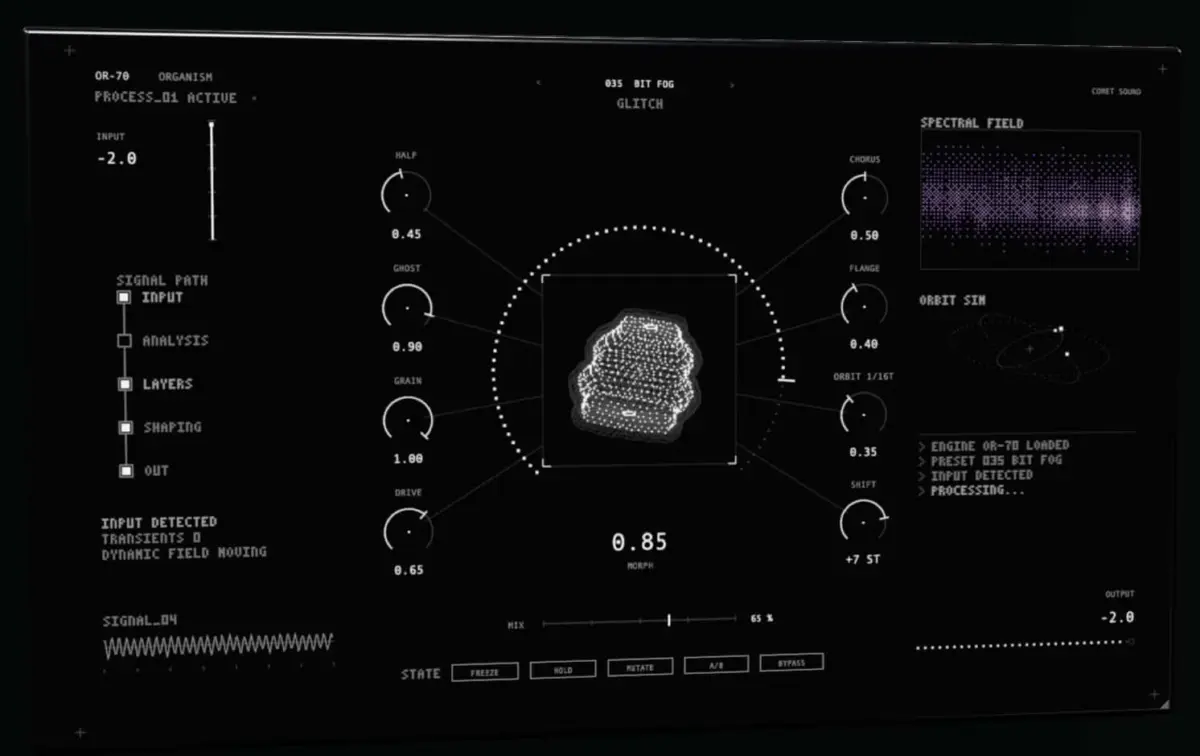
Overview of the OR-70 Processing Architecture
The OR-70 is engineered as a multi-effects suite that integrates several advanced digital signal processing (DSP) techniques into a streamlined user interface. At its core, the plugin is designed to handle four primary types of audio manipulation: spectral, granular, rhythmic, and harmonic. By combining these disparate methods, the OR-70 allows users to transcend simple effects processing, instead facilitating the creation of entirely new sonic environments.
The plugin’s architecture is centered on eight distinct processing modules. While many multi-effects units require complex routing and manual parameter mapping, the OR-70 utilizes a centralized "MORPH" control. This macro-parameter acts as the primary interface between the user and the underlying DSP. As the MORPH dial is adjusted, it coordinates multiple internal parameters across all eight modules, blending the dry input signal with the heavily processed "organic" layers. This approach enables a performative workflow, where sound designers can transition from a recognizable source—such as a vocal line or a synthesizer pad—into a dense, ethereal soundscape with a single movement.
Technical Specifications and Sound Manipulation Modules
The effectiveness of the OR-70 lies in its sophisticated handling of audio data. To understand the impact of this tool, it is necessary to examine the specific technologies it employs.
Spectral Processing
Spectral processing involves analyzing the frequency content of an audio signal using Fast Fourier Transform (FFT) algorithms. Unlike traditional equalization, which boosts or cuts fixed frequency bands, spectral effects can manipulate individual frequency bins. In the OR-70, this allows for the "smearing" of audio across the frequency spectrum, creating the blurred, ambient qualities often associated with high-end cinematic sound design.
Granular Synthesis
The granular module within the OR-70 functions by dividing the incoming audio into tiny fragments, or "grains," typically ranging from 1 to 100 milliseconds in length. These grains can be rearranged, layered, and pitched independently. When applied to a synthesizer pad or a vocal loop, granular synthesis creates a shimmering, "cloud-like" effect that maintains the harmonic essence of the original sound while stripping away its rhythmic or linear constraints.
Rhythmic and Harmonic Enhancement
To prevent the resulting textures from becoming static, the OR-70 includes rhythmic and harmonic modules. The rhythmic processing introduces temporal fluctuations, often synchronized to the DAW’s tempo, which can create pulsing or stuttering effects. The harmonic engine focuses on overtone reinforcement, ensuring that even the most abstract textures remain musically relevant and harmonically rich.
Development and Industry Context
The release of the OR-70 by Comet Sound arrives at a time when the music production industry is seeing a surge in demand for "intelligent" or "generative" audio tools. In the past decade, the barrier to entry for high-quality sound design has lowered, yet the demand for unique, non-generic sounds in film scoring and electronic music has increased.
Historically, achieving the level of textural complexity offered by the OR-70 would have required a chain of multiple expensive plugins or a deep knowledge of modular synthesis environments like Max/MSP or Reaktor. By consolidating these processes into a free, accessible plugin, Comet Sound is following a growing industry trend of "democratizing" high-end DSP. Other developers, such as Valhalla DSP and Tokyo Dawn Labs, have found success with similar models—releasing high-quality "freeware" to build brand loyalty and establish a presence in a crowded market.
The OR-70 was developed with a focus on "organic" sound, a term often used in the industry to describe digital audio that exhibits the unpredictability and warmth of physical instruments or natural environments. The developer’s decision to offer the plugin without a license key, subscription, or trial period is a strategic move that bypasses the friction often associated with modern software installations, such as iLok authorization or mandatory account creation.
Application in Modern Sound Design
The OR-70 is optimized for specific types of source material, though its versatile nature allows for experimentation across all audio types.
- Synthesizer Pads: By applying the OR-70 to static synth chords, producers can add "micro-movements" that prevent the sound from feeling "plastic" or repetitive.
- Vocals: One of the most common uses for granular and spectral effects is the transformation of the human voice. The OR-70 can turn a simple vocal phrase into a choir-like wash or a haunting, unrecognizable texture suitable for horror or sci-fi scores.
- Audio Loops: For electronic music producers, the plugin can be used to "deconstruct" drum or melodic loops. By pushing the MORPH control to its extremes, a standard drum beat can be turned into a rhythmic ambient pulse that provides a subtle background layer for a track.
Comparative Analysis of the Freeware Market
The "free" price point of the OR-70 does not necessarily reflect a compromise in quality. In the current VST (Virtual Studio Technology) market, the distinction between "pro" paid plugins and "amateur" free plugins has largely vanished. Many developers use free releases as a "proof of concept" for their coding capabilities.
Compared to other popular free multi-effects, the OR-70 distinguishes itself through its focus on textural synthesis. While plugins like MeldaProduction’s MFreeFXBundle provide utility and standard mixing tools, the OR-70 is a creative "color" plugin. It competes philosophically with paid products like Output’s Portal or Glitchmachines’ suite of granular processors, providing a similar aesthetic of "glitched" or "stretched" audio without the financial investment.
Installation and Compatibility Data
Comet Sound has ensured that the OR-70 is accessible to a wide range of users. The plugin is available for download directly from the official Comet Sound website. It supports standard formats, including VST3 and AU (Audio Units), making it compatible with major DAWs such as Ableton Live, FL Studio, Logic Pro, Cubase, and Reaper.
The system requirements are modest, designed to run on both Windows and macOS environments. Because spectral and granular processing can be CPU-intensive—requiring significant real-time calculations—the plugin has been optimized to maintain stability even when the MORPH control is pushing all eight modules to their maximum settings. The lack of a "time limit" or "demo noise" ensures that professional users can integrate the plugin into commercial projects without the risk of software expiration.
Broader Impact on the Production Community
The release of the OR-70 is expected to have a notable impact on the independent production community. By providing a tool that specializes in "organism-style" sound transformation, Comet Sound is enabling bedroom producers to achieve a level of sonic sophistication previously reserved for high-budget studios.
From a pedagogical perspective, the OR-70 serves as an excellent introduction to complex synthesis concepts. The single-knob interface allows users to hear the results of spectral and granular manipulation before they necessarily understand the underlying mathematics. This "ears-first" approach to sound design is increasingly popular in modern software development, prioritizing creativity and flow over technical menu-diving.
Conclusion and Future Implications
The Comet Sound OR-70 stands as a testament to the evolving landscape of digital audio tools. By blending eight distinct processing modules under a unified control scheme, it offers a powerful solution for those seeking to add depth and "life" to their audio recordings. The decision to release the software for free, without the encumbrance of digital rights management (DRM), signals a commitment to the user community and a confidence in the plugin’s ability to stand on its own merits.
As the music industry continues to lean toward more atmospheric and textured soundscapes—evidenced by the current trends in Lo-Fi, Ambient, and Cinematic music—tools like the OR-70 will likely become staples in the digital toolkit of modern creators. Whether used for subtle enhancement or radical transformation, the OR-70 provides a sophisticated, high-quality gateway into the world of advanced sound design. The industry will be watching closely to see how Comet Sound follows this release, as the OR-70 sets a high bar for what is expected from independent software developers in the current market.
