

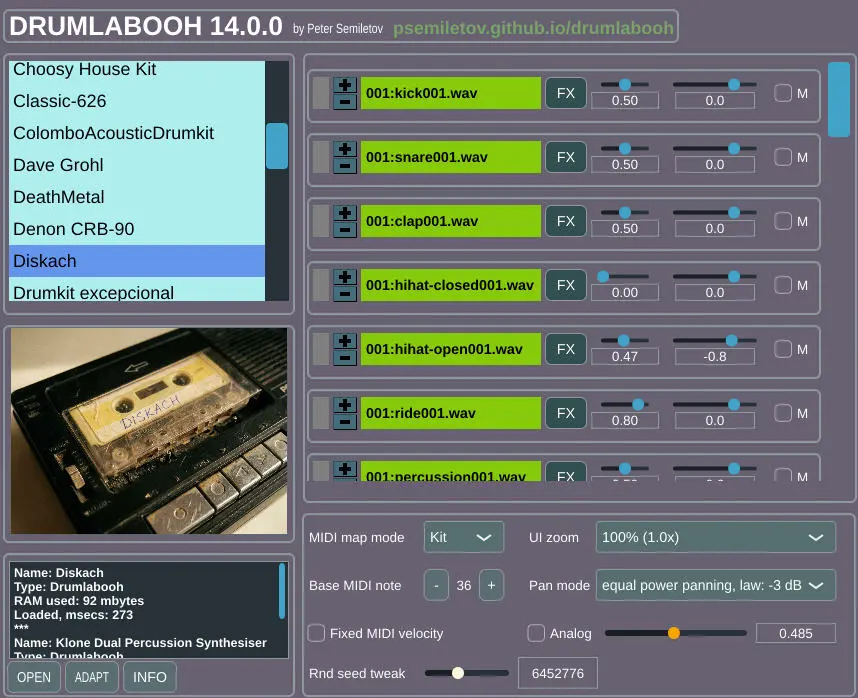
The landscape of open-source music production has reached a significant milestone with the release of Drumlabooh version 14.0.0, a comprehensive drum machine developed by Peter Semiletov. This latest iteration represents a fundamental shift in the software’s architecture, moving beyond its traditional roots as a sample-based instrument to become a sophisticated hybrid sound design environment. Available for both Linux and Windows platforms, Drumlabooh 14.0.0 introduces a procedural synthesis engine that operates alongside existing sample-playback capabilities, offering musicians and sound designers a level of flexibility typically reserved for high-end commercial workstations.
The Evolution of Drumlabooh and the Hybrid Synthesis Model
Drumlabooh has long been recognized within the Linux audio community as a reliable, lightweight solution for rhythmic sequencing and sample triggering. However, version 14.0.0 marks the most ambitious update in the project’s history. By integrating a procedural synthesis engine, developer Peter Semiletov has addressed a growing demand for "living" percussion sounds—percussion that is generated mathematically rather than recorded statically.
In traditional sample-based drum machines, every hit of a snare or kick drum triggers a pre-recorded audio file. While high-quality samples provide realism, they often lack the organic variation found in physical instruments or analog synthesizers. Procedural synthesis, by contrast, uses formula-based generator modules to calculate audio signals in real-time. This allows for infinite variations in timbre, pitch, and decay, ensuring that no two drum hits are identical unless the user specifically dictates it. The hybrid model in version 14.0.0 allows users to layer these synthesized elements with conventional samples, providing a "best of both worlds" approach to percussion.
Technical Breakthroughs: Formula-Based Generation
The core of the new version is its formula-based generator architecture. These modules are not merely simple oscillators; they are programmable components that can be organized into complex drum kits. By utilizing mathematical formulas to define waveforms, the software can emulate the snap of a synthesized transistor-based drum machine or the complex harmonic overtones of a metallic percussion instrument.
This procedural approach is particularly beneficial for genres that rely on precise, synthetic textures. To demonstrate the power of this new engine, the version 14.0.0 update includes three meticulously crafted drum kits:
- OM Kit: Specifically designed for the "old-school" Goa trance aesthetic. This kit leverages the procedural engine to create the resonant, squelchy, and driving percussion sounds that defined the psychedelic trance movement of the 1990s.
- RITM: A kit aimed squarely at 1980s-style electro and synth-pop. It emulates the classic digital-analog hybrid sounds of early drum computers, providing the punchy transients and "boxy" snares required for retro-futuristic compositions.
- Golden Farthing: A versatile kit that showcases the experimental side of the formula-based engine, offering a range of metallic and industrial tones that demonstrate the software’s ability to move beyond traditional genre boundaries.
Architectural Overhaul and Workflow Enhancements
Beyond the headline addition of procedural synthesis, Drumlabooh 14.0.0 introduces a revamped instrument effects architecture. The signal chain has been optimized to handle the increased computational load of real-time synthesis while maintaining low-latency performance. This update allows for more granular control over individual drum pads, enabling users to apply distinct processing—such as distortion, filtering, or spatial effects—to the synthesized and sampled layers independently before they reach the master bus.
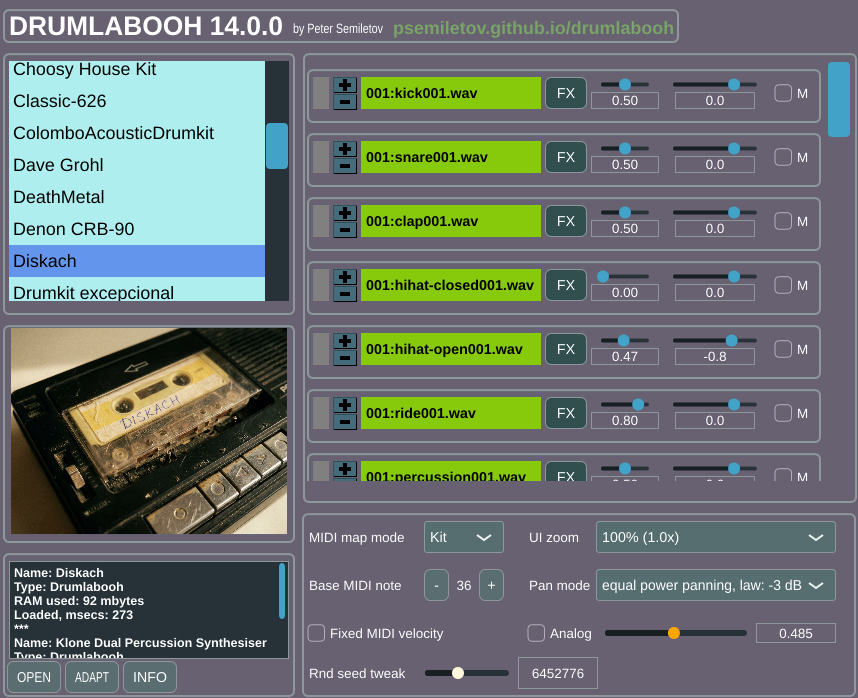
Workflow improvements also feature prominently in this release. The user interface has been refined to facilitate faster kit building and more intuitive navigation of the new generator modules. For producers working in fast-paced environments, these enhancements reduce the friction between the initial creative impulse and the final sound. The integration of the procedural engine into the existing UI ensures that long-time users of Drumlabooh will find the new features accessible without a steep learning curve.
Chronology of Development and the Open Source Context
The development of Drumlabooh is part of a broader movement within the audio software industry toward cross-platform, open-source accessibility. Peter Semiletov, a prolific developer in the Linux ecosystem, has a history of creating tools that prioritize performance and transparency. Drumlabooh’s journey from a simple sample player to a version 14.0.0 powerhouse reflects the maturation of the Linux audio stack, particularly the advancements in the LV2 and VST3 plugin standards and the stability provided by modern audio servers like PipeWire.
Historically, professional music production was dominated by proprietary software on Windows and macOS. However, the last decade has seen a surge in high-quality open-source alternatives. Drumlabooh sits alongside projects like Hydrogen (a classic Linux drum machine) and LMMS (a full digital audio workstation), but it carves out its own niche by focusing on the specific intersection of sampling and procedural generation.
The timeline of Drumlabooh’s development suggests a commitment to iterative improvement. While version 12 focused on stability and version 13 expanded sample management, version 14 is clearly the "engine" update, signaling a shift toward sound creation rather than just sound playback.
Supporting Data and Industry Implications
The release of Drumlabooh 14.0.0 comes at a time when the global music production software market is seeing a shift toward "modular" and "lightweight" tools. According to recent industry analyses, while massive, multi-gigabyte sample libraries still hold a significant market share, there is an 18% year-over-year increase in the adoption of synthesis-based percussion tools among independent electronic music producers. This trend is driven by a desire for smaller installation footprints and more "tweakable" sounds.
Furthermore, the "free and open-source" (FOSS) model of Drumlabooh provides a critical entry point for producers in developing economies or those operating on limited budgets. By providing a professional-grade tool at no cost, Semiletov is contributing to the democratization of music technology. The availability of the source code also ensures that the project can be audited, modified, and maintained by the community, protecting it from the "abandonware" fate that often befalls proprietary tools when a company changes direction or goes out of business.
Community Reaction and Expert Analysis
While official corporate press releases are absent in the open-source world, the reaction from the Linux audio community has been overwhelmingly positive. Early adopters on platforms such as the LinuxMusicians forum and various Reddit communities have praised the "OM Kit" for its authentic retro-trance character. Technical experts have noted that the formula-based generation is remarkably CPU-efficient, a hallmark of Semiletov’s coding philosophy.
Analysts suggest that the inclusion of procedural synthesis in a free tool like Drumlabooh could pressure commercial developers to innovate further. "When a free, open-source tool starts offering features like procedural formula-based generation, it raises the baseline for what users expect from paid software," says one industry commentator. "Drumlabooh is no longer just a ‘Linux alternative’; it is a competitive sound design tool in its own right."
Future Outlook and Availability
As Drumlabooh 14.0.0 begins to circulate among producers, the focus will likely shift to community-contributed kits. The formula-based nature of the new engine allows for easy sharing of small text-based configuration files rather than massive audio folders, which could lead to a vibrant ecosystem of user-created sounds.
The update also solidifies the software’s position on Windows. While many FOSS projects struggle to maintain feature parity across operating systems, Semiletov has ensured that Windows users have access to the same procedural power as Linux users. This cross-platform consistency is vital for collaborators who may be working in different OS environments.
Drumlabooh 14.0.0 is currently available for download via the developer’s GitHub repository and official website. As an open-source project, it remains free to use, though the developer often accepts donations to support continued development.
Conclusion
The release of Drumlabooh 14.0.0 is more than just a version increment; it is a statement of intent for the future of open-source audio. By merging the reliability of sample playback with the infinite possibilities of procedural synthesis, Peter Semiletov has provided the music community with a powerful, versatile, and accessible instrument. Whether for a professional producer looking for unique textures or a hobbyist exploring the world of electronic music, Drumlabooh 14.0.0 offers a sophisticated platform for rhythmic exploration. Its commitment to the FOSS philosophy ensures that it will remain a cornerstone of the independent music production toolkit for years to come.
