

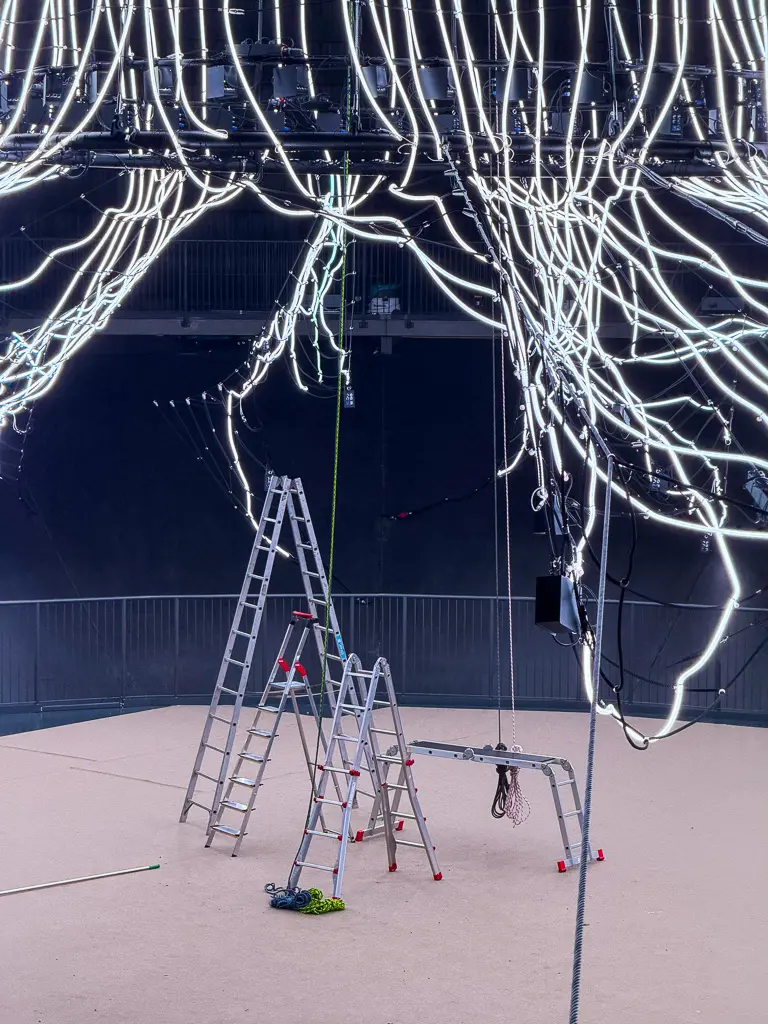
The Gasometer Oberhausen, a monumental relic of Germany’s industrial heritage, has once again transformed its cavernous interior into a theater of ecological wonder with the launch of its latest exhibition, Mythos Wald (The Myth of the Forest). Standing at a height of 117.5 meters, this former gas storage facility—often referred to as the "Industrial Cathedral" of the Ruhr region—is the highest exhibition hall in Europe. Since March 2026, it has served as the backdrop for a sprawling exploration of the world’s forests, following the monumental success of its predecessor, Planet Ozean. While the exhibition features a vast array of photography and scientific displays curated by Jeanette Schmitz, Thomas Wolf, and Nils Sparwasser in collaboration with Museum Koenig Bonn and the LWL-Museum für Naturkunde, the undisputed centerpiece is "Der Baum" (The Tree). This 35-meter-tall light and sound installation represents a pinnacle of creative engineering, realized through a partnership between Ars Electronica Solutions and the Berlin-based media technology firm Garamantis.
The installation is not merely a visual spectacle but a meticulously programmed 15-minute narrative journey that guides visitors from the depths of a subterranean root system up through a massive trunk and into a sprawling canopy. Achieving this required the integration of 2.8 kilometers of LED strands, custom-developed software, and a unique structural approach that pushed the limits of both hardware and human endurance.
Structural Engineering and the Rigger’s Challenge
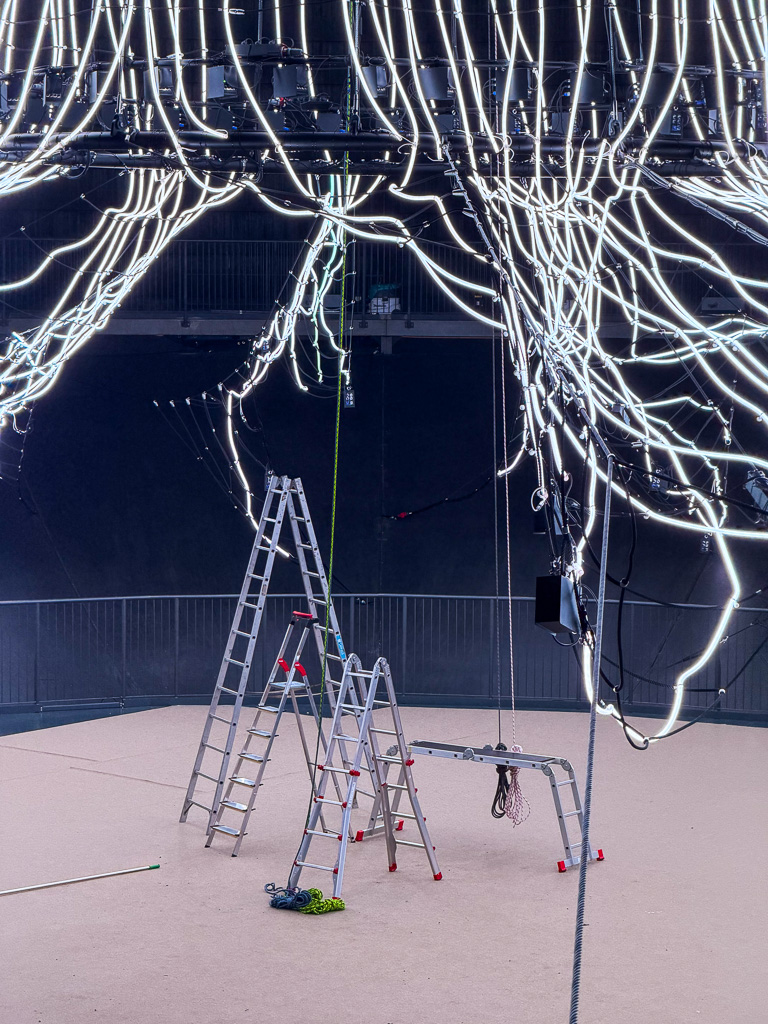
The physical foundation of "Der Baum" is a complex web of high-tensile ropes, a construction method more commonly associated with heavy-duty playground climbing frames. This woven rope skeleton was specifically designed to support the weight and tension of nearly three kilometers of LED cabling while maintaining the organic, branching silhouette of a giant tree. The assembly of this structure within the pitch-black void of the Gasometer presented a unique set of logistical hurdles.
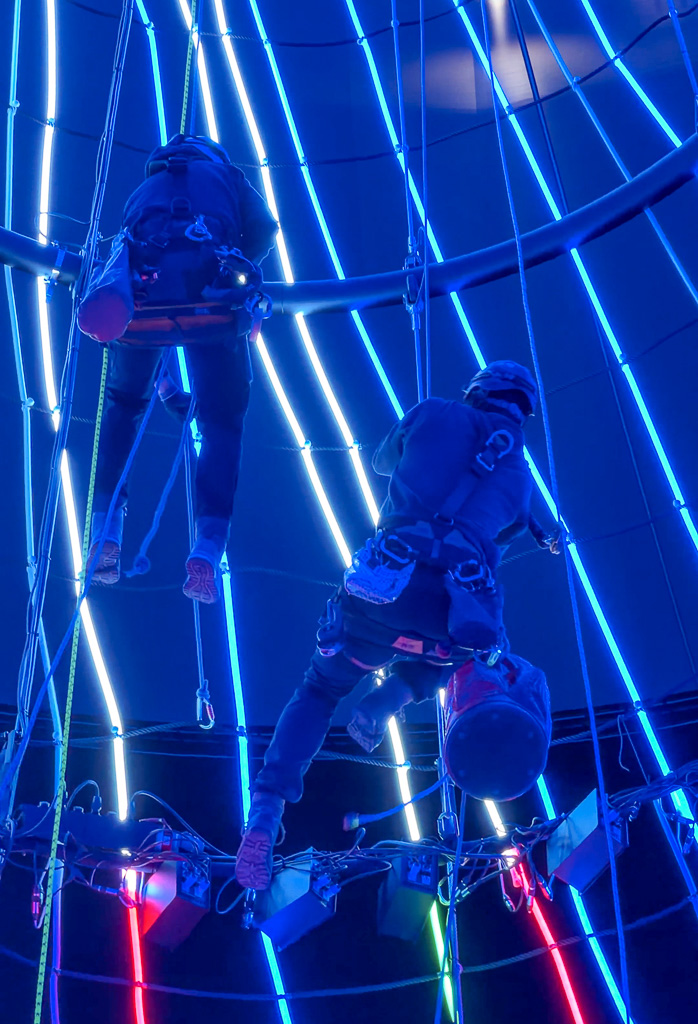
Professional industrial climbers were tasked with mounting the rope structure, abseiling from the Gasometer’s highest interior gallery into the darkness. Marcus Dittebrand, Founder and CTO of Garamantis, noted that the task proved psychologically taxing even for seasoned professionals. Many experienced riggers found the lack of spatial reference points in the vast, dark interior disorienting. Unlike typical outdoor or construction site assignments where the ground or surrounding buildings provide a sense of scale and orientation, the interior of the Gasometer can feel like a bottomless void. This "black hole" effect meant that younger, perhaps more adventurous climbers were often more comfortable with the task than their senior counterparts, who preferred environments with visible landmarks.
Once the rope structure was secured, the technical integration began. Tennagels, a specialist in LED integration, was brought in to procure and test the lighting elements based on specifications defined by Garamantis. The installation utilizes double-sided LED tubes, ensuring that the light is visible from every angle within the 360-degree viewing space. To maintain power stability across the 35-meter height, power controllers were strategically placed every ten meters, each feeding four separate LED strands. This modular power distribution was essential to prevent voltage drops that would otherwise lead to flickering or inconsistent color reproduction.
Real-Time Rendering: Moving Beyond Pre-Rendered Video
In the early stages of the project, the development team considered using pre-rendered video sequences to drive the LED animations. This approach is standard for many large-scale light shows as it allows for predictable results and lower on-site processing requirements. However, initial tests revealed that video compression significantly degraded the color fidelity of the LEDs. Furthermore, the massive scale of the installation meant that any minor adjustment to timing, speed, or color would have required a full re-render in software like Adobe After Effects, a process that could take hours and stall on-site progress.
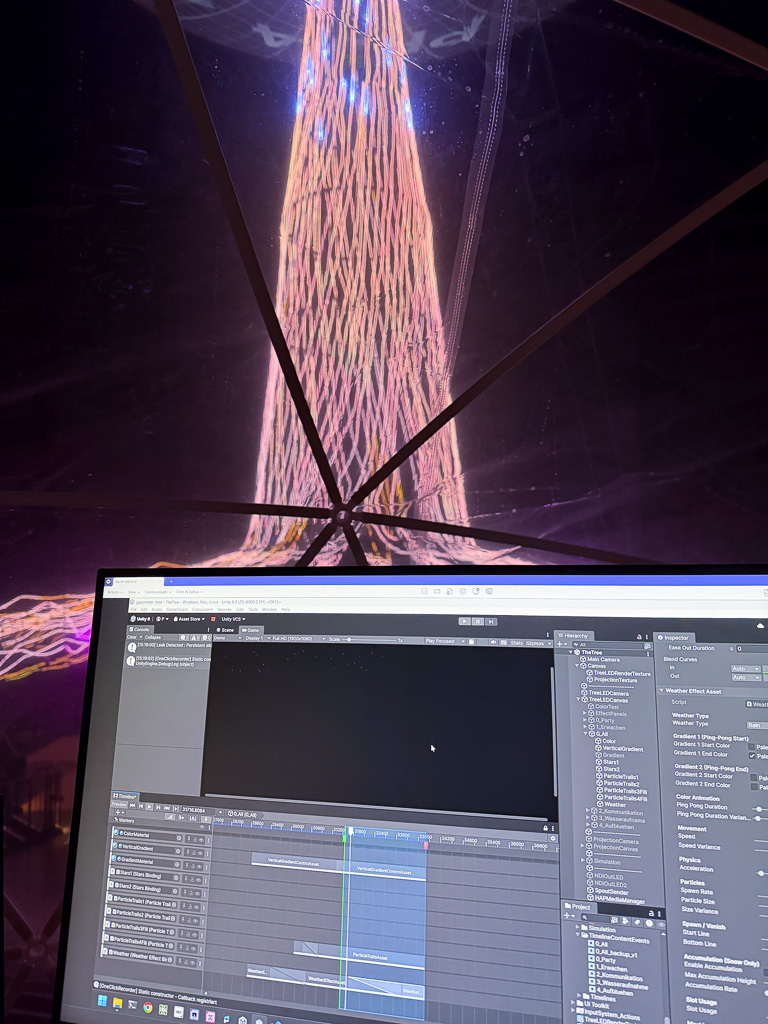
Garamantis ultimately decided to utilize a real-time rendering approach using the Unity game engine. By mapping the entire 2.8-kilometer LED network onto a 1024×1024 pixel texture, the team could treat the entire "Tree" as a single living organism. Instead of playing back a file, the system calculates every light pulse and color shift in real-time. This allowed the developers to use custom shaders and a proprietary framework to make instantaneous adjustments during the fine-tuning phase.
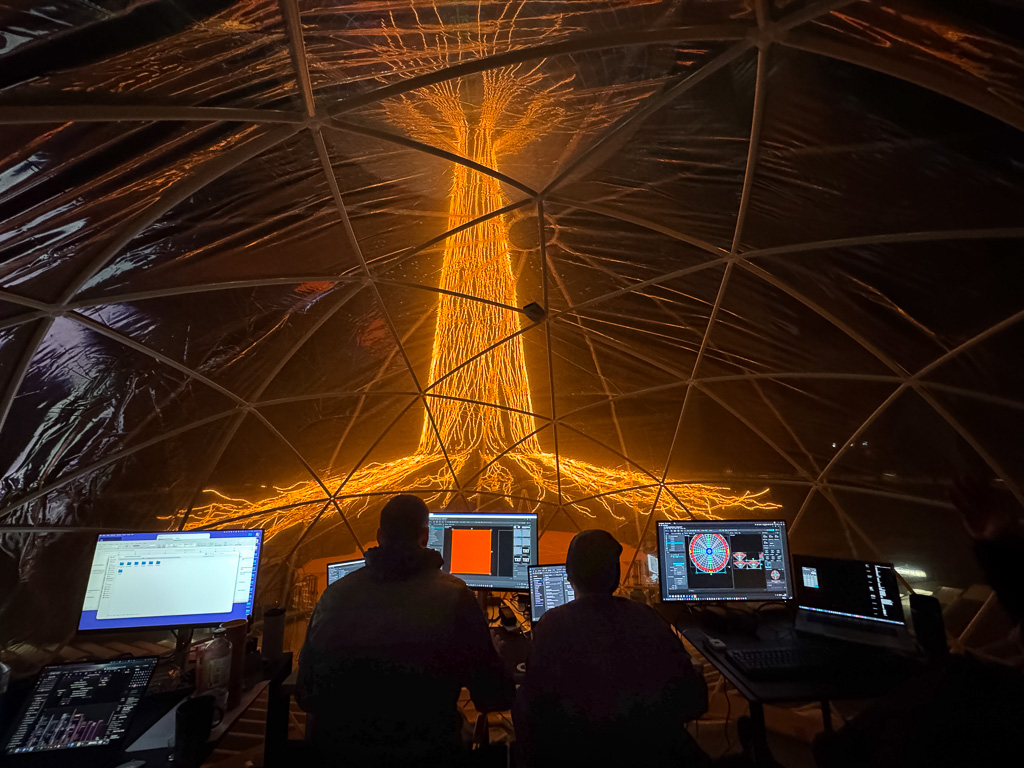
The technical backbone of the playback system consists of two high-performance render nodes equipped with NVIDIA Quadro graphics cards—one serving as the primary driver and the other as a redundant backup. This system does more than just control the LEDs; it also manages five high-lumen projectors positioned above the tree’s canopy. These projectors cast detailed imagery onto a transparent gauze stretched across the top of the installation, adding a layer of depth and resolution to the "leaves" of the tree. By driving both the LEDs and the projections from a single machine, the team eliminated the need for complex external synchronization protocols, ensuring that the light pulses in the trunk were perfectly timed with the shimmering foliage above.
Overcoming the Constraints of Limited Color Space
Perhaps the most significant technical challenge described by Dittebrand was managing the color space in an environment of extreme darkness. While many LED installations are designed to compete with ambient light or sunlight, "Der Baum" operates in near-total darkness. To prevent the installation from blinding visitors and to maintain the atmospheric "mythical" quality of the forest, the LEDs are run at extremely low intensity—often less than five percent of their maximum brightness.
At this low level of luminosity, the limitations of standard 8-bit color depth become apparent. Because each color channel (Red, Green, Blue) only has 256 discrete steps of brightness, the transitions between those steps become visible to the naked eye when the overall light level is low. This results in "color banding," where a smooth gradient appears as a series of harsh, distracting jumps.
To combat this, the Garamantis team developed a suite of creative workarounds. They avoided traditional "fades" between colors, which would have highlighted the stepping effect. Instead, they utilized particle systems where individual "sparks" of light would travel along the strands, gradually filling the tree with a new hue. In other scenarios, such as a simulated thunderstorm, the team used brief, high-intensity white flashes to mask an instantaneous shift in the underlying color palette. These "perceptual tricks" allowed the installation to feel fluid and organic despite the underlying hardware constraints.
The Acoustic Landscape and the 16-Second Echo
The immersive experience of Mythos Wald is bolstered by a bespoke soundscape composed by the renowned Viennese musician Rupert Huber. The audio is not merely a background track but is synchronized with the visual narrative of the tree’s life cycle. However, the Gasometer’s unique architecture introduces an acoustic variable that would be a nightmare for most sound engineers: a 16-second natural reverb.
In a space where a single clap can echo for over a quarter of a minute, precise audio synchronization becomes less critical, as the building itself "blurs" the timing of the sound. This natural acoustic delay actually worked in the team’s favor, masking any micro-latencies between the visual playback and the audio output. During the final weeks of setup, Huber worked on-site to refine the composition, ensuring that the deep bass frequencies of the "roots" and the airy melodies of the "canopy" harmonized with the building’s cavernous resonance.
Logistics and On-Site Endurance
The final implementation of "Der Baum" required six weeks of intensive on-site work. Because the Gasometer is an unheated industrial structure, the team faced harsh conditions, particularly during the winter months of the setup phase. To facilitate programming, a small, transparent plastic tent was erected at the base of the installation. Equipped with portable heaters, this makeshift laboratory allowed the developers to observe the installation in its entirety while protecting their hardware—and themselves—from the biting cold.
The reliability of the system was a primary concern. Given the difficulty of accessing the 35-meter structure once the exhibition opened, the team conducted rigorous stress tests on all components. Some hardware was sourced directly from manufacturers in China due to specific availability requirements in the European market, followed by months of "burn-in" testing to identify potential failure points. Despite the complexity of the network—which involves over 400 DMX/Art-Net universes—the initial startup was remarkably successful, with only a handful of LED strands requiring replacement out of thousands.
Broader Implications and the Future of Immersive Exhibitions
The success of "Der Baum" and the Mythos Wald exhibition signals a shift in how museums and cultural institutions approach environmental education. By moving away from static displays and toward massive, immersive installations, the Gasometer Oberhausen is able to engage a broader audience, including younger generations accustomed to digital interactivity.
The previous exhibition, Planet Ozean, attracted over 1.5 million visitors, and early indicators suggest that Mythos Wald will achieve similar, if not greater, impact. The installation serves as a powerful metaphor for the interconnectedness of global ecosystems, using light and sound to bridge the gap between the industrial history of the Ruhr and the biological future of the planet.
For Garamantis and Ars Electronica Solutions, the project reinforces the value of a hybrid development model: approximately 60 percent of the conceptual and framework development was completed in the studio, while the remaining 40 percent was adapted on-site to respond to the unique physical realities of the space. This flexibility allowed the team to transform a giant steel shell into a living, breathing symbol of the natural world. As the exhibition looks toward a likely extension through 2028, "Der Baum" stands as a testament to the power of merging industrial-scale engineering with the delicate precision of digital art.
