

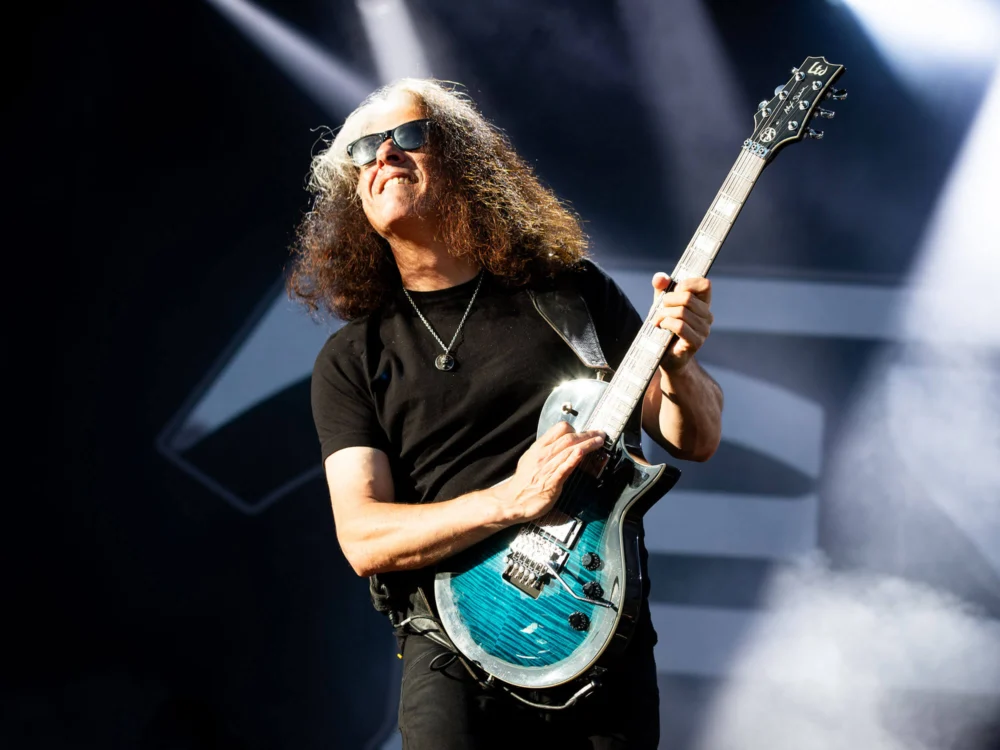
The pantheon of thrash metal is unequivocally defined by four colossal names: Metallica, Megadeth, Slayer, and Anthrax. These bands, collectively known as the "Big Four," represent the genre’s foundational pillars, their influence extending far beyond the confines of heavy metal into the broader landscape of popular music. Yet, for decades, a spirited debate has simmered among fans and critics alike, questioning whether other equally formidable acts deserve a place within this exclusive circle. Among the most frequently cited contenders are Bay Area luminaries Exodus, East Coast stalwarts Overkill, and arguably the band most consistently championed as the "fifth member," Testament.
Testament, with a sprawling discography spanning 14 studio albums across four decades, has undeniably forged a powerful legacy, frequently positioning itself as a legitimate claimant to this coveted "fifth" spot. Their technical prowess, lyrical depth, and unwavering commitment to the thrash sound have earned them immense respect and a dedicated global fanbase. However, in a recent interview with The Classic Metal Show, as reported by Blabbermouth, Alex Skolnick, the esteemed guitarist for Testament, offered a definitive and insightful perspective on why the "Big Four" designation has remained static. Skolnick’s explanation hinges predominantly on a crucial factor: chronology.
The Genesis of the "Big Four": A Historical Overview
To fully appreciate Skolnick’s argument, it is imperative to delve into the historical context surrounding the emergence of the "Big Four." The term itself gained widespread recognition in the early 2000s, but the bands it describes were instrumental in defining and popularizing thrash metal in the early to mid-1980s. Each of these four acts contributed uniquely to the genre’s nascent sound, blending the speed and aggression of punk rock and New Wave of British Heavy Metal (NWOBHM) with a newfound technicality and lyrical intensity.
Metallica, formed in Los Angeles in 1981, quickly relocated to the Bay Area and released their groundbreaking debut, Kill ‘Em All, in 1983. This album, along with its successor Ride the Lightning (1984), introduced a raw, aggressive, yet melodically sophisticated brand of thrash that would become the blueprint for countless bands. Megadeth, forged in 1983 by former Metallica guitarist Dave Mustaine, debuted with Killing Is My Business… and Business Is Good! in 1985, showcasing a more complex and technically intricate approach to the genre. Slayer, originating in Huntington Park, California, in 1981, unleashed Show No Mercy in 1983, immediately establishing themselves as the most extreme and relentless of the group, pioneering elements of death metal and black metal. Anthrax, hailing from New York City and formed in 1981, delivered Fistful of Metal in 1984, bringing an East Coast sensibility characterized by speed, punk energy, and later, a strong sense of humor and crossover appeal.
These bands were not only innovators but also prolific, releasing multiple albums in quick succession throughout the 1980s. By the end of the decade, they had achieved significant commercial success, with Metallica’s Master of Puppets (1986) and …And Justice for All (1988), and later the self-titled "Black Album" (1991), reaching multi-platinum status and propelling thrash metal into the mainstream. Megadeth’s Peace Sells… but Who’s Buying? (1986) and Rust in Peace (1990) cemented their critical acclaim and commercial viability. Slayer’s Reign in Blood (1986) is universally regarded as a landmark album, pushing the boundaries of extreme music, while Anthrax’s Among the Living (1987) showcased their evolution and widespread appeal. Their collective touring efforts, often alongside each other, further solidified their intertwined identities and status.
The Enduring Debate: Beyond the Original Four
Despite the undeniable dominance and pioneering efforts of the "Big Four," the discussion surrounding a potential "fifth member" persists, fueled by the sheer quality and longevity of other bands that emerged in the same era. Exodus, considered by many to be the original Bay Area thrash band (even before Metallica, with Kirk Hammett briefly a member), released their seminal Bonded by Blood in 1985, a visceral and influential album. Overkill, a consistent force from New Jersey, debuted with Feel the Fire in 1985, showcasing a relentless, aggressive style that has remained their trademark. Testament, originally formed as Legacy in 1983, would eventually release their debut, The Legacy, in 1987.
These bands, while often lauded for their contributions, faced the daunting task of carving out their own identities in a scene already heavily dominated by the "Big Four." They were often perceived as part of a "second wave" or "next tier" of thrash, a designation that, while acknowledging their talent, also subtly reinforces the chronological gap that Skolnick highlights. The debate isn’t merely about musical quality; it’s also about historical precedence, market penetration, and the sheer timing of their ascent.
Alex Skolnick’s Chronological Perspective: "First Four" Not Just "Big Four"
Skolnick’s recent comments offer a refreshing and pragmatic lens through which to view this long-standing discussion. He asserts, "I never give it much thought, because, to me, it’s not just the ‘Big Four’ — it’s the first four." This distinction is pivotal. It shifts the focus from a subjective measure of "bigness" (which can be debated based on sales or influence) to an objective, verifiable fact: who was there first, laying the groundwork?
Skolnick elaborates on this point, drawing a clear timeline: "Those bands had albums out when Testament was still called Legacy and was still a local band that I used to hear about when I was in high school. And they supported some of those bands, but all of the ‘Big Four’ bands had records out at the time that Legacy was still getting started. And by the time Legacy became Testament and released its first album, those bands all had several albums out. So you can’t really make the comparison."
This statement is not born of resentment or a desire to diminish Testament’s achievements; rather, it reflects a keen understanding of the genre’s historical development. Skolnick acknowledges the formidable head start the "Big Four" had, a lead that allowed them to establish their sound, build their fanbases, and secure record deals before Testament had even fully coalesced under their definitive name.
A Tale of Two Timelines: Early Thrash Development
To underscore Skolnick’s point, a brief chronological comparison is illustrative:

- 1983: Metallica releases Kill ‘Em All and Slayer releases Show No Mercy. Testament is forming as Legacy.
- 1984: Anthrax releases Fistful of Metal and Metallica releases Ride the Lightning. Legacy is still a local band, honing its craft.
- 1985: Megadeth releases Killing Is My Business… and Business Is Good! and Slayer releases Hell Awaits. Anthrax releases Spreading the Disease. Legacy is evolving.
- 1986: Metallica releases Master of Puppets, Megadeth releases Peace Sells… but Who’s Buying?, and Slayer releases Reign in Blood. By this point, the "Big Four" collectively boast at least ten full-length albums, numerous EPs, and extensive touring experience. They are major forces in the metal scene.
- 1987: Testament releases The Legacy. By this time, Metallica is arguably the biggest metal band in the world, having extensively toured for Master of Puppets. Megadeth, Slayer, and Anthrax are firmly established, with multiple critically acclaimed albums and significant fan followings.
This timeline clearly demonstrates that by the time Testament made their official debut, the "Big Four" had already completed their formative years and were deep into their imperial phase, having defined the sound and established the commercial viability of thrash metal. They had already released several albums, toured extensively, and cultivated massive, loyal fanbases. Testament, despite their undeniable talent and immediate impact with The Legacy, was entering a landscape already shaped and dominated by these predecessors.
Skolnick’s perspective is one of respectful acceptance. He states, "They were there. They were so much further along by the time we even got started. So I think it makes more sense to look at, okay, the next wave after the so-called ‘Big Four’ bands. And it’s an honour that people think — most of the time we’re one of those names. That’s great. I’ll take it." This sentiment highlights a maturity and self-awareness within the band, recognizing their place in history without diminishing their own considerable achievements.
Testament’s Legacy: A "Next Wave" Powerhouse
While Skolnick’s analysis firmly places Testament outside the "first four," it simultaneously reinforces their status as a leading band in the subsequent wave of thrash metal. Testament’s impact since their 1987 debut has been profound and enduring. Albums like The New Order (1988), Practice What You Preach (1989), and Souls of Black (1990) solidified their reputation for intricate musicianship, powerful vocals, and consistently high-quality songwriting. Throughout the 1990s, despite the seismic shifts in the music industry brought on by grunge and alternative rock, Testament persevered, navigating lineup changes and stylistic explorations while largely remaining true to their thrash roots.
Their resilience and continued output into the 21st century, with critically acclaimed albums such as The Formation of Damnation (2008), Dark Roots of Earth (2012), and Titans of Creation (2020), demonstrate a remarkable longevity and creative vitality that few bands from their era can match. Testament’s live performances remain a force to be reckoned with, showcasing their tight musicianship and the enduring power of their catalogue. They have influenced countless bands and continue to draw large audiences globally, proving that "first" does not always equate to "only."
Commercial Trajectories and Cultural Impact
The commercial success of the "Big Four" also plays a role in their unique status. Metallica, in particular, transcended genre boundaries, becoming one of the best-selling musical acts of all time. Megadeth, Slayer, and Anthrax also achieved multi-platinum sales and headlined major festivals worldwide. While Testament has enjoyed a respectable commercial career, their album sales, while significant within the metal community, have generally not reached the same stratospheric levels as the "Big Four." This commercial disparity, while not a sole determinant of artistic merit, undoubtedly contributed to the "Big Four" being recognized as a distinct commercial and cultural phenomenon.
Furthermore, the "Big Four" live concert series, which saw Metallica, Megadeth, Slayer, and Anthrax share stages across the globe between 2010 and 2011, cemented their collective identity in the public consciousness. These tours were monumental events, celebrating a shared history and sound, and effectively institutionalizing the "Big Four" as a definitive entity within heavy metal history. While other bands have toured together, none have achieved the same level of symbolic weight as these joint performances.
Official Responses and Broader Implications
Skolnick’s sentiment, that "I don’t know of anybody that has any issue with that," suggesting no bandmate feels Testament should be in the Big Four, resonates with a mature understanding within the thrash community. Many artists and fans alike acknowledge the unique historical circumstances that elevated the initial four bands. There’s a shared respect for their pioneering efforts, even among those who might argue for the artistic equivalence or even superiority of certain "next wave" acts. The acceptance of their role as leaders of the "next wave" is not a concession but a recognition of their distinct and equally valuable contribution to the genre’s evolution.
The ongoing debate about the "Big Four" serves as a testament to the enduring power and influence of thrash metal itself. It highlights the passionate engagement of its fanbase and the critical role these bands played in shaping a genre that continues to thrive decades after its inception. Rather than diminishing Testament, Skolnick’s comments clarify their position, solidifying their status as an undisputed giant of the "next wave," a crucial and formidable force that took the torch from the pioneers and carried it forward with unwavering intensity.
The "Thrash of the Titans" Tour and Future Relevance
Testament’s continued relevance is vividly demonstrated by their upcoming North American tour, aptly titled "Thrash of the Titans," scheduled for March and April 2026. This trek will feature Testament alongside fellow thrash legends Overkill and German thrash titans Destruction. This lineup itself is a powerful statement, showcasing three bands that, while not part of the "Big Four," have undeniably shaped the landscape of thrash metal through their relentless output and unwavering dedication. It represents a celebration of the genre’s enduring vitality and the strength of the "next wave" that Skolnick so clearly articulates.
The tour not only promises exhilarating live performances but also underscores the symbiotic relationship within the thrash metal community. It allows these highly respected bands to showcase their collective power, attracting fans who appreciate the depth and breadth of the genre beyond its most famous initial exponents. Testament’s official website will provide ticket information and a full list of dates, marking another chapter in their storied career and reaffirming their vital role in the ongoing narrative of heavy metal.
In conclusion, Alex Skolnick’s articulation of why Testament isn’t part of the "Big Four" is a pragmatic and historically grounded assessment. It underscores that the designation is less about subjective "bigness" and more about objective "firstness." By respectfully acknowledging the chronological advantage and pioneering impact of Metallica, Megadeth, Slayer, and Anthrax, Skolnick reaffirms Testament’s equally significant, albeit distinct, place as a titan of the "next wave" – a band that refined, sustained, and propelled thrash metal into new frontiers, securing its own immortal legacy in the process.
