

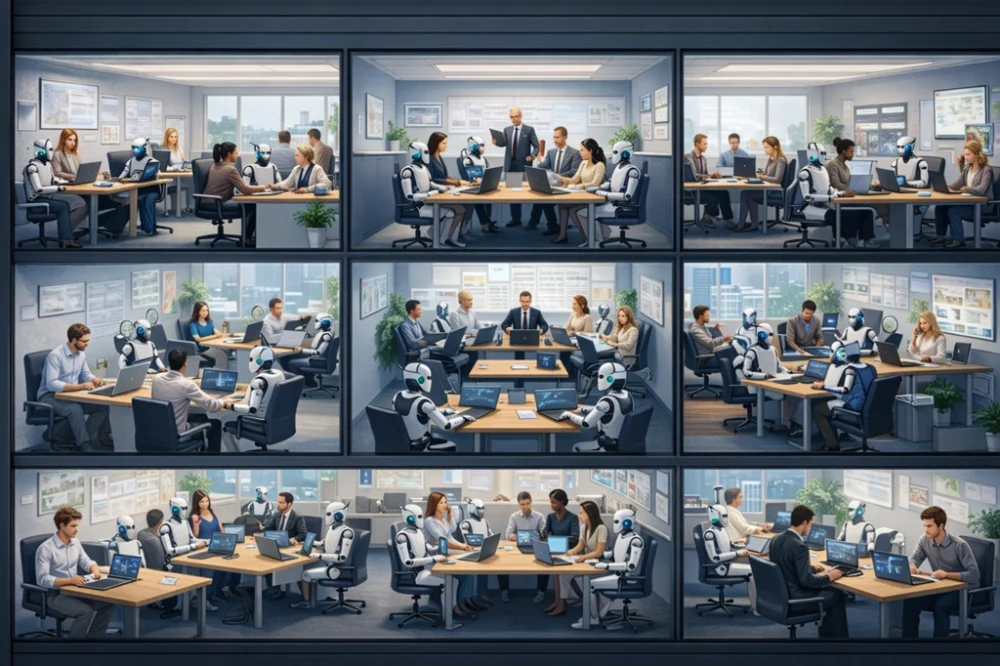
The trajectory of artificial intelligence has moved beyond a steady progression, entering a phase of exponential acceleration that fundamentally redefines the relationship between technology and corporate structure. As of early 2026, the global technological landscape is no longer characterized by the mere introduction of new large language models, but by the rapid emergence of autonomous AI agents capable of independent planning and execution. This shift marks a transition from "generative" AI, which focuses on content creation, to "agentic" AI, which focuses on operational autonomy. However, as these systems become more sophisticated, a critical gap has emerged: while technology advances at an exponential rate, human and organizational adaptation remains linear. The primary challenge for modern enterprises is no longer the selection of a high-performing model, but the preparation of teams and data infrastructures to support these autonomous systems.
The Paradigm Shift from Chatbots to Autonomous Agents
The distinction between the previous generation of AI tools and the current era of AI agents is foundational. For much of the early 2020s, enterprise AI was synonymous with chatbots—reactive systems that required a human prompt to produce a specific output. These "one-shot" interactions were limited by the user’s ability to frame a request and the model’s inability to interact with external software or perform multi-step reasoning without constant human intervention.
In contrast, the AI agents of 2026 are defined by their capacity for "reasoning" and "agency." These systems utilize advanced reasoning models that do not merely predict the next token in a sentence but simulate decision-making paths. When assigned a high-level goal—such as "optimize the logistics for the upcoming regional conference"—an agent does not simply provide a list of suggestions. Instead, it breaks the goal into sub-tasks: it queries calendar availability, accesses CRM systems to identify key stakeholders, cross-references travel budgets, and communicates with external vendors to secure bookings.
This technological leap is supported by the integration of "tool-use" capabilities, where the AI is granted permission to interact with APIs, email clients, and project management software. The agent acts as a digital proxy for the employee, moving from a role of "assistant" to that of a "collaborator" or "executor."

A Chronology of the AI Transformation (2022–2026)
To understand the current urgency, one must look at the compressed timeline of development that has led to the agentic era.
- Late 2022 – Early 2023: The Democratization of LLMs. The release of ChatGPT and subsequent models by Google and Anthropic introduced the public to generative AI. Organizations focused on "prompt engineering" and basic text-based productivity gains.
- 2024: The Rise of Multimodality and Agentic Frameworks. AI began to process images, audio, and video simultaneously. Early agentic frameworks like AutoGPT emerged, though they were often unreliable and prone to infinite loops.
- 2025: The Integration of Reasoning Models. Major providers released models specifically designed for "slow thinking" or chain-of-thought reasoning. These models demonstrated a marked improvement in complex problem-solving and reduced "hallucination" rates, making them viable for enterprise-grade tasks.
- 2026: The Year of the Agentic Enterprise. Organizations began moving away from generic AI tools toward bespoke agents integrated into their core business processes. The focus shifted from "How do we use AI?" to "How do we manage an AI-augmented workforce?"
The Data Quality Crisis: The Hidden Bottleneck
Despite the impressive capabilities of 2026-era AI agents, their efficacy remains strictly tethered to the quality of the data environments in which they operate. The "Garbage In, Garbage Out" (GIGO) principle has taken on a new level of criticality. In a reactive chatbot scenario, a data error might result in a wrong answer that a human can easily spot. In an agentic scenario, where the AI has the autonomy to execute actions, a data error can lead to systemic operational failures.
Research into corporate data structures reveals that many organizations are still struggling with "data debt"—the accumulation of inconsistent, outdated, and siloed information. Incomplete CRM entries, duplicate contact records, and uncoordinated file structures act as friction for AI agents. If an agent is tasked with sending personalized invitations to a high-value client list but the database contains obsolete email addresses or conflicting purchase histories, the agent will execute the task based on that flawed information, potentially damaging client relationships at scale.
Furthermore, the complexity of historically grown IT infrastructures often means that agents lack the necessary context to make nuanced decisions. Governance and documentation become paramount. As systems gain autonomy, the need for transparent "audit trails" increases. Organizations must be able to reconstruct why an agent made a specific decision, which data points it prioritized, and which external tools it accessed.
Human Capital and the Learning Gap
As AI capabilities surge, the human element remains the most significant variable in the success of AI integration. There is a documented disparity between the speed of technological evolution and the speed of human skill acquisition. While an AI model can be updated or replaced in a matter of days, the upskilling of a 5,000-person workforce is a multi-year endeavor.

Industry analysts observe that "AI anxiety" remains a prevalent factor in the workplace. Many employees feel overwhelmed by the pace of change and uncertain about their roles in an agent-driven economy. Successful organizations are those that treat AI integration not as a technical rollout, but as a cultural transformation. This involves moving beyond one-off workshops and toward continuous learning frameworks.
Iris Kern, Business Development Manager at the AI Genie Academy, emphasizes that the bottleneck is not the technology, but the capacity of teams to utilize it. Based on her experience with major digital transformations at firms like ProSiebenSat.1 and Ströer, she argues that "technology alone does not decide success; what matters is whether people are brought along on the journey." This sentiment is echoed by many C-suite executives who have realized that a "tools-first" strategy often leads to low adoption rates and wasted investment.
Strategic Framework for AI Readiness
For an enterprise to be considered "AI-ready" in 2026, it must move through a structured maturity model. The AI Genie Academy, an initiative of the Ebner Media Group, has proposed a three-tiered approach to building this internal competency:
1. Establishing a Unified Baseline
The first step is ensuring that every member of the organization possesses a fundamental understanding of AI capabilities, limitations, and ethical considerations. This prevents the formation of "knowledge silos" and ensures that all departments are speaking the same language when discussing automation.
2. Developing AI Ambassadors
Within each department, "AI Ambassadors" should be identified and trained. These individuals act as the bridge between technical possibilities and departmental needs. They are responsible for identifying high-impact use cases for AI agents and troubleshooting initial implementation challenges.
3. Specialized AI Management
At the leadership level, organizations require specialized AI Managers who can oversee the intersection of strategy, governance, and technology. These roles are responsible for managing the "AI lifecycle," ensuring that agents remain aligned with business goals and regulatory requirements, such as the EU AI Act.
Broader Impact and Implications for the Future of Work
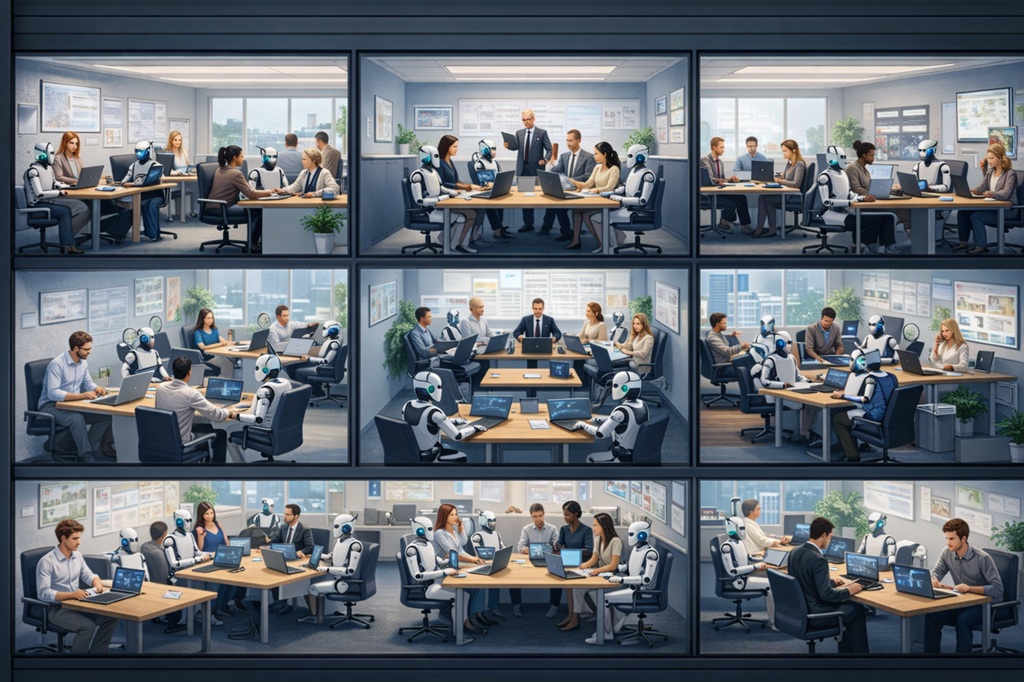
The shift toward autonomous agents is expected to lead to a significant reallocation of labor. Routine administrative and coordinative tasks—once the bulk of middle-management responsibilities—are increasingly being handled by AI agents. This does not necessarily signal a reduction in headcount, but rather a shift toward "higher-order" human tasks: strategic judgment, ethical oversight, and complex interpersonal relationship management.
The competitive advantage in the late 2020s will likely belong to firms that have mastered "Human-AI Teaming." In this model, humans do not just "use" AI; they manage fleets of digital agents, directing their efforts and intervening only when high-level exceptions occur. This requires a new set of management skills centered on delegation to non-human entities and the interpretation of AI-generated insights.
Conclusion: The Strategic Value of Time
The current era of AI development is characterized by a "land grab" for efficiency and innovation. However, the rush to adopt the latest models can be counterproductive if the organizational foundation is weak. The most successful companies of 2026 are those that have recognized that "AI-ready" is a state of constant learning rather than a final destination.
By investing in data hygiene, establishing clear governance structures, and, most importantly, empowering their workforce through structured education, companies can turn the "noise" of AI into a structured competitive advantage. The AI Genie Academy’s approach highlights a fundamental truth of the digital age: in a world of exponential technology, the human factor remains the ultimate differentiator. Organizations that start this journey now, focusing on structured competence building rather than reactive tool adoption, are the ones that will secure their position in the autonomous economy.
