

Sender Spike has officially released qb (Kyubi), a free multimode distortion plugin designed exclusively for Windows operating systems. This new offering expands the developer’s growing portfolio of audio production tools, providing a versatile solution for sound designers and music producers seeking to introduce grit, saturation, and harmonic complexity into their tracks. The release, dated February 22, 2026, marks another significant contribution from Sender Spike to the freeware VST market, following closely on the heels of their critically acclaimed hybrid synthesizer, SN Zero.
Development Context and Chronology
The emergence of qb (Kyubi) as a standalone effect plugin offers an insightful glimpse into the iterative process of software development within the audio industry. Its genesis is directly linked to the development of Sender Spike’s earlier project, SN Zero, a hybrid FM vector synthesizer. SN Zero, which garnered considerable attention upon its release on January 8, 2026, was praised for its clean interface, unique FM and vector synthesis capabilities, and a practical sample loading feature. During the development phase of SN Zero, Sender Spike explored the possibility of integrating an internal effects section to enhance the synthesizer’s sonic palette. Among the effects considered was a dedicated distortion module.
However, after careful consideration, the developer made the strategic decision to omit an integrated effects section from SN Zero. This choice, while seemingly counterintuitive at first glance, is often driven by a desire to maintain the core identity and performance efficiency of a primary instrument. Integrating complex effects directly into a synthesizer can increase CPU overhead, complicate the user interface, and potentially dilute the focus on the instrument’s fundamental sound generation capabilities. Instead, the distortion module that had been under development, now refined and expanded, was repurposed and released as a separate, dedicated plugin: qb (Kyubi). This approach allows both SN Zero and qb (Kyubi) to excel in their respective domains without compromising each other’s design principles. It also provides users with greater flexibility, enabling them to apply Kyubi’s distortion capabilities to any audio source within their digital audio workstation (DAW), not just the output of SN Zero.
Comprehensive Feature Set: Delving into Kyubi’s Capabilities
Kyubi distinguishes itself through a robust array of nine distinct distortion modes, meticulously crafted to offer a broad spectrum of sonic transformations. These modes are strategically positioned between a comprehensive pre-EQ and post-EQ section, affording users unparalleled control over the tonal characteristics of the distorted signal. The inclusion of both pre- and post-distortion equalization is a critical design choice, empowering producers to sculpt the frequency response before it hits the distortion stage and then refine it after the effect has been applied.
The nine distortion modes encompass a range of classic and contemporary effects:
- Soft Clip: This mode gently rounds off the peaks of the audio waveform, introducing subtle saturation and warmth. It’s often used for adding a touch of analog character without harshness, mimicking the natural compression of analog circuitry.
- Hard Clip: In contrast to soft clipping, hard clipping abruptly chops off waveform peaks, resulting in a more aggressive, squared-off sound. This mode is excellent for creating intense, industrial-style distortion or for pushing sounds to their extreme limits, often characterized by strong odd harmonics.
- Linear Fold: A type of waveshaping distortion, linear fold operates by folding the waveform back on itself once it exceeds a certain threshold. This creates unique, often metallic or digital-sounding harmonics that are distinct from traditional clipping.
- Sine Fold: Similar to linear fold but employing a sine-wave based folding algorithm. This can produce more musical and complex harmonic structures, offering a smoother yet still distinctively folded sound.
- Full Rectifier: This mode converts all negative portions of the audio waveform into positive ones, effectively flipping them. The result is a doubling of the fundamental frequency and the introduction of a strong octave-up harmonic, often leading to a thick, buzzing, or synth-like texture, particularly effective on bass sounds.
- Half Rectifier: Only the negative half of the waveform is clipped or attenuated, while the positive half remains largely untouched. This asymmetrical distortion can produce unique sonic characteristics, often less harmonically rich than full rectification but capable of interesting textural shifts.
- Asymmetric Tube Screamer: Inspired by the iconic Ibanez Tube Screamer pedal, this mode emulates its distinctive asymmetrical clipping characteristics. The Tube Screamer is renowned for its mid-hump, which cuts bass and treble while boosting midrange frequencies, making it ideal for pushing guitar amplifiers into saturation without muddiness, or for giving vocals a cutting presence. Kyubi’s implementation provides this classic, warm, and articulate overdrive.
- Additional Asymmetric Waveshaper: This mode offers another flavor of asymmetrical distortion, allowing for further exploration beyond the specific Tube Screamer emulation. Asymmetrical waveshaping can generate a wider range of even and odd harmonics, contributing to unique tonal colors and textures that are often perceived as more complex or "alive" than symmetrical distortion.
- Bit Crushing: This digital distortion effect deliberately reduces the bit depth and/or sample rate of the audio signal. It introduces aliasing artifacts and quantization noise, resulting in a lo-fi, grainy, and often aggressive sound reminiscent of early digital audio or retro video game consoles. It’s highly effective for adding harshness, character, or degradation to modern sounds.
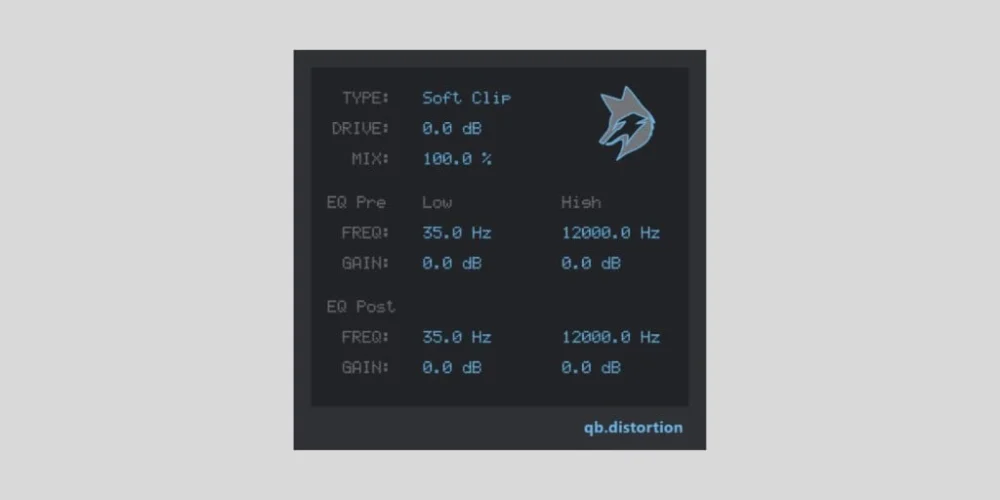
Beyond the diverse distortion modes, Kyubi provides essential controls for fine-tuning the intensity and blend of the effect. The drive gain is adjustable across a wide range, from -30 dB to +30 dB, allowing for subtle saturation or extreme overdrive. A wet/dry mix knob, ranging from 0% to 100%, enables users to blend the distorted signal with the original dry signal, facilitating parallel processing techniques and preserving the integrity of the source audio while introducing effects.
The pre and post EQ sections are critical to Kyubi’s versatility. Each section features both a low shelf and a high shelf filter. The low shelves cover a frequency range from 35 Hz to 400 Hz, while the high shelves span from 1100 Hz to 12 kHz. All four filters offer a substantial gain range of -18 dB to +18 dB. This granular control over frequency response before and after distortion is a significant advantage. The pre-EQ allows users to emphasize specific frequencies that will then be pushed harder into the distortion module, altering the character of the harmonics generated. Conversely, the post-EQ can be used to tame harsh frequencies that might emerge from the distortion process, sculpt the overall tone, or integrate the distorted signal more seamlessly into a mix. This strategic placement of equalization significantly enhances the plugin’s utility, moving it beyond a simple "set and forget" effect.
Design Philosophy and User Experience
Kyubi adopts a text-based interface, a design choice that, while not universally favored in an era of graphically rich plugins, carries a distinct aesthetic and functional rationale. The interface utilizes a retro digital font, evoking a subtle video game quality that contributes to its unique charm. This minimalist approach can be seen as a deliberate move to prioritize functionality and clarity over visual embellishment. In some contexts, a text-based interface can be more CPU-efficient and provide a clear, unambiguous display of parameter values. For users accustomed to visual knobs and graphs, it might require a brief adjustment period. However, for those who appreciate a focused, direct interaction with controls, this aesthetic can be quite appealing, offering a refreshing departure from more conventional graphical user interfaces. It speaks to a certain segment of producers who value functionality and a distinct visual identity over photorealistic skeuomorphism.
Market Positioning and Industry Trends
In the increasingly crowded landscape of VST plugins, Kyubi enters a market segment that is well-established but continually evolving: multimode distortion. While the plugin covers standard distortion territories with its diverse modes, it does not overtly break new ground in terms of fundamentally new distortion algorithms or groundbreaking synthesis methods. Its strength lies in its comprehensive feature set, intuitive control layout, and most notably, its accessibility as a free download.
The freeware plugin market has seen exponential growth in recent years, becoming a vital resource for aspiring producers and seasoned professionals alike. High-quality free plugins like Kyubi lower the barrier to entry for new musicians, allowing them to build a robust toolkit without significant financial investment. For experienced producers, such plugins offer an opportunity to expand their sonic palette, experiment with different "flavors" of effects, or discover hidden gems that can complement their existing premium plugin collections. Sender Spike’s commitment to providing high-quality freeware aligns with this broader industry trend, fostering a more inclusive and innovative production environment. The absence of registration requirements for download further simplifies access, removing a common hurdle associated with many free offerings.
However, a key limitation to note is Kyubi’s exclusivity to the Windows operating system. In an industry where cross-platform compatibility (Windows and macOS being the dominant ecosystems) is often a standard expectation, the Windows-only restriction might limit its reach among a significant portion of the music production community. This decision could be due to development resource constraints or specific technical considerations, but it remains a notable point for potential users.
Implications and Target Audience
The release of qb (Kyubi) carries several implications for different segments of the music production community. For newcomers to VST plugins and those actively building their initial software toolkit, Kyubi represents an invaluable resource. Its comprehensive range of distortion types, coupled with flexible EQ, provides a solid foundation for understanding and applying distortion effects. The "free" price tag makes it an obvious choice for exploration and learning without financial commitment. It empowers beginners to experiment with sound design, add aggression to drums, warmth to synthesizers, or character to vocals, all within a well-designed framework.
For experienced producers, Kyubi might not be a "must-have" if they already possess an extensive collection of premium distortion plugins. However, its unique combination of modes, particularly the asymmetric waveshapers and the dedicated Tube Screamer emulation, alongside the powerful pre/post EQ, could still offer a fresh perspective or a specific sonic character not easily found elsewhere. It provides another versatile tool for creative sound design, especially for those who enjoy testing different distortion flavors or who are constantly seeking to expand their palette of effects. Its distinct text-based interface might also appeal to producers looking for something aesthetically different.
The Windows-only limitation means that macOS users will unfortunately miss out on this particular offering. This underscores the fragmented nature of some parts of the freeware plugin ecosystem, where developers often focus on a single platform due to resource limitations or personal preference. This means that while Kyubi contributes significantly to the Windows freeware scene, it does not address the needs of a substantial portion of the global production community.
In conclusion, qb (Kyubi) stands as a testament to Sender Spike’s ongoing dedication to providing innovative and accessible tools for music producers. Its origin story, stemming from the development of a synthesizer, highlights a practical and iterative approach to software design. With its diverse range of distortion modes, powerful pre and post equalization, and distinct text-based interface, Kyubi offers a robust and creatively inspiring solution for Windows users looking to inject character and intensity into their audio. As the freeware market continues to thrive, Kyubi reinforces the notion that high-quality production tools are increasingly within reach for all.
Availability:
qb (Kyubi) Multimode Distortion is available for free download directly from the developer’s website. No registration is required to access the plugin.
Download: qb (Kyubi) Multimode Distortion (FREE)
Last Updated on February 24, 2026 by Tomislav Zlatic.
