

Aethis, a groundbreaking new project spearheaded by developer Agastya Jindal, has officially launched its free alpha version for macOS and Windows, boldly entering the competitive digital audio workstation (DAW) landscape with the ambitious claim of being the “end-all, be-all guitar plugin.” This initial release, Alpha v0.2.2, positions Aethis as a comprehensive, single-solution platform designed to cater to a vast spectrum of guitarists and music producers, offering everything from classic amplifier emulations to unique, complex harmonic processing tools. The project aims to consolidate the entire guitar tone-shaping and effects chain into one intuitive interface, eliminating the traditional reliance on multiple plugins and external hardware.
The Evolution of Digital Guitar Processing: A Market Overview
The journey of guitar amplification has seen a remarkable transformation, evolving from bulky tube amplifiers and pedalboards to sophisticated digital emulations and software plugins. This shift has been largely driven by the increasing accessibility of Digital Audio Workstations (DAWs) and the proliferation of home recording studios. Musicians and producers today demand versatile, high-quality, and cost-effective solutions that can seamlessly integrate into their digital workflows. The market for guitar plugins has consequently exploded, with numerous developers offering specialized amplifier models, effect pedals, and cabinet emulations. However, the common challenge often lies in assembling a cohesive and efficient signal chain from a myriad of disparate plugins, which can be resource-intensive and workflow-disrupting.
It is into this dynamic environment that Aethis emerges, seeking to address the inherent fragmentation of the digital guitar rig. Industry analysts estimate the global music software market, including plugins and DAWs, to be experiencing robust growth, fueled by both professional studios and the burgeoning independent artist community. The convenience of software, coupled with advancements in digital signal processing (DSP) and machine learning, has made high-fidelity guitar tones more accessible than ever before. Aethis’s promise of a "one-stop shop" directly taps into this demand for integrated solutions, aiming to streamline the creative process and provide a comprehensive toolkit for tone crafting and musical expression.
A Deep Dive into Aethis’s Core Features
At its heart, Aethis is engineered to be a complete ecosystem for guitarists. It integrates a suite of essential components, including advanced amplifier models, a versatile array of built-in effects, and a particularly innovative Multivoicer feature. This holistic design philosophy means users can sculpt their tone and craft intricate sonic textures entirely within Aethis, from the initial guitar input to the final amplifier output, without the necessity of chaining additional third-party plugins.
Neural Amp Modeling (NAM) at its Heart:
Aethis leverages the cutting-edge technology of Neural Amp Modeler (NAM) to deliver its amplifier emulations. NAM technology represents a significant leap forward in digital amplification, utilizing neural networks to "learn" and accurately replicate the complex, non-linear characteristics of real tube amplifiers. Unlike traditional digital modeling, which often relies on fixed algorithms, NAM captures the nuanced behavior, harmonic richness, and dynamic responsiveness of physical tube circuits, offering an unprecedented level of authenticity.
Aethis features five distinct neural amp models, meticulously trained on actual tube amplifiers, and distributed across three primary amplifier archetypes: Noctis, Vesper, and Lumina. Each amp is designed to cover specific tonal territories, providing a wide palette for various musical genres and playing styles.
-
Noctis: The High-Gain Powerhouse: This two-channel, modern high-gain amplifier is explicitly tailored for heavy metal and other aggressive genres. The design prioritizes clarity and definition even under extreme gain settings, a common challenge in high-gain amplification where tones can often become muddy or indistinct. Noctis’s first channel offers a robust, articulate high-gain sound, while its second channel pushes the aggression further, delivering an even more intense sonic assault. Crucially, neither channel sacrifices clarity, ensuring that intricate riffs and complex chords remain distinct, particularly during transitions into heavier musical passages. This attention to detail in preserving note articulation under high saturation distinguishes Noctis in a crowded field of digital metal amps.
-
Vesper: Dynamic Versatility: Stepping down slightly from Noctis’s sheer aggression, Vesper presents another two-channel amplifier designed for greater dynamic versatility. This amp is engineered to be highly reactive to the player’s touch, feel, and articulation. It excels in scenarios where tactile control over the "grit" in the tone is paramount, allowing guitarists to transition smoothly between clean, crunchy, and overdriven sounds simply by adjusting their picking dynamics or guitar volume knob. Vesper’s responsiveness makes it an ideal choice for blues, rock, and fusion players who rely on nuanced performance to shape their sound. Its ability to clean up or break up dynamically provides a broad tonal spectrum within a single amp model.
-
Lumina: Pristine Cleanliness: Completing the trio, Lumina is positioned as the cleanest amplifier model within Aethis. Its design philosophy centers around pristine clarity and transparent fidelity, making it the go-to choice when voicings and harmonic purity are prioritized over aggressive "attitude." Lumina is perfect for genres requiring shimmering cleans, intricate arpeggios, or ambient textures. It serves as an excellent foundation for layering effects or for players who prefer a clean canvas to build their sound upon, allowing the natural character of the guitar and the nuances of the player’s technique to shine through.
Integrated Effects Suite:
Beyond its robust amplifier section, Aethis boasts a comprehensive suite of built-in effects, designed to cover virtually every stage of the guitar signal chain. This integrated approach significantly enhances workflow efficiency, as users no longer need to instantiate multiple individual effect plugins. The included effects encompass:
- Boost: For pushing amplifier stages or adding volume.
- Compressor: For dynamic control and sustain.
- Overdrive: To add grit and saturation before the amp.
- Gate: For noise reduction and tightening up high-gain tones.
- Chorus: For lush modulation and stereo widening.
- Delay: For echoes and spatial effects.
- Reverb: For simulating acoustic spaces and adding depth.
- Nine-band EQ: For precise tonal sculpting and frequency management.
This extensive collection ensures that users have all the necessary tools at their fingertips to shape their sound, from subtle tonal refinements to dramatic sonic transformations, all within the Aethis environment.
The Groundbreaking Multivoicer: Harmonic Innovation
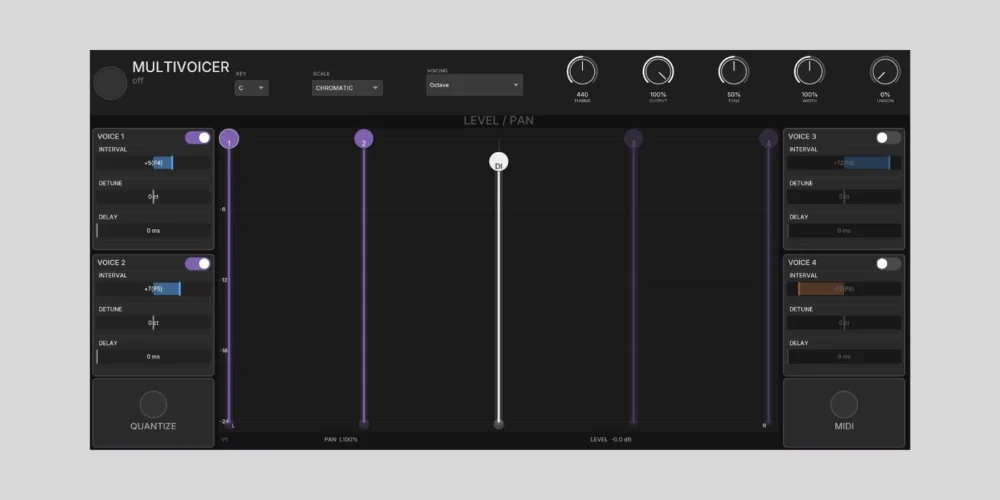
Perhaps one of Aethis’s most intriguing and potentially transformative features is its innovative Multivoicer. This sophisticated module extends beyond conventional guitar effects, venturing into the realm of harmonic generation and musical arrangement. The Multivoicer offers four independent voices, each capable of a +/- 15 semitone range. This allows users to stack these voices to create incredibly dense, rich harmonies from a single input note, or to employ them for more fundamental tasks like basic doubling to add thickness to a sound.
The true power of the Multivoicer lies in its ability to democratize complex harmonic arrangements. For many musicians, particularly non-guitarists or those experimenting with sound design, generating musically coherent harmonies can be a daunting task requiring deep theoretical knowledge or laborious overdubbing. Aethis’s Multivoicer simplifies this significantly. Imagine triggering a full chord or an intricate harmonic progression by playing a single note on a guitar – this is the promise of the Multivoicer. The feature is not limited to guitar applications; its capacity to add thirds, fifths, or other intervals above simple melody lines echoes the techniques employed by skilled organists, transforming a monophonic line into a rich, polyphonic texture when used judiciously. This "Harmonic Mode" capability is further enhanced by the option to lock the generated voices to a particular musical scale, ensuring that the resulting harmonies are always musically consonant and pleasing, even for users with limited theoretical background. This aspect alone could open up new avenues for creative expression for producers, composers, and sound designers, making complex harmonic textures readily accessible.
Strategic Alpha Release and Development Trajectory
Aethis’s launch as a free alpha release (v0.2.2) is a strategic move, common in modern software development, designed to foster community engagement and gather critical user feedback. During this alpha stage, the plugin is available for free download in AU, VST3, and Standalone formats, ensuring broad compatibility across various DAWs on macOS and Windows platforms. The developer, Agastya Jindal, has clearly communicated that while Aethis will remain free throughout its alpha development, the final, polished product is intended to be a paid plugin.
This approach serves multiple crucial purposes:
- User-Centric Development: By releasing an early version, Jindal invites a global community of musicians and producers to test the plugin in real-world scenarios, identifying bugs, suggesting features, and providing insights that might otherwise be missed during internal testing. This iterative development model, driven by user feedback, often leads to a more robust and user-friendly final product.
- Community Building: A free alpha generates excitement and builds a loyal user base even before the commercial release. Early adopters become advocates, helping to spread awareness and establish Aethis’s presence in the market.
- Market Validation: The alpha phase allows the developer to gauge market reception, assess demand for specific features, and refine the product’s value proposition before its official launch.
- Iterative Improvement: Software development is rarely a linear process. The alpha phase allows for rapid prototyping and iteration, ensuring that core functionalities are stable and new features are integrated smoothly.
The developer’s explicit welcome of feedback and donations during this period underscores a commitment to transparent, community-driven development, aiming to refine Aethis into a truly exceptional tool that resonates with its target audience.
Agastya Jindal’s Vision and Market Implications
Agastya Jindal’s ambitious vision for Aethis as the "end-all, be-all guitar plugin" sets a high bar and signals a direct challenge to established players in the digital guitar processing market. This claim implies not only comprehensive functionality but also a superior user experience and sonic quality that transcends existing solutions. In a market populated by highly regarded plugins from companies like Native Instruments, Positive Grid, Neural DSP, and IK Multimedia, Aethis seeks to differentiate itself through its integrated design, the authenticity of its neural amp models, and the innovative capabilities of its Multivoicer.
The implications for independent music production are significant. By offering a professional-grade, all-in-one solution, Aethis could empower a wider range of musicians to achieve high-quality recordings and productions without needing extensive hardware investments or a complex chain of specialized plugins. During its free alpha phase, it provides an invaluable resource for aspiring and established artists alike, democratizing access to advanced tone-shaping and harmonic tools. Should Aethis successfully deliver on its promise in its final paid iteration, it could redefine expectations for what a single guitar plugin can accomplish, potentially shifting market preferences towards more integrated and harmonically versatile solutions. The success of Aethis will largely depend on its ability to maintain sonic fidelity, optimize performance, and continue innovating based on user feedback, ultimately carving out a unique and indispensable niche in the evolving landscape of music technology.
Technical Accessibility and Future Outlook
Aethis’s availability across AU, VST3, and Standalone formats for both macOS and Windows ensures maximum compatibility with virtually all major DAWs, including Logic Pro, Ableton Live, Cubase, FL Studio, Studio One, and Reaper. This broad accessibility is crucial for widespread adoption and integration into diverse professional and home studio setups. The choice of formats reflects an understanding of the varied technical environments musicians operate within, making Aethis a versatile tool for any workflow.
As the project moves beyond its alpha stage, the focus will undoubtedly shift towards optimizing performance, expanding the library of amp models and effects, and potentially introducing new features based on community input. The long-term vision for Aethis appears to be one of continuous innovation, aiming to establish itself as a staple in digital guitar processing. The importance of ongoing development, coupled with a robust support system and continued engagement with its user base, will be paramount to Aethis’s sustained success in a highly competitive and rapidly evolving industry. Its current trajectory suggests a promising future for a plugin that seeks not just to emulate, but to innovate and inspire new forms of musical expression.
Availability Information:
Aethis is currently available for free download in its Alpha v0.2.2 stage. Users interested in experiencing this ambitious new guitar plugin and contributing to its development can download it from the official website.
Download: Aethis (FREE alpha)
Last Updated on March 2, 2026 by Tomislav Zlatic.
