

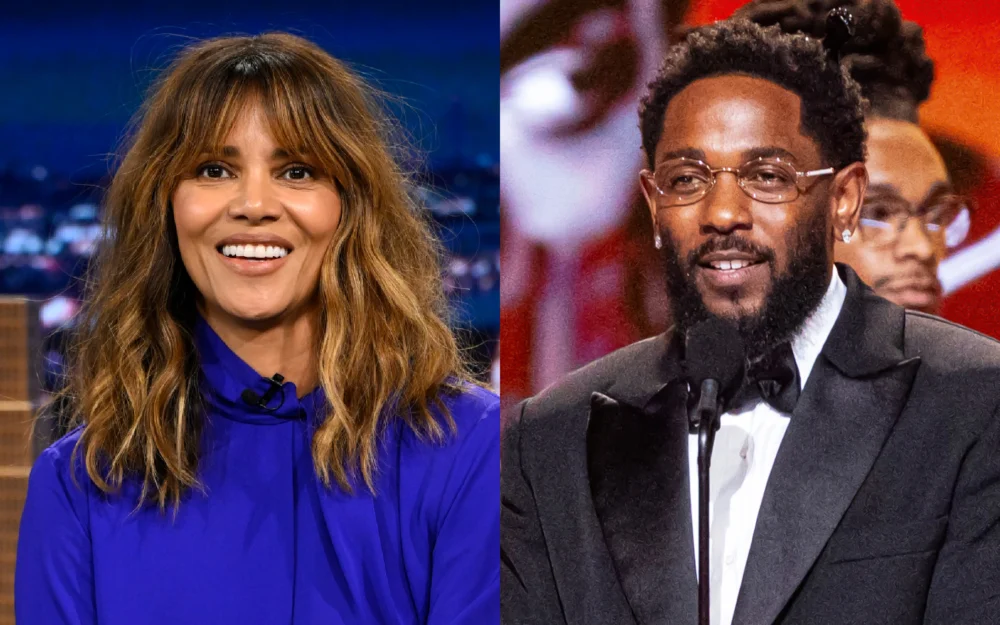
Oscar-winning actress Halle Berry has publicly declared her affinity for Kendrick Lamar’s music, specifically naming him as her favorite artist hailing from Los Angeles. This declaration, made during a promotional appearance for her upcoming film Crime 101, also carried a subtle jab at rapper Drake, highlighting the ongoing lyrical feud between the two artists. Berry’s candid remarks, shared alongside co-stars Chris Hemsworth and Mark Ruffalo, provided a glimpse into her musical preferences and her awareness of contemporary hip-hop discourse.
The interview segment, part of UPROXX’s "That Tracks" series, presented the actors with various music-related hypothetical scenarios to gauge their reactions. The prompt that ignited Berry’s passionate response centered on a common urban experience: being stuck in traffic. Chris Hemsworth posed the question, "If I’m stuck in traffic in the 101, I’m listening to my favorite L.A. based artist, Kendrick Lamar. Does that track?"
Berry’s immediate and emphatic reply was, "Absolutely, hell yes!" Her enthusiasm was palpable as she not only confirmed her appreciation for Lamar but also hinted at a specific song that would accompany her hypothetical traffic jam. With a playful laugh, she mimicked Kendrick Lamar’s signature introductory phrase, "Say Drake!" This reference was a clear nod to Lamar’s highly publicized diss track, "Not Like Us," a critical and commercial success that dominated headlines and streaming charts in recent months. Berry’s choice to quote the song’s memorable opening, juxtaposed with the mention of Drake, underscored her alignment with Lamar in the high-profile rap beef. She concluded her statement on the matter by stating, "That’s all I’m gonna say," leaving little room for misinterpretation regarding her allegiances.
Further solidifying her admiration for the Compton rapper, Berry offered an unsolicited piece of praise to her co-stars, highlighting Kendrick Lamar’s perceived impact on popular culture. She asserted that Lamar’s performance at the 2025 Super Bowl halftime show, a hypothetical event at the time of the interview, was "still the number one-performing halftime show ever." While this statement may be a hyperbole or a prediction of future success, it demonstrates Berry’s profound respect for Lamar’s artistic achievements and stage presence.
Mark Ruffalo, seemingly caught slightly off guard by the intensity of the discussion, responded with a sheepish agreement, stating, "Crazy! … Yeah, let’s go with that – just because." His reaction suggested a general acceptance of Berry’s enthusiasm and an acknowledgment of Lamar’s significant cultural footprint. Chris Hemsworth also chimed in, revealing his own appreciation for Kendrick Lamar’s music, albeit with a more nuanced perspective. He responded to the traffic scenario by saying, "On certain days, for sure," indicating that while he enjoys Lamar’s work, his listening habits might be more varied.
The interaction between Berry and her Crime 101 co-stars not only illuminated her musical tastes but also provided a backdrop to a pre-existing relationship between the actress and the rapper. Kendrick Lamar himself has previously paid homage to Halle Berry, famously naming her in the chorus of his 2012 hit song "Money Trees." This lyric, "I know my mama proud of me, but I’m tryna make my mama proud of me / And my auntie too, and my cousin too / And my sister too, and my nieces too / And Halle Berry too," served as an early indicator of Lamar’s respect for the actress and her enduring presence in popular culture. The inclusion of her name in such a widely recognized track underscored her status as an icon, a sentiment that Berry appears to reciprocate.
However, the narrative surrounding Halle Berry’s relationship with the hip-hop world is not exclusively positive. Her interactions with Drake have been notably less harmonious. This discord stems from Drake’s unauthorized use of Berry’s image as the cover art for his 2023 single "Slime You Out," featuring SZA. The artwork, which depicted Berry covered in green slime from her appearance at the 2012 Nickelodeon Kids’ Choice Awards, sparked significant backlash.
Following the single’s release, Berry took to Instagram to express her displeasure. Her initial post, while seemingly subliminal, carried a clear message: "Sometimes you have to be the bigger guy… even if you’re a woman!" The inclusion of a middle finger emoji further amplified her discontent. In the comments section of the post, Berry elaborated on her grievances, stating, "Didn’t get my permission. That’s not cool I thought better of him!" She also responded to a fan, remarking, "When people you admire disappoint you you have to be the bigger person and move on!" This exchange highlighted a breach of trust and a perceived lack of respect from Drake’s camp, leading to a tangible rift between the actress and the rapper.
The "Not Like Us" track, which Berry alluded to in her interview, was released in April 2024 and quickly became a cultural phenomenon. The song, characterized by its aggressive tone and direct lyrical attacks, was a central piece in Kendrick Lamar’s escalating conflict with Drake. The track’s success, marked by its rapid ascent on streaming platforms and its widespread adoption as a meme and a cultural talking point, further cemented its significance in contemporary hip-hop history. The song’s virality was further amplified by its use in various social media trends and its subsequent performance by Lamar at high-profile events, including the widely discussed Super Bowl halftime show that Berry referenced. The "Not Like Us" controversy generated significant media attention, with numerous outlets dissecting its lyrical content and its impact on the rap landscape. Music critics and fans alike debated the merits of the diss track, its cultural relevance, and its place within the broader narrative of hip-hop feuds.
The Super Bowl halftime show itself is a significant cultural touchstone, with performances often reaching a massive global audience and leaving a lasting impression. Historically, halftime shows have been a platform for artists to showcase their artistry and reach new demographics. Artists like Michael Jackson, Prince, Beyoncé, and Lady Gaga have delivered iconic performances that are still discussed years later. The expectation and anticipation surrounding any Super Bowl halftime performance are immense, and a truly exceptional show can elevate an artist’s career to new heights. If Kendrick Lamar were to perform at a future Super Bowl, as Berry alluded, it would undoubtedly be a moment of considerable cultural significance, subject to intense scrutiny and analysis. The reference to it as the "number one-performing halftime show ever" suggests Berry’s belief in Lamar’s ability to deliver such a groundbreaking performance.
The legal and ethical implications of using an individual’s image without their consent are significant. In the case of Drake’s "Slime You Out" cover art, the unauthorized use of Halle Berry’s likeness raises questions about intellectual property rights and the boundaries of artistic expression. While artists often draw inspiration from existing imagery, obtaining permission is crucial, especially when dealing with recognizable public figures. The incident highlights the growing importance of respecting personal and professional boundaries in the digital age, where images can be easily disseminated and manipulated. Berry’s reaction underscores the expectation that artists, particularly those with a public platform, should conduct themselves with a degree of professionalism and respect for others’ rights.
The ongoing dialogue surrounding Kendrick Lamar’s music and his lyrical battles with Drake continues to captivate the public imagination. Halle Berry’s public endorsement of Lamar, coupled with her past experiences, adds an interesting layer to this narrative. Her willingness to engage with contemporary hip-hop culture, even to the point of referencing contentious lyrical exchanges, demonstrates her relevance and her understanding of the current cultural landscape. The interview segment, therefore, served not only as a promotional opportunity for Crime 101 but also as a moment where a prominent Hollywood figure weighed in on a significant cultural event, revealing her personal preferences and her awareness of the complex dynamics within the music industry. The juxtaposition of her admiration for Lamar and her dissatisfaction with Drake’s actions provides a nuanced perspective on celebrity interactions and the power of artistic expression, both in music and in public discourse.
The context of the "That Tracks" series itself is rooted in exploring the intersection of music and relatable life experiences. By posing scenarios such as being stuck in traffic, the series aims to uncover how music functions as a soundtrack to everyday life and how artists resonate with their audience on a personal level. The actors’ responses are intended to be authentic and indicative of their genuine musical tastes and their understanding of musical genres and their cultural impact. The format encourages a candid and often lighthearted discussion, allowing for personal anecdotes and opinions to surface. In this instance, Berry’s response transcended a simple musical preference, touching upon the broader implications of a high-profile rap feud and the artistry involved.
The broader impact of such public endorsements from established figures like Halle Berry cannot be understated. For artists like Kendrick Lamar, support from respected actors can broaden their appeal and validate their artistic contributions in the eyes of a wider audience. It signifies that their music transcends the traditional boundaries of genre and demographic, reaching individuals from diverse backgrounds and professions. Conversely, negative interactions, such as the incident with Drake, can damage an artist’s public image and raise concerns about their professional conduct. The ripple effect of these interactions can influence fan perception, media coverage, and even the trajectory of an artist’s career. Halle Berry’s clear stance in this instance, therefore, serves as a public statement of her allegiance and her judgment, adding another dimension to the ongoing discourse surrounding the artists involved.
