

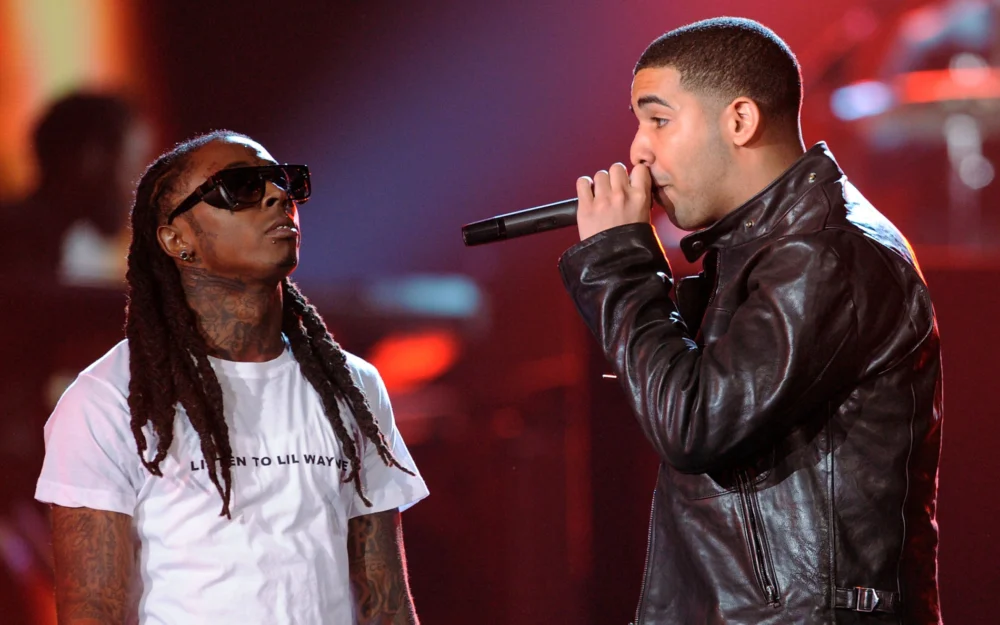
Adam Bhala Lough, the acclaimed director behind the seminal documentary The Carter, has unveiled a series of candid anecdotes that shed new light on the formative years of Young Money and the behind-the-scenes struggles of documenting one of hip-hop’s most influential figures, Lil Wayne. In a recent conversation with music journalist Andre Gee for his Substack newsletter, Lough detailed a surprising period when a young Drake, now a global music icon, was reportedly not permitted on Lil Wayne’s tour bus, a stark contrast to the powerhouse collaboration they would later forge.
The revelations stem from Lough’s immersive experience capturing Lil Wayne at the zenith of his creative output during the Tha Carter III era. This period, characterized by unprecedented commercial success and artistic dominance for the New Orleans rapper, also presented a unique environment for documentary filmmaking. Lough described a dynamic within Lil Wayne’s inner circle where the budding artist Drake, despite his growing association with the Young Money label, often found himself on the periphery.
The "Dorky" Outsider: Drake’s Early Exclusion
Lough recounted moments where, while not actively filming Lil Wayne, he would find himself in the company of Wayne’s then-manager Tez Bryant, Mack Maine, and Nicki Minaj. It was during one such instance, prior to Lil Wayne’s appearance on The Jimmy Kimmel Show when Nicki Minaj was still an emerging artist, that the director witnessed Drake’s unusual exclusion. "At one point, I spent some time with her before Wayne did The Jimmy Kimmel Show, when nobody knew who she was, and they wouldn’t even let Drake on the bus," Lough stated. "He was, like, such a dork that they wouldn’t even let him on the bus."
This seemingly minor detail speaks volumes about the early dynamics of Young Money. While Drake had signed with the label in 2009, his initial reception within the broader touring entourage appears to have been one of cautious distance. Lough elaborated on the underlying reasons for this, pointing to the presence of hardened Blood gang members within Lil Wayne’s immediate circle. "When he started selling millions and millions of records, it was a different story entirely," Lough explained. "But he was definitely not allowed on the bus and wouldn’t hang out with any of [them] because there were real Blood gang members around all the time. And I’m sure he was intimidated by them, too. I was, even though they were super cool to me. These are serious, Blood gang members with guns on them. Like, some shit could go down."
This observation underscores the gritty realities that often coexisted with the glamorous facade of hip-hop touring in the late 2000s. The presence of individuals with documented gang affiliations served as a constant reminder of the potentially volatile environment. For a young Drake, whose public persona at the time was more reflective of a prodigious talent rather than a street-hardened figure, navigating such a landscape would have presented a significant challenge. His eventual ascent to global superstardom, marked by multi-platinum sales and a distinct artistic identity, undeniably altered his standing within the collective, transforming him from an outsider to a central pillar of the Young Money empire.
The Unforeseen Financiers of The Carter
Beyond the anecdotes of artist dynamics, Lough also revealed a surprising and somewhat controversial chapter in the production of The Carter documentary itself. He disclosed that the initial funding for the film was slated to come from a partnership involving disgraced Hollywood producer Harvey Weinstein and former Trump strategist Steve Bannon.
Lough explained that Quincy Jones III, who was involved in the project, contacted him with an offer to finance the documentary through a company that had a deal with an offshoot of Miramax. "You’re not going to believe this, but it was a company owned by Harvey Weinstein and Steve Bannon," Lough stated. He further elaborated on Bannon’s background, noting, "A lot of people don’t remember, but Steve Bannon actually came from Hollywood; he was a movie producer."
The original plan was for Weinstein and Bannon’s involvement to provide the financial backing for The Carter. Lough described this potential collaboration as "amazing if it had actually happened." However, the financing arrangement ultimately collapsed when the company owned by Weinstein and Bannon shut down during the film’s production. This unexpected turn of events forced Lough and his team to find alternative funding sources, a common hurdle in independent filmmaking, especially for projects of this magnitude. The association with such polarizing figures, even in a historical context, adds another layer of intrigue to the documentary’s creation narrative.
A Leaked Sequel and the Future of The Carter Series
The conversation also delved into the recently surfaced sequel to The Carter documentary, a project that experienced its own set of unexpected challenges. Lough revealed that a rough cut of this film, which was recorded during the Tha Carter and Tha Carter II eras, was leaked online by hackers. In response, Lough decided to release the unedited footage himself on YouTube, allowing fans to access the material while he works towards a more polished, official release.
This leaked sequel offers an intimate look at Lil Wayne during a pivotal period in his career, predating the immense success of Tha Carter III. The two-hour video captures rare moments, including Lil Wayne playing unreleased music, engaging in studio sessions with emerging artists like 2 Chainz (then known as Tity Boi) and Curren$y, and openly discussing his complex relationship with Cash Money Records. These candid segments provide invaluable insight into Lil Wayne’s artistic process and his early dealings with the label that would shape his career.
Lough expressed his commitment to producing a finished version of the sequel and has been in positive discussions with Lil Wayne’s current manager, Fabian Marasciullo. He outlined two potential avenues for the film’s official release: either through a major streaming network or via a direct-to-fan self-distribution model. "There’s basically two options: There’s a big [streaming network] that would pick it up and put it out," Lough explained. "The other option that I talked to [Fabian] about was some type of self-distribution where we just put it out ourselves to the fans. We’ll see where it ends up. It’ll go how it needs to go."
The director also hinted that the sheer volume of footage captured for the sequel might necessitate a two-part release. "There’s so much footage, I think maybe there could be two films," he suggested. If the sequel is indeed split into two parts, Lough estimates it to be approximately 40% complete, accounting for the necessary post-production work such as mixing and color correction. If it remains a single film, he places the completion percentage closer to 70%. This indicates a significant amount of work still lies ahead before the project can be officially shared with a wider audience.
Broader Implications and the Enduring Legacy of Lil Wayne
The revelations from Adam Bhala Lough offer a compelling narrative that extends beyond mere biographical details. They highlight the organic and sometimes chaotic evolution of a record label that would redefine hip-hop. Drake’s initial exclusion from the tour bus, while seemingly minor in retrospect, underscores the importance of social dynamics and perceived affiliations within the music industry’s inner circles. It also serves as a testament to his eventual triumph, demonstrating how talent and perseverance can transcend early barriers.
Furthermore, the tumultuous journey of The Carter documentaries, from the initial involvement of controversial financiers to the recent leak of the sequel, speaks to the inherent challenges of capturing and controlling the narrative of significant cultural figures. The film’s ability to survive these obstacles and still offer a valuable glimpse into Lil Wayne’s career is a testament to its enduring importance.
The potential for a two-part sequel, or even a series of releases, suggests that the archival footage holds a wealth of unexplored material. This could further solidify Lil Wayne’s position not just as a prolific artist but as a subject of significant historical interest within the genre. The discussions with his management indicate a renewed effort to bring these projects to fruition, promising fans deeper insights into the artistry and evolution of one of hip-hop’s most influential figures. The story of The Carter films, much like the career of Lil Wayne himself, continues to unfold, revealing new layers and perspectives with each passing revelation.
