

Swedish pop sensation Zara Larsson has once again found herself at the center of a swirling public debate, this time after doubling down on a controversial abortion joke she made on TikTok. Known for her outspoken nature and a history of inadvertently stirring discussion—from raising awareness about unflattering Wikipedia photos to the accidental wearing of a Burzum-themed dress to an awards show—Larsson’s latest move underscores her commitment to challenging societal norms and advocating for a nuanced understanding of reproductive rights. The incident has prompted widespread reactions, reigniting discussions around humor, celebrity activism, and the deeply polarized landscape of abortion discourse.
The Incident Unfolds: A Digital Controversy
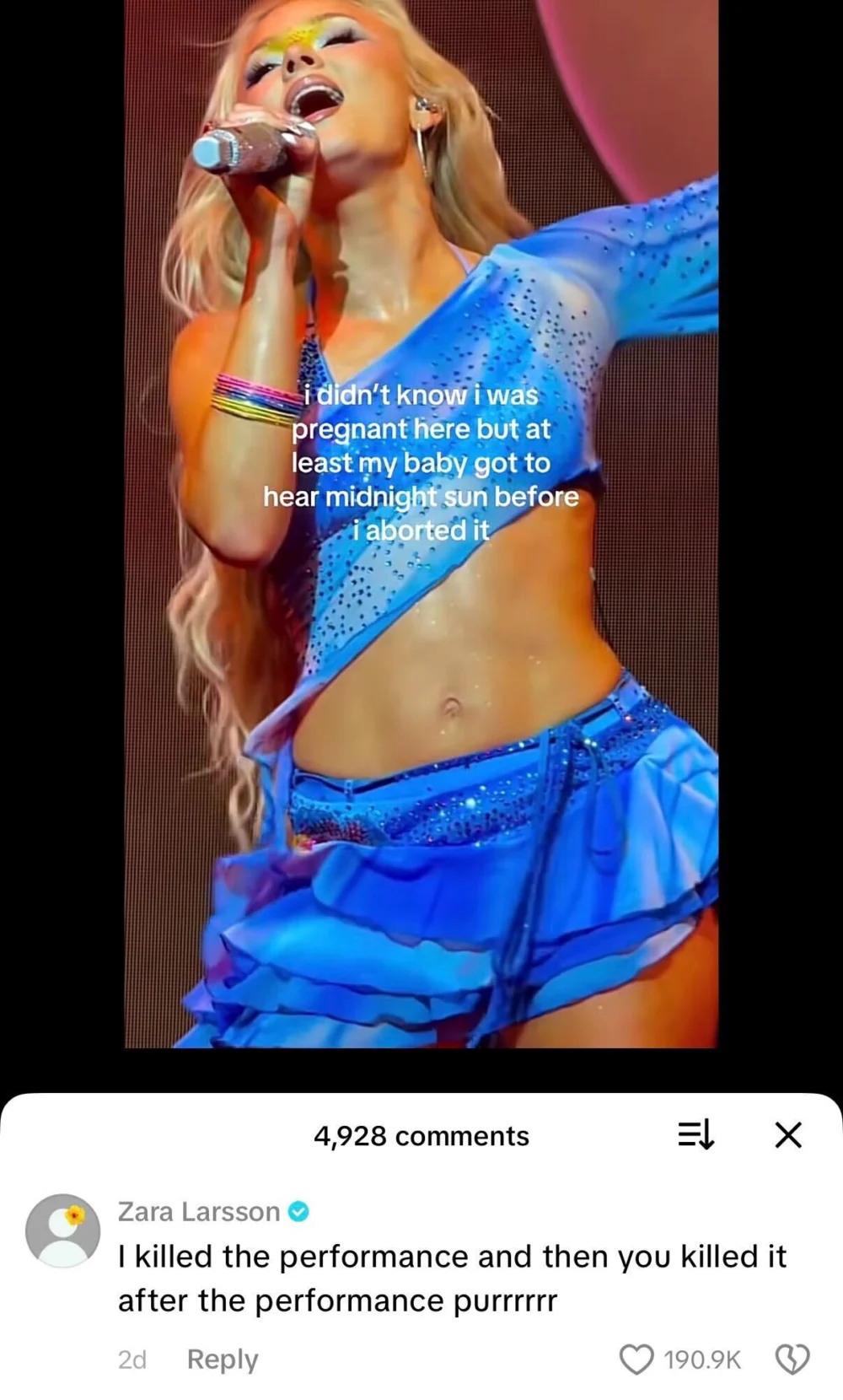
The genesis of the current controversy lies in a TikTok video posted by a fan, @honeyhazelwood, featuring footage of Larsson performing. Overlaying the performance, the fan’s text read: "i didn’t know i was pregnant here but at least my baby got to hear midnight sun before i aborted it." Larsson, engaging with her fanbase on the platform, commented on the video with a quip that quickly went viral: "I killed the performance and then you killed it after the performance purrrrrr."
This comment, perceived by many as flippant given the sensitive nature of the topic, swiftly garnered a significant backlash. The phrase "pearl-clutching," as described in initial reports, accurately captured the immediate reactions from a segment of the online community who deemed the joke inappropriate or insensitive. Social media platforms became a battleground of opinions, with users expressing outrage, discomfort, and condemnation, arguing that abortion, regardless of one’s stance, is a serious medical and ethical issue not to be trivialized with humor.
Larsson’s Resolute Defense: "Abortion is Healthcare" and the Nuance of Humor
Rather than retreating in the face of criticism, Larsson chose to confront it head-on, posting a follow-up TikTok video where she passionately defended her joke and articulated her broader philosophy on abortion rights and public discourse. Her defense was not merely an apology or a clarification but a challenge to the prevailing narratives surrounding abortion.
"Sorry, that’s funny. Like, I don’t know what to say. That’s funny. Sorry if you don’t have humor," Larsson began, acknowledging the divisive nature of her initial comment. She quickly pivoted from addressing those fundamentally against abortion, stating, "I’m not really here to argue with the people who are very against abortions for whatever reason because we’re so fundamentally different in the way we view the world, at least on this topic." This established her intent to engage with those who, while ostensibly pro-choice, still harbor reservations about the casual treatment of abortion.
Her primary target audience, she explained, were those who commented, "This is not something to joke about. I’m so pro-choice. I am as pro-choice as the next person, but abortion is a very serious topic." Larsson then posed a series of provocative questions designed to expose what she perceives as a conditional acceptance of abortion within some pro-choice circles: "Why do you feel like abortion is only okay when it’s a very hard decision, when it’s something that women have to struggle with going through, when it’s emotionally or physically painful? Why does that make it morally superior to someone just wanting an abortion for whatever reason? Why is it only morally okay when women have to suffer? Now riddle me that. Why can’t it just be okay for a woman to want to have an abortion?"
This line of questioning directly challenged the pervasive narrative that abortion is only justifiable under extreme circumstances, such as rape, incest, or medical necessity, and that a woman’s decision must always be accompanied by profound emotional distress to be deemed legitimate. Larsson argued for a pro-choice stance that is absolute and unconditional, asserting that a woman’s autonomy over her body should not be contingent on her suffering or the perceived "moral weight" of her reasons.
She further elaborated on the importance of comprehensive sexual education and access to contraception, stating, "I do agree that we should prevent it, we should teach sexual education to children, we should make sure that we’re like, if you don’t want babies, have birth control. Access to free condoms, free whatever, because people love sex. Just face it. People want to fuck. That’s just human nature. But also that doesn’t mean that you have to have a baby because of it." She emphatically concluded this point by stating, "If you’re in this ‘I’m pro-choice if the woman’s been raped’ — no, baby, if you are pro-choice, you have to be pro-choice always."
Larsson underscored her belief that humor plays a crucial role in destigmatizing topics often shrouded in shame and secrecy. "And I feel like joking about stuff like that, which is a ‘serious topic,’ it also makes it something that we can just talk about. It doesn’t have to be taboo. It doesn’t have to be this bad thing that women do." She argued that speaking about abortion in a casual manner can normalize the experience for women who undergo it, including those who genuinely suffer due to complex circumstances, such as the tragic cases in Texas where women are forced to carry non-viable pregnancies due to restrictive policies. "So let’s just make more jokes, like the fuck? I don’t know. Abortion is healthcare, what can I say. And it’s not better because women have to suffer."
The Broader Context: Abortion Rights and Public Discourse
Larsson’s comments land squarely in a highly charged socio-political environment, particularly in the United States, where reproductive rights have undergone a dramatic transformation. The overturning of Roe v. Wade by the Supreme Court in June 2022 eliminated the constitutional right to abortion, leading to a patchwork of state laws that have severely restricted or outright banned abortion in many regions. This legal shift has intensified the national debate, pushing the issue to the forefront of political and cultural discussions.
Public opinion on abortion is complex and often nuanced. While a significant majority of Americans believe abortion should be legal in all or most cases, there is often a divergence in views regarding specific circumstances. For instance, polls consistently show higher support for abortion legality in cases of rape, incest, or to save the pregnant person’s life, compared to abortion for "any reason." This "pro-choice but…" sentiment, which Larsson directly addressed, reflects a societal discomfort with the idea of abortion as a purely elective procedure, suggesting an underlying moral judgment often tied to the perceived suffering or justification of the individual seeking the procedure.
The singer’s reference to "cases about this in Texas where women want their children and they have to do abortions because they will not live outside of the womb and they can’t have it because of the fucking policies about it" highlights the real-world consequences of increasingly restrictive abortion laws. Texas, among other states, has implemented highly stringent regulations, including near-total bans, which have created harrowing situations for individuals facing complicated or life-threatening pregnancies. These cases underscore the urgent need for open and honest dialogue about reproductive healthcare, free from judgment and stigma.
A History of Provocation: Larsson’s Public Persona
This is not Zara Larsson’s first foray into public controversy, nor is it her first time using her platform to express strong opinions. Her public persona has often been characterized by a blend of pop stardom and fearless activism. In 2021, she drew attention for her comments regarding unflattering Wikipedia photos, advocating for more realistic and less Photoshopped images of women in media. Prior to that, in 2016, she made headlines when she unknowingly wore a dress featuring the logo of Burzum, a controversial black metal band with ties to neo-Nazism, to an awards show. While she swiftly apologized and clarified her ignorance of the band’s background, these incidents collectively paint a picture of an artist who is not afraid to engage with public issues, sometimes stumbling, but always learning and evolving in the public eye.
Her consistent willingness to speak her mind, even on polarizing subjects, distinguishes her in the pop landscape, where many artists opt for more carefully curated and controversy-averse public images. This history provides context for her current stance, suggesting a genuine conviction behind her words rather than a calculated attempt to court attention.
The Role of Humor in Taboo Topics
Larsson’s defense of her joke also delves into the sociological function of humor in relation to taboo subjects. Humor, particularly dark or provocative humor, can serve as a coping mechanism, a tool for social commentary, and a means of destigmatization. By making light of a topic often treated with solemnity, individuals like Larsson aim to dismantle the associated shame and fear, making it more approachable for discussion.
Sociologists and cultural critics often argue that humor, even when controversial, can be a powerful force in challenging established norms and fostering open dialogue. When a subject is deemed "too serious to joke about," it often remains relegated to hushed tones and private conversations, perpetuating stigma. Larsson’s argument suggests that by infusing humor into the abortion discourse, she is attempting to normalize the conversation, allowing women who have undergone abortions, regardless of their circumstances, to feel less isolated and judged. This approach, while effective for some, inevitably alienates others who feel it diminishes the gravity of the experience.
Public Reaction and Digital Echo Chambers
The immediate aftermath of Larsson’s defense has seen a predictable schism in public opinion. Supporters have lauded her for her courage, her articulate defense of unconditional bodily autonomy, and her willingness to challenge internalized misogyny within even pro-choice frameworks. Many resonated with her call to destigmatize abortion and her critique of the "suffering equals moral justification" narrative.
Conversely, critics, including some who identify as pro-choice, have maintained that while her underlying message about destigmatization may be valid, the use of a joke was ill-advised. They argue that regardless of intent, such humor can be triggering for individuals who have experienced difficult abortions, or it can inadvertently provide ammunition for anti-abortion activists who seek to portray pro-choice advocates as callous or dismissive of life. The online environment, characterized by its echo chambers and rapid dissemination of decontextualized soundbites, amplified these polarized reactions, creating a highly charged debate.
Implications for Celebrity Activism and Social Media
Zara Larsson’s latest controversy highlights the complex role of celebrities in contemporary social and political discourse, particularly on platforms like TikTok. Social media has democratized communication, allowing public figures to bypass traditional media gatekeepers and engage directly with their audiences. However, this direct engagement also comes with heightened scrutiny and the risk of misinterpretation, especially when discussing sensitive topics.
Celebrities like Larsson often find themselves navigating a delicate balance: using their platform for advocacy without alienating significant portions of their fanbase or inadvertently causing harm. Her articulate defense, however, demonstrates a growing trend among public figures to move beyond simple statements of support towards more nuanced and challenging forms of activism, even if it means weathering criticism. It also underscores the power of social media to not only spark controversy but also to provide a direct channel for individuals to elaborate on their views, bypassing traditional media filters.
Balancing Controversy with Career: A Rising Chart Presence
Amidst the swirling controversy, Larsson’s professional career continues to thrive. Her remix of PinkPantheress’ "Stateside" is reportedly expected to hit the Top 10 in the US next week. This potential milestone would mark her first Top 10 hit in the United States, signaling a significant moment in her career, especially considering the current "Alysa Liu fever" surrounding the figure skater’s use of PinkPantheress’ music. This simultaneous professional success alongside a major public debate illustrates the often-duplicitous nature of celebrity life, where public image controversies can coexist with, or even paradoxically fuel, career momentum.
Conclusion
Zara Larsson’s unapologetic defense of her abortion joke has firmly placed her at the forefront of a crucial conversation about reproductive rights, destigmatization, and the boundaries of humor. By challenging the conditional acceptance of abortion and advocating for an unconditional pro-choice stance, she has sparked a necessary, albeit uncomfortable, dialogue. Her actions underscore the ongoing evolution of celebrity activism and the powerful, often turbulent, intersection of pop culture, social media, and deeply held societal beliefs. As the debate continues, Larsson remains a prominent voice, urging a re-evaluation of how society discusses and perceives abortion, insisting that it is healthcare, and that suffering should not be a prerequisite for moral legitimacy.
