

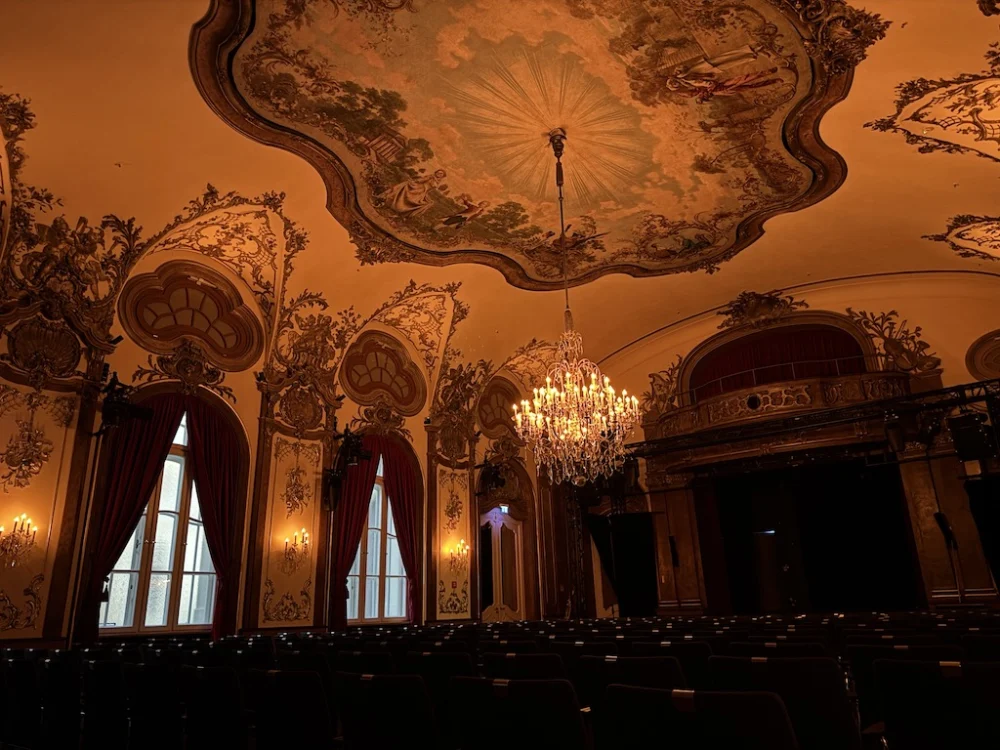
The Deutsches Theater München, one of Germany’s most prestigious and historically significant cultural venues, has successfully completed a comprehensive lighting modernization of its iconic Silbersaal (Silver Hall). This project, finalized in September 2025, represents a landmark achievement in the field of heritage preservation, demonstrating how cutting-edge LED technology can be integrated into 19th-century architecture without compromising aesthetic integrity or requiring invasive structural changes. By utilizing the specialized GDS Lamp system and proprietary IPM (Induction Power Microdata) technology, the theater has achieved a rare balance: an 85% reduction in energy consumption alongside a 25% increase in ambient brightness, all while maintaining the warm, flicker-free dimming characteristic of traditional halogen illumination.
Preserving the Heritage of the Silbersaal
Founded in 1896, the Deutsches Theater München has long served as a cornerstone of the Bavarian capital’s cultural life. While much of the original building was damaged during World War II and subsequently rebuilt, the Silbersaal remains the only room in the entire complex preserved in its original Neo-Baroque splendor. The hall is defined by its ornate stucco work, expansive window arches, and a series of historical chandeliers and wall sconces that have provided the room’s signature atmosphere for over a century.
For decades, this atmosphere was dependent on halogen lamps, which provided the specific "warm" glow essential for the venue’s gala events, intimate concerts, and musical theater performances. However, the theater faced a looming crisis: the progressive phase-out of halogen lamps under European Union energy efficiency regulations (such as the Ecodesign Directive) meant that replacement bulbs were becoming increasingly difficult to source. Furthermore, the high heat output and short lifespan of halogens imposed significant maintenance burdens on the theater’s technical staff. The challenge for the lighting department was to find an LED alternative that could replicate the specific dimming curve of a filament-based lamp—shifting from a crisp white to a deep amber—without requiring the installation of new data cables through the protected 1896 masonry and plasterwork.
The Technological Core: GDS Lamps and Fade-to-Warm Innovation
The solution was found through a partnership with VisionTwo, the exclusive German distributor for the British manufacturer GDS – Pioneering Light. Central to the modernization were the newly developed GDS Lamps in a candle-shaped form factor. These lamps were specifically engineered to replace E14 halogen bulbs in decorative fixtures where the light source is visible.
Unlike standard "retrofit" LED bulbs found in consumer markets, which often suffer from poor dimming performance and a static color temperature, the GDS Lamps feature a sophisticated "Fade-to-Warm" characteristic. At full intensity, the lamps operate at a color temperature of 3,000 Kelvin (K). As they are dimmed, the temperature shifts dynamically down to 1,800K, perfectly mimicking the physical properties of a glowing halogen filament. This behavior is crucial for the Silbersaal, where the lighting must transition from functional brightness for cleaning or rehearsals to a romantic, candlelight-like glow for evening performances.
The technical construction of these lamps also addresses the issue of longevity. While many LED "filament" bulbs rely on fragile glass-mounted LED strips that are prone to premature failure due to heat buildup, the GDS Lamps utilize high-performance SMD-LED technology mounted on a ceramic heat sink. This design ensures superior thermal management, extending the operational life of the units far beyond that of traditional lamps. Each 4.2-watt GDS Lamp produces 490 lumens, effectively replacing a 28-watt halogen bulb while consuming only a fraction of the power.
Overcoming Structural Constraints via IPM Technology
Perhaps the most significant hurdle in modernizing a listed historical building is the infrastructure. Traditional professional LED dimming systems usually require dedicated data cabling (such as DMX or Shielded Cat5) to each fixture to ensure flicker-free control. In the Silbersaal, pulling new cables through the 19th-century ceilings and into the historic chandeliers was economically and architecturally unfeasible.
To solve this, the project utilized GDS’s proprietary IPM (Induction Power Microdata) technology. IPM allows for the simultaneous transmission of both power and high-resolution control data over existing two-wire electrical circuits. This meant that the Zeiler-Technik GmbH installation team could simply swap the old bulbs for GDS Lamps and replace the central dimming rack without touching a single inch of the building’s internal wiring.
The IPM system ensures that the dimming is completely linear and flicker-free across the entire range from 0% to 100%. This is particularly important for television broadcasts and high-speed photography, where the "stepping" or "strobe" effect of inferior LED dimmers can ruin visual recordings. By using the existing infrastructure, the theater avoided costly construction work, asbestos risks common in older buildings, and the need for complex fire-safety re-certifications that usually accompany new wiring projects.
Installation Chronology and Execution
The modernization project followed a precise timeline to minimize disruption to the theater’s busy production schedule. Following an extensive consultation and testing phase led by VisionTwo, the physical installation was scheduled for September 2025.

The execution was carried out by Zeiler-Technik GmbH, a firm specializing in complex theatrical installations. Due to the "plug-and-play" nature of the IPM technology, the entire transition was completed within just two days. During this window, technicians replaced 95 lamps across seven historic chandeliers. The large central chandelier, the room’s focal point, was outfitted with 65 GDS Lamps across two separate circuits. Six smaller peripheral chandeliers received the remaining 30 lamps.
In addition to the chandeliers, the hall’s eight distinctive window arches were upgraded. Sixteen GDS Cygnus fixtures were installed, utilizing a custom configuration: a 1K LED engine housed in a larger 2K casing. This specific modification allowed the integration of the IPM Break-Out Box directly within the fixture housing, maintaining a clean aesthetic. All 111 light sources (lamps and Cygnus fixtures) are now controlled by a single GDS DriveHub MiniPack, a compact, modular driver system that handles power distribution and signal processing for all six lighting circuits in the hall.
Economic and Environmental Performance Metrics
The data collected following the installation confirms the project’s success as a model for sustainable theater operations. The most immediate impact was observed in energy consumption. By transitioning from 28W halogen sources to 4.2W LED sources, the theater reduced its lighting energy demand for the Silbersaal by 85%. In an era of volatile energy prices, this reduction provides the institution with significant long-term budgetary stability.
Furthermore, the "light yield" or efficacy of the new system has resulted in a 25% increase in maximum brightness. This extra headroom allows the lighting designers more flexibility, as the system rarely needs to run at 100% capacity, further extending the lifespan of the components.
From a maintenance perspective, the benefits are equally profound. The previous halogen system required frequent bulb replacements, often involving specialized lifts or scaffolding to reach the high-mounted chandeliers—a process that was both labor-intensive and risky for the delicate fixtures. The SMD-LED and ceramic cooling technology of the GDS system are designed for years of maintenance-free operation, allowing the technical team to redirect their resources toward creative production tasks rather than routine repairs.
Operational Feedback and Artistic Impact
The reaction from the theater’s technical leadership highlights the importance of the "Fade-to-Warm" feature in maintaining the hall’s artistic standards. Georg Nemec, the Head of Lighting at the Deutsches Theater München, expressed high satisfaction with the results.
"We no longer have to change bulbs," Nemec noted, emphasizing the operational relief. "The hall is significantly brighter than before, with significantly lower energy costs. Thanks to the Fade-to-Warm characteristic, at around 70 to 80 percent brightness, we achieve exactly the warm halogen color we wanted. It preserves the character of the room while bringing it into the modern age."
This sentiment is echoed by performers and event organizers who have used the hall since the September upgrade. The ability of the GDS system to emulate the "softness" of traditional lighting is vital for the Silbersaal’s identity. The "Personalities" feature of the GDS Lamps—which allows the behavior of the bulb to be reconfigured via software (e.g., changing from Fade-to-Warm to a fixed color temperature or a candle-flicker mode)—ensures that the venue can adapt to future artistic requirements without further hardware investments.
Broader Implications for Historic Venue Modernization
The successful renovation of the Silbersaal serves as a technical blueprint for thousands of historical venues across Europe facing similar challenges. As halogen supplies dwindle and carbon reduction targets become more stringent, the pressure to modernize is universal. However, the fear of losing the "soul" of a historic space or the prohibitive cost of rewiring often leads to delays.
The Munich project demonstrates that with the right technology—specifically IPM for data over power and high-quality LED engines that prioritize color science—the transition to green technology can be seamless. It proves that "sustainability" in the arts does not have to mean a compromise in "atmosphere."
As the first installation of the new GDS Lamp in candle form in Germany, the Deutsches Theater München has positioned itself at the forefront of the "Pioneering Light" movement. This project confirms that the future of theatrical lighting lies in systems that respect the past while embracing the efficiency of the future, ensuring that historical treasures like the Silbersaal remain vibrant, illuminated, and economically viable for the next century of performances.
